When you look up the definition for religion, it states among other things that it is “a pursuit or interest to which someone ascribes supreme importance”
How many conflicts has the world endured, is enduring, and will continue to endure because of this belief to which one ascribes supreme importance? I had written about it here (religion).
Who was it who said that every good kind of learning can be obtained from Childrens’ books? I whole heartedly agree.
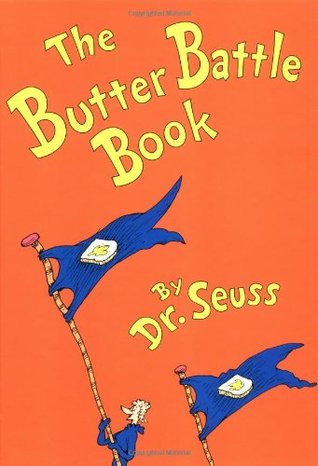
The latest book that I am babbling about is the Butter Battle book, by Dr Seuss.
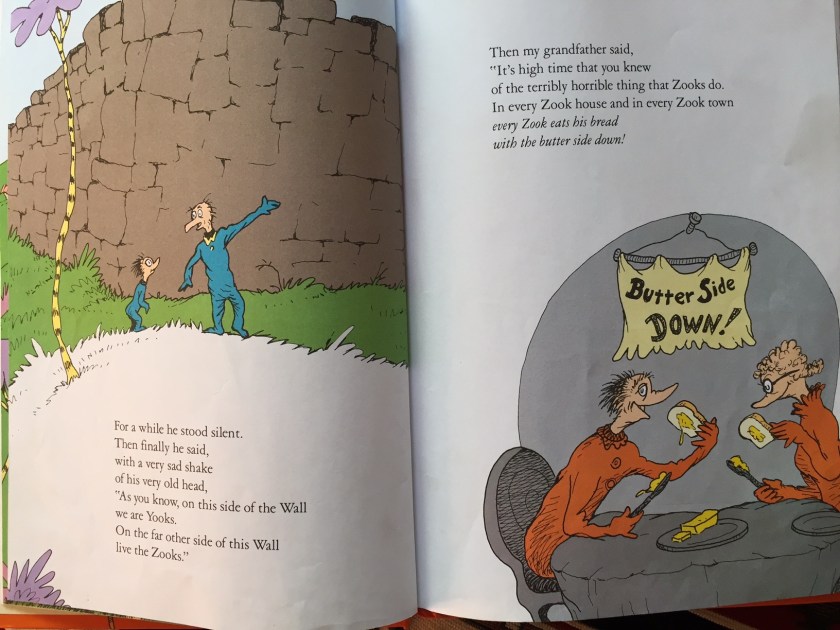
The Yooks and the Zooks live on either side of a long, meandering wall. The Yooks wear blue, the Zooks wear orange.
The Yooks think the Zooks silly for buttering their bread with the butter side down, while the Zooks think the Yooks are somewhat dim-witted for buttering their bread with the butter side facing up. The flags of the Yooks and Zooks represent the belief in buttering bread, and the animosity builds from this bread-butter-theory to which they attach supreme importance.
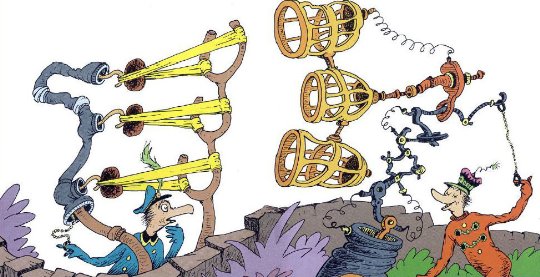
One day, the Yook patrolman is prowling the place with his Tough-Tufted Prickly Snick-Berry Switch, when a Zook pelts him with a slingshot. This sets in motion an escalating conflict, with both sides coming up with more and more exotic and dangerous arms with which to fight each other.
The Triple Sling Jigger, the Jigger Rock Snatchem, the Blue Goo-er, the Kick-a-poo kid operated by a cocker spaniel – Daniel, the Eight-Nozzled Elephant-Toted Boom Blitz.
The last page has the Yook patrolman sitting atop the wall with a Zook warrior. Both of them have in their hands a Bitsy Big-Boy Boomeroo – a small bomb that can annihilate life as we know it, signifying the nuclear threat.
I know we ask of no formal training as a politician: there are no politician licenses, no courses one has to complete to take up public office, but I really think there should be a set of children’s books that they all have to read and re-read as refreshers every year in order to stay in office. We could call it the Butter Battle Course.
The Butter Battle Book has of course given rise to great hilarity in the house. “Do you want to be a Yook or a Zook?”, we ask taking out the butter and the bread. We now butter our bread on both sides so we can be Yooky-Zooks, and sometimes Zooky-Yooks.
The next time any two nations start warring, I suggest thrusting bread buttered on both sides to both parties.
I looked at the delectable pile of books by my side waiting to be read. The top of the pile was the beautifully annotated ‘Jane Austen’s History of England. –
Just the sort of history book that appeals to me. Written by Jane Austen when she was 16 years old, the book bears the hallmark of her humor.
I sat smiling at some of the things written about Henry the 8th & Anne Boleyn.
The book certainly sounded like some of the answer papers of my youth.
I have always felt that History was one of those subjects that was calculated to freeze my brain. Good though my teachers in the subject were, bless them, they could not but help say that the Second Battle of Panipat was fought in 1556. Inside my brain, this simple fact would start a whistling train of thought:
1556. Hmm … funny number.
How to remember that number?
55 in the middle and 6-1 = 5.
Why not 6551? Because that is in the future.
Very clever. But what about the number 6? Why 6 and not 7?
Maybe, History is the sixth period(?)
But only on Wednesdays.
If only it were 1596, 15*6=90 and then add 6
“Can anybody tell me what happened to Akbar after that battle?” These teachers have voices that have a way of cutting through the most interesting meanderings of the mind.
“What battle?”, I’d write on the side margin, and slip it across to my friend. There she would be, sitting by my side at the wooden desk with a vacant expression on her face biting her pencil. But at this urgent message, she’d stoutly pull herself together and write back, “The Battle of Panipuri, I think.”
Then the exams would roll along, and after days spent cramming the dates and emperors, I would come to the conclusion that all emperors who sought to reign should be made to stand in line in shorts and recite the dates of all those who aspired to power before them. If they still want to reign, may their shorts fall while they lead the charge – that should teach them not to add to that horribly long list.
To make matters worse, the rumor mills during examination time worked overtime:
(a) The teachers likes diagrams, one person would say, stating emphatically that whatever you do, make sure you draw a diagram for it.
Feverishly, we would start drawing Africa maps, and label the Gold Coast, and the Sahara desert, throwing in the Kilimanjaro for luck. Never mind that the question was about Egypt.
(b) The more you write, the better will be your marks.
So, we would write double-spaced and add spice to the Spice Wars.
One time I remember writing about Alexander’s Horse. Our History teacher had on one occasion told us about the fine breeds of horses that emperors prided themselves on. My brain tick-tocked away with Alexander’s Horse, and I found to my amazement that the brave stallion was heroic beyond what History books knew. I imagined the horse pulling his great emperor across the blizzards of the mountains one day just by trusting its instinct. The marvelous animal found a stream of fresh flowing water for its emperor. I wrote about 16 sentences on the virtues of the horse, borrowing heavily from my recent reading of Black Beauty (also a black horse with a star on its forehead, duh!) I wrote of its aching muscles, its loyalty that was much admired, and how stable managers had a job that was olfactorily unsatisfactory maybe, but really quite a prestigious one, if it meant looking after the emperor’s horse. I also gave him a name, Macedonia, if I remember right – sealing my understanding of the reign once and for all. (Alexander’s Horse, Bucephalus, would have turned in his grave and asked ‘Is she talking about me? Neigh! ‘ )
“15 more minutes.” the examiner said, and I looked to see that while the paper had a brilliant character sketch of the horse, it had very little about Alexander the Great.
I hastily started another paragraph on the the horse’s rider and finished up the paper. I came out into the brilliant sunshine from the exam hall when my friend said looking at me in admiration, “How much you wrote! I saw you taking two extra sheets! I am sure you are going to ace it!”
I shrugged off this undue praise guiltily, feeling a little sorry for the teacher who had to read such drivel.
It was years later that I read “I, Claudius”, the historical fiction book written by Robert Graves,and came upon Incitatus, Caligula’s horse. Whether it was fiction or not I cannot say, but this was the horse that the Roman ruler, Caligula, sought to make a senator, and invited to State dinners.
The truth is stranger than fiction, but it is because Fiction is obliged to stick to possibilities; Truth isn’t. Mark Twain
I smiled at these pleasant memories, and opened the book in my hand.
Jane Austen said,
Edward the 4thThis monarch was famous only for his Beauty & his Courage of which the Picture we have here given of him, & his undaunted behavior in marrying one Woman while he was engaged to another are sufficient proofs. His Wife was Elizabeth Woodville, a Widow who, poor Woman! was afterwards confined in a Convent by that Monster of Iniquity & Avarice Henry the 7th. One of Edward’s Mistresses was Jane Shore, who has had a play written about her, but it is a tragedy & therefore not worth reading. Having performed all these noble actions, his Majesty died, & was succeeded by his son.
We were at a party of sorts where good friends gathered for the evening with families. Adults, senior adults, teenagers, tweens, kids all jostled together happy to see one another.
The children got eating out of the way as soon as they could, and started playing in that vigorous fashion that makes me want to drop everything and join them.
People with food on their plates drifted like continents and grouped and regrouped for conversations. At one point, I found myself amidst septuagenarians talking about sleep, or lack thereof. “Go on and tell them how little I sleep!”, said the father-in-law to me.
“He does have difficulty falling asleep…”, I said carefully, casting a longing look at the children playing outside.
He gave me a wilting look for this lame endorsement, and decided to stick it out on his own.
“I was never like this. I cannot sleep these days. I used to sleep the moment my head touched the pillow.” he said
“Me too” agreed an uncle.
“It would take sometime to fall asleep, but once I did, I could sleep well without interruptions.” said an aunt.
“How many times can one turn this way and that? How many times to say our prayers?”
“It is such a big problem. What do you think we should do?” they asked, looking at me earnestly.
Sometimes, I get when it is a rhetorical question, and nod. Other times, I behave like a particularly dimwitted penguin, and start telling an ostrich how to bury its head in the sand. I go on to make comparisons between the similarities in nature between sand and snow and how it is all a matter of technique.
“Well, sometimes when I am excessively tired, I find a hot bath before bed helps.” I said.
“I take a hot bath every night. Nothing helps.” my father-in-law said looking miserable. All the senior adults agreed: Baths were elementary stuff.
The squeals from the garden indicated an energetic game of hide-n-seek in progress. I glanced to see a squealing army run towards the washing machine – apparently somebody saw one of them go there to hide, and everybody was running to investigate.
By now, more folks had joined in the conv. Herbal teas were discussed next as aides to that Elusive Soother of Souls, Sleep. Chamomiles, lavenders and orange blossoms wafted their scents in. In time, the topic had slid down the tea slopes and gone on to meditation as a technique.
“I find I worry if I have nothing to worry about”, said an aunt, and smiled wanly. “One day, I saw 2 o’clock and was so disgusted”, said she.
“But it cannot be as bad as mine. The other day, I saw 3 o’clock on the clock. 3 o’clock can you believe it?.”
My father in law said he saw 3:10, while another uncle said 3:30.
They all looked at me to declare the winner. Braver generals could have taken on the task, maybe, but I confess I shrank from the task. These individuals who would happily set themselves to lose in a game against their grandchildren were now competing for The Most Ardent Sufferer Award, and I wasn’t going to be the one to decide. Nu-Uh.
I quietly slipped into the garden, to see the children were all running strictly following the principles of Brownian motion. They ran onto the lawn and tumbled over, and ran again. The setting sun washed them all aglow. The grass on their beautiful clothes, the dirt on their cheeks, the sweat pouring down their faces, and their squeals of laughter made a marvelous sight.
The evening slowly wound down, and we gathered all the folks up and started back on the ride home. The children were giggling still, while the senior citizens in the car were discussing the food in detail.
When I look back upon my childhood, I see that it sparkled with a fine collection of aunts and uncles (most not related by ties of blood) My father was a teacher in a residential school (Lawrence, Lovedale), and all teachers lived on the campus along with their broods like one large, extended family. It is only natural that we adopted some of his close friends for our very own aunts and uncles as well.
“Isn’t she such an inspiration?” said my friend, as we waved to Athai (meaning Father’s sister) one night about thirty years ago. “Poor thing has had such a tough life.” Athai seemed happy enough to me, I thought to myself, why was her life tough? Seeing my puzzled expression, my friend, who was older, taller and wiser (she still is), took it upon herself to enlighten me.
That evening, she told me how Athai was a very well off young lady when she lost her husband unexpectedly. She realized later that she not only lost her husband, but her fortunes as well. Suddenly, she found herself rudderless. She told me how Athai took up the job as matron in her children’s school, and how she had rebuilt her life with dignity and perseverance. She had gone on to raise her three children as a single mother through those hard times.
I never looked at Athai the same way again.
They say children have an innocence that is hard to define, and I understand now what that means. I had known Mrs Ramachandran my whole life spanning less than a decade without stopping to think about her past life: her life beyond being matron to hundreds of children, the person who managed the kitchens and Athai to all of us. In all of these roles, she was gracious, loving and giving. It was as if she had simply sprung into being the same beautiful way in which I interacted with her everyday. Her grey hair framing her round face with a ready smile that dimpled her cheeks.
When I stopped to think of it, I realized that she must have been a stunning beauty in her youth.
It was then that I started asking Athai about her life. She would share bits and pieces of some incidents here and there and I was happy to listen whenever she did. She came home in the evenings some days with her friends and we always looked forward to seeing her if only for a few minutes.
One day, I opened the door looking despondent. She asked me what the matter was, ever ready to deal with the intensity of teenage turmoil.
“This is one of the reasons I don’t like jewelry!” I said as I finished telling her about how I lost one of my gold earrings on the playground. I was feeling miserable.
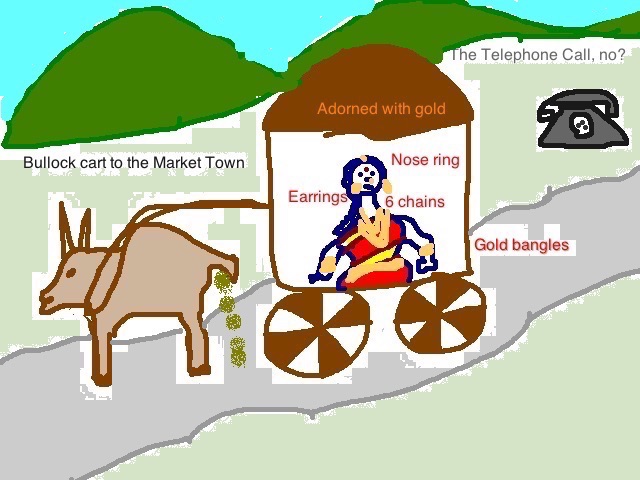
With her characteristic humor, and knowing how much I balked at wearing jewelry, she teased me that I might find myself married to a husband in a remote village, where every woman wore six chains, twelve bangles, sagging earrings, a nose-ring, and that I would have to get into a bullock cart decked up in my finery, in order to take a phone call from my sister on market day. I laughed, feeling better already.
Then, she said, “You should be careful with your belongings, but you must not become attached to them.”
Every bit that Athai shared of her life was beyond inspirational, it was motivating. I sat mesmerized by how without her ever realizing, she weaved her grief, misfortunes, perseverance and joy together as one beautiful tapestry through which her personality shone through. I loved every interaction with her, the attentive companionship she gave, and her unfailing good humor.
Last week, Athai passed away at the age of 88. I wished I lived in a remote village and had to wait till market day to receive the sad news of her passing. But WhatsApp is relentless and swift. The network packets encrypted and decrypted the message the same way it packaged every inane joke and forwarded message: “Athai passed away. “ it said blankly.
Don’t cry that it is over, smile because it happened. – Dr Seuss.
I dragged my children along for a walk that evening. Fresh air always makes it easier for me to think happy thoughts, and I knew the walk would help me celebrate Athai’s life. I do not know whether my children will remember the evening, but for me, it was important. It is a tiny piece of Athai that I wish to share with my dear ones.
I know Athai would have liked to know my little ones. In her heart, there was always place for love.
Dear Athai – may you rest in peace and thank you for everything.
This post of mine was published in The Hindu dated 15th June, titled Undistilled Wodehouse
I was reading a short story by P.G.Wodehouse on the train. These are the times when I most mistaken for a lunatic. My seat shudders with unconcealed mirth. I giggle, laugh and sometimes wipe away tears of laughter, while the world is going about the stern business of earning a living. He is one of my favorite authors, and after every few books that makes me mope around the world pondering on the wretchedness and seriousness of life, I turn to a P.G.W book to remind myself that tomfoolery is a virtue to be exalted and celebrated. His turn of phrase, his romping joy, is enough to set me straight.
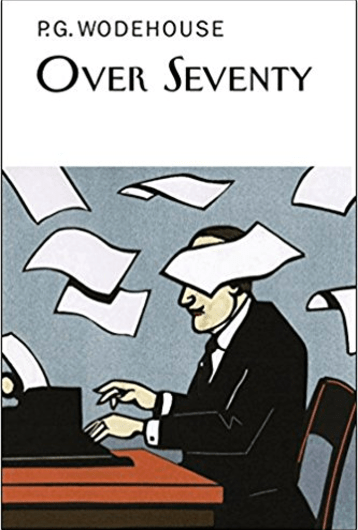
When I read his autobiography ‘Over Seventy’ a few years ago, I could see that the septuagenarian viewed his own life pretty much the same way he came across in his writing: Sunny and delightful. In his own words, he simply lacked the life required for a gripping autobiography because one needs some level of suffering to bung into the thing. “My father was plain as rice pudding and everyone in school understood me perfectly.” he wrote.
So, it must have been particularly jarring to the man when he was treated as badly in his own country.
P.G.Wodehouse had his head in books and led a sheltered life. Whether it was Blandings Castle, or Jeeves rescuing his young master, his thoughts were almost always occupied with love and the stirrings of the idiotic. P.G.Wodehouse, known as ‘Plum’ to his friends, had a villa in Le Touquet, France where he and his wife Ethel often stayed. Plum and his wife were unfortunately there, when German troops stormed France, and he was taken prisoner at the beginning of the Second World War.
The Germans released him after 42 weeks, when he was nearing 60 as they seldom kept foreign internees beyond the age of 60. Through an old Hollywood friend of his, they sought to use him to make humorous broadcasts about his internment, and he naively did so. His was a trusting nature completely devoid of malice of any kind, and incapable of seeing political propaganda. Though he suffered immensely during his internment – he lost around 60 pounds, and ‘looked like something the carrion crow had brought in’, he did not quite realize the extent of evil and genocide that was happening inside War-time Germany. He simply intended to let his readers know that he was alive and well.
That back-fired, however, and the author went from beloved to detested in his native United Kingdom. People were looking for a scape-goat and he fitted the bill perfectly. He sadly became his own Bertie Wooster with no Jeeves to help.
Sometime after the Second World War ended, P.G.W was goaded by a journalist asking him whether he hated the Germans for what they put him through. To which the author supposedly replied, elegantly smoking his pipe, ‘I do not hate in the plural’.
A truly astounding statement. It was this statement of ‘not hating in the plural‘ that I sought out to find when I read the books below, but I could find no reference to the actual statement.
What I found instead was a man who was not only the world’s funniest author, but also the most hard-working, shy, kind and gentle person, who so magnanimously shared the gift of his sunny mind with the world.
I read all five of his broadcasts in entirety and to my equally naive mind, there is nothing in there that can be seen as treason. It shows how war, and malice can take any inane thing and wring it out of shape and proportion. What is real and what is fake when power is involved?
The piece written by George Orwell defending P.G.W’s innocence is well worth reading:
Quote : The article and the broadcasts dealt mainly with Wodehouse’s experiences in internment, but they did include a very few comments on the war. The following are fair samples: “I never was interested in politics. I’m quite unable to work up any kind of belligerent feeling. Just as I’m about to feel belligerent about some country I meet a decent sort of chap. We go out together and lose any fighting thoughts or feelings.”
P.G.Wodehouse was finally knighted by the British Government in January 1975. He died the following month on 14th February 1975, aged 93.
I am immensely grateful to the dear author, even if that means the Prims & Propers of the world lift their eyebrows and look away uncomfortably when I laugh. I cannot say it better than Stephen Fry does on the personal influence of P.G.Wodehouse: He taught me something about good nature. It is enough to be benign, to be gentle, to be funny, to be kind.
I recently read a book called Biomimicry by Janine Benyus. A book, whose underlying concept appealed to the very core of my being, for it outlined how little we know of the world around us, and how much more there is to learn from Nature’s processes.
How do we become harmonious citizens of a planet that houses, apart from 7 billion of us, billions of plant and animal forms? It is a question that floats into my mind every so often. How beautifully a bee arranges its hive, how marvelously a dandelion reproduces, how trees take in water, how they produce energy. All of these things make me wonder and marvel at Nature the Tinkerer.
I am afraid I made rather a pest of myself with friends and family. I cornered parents-in-law while they were taking a rest and spoke to them of Do-Nothing farming, I got a children’s book on the subject and read tantalizing bits of information out to the children. I bored friends with it. I could see the scramble-and-run-before-it-is-too-late look on everyone’s faces when I stopped to admire the squirrel prudently checking whether the fruits are ripe before digging in.
‘Why is it wet winter or hot summer, some grasslands thrive?’, I’d ask, only to find that tasks of monumental importance spring up requiring immediate attention for my audience.
Did that stop me? No. If anything, I am going to go and do on the blog what I have been physically doing to those around me.
The book is arranged into the following sections:
Echoing Nature Why Biomimicry now?
How will we feed ourselves? Farming to fit the land: Growing food like a prairie
How will we harness energy? Light into life: Gathering energy like a leaf
How will we make things? Fitting form to function: Weaving fibers like a spider
How will we heal ourselves? Experts in our midst: Finding cures like a chimp
How will we store what we learn? Dances with Molecules: Computing like a cell
How will we conduct business? Closing the loops in commerce: Running a business like a redwood forest
Where will we go from here? May wonders never cease: Toward a biomimetic future
Higher education in Science has arranged itself along silo-ed areas of expertise. Biologists rarely study Computer Science. Mechanical Engineers rarely take up Zoology.
The author writes of her interactions with various scientists who have successfully transcended narrow areas of study to walk the line between disciplines to see where we can benefit from nature.
1) The materials science engineer who combines fibre optics and biology to study the beauty and resilience of spider silk
2) The agriculturist who, over decades, has perfected the technique of do-nothing farming, conscientiously chipping away at unnecessary practices while studying natural prairies and grasslands to see how plants grow in the wilderness, thereby coming up with the highest yield of natural grain per acre.
3) The anthropologist who studies chimps and how they cure themselves to see how we can identify cures for common problems.
Quote: In exploring life’s know-how, we are reaching back to some very old roots, satisfying an urge to affiliate with life that is embossed on our genes. For the 99% of time we’ve been on Earth, we were hunter and gatherers, our lives dependent on knowing the fine, small details of our world. Deep inside, we have a leaning to be reconnected with the nature that shaped our imagination, our language, our song and dance, our sense of the divine.
This about sums up our position on Earth. “In reality we haven’t escaped the gravity of life at all. We are still beholden to ecological laws, the same as any other life form.”
Now is the time for us to take our place as one species among billions in the ecological vote bank, and make wise choices.
The husband was back from watching the movie Baahubali 2. Indian cinema had outdone itself, and he was regaling us with the story line and the amazing fight sequences. This enthusiastic performance was greeted differently by the household:
(a) Avid interest in the toddler son, who was wondering whether to raise Baahubali to the echelons of Hanuman, or Spiderman,
(b) An eye-roll from the daughter who was doing something with her slime (coming up soon), and
(c) An almost soporific nod from me wondering when would be a good time to get a cup of tea.
“There is one scene where the bulls are all charging at Baahubali and he catches them by the horns like this and flings them – booyang!” , he said reaching for a water bottle, with a loose lid, to demonstrate. I held the water bottle on the other side, and he looked piqued that his bull showed resistance. Baahubali’s cows did not resist, they flew.
I had smartly declined the movie invitation and enjoyed a quiet afternoon in the park with the children.
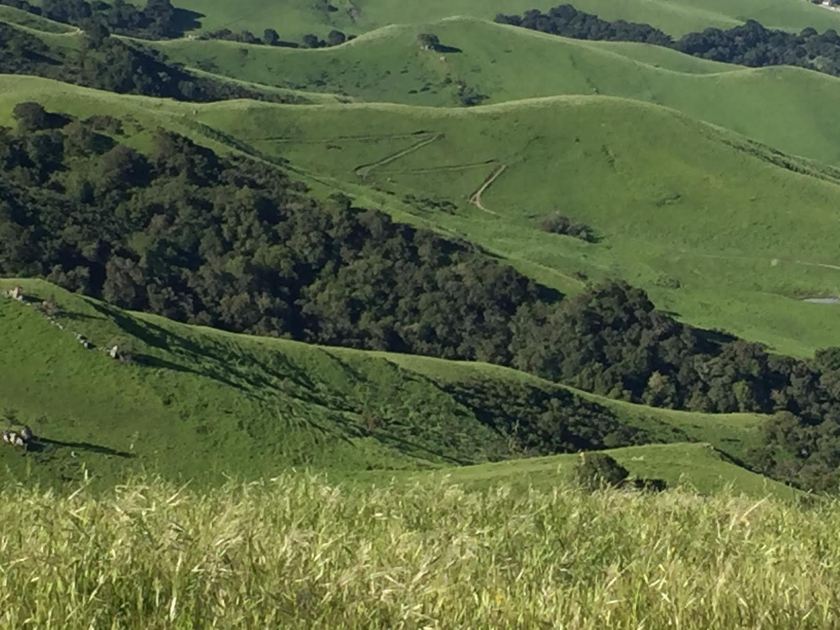
The next day, the husband, friend and I were up early for a hike in the rolling hills nearby. The early morning clouds were scuttling about in a desultory fashion, the grass was swaying to the breezes. Only the birds seemed to be bright and energetic. I was plodding along not yet completely awake, and the husband and friend were talking about the Baahubali movie again. The friend had seen a late night show and was bleary eyed after the movie. But mere mention of that great and able Baahubali seemed to infuse him with energy. I watched the pair of them make animated conversation and smiled to myself as I imagined the daughter shaking her head and saying, “Boys! Amma – they can’t help themselves!”
There was a touch of the English countryside about us that morning. There were cows grazing calmly, and an occasional deer or two were visible far away. I was throwing my mind pleasantly to a book I had read recently, A Road To Little Dribbling by Bill Bryson. There were lovely passages in the book that seemed to match my surroundings at the time. The rolling hills, the slight chill in the air.In the book, Bill Bryson writes about how he took up a road trip across Great Britain without the use of a car, and mostly on foot.
“What a joy walking is. All the cares of life, all the hopeless, inept *wits that God has strewn along the Bill Bryson Highway of Life, suddenly seem far away and harmless, and the world becomes tranquil and welcoming and good.”
As we were ambling along, we noticed several cow-shaped obstructions in our path. Three cows stood in front of us blocking us quite effectively. One of the cows locked eyes with me.
I looked at her, she looked at me.
I looked, she looked.
I blinked, she didn’t.
I looked away, she didn’t.
“I like being in a country where when cows attack, word of it gets around. That’s what I mean when I say Britain is cozy.”
―Bill Bryson, The Road to Little Dribbling: More Notes from a Small Island
The cow showed no inclination of looking away, or moving. I am in for the long haul, she seemed to say.
I can wait, I told her.
Ha! she said. It is you humans who are always in a hurry. I have no problems. I could stand here all day. Want to see? she said and stood there chewing the cud in what I thought was an unnecessarily exaggerated manner. If I had chewing gum, I could have played the game too, but I didn’t have any on me at the moment.
I then actually tried talking to her. “Please – we won’t do anything. We just want to pass you by.” I said.
To this she responded. She stared at me even more intensely, and then donned a positively bored look and looked away. It was like I was giving a teenage kid advice.
The husband and friend were standing nearby in a thoroughly helpless fashion.I looked at the pair of them shuffling their feet and asked them to summon their inner Baahubali and scare the cows away.
The duo guffawed loudly at this, and said the best performance they could come up with was to flex their muscles till it plopped and then fly like Baahubali’s cows in the opposite direction.
I looked back at the cows to appeal to them once again, and started laughing. It reminded me of one of the passages in Road to Little Dribbling where Bill Bryson had gone walking through a field. The field was on a hill, and he huffed and puffed up the hill, only to be confronted by an angry bull or cow(he couldn’t stop to see). One cow-or-bull-snort later, he came charging down the 2 mile hill to the nearest village. He entered a pub sorely in need of restoration to body and spirit. There, in the pub, was an old farmer who listened to his tale of woe, and said calmly, “Oh, That is only Betsy. She won’t do anything!”
The Betsy in our path seemed to derive inspiration from the story, and moved enough to let us pass.
The Baahubalis scampered across, while Betsy got her entertainment fix for the day.
The thing about travel is it lets you indulge in conversations that you otherwise may not have: With car drivers (White Tiger, Driver Shiva or Murugan and Driver KillerMan ) for instance.
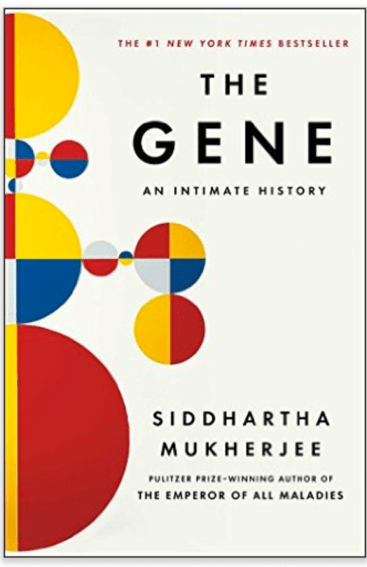
We were returning from a trip to Chichen Itza by van. The drive is a good three hours, and the husband was chatting amiably with the van driver, while we pulled out our books to read. I settled down with ‘The Gene’, By Siddhartha Mukherjee. The book is one that requires concentration, especially for one who made stout Biology teachers quail. The book is held tight by a web weaving historical context, scientific detail and personal insights. It is a fascinating read, if somewhat heavy going in places.
Genetics as a discipline had a number of misdirections and key researches almost lost to mankind, like Mendel’s experiment with pea plants, but for a lucky discovery of his article over 50 years after his death. The book touches upon many such instances. It talks about the supposed brilliance of scientists, how scientists are after all human and how their personalities can sometimes thwart and stifle growth. I particularly enjoyed the little quotations at the beginning of every chapter.
Every now and then, I stopped to take in the rustic scenery outside in the Yucatan province. Up in the front, the conversation was flourishing, if in a somewhat one-sided fashion. The van driver liked his audience and his theories grew wilder, and his tales more grandiose.
The man said he was originally from Canada, then moved to US before settling in Mexico. His tales, at any rate, portrayed a colorful life – a trucker, a pop-star, construction, sound recording. We had niggling doubts as to why his life had followed the pattern it had, but did not dig too closely. (He had the power of the van remember?)
‘How is Gene?’ asked the husband turning his head wife-ward. I had gotten past the horrifying section on Eugenics thankfully and said a thing or two about what all mankind is answerable for. Evolution, I said, better have a good reason for cruelty.
’Ah! Evolution. I don’t believe in evolution as a theory. I have a theory’, said the van driver, perking up since he hadn’t spoken for all of three minutes. He bore the look of a man doing a grand flick off some sad sop’s tale from the internet, ‘My theory is that aliens are responsible for life on earth. I think that the aliens had tried to see if life can flourish on Earth with dinosaurs.’
Four second pause.
‘And then they found them too big. The dinosaurs were too big, you know? I think that the asteroid that hit the Earth was nothing but a nuclear bomb sent by aliens. You see it all the time, don’t you?’
‘Eh… What do I see all the time?’ I asked. I have to come clean and admit that I don’t see dinosaurs all the time. Or aliens if you come to think of it, and definitely hope not to see nuclear bombs sent by the unseen aliens to hit the now extinct dinosaurs. I like a quiet life.
‘I mean, look at the size of those computers earlier on, and look at them now.’ He stopped here for dramatic effect, like one coming with the argument that clinches all.’ The aliens then got a much better model with humans and current life forms and decided to drop a nuclear bomb on Earth to get rid of the dinosaurs.They were just too big for them.’
The husband and I exchanged significant glances in our minds without once looking at each other. “I will take it that you just consider it a theory.”, said the husband, a man who would have obviously done well in the diplomatic services.
“Well…evolution is a theory no doubt,” said the driver, as though conceding a poorly paid chess move by dim witted opponents. “But aliens is a better concept. You know the supposed asteroid that wiped out the dinosaurs fell right here? Yes – right here in the Yucatan desert.” , he said opening his arms wide, and the van jerked alarmingly. I implored him to hold the steering wheel, to which he laughed, ‘Of course, it was a nuclear bomb sent by aliens, and it is funny that centuries later, we are talking about it, and trying to fit in theories like evolution.”
The Chicxulub crater in the Yucatán Peninsula, the site of the impact that decimated the dinosaurs.(Illustration: Detlev van Ravenswaay / National Geographic)
I set out to explain the experiments with pea plants, how the evidence set up the basis for genetics etc, but the man was bored, and said I must open my mind a little and consider the aliens theory. I bridled. I love a tall tale as much as the next one, but… The husband seem to sense my state, and shot me a warning look.
I had to concede that here was a fellow who had obviously educated himself on the Internet, and was proud of it. The Science teachers in his school days had done their best, and I too must learn to accept that he liked his erudition because he understood complex theories like aliens implanting life on earth.
By the end of the trip I needed some time to reflect, and when I did, I realized that travel had once again made sure I met a person so different in ideologies than myself. I hope he thought a little bit about things that could be proven vs things that could not be, when he reflected later on.
I, for my part, was able to understand why it is easy to believe compulsively written theories on the Internet.
Science lessons seem so far off tucked away in the recesses of the childhood brain. What time is left after earning one’s livelihood can easily be spent in the entertainment industry’s efforts to keep us glued: An industry that thrives on blurring the lines between fact and fiction.
As Lisa Randall says in Dark Matter and the Dinosaurs: The beauty of the scientific method is that it allows us to think about crazy-seeming concepts, but with an eye to identifying the small, logical consequences with which to test them.
What we need is to be able to travel more, so we get to see another’s view point every now and then, even if we do not agree. Especially if we do not agree.
We went on a short vacation to Cancun. The husband is in charge of booking trips. He is the planner. I am the slacker. Give the husband a task like planning a vacation, and he bustles about most impressively (on the couch of course). In true form, he booked a lovely place to stay, surprised his daughter with a day with dolphins, and booked a van to spend the day with the ancient Mayans at the pyramid at Chichen Itza. All in all it turned out to be a marvelous vacation with novel experiences.
The drive to Chichen Itza is a good three hours from Cancun, and we settled down with books, games, snacks, and water to keep us occupied on the journey.
The husband was chatting amiably with the van driver, while we pulled out our books to read. Up in the front, the conversation was flourishing, if somewhat one-sided. The van driver liked his audience, and his theories grew wilder, and his stories more grandiose.
The scenery outside was rustic. We were passing village after village tucked away in the Yucatan province. Outside the opulence of the tourist city of Cancun was where we got a peek into the real Mexico. Small brick buildings, children in slippers and shorts, palm trees, livestock, dogs. The rising heat was already setting the tone for the rest of the day. The talk inside the van turned to regional flora and fauna. I asked about tropical birds, and he assured me that they were plenty and marvelous.
‘Have you heard the cry of the Jaguar?’, he said.
‘No! Indeed!’, we cried.
The van driver then went on to explain. ‘Well….what is most impressive about those ancient Mayans is that if you clap your hands at the foot of the pyramid, you will hear the Jaguar cry from within the pyramid. Jaguars are sacred animals to the Mayans. You’ll hear all from the guide no doubt’.
The toddler was impressed. ‘Could I really clap like this, and jaguars will come?’ he asked clapping his hands and blinking his eyes at the same time.
The guide at Chichen Itza, told us about the ancient agrarian economy, and how the ruling class were probably mathematicians and scholars, and not wizards like the peasant class believed at the time. There was an impressive sort of buildup to the clap-echo section: the children even scoured the bushes for hidden jaguars.
When it came to the clapping section, the guide’s CLAP reverberated through the pyramid. It just goes to prove that practice makes a world of difference – our claps were like birds rustling leaves compared to the thunder-shots that rang through when he clapped. That guide clapped for a living and it showed.
It was lovely to stand there in the heat under a perfectly blue sky with lazy clouds flitting here and there, and listen to the chirruping sound that emanates. For some reason, I thought the Jaguar ’s cry would sound like a roar or even a grumble – piteous, scary or ominous, but I was not prepared for it sound like a bird call.
The call we heard, the guide told us, was the sound of the elusive Quetzal bird.
The toddler was disappointed: maybe he expected a Jaguar to come out from the pyramid’s top. A bird flying out was not half as impressive as a Jaguar leaping out, but finally neither came out. We showed him an iguana sunning himself nearby, to which he gave us a look that made his teen sister proud and drooped away to the shade.
Moments later, he philosophically resigned himself to treating life’s disappointments with ice-cream. Jaguars and quetzals could cry or fly, but they didn’t get ice-cream and he did. That was all that mattered.
Coming up next: The Van Driver’s Theory Blasting Evolution to Pieces.
We are back from what can only be termed an exotic vacation by the seaside, and the old brain nudged me to look for something written on marine life a while ago, and I did. I had written this post a few months ago, and forgot to publish it.
So, here is the old post while I marshal my thoughts from the vacation.
One evening over dinner, the husband asked in what he thought was a nonchalant tone whether we should go to the Monterey Bay Aquarium that week-end.
“Hmm…Did they send you the renewal plea for the annual pass?” I asked shrewdly.
He laughed and said that they had indeed.
We are as gullible as galloping oysters in fish sauce when it comes to the annual pass gab. We look and analyze the thing from all angles and figure that if we go just once more in the next year, it all makes sense and buy the annual passes. The year ahead seems to be sprawling with empty week-ends. Week-after-week, month-after-month: having nothing to do, we say why not set aside one week-end a month for the Science museum, one for the zoo, one for the natural history museum and another for ecological preservation?
Then, of course life unfolds, which in the nourish-n-cherish household has been established to be somewhat erratic, and hectic, and we are left wondering whether the weekdays with all its attendant worries is calmer than week-ends with all its hectic activity. Before we know it, the renewal plea arrives and we try our best to scramble in another visit before the annual pass expires.
“If we go straight to the Diwali party from the museum, we can work in that week-end.”, we say and scramble in a trip to the Aquarium.
Anyway, what I meant is that we went to the Monterey Bay Aquarium a few months ago. The salty, tangy, eucalyptus-scented air ruffles your hair as you make your way towards the museum. The cawing of the seagulls and the faint smells of seals and seaweed greet you long before the wonders inside.
Observing marine life is as mesmerizing as it is mystical. Standing there in front of the large glass tanks and looking at sharks, turtles, fish of every color and variety, is magical.
There is one section where we can see jellyfish boink around. Jellyfish that are colored brilliantly, transparent jellyfish, and jellyfish that contain bioluminescent bacteria. As I was standing there marveling at the brilliance of nature, I noticed that there were patterns in the glowing bacteria. Some had patterns that if one squinted one’s eyes resembled constellations in the night sky. I don’t know whether the patterns in the jellyfish are unique to each one much like the Zebra’s stripes are, but it would definitely not surprise me if that were the case. Nature’s patterns are as varied as they are diverse.
We came home that night, reluctantly pulling ourselves away from the enthralling environs of teeming marine life, and sat around for a hastily thrown together dinner. The conversation drifted towards marine life, a topic that is dear to the daughter’s heart. The love started young as we know to our chagrin – we might have watched Finding Nemo five hundred times when she was growing up. Every little fish and piece of coral was much loved in the home. The conversation flitted dangerously close to the ‘I wish I could live in the sea’ theme. The husband watched us for a moment and said in a strangely ruminative tone: “It is a scary world out there isn’t it? A-fish-eats-fish world.”
I was reminded of a quote that floats up in my mind every so often when I am observing the world around us. A quote that is prominently placed in the Monterey Bay Aquarium too:
The sea is as near as we come to another world: Anne Stevenson
Yes, it is a fish-eats-fish world, but it is also the world of beauty, survival, co-existence, and a symbiosis of life.














 Nourish-n-Cherish