The Wonder Formula

Someone told me once that we lose the joy and wonder in things as we knew more and more about how things work. If we knew the conditions were right for a rainbow to form, or the planets will shine in the evening skies brighter than usual, we seem to expect them, and then lost the magic of it all.

I have pondered on that often – could adding a pleasurable anticipation make up for the lost serendipity? As we watch the bleak skies of the winter, we can wait and feel the weight of the buds in the spring snowflake 🌱 plants, or watch the tulips bulbs shoot up from the Earth admiring their sense of timing, can’t we?.

While, waiting for the rains to subside, we can nurse a secret longing for a rainbow – I know I do.

Aside from all else, what isn’t lovely about a World that has rainbows? Maybe on other planets, with different atmospheric makeups than our own, rainbows themselves manifest differently or not at all, but it is comforting to know the colors of the rainbow and their perfect arc will be this way on this Earth as long as the suns rays can diffract the light in the moisture laden droplets.

img_6569

One day during the Winter holidays, I got to sit in a beach. It being the rainy season, there weren’t as many people around. There were a few beach lovers, so we curled up our beach towels and all set to greet the noisy seagulls. There I sat watching the Atlantic ocean with my umbrella open, sitting on a Mickey Mouse towel with a book in hand.

It was a few minutes afterward that we discerned the rainbow forming in the sky. How marvelous and wondrous an experience to watch the rainbow go from a faint smearing of smudged colors as though making up its mind whether to come out in all its glory or not; and then watch a colorful, bright rainbow full of the conviction of Being play on the horizon. The son came running across from where he was playing, flush with excitement pointing at the rainbow -🌈 “I knew it will come now.”

Sometimes, I wonder why we cannot be like children. Even though, they know the hows and whys behind things, they still retain Shoshin: the Zen concept of wonder as in a beginner’s mind. I smiled and patted him to sit next to me and take in the rainbow 🌈 with me.

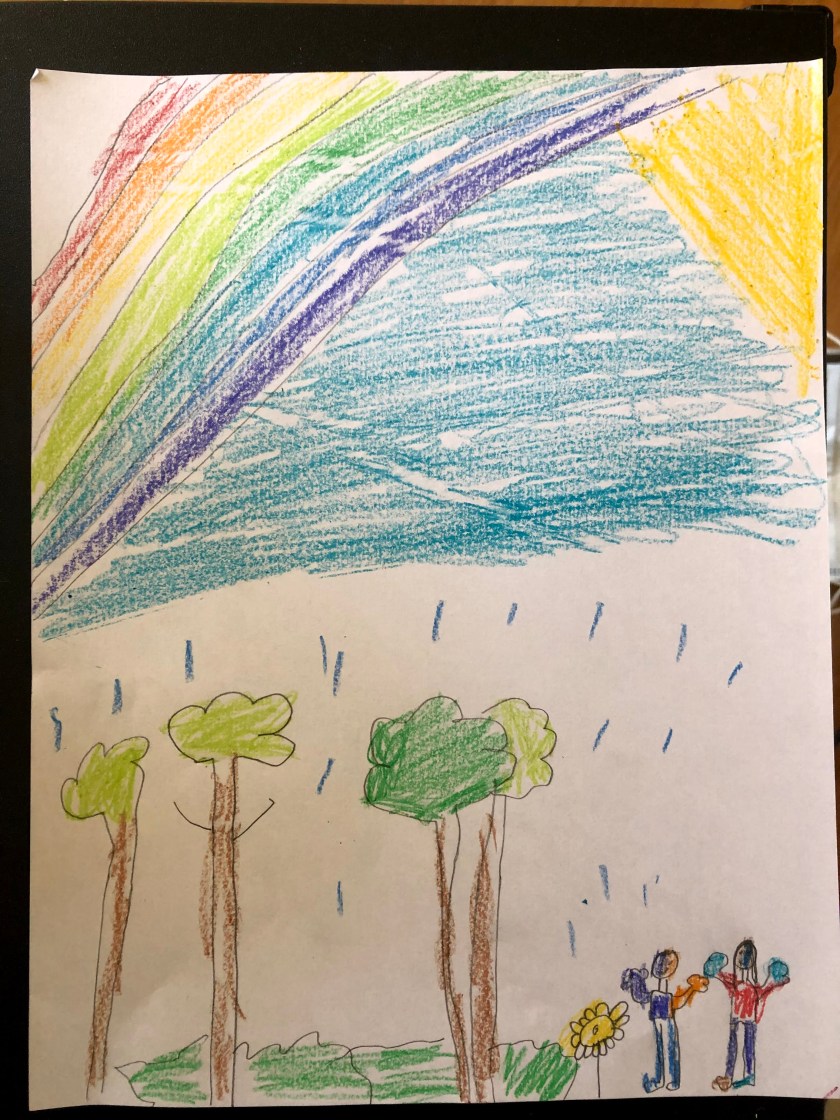
After a while, he went back to playing in the ocean waves with his sister. I sat there, nourishing my musings with whimsy. I remembered some drawings of the daughter when she was much younger. Dolphins leapt out of the seas, with a rainbow arc-ed beautifully around them. Of course, children imagine the best possible things together – there isn’t any dearth or rationing in their imaginary worlds, is there?

Because when you are imagining, you might as well imagine something worth while.” as Anne of Green Gables would say.

The dolphins may get to see rainbows, but the fish do not. But maybe their world is marvelous enough with a thousand prickling and tricks of light that the water medium presents to them.

Musing in a world of rainbows is nothing short of magical even if I do know the concept of light refracting and producing the colors of a rainbow. My heart still lifts.

I had been traveling during the past few weeks. One such time on my sojourns, I left my home amidst brown hills. The summer sun had toasted the hillsides, and I yearned for a little respite to the eyes. In the two weeks that I was out, the rains had lashed the area liberally, and when I came back, the hillsides had turned a marvelous green. The rolling hills lifted their misty veils every morning, and I felt my heart pound with the magic of it all. Yes, I knew the rains make the grass grow, but the transformation is still a miracle that my heart waits for every year.

When I watch the dew drops glisten on the spring snowflakes,
When I watch the rainbow makes up its mind and throw itself like a garland across the skies
When I watch the eight-legged marvels creations catch in the sunset
When I watch the waves lap and play with the sandpipers

I feel hope stir in the spirits
I feel decisive and conviction in Being
I feel solitude’s gift can be tangible and needs to be nurtured for its fragile state
I feel engaged with the planet and all its gifts

I recently read a book bySasha Sagan, that is full of the joy of being. Titled: For Small Creatures Such as We: Rituals for Finding Meaning in Our Unlikely World, the book immediately caught my attention and I savored its many truths and facts about our rituals and festivals – the meaning behind life’s celebrations.

“My parents taught me that the provable, tangible, verifiable things were sacred, that sometimes the most astonishing ideas are clearly profound, but when they get labeled as “facts”, we lose sight of their beauty. It doesn’t have to be this way. Science is the source of so much insight worthy of ecstatic celebration.” – Sasha Sagan

sasha_sagan

I was also reminded of Richard Feynman’s meditations on 🌺 flowers.

Ode to a Flower – By Richard Feynman.

There is beauty in knowledge, and wonder in anticipation. We just need a formula linking the two now.

For Small Creatures Such as We ( Sasha Sagan )

As I set out the kanu leaves in the backyard on a bitingly cold morning , the rain drops from the trees above dripped onto my back. When one refers to shivers down the spine, I suppose that is a literal enough description. I charged back into the warmth of the kitchen multiple times as I drew out the squiggly lines with rice flour – quick kolams to appease whom or what I did not know. I am not one for following rituals every much, but some how I like this one.

Kanu Pongal – Celebrated during Makara Sankranthi

Rains are lashing the Earth, and I am grateful. Last week, we celebrated the Indian version of Thanksgiving, Makara Sankranthi – the beautiful festival thanking Mother Earth for providing us with plentiful food, a nourishing environment, and so much more.

Kanu is typically celebrated by having the daughters in the family set the morning kanu for two reasons: (1) our forbears supposedly come and eat the offerings as crows, (2) the girls pray for the well-being of their brothers, who then give them gifts for their prayers and wishes.

In our feminist household of course, we have long since modified the ritual. It isn’t just the women who set out the kanu for the brothers – we all set the kanu and pray for our siblings’ well-being. We celebrate not just gratitude to Mother Earth for feeding our rather populous brood of humanity with her harvests, but also for the gift of sibling love in this large world.

Coincidentally, I picked up the book, For Small Creatures Such as We, By Sasha Sagan. (The daughter of Carl Sagan and Ann Druyan). After all, her father’s Cosmos book and her parents’ TV show, Cosmos, still has me ringing with the Joy of Existence every time I dip my feet into the “shores of the cosmic ocean“.

Sasha Sagan’s book does not disappoint. She says, and I quote:
Beneath the specifics of all our beliefs, sacred texts, origin stories, and dogmas, we humans have been celebrating the same two things since the dawn of time: astronomy and biology.

I sat there savoring that sentence for its simple truth, and elegant choice of words. Festivals and rituals are our ways of making sense of ourselves with respect to the larger cosmos – and her book marvelously outlined rituals and festivals in various parts of the world in different cultures and religions.

Discerning the sentiments behind the rituals is a particularly savory task, partly because I have a healthy skepticism about the Gods, and oscillate between being a secular agnostic and a believer. For those who are Secular in outlook, Sasha Sagan’s book is a marvelous read. It encourages us to come up with our own models for celebrating life in this cosmos.

sasha_sagan

That cold morning as I set out the kanu, I wondered, not for the first time, why we set out cooked rice pongal for the crows. Is it to acknowledge our evolution as mankind to be where we are? Using fire to cook, was probably the single biggest leap in our journey, followed by becoming agriculturists from the hunter/gatherer mode. How different would everything have been if these two had not happened?

I especially thought of the brilliant poem she had referenced in the book by Vietnamese Zen Master, Thích Nhất Hạnh :
In this plate of food,
I see clearly
the presence of the entire universe
supporting my existence.

I also read a poem by Mary Oliver on Rice in the book. Blue Iris, and together with the books For Small Creatures Such as We, and Cosmos, it makes for a marvelous way to start the decade.

Rice – A Poem by Mary Oliver

It grew in the black mud.
It grew under the tiger’s orange paws.
Its stems thicker than candles, and as straight.
Its leaves like the feathers of egrets, but green.
The grains cresting, wanting to burst.
Oh, blood of the tiger.

I don’t want you to just sit at the table.
I don’t want you just to eat, and be content.
I want you to walk into the fields
Where the water is shining, and the rice has risen.
I want you to stand there, far from the white tablecloth.
I want you to fill your hands with mud, like a blessing.

As more and more of us move towards urban hubs for living, the less we realize all that happens to make food available for us to consume. How many of us have seen rice plants, or coffee plants or pepper vines – actually even if we have, how many of us consciously think of the journey from farm to table in its cooked form?

It is truly an enterprise of staggering proportions to realize how much has to happen for smooth functioning of Society, and it is lovely to read a book that is so full of joie-de-vivre

I like the concept of  thanking Mother Earth for her bountiful gifts to life (Did I mention this already?). When it starts off with fierce winds ripping branches from your backyard trees, followed by glimpses of sunlight illuminating the clouds during the sunrise, followed by mild rain, and then seeing a glorious double rainbow; what is not there to feel thankful about?

img_6569

Books:

The Chrysalis of Clouds

Long flights are a time for introspection and solitude. Maybe given how little I get of this precious time unconnected, and alone, I am doubly appreciative of these spots of solitude gifted to me.

It is strange to think I am surrounded by sentient beings on a flight amidst the clouds. It was cramped being surrounded by people, but yet, free enough to let my fancies roam the beautiful worlds outside. The stars that I stare at from down below seem closer, and more familiar without the forms of the lit urban landscape to obscure the view.

Squinting into the night, it is faintly possible to remember a world swirling below and worlds swirling all around us, and worlds in which our problems are just that – fleeting wisps of cloud.

It is also rarely that I get to indulge in the beautiful meditations afforded by looking out the window. The tinkling lights of spots of civilization below make me think of how our problems look from above. I can think benignly of mankind just as I can do so when I am atop a mountain looking down at our lives.

img_5571

The rain bearing clouds were floating heavily as I surveyed them longingly from the airplane window. There is a strange uplifting feeling in being up among the clouds. When you are up there for hours together just quietly admiring the clouds, and the various lights that illumine them, there is cosmic beauty there. A calm beauty that words cannot do justice to. The idea of a soaring high atop a large thrumming bird watching the moonbeams light up the clouds is magical.

Watching the sun rise from above the clouds is even more magical. The transformation between dusk to night and from night to dawn is amazing. When on a long flight like that, it is doubly interesting to note that it is hard to imagine trees among the clouds. There is just a white/grey world tinged with silver, gold, yellow and orange against a black or blue sky. Where are the greens and purples that the eyes yearn for up there?

img_5532-effects

Flying among the clouds, there was a strange sense of being transient. Aren’t we all transient beings, here among the clouds for a while? This world. While it feels beautiful to experience this fleeting sensation, it is also bourne upon us about the fragility of our beings. We are in pressure controlled vessels , being looked after by flight attendants with food and drink that our peculiar palates can accept.

As the flight announcements came on about our landing, I felt an unease. A return from the lands of fancy above to one tinged with reality. Was this how adventurers felt? Maybe it was because of the chapter I was reading in The Snow Leopard by Peter Matthiessen as he wraps up his 6 month trek in the Tibetan Dolpo region on the lookout for snow leopards:
“To emerge gradually from such a chrysalis, drying new wings in the sun’s quiet, like a butterfly, to avoid a sudden tearing of the spirit. Certainly this has been a silent time, and a hallucinatory inner journey too, and now there is this sudden loss of altitude.”

The transcendental nature of flights,  watching the moonbeams, suns-rays and so on illumine the fluffy worlds below is a gift indeed. A time of mellifluous thought,  the landing to the earth is seldom smooth – do birds feel that way?

img_5549

A Poem From The Clouds:


The rain bearing clouds shimmer over the city lights below

Giving way to a darker journey where

The stars keep me company as they twinkle over the wing

Blinking and twinkling their friendly greeting as my eyes fathom their shapes.
The sun’s rays across the wing span creep in, slowly

Ushering in a new world

The same world blanketed by the stars

Or is it?
A billion diamonds replaced by one

One Star that outshines everything – The Supreme Star

Till Time takes charge at dusk again

A reminder that Time alone endures.

Shiva & Buddha Together

After all the years in which several girlfriends and I sat around planning grand trips involving sky-diving, snorkeling and weeks in Bali – we decided just like that, to set off to Sedona, Arizona. It sounded like the most exciting place on Earth. Like the son said, there is such a matching ring to it, that it is fun to say it together.

Driving to Sedona from Phoenix, Arizona was surreal and giggly. The full moon shone down on the desert landscape with giant cacti illuminated in the glow of the moon. The constellations traveled with us. I gazed out the window, not really knowing how harsh the environment was. It was all muted and beautiful in the moonlight. The cacti stood out tall and distinct, and I was wondering how tall they must have been to stand out like that. I was to find out two days later that they could be as tall as 40 feet tall, and not for the first time I thought of how precious life must be to thrive in environments like these. Arizona is of course very proud of its cacti: The Arizona State Bird is the Cactus Wren and the State Flower of Arizona is the Saguaro Cactus Flower.

Hiking in Sedona is an experience unto itself. The vast expanse is humbling, the red rocks, layers upon layers of it, that were once the ocean bed is mesmerizing to look at. Hiking to a vista point, each of us I am sure had different things in mind. I had my backpack on for no real reason. When quizzed about its contents, I sheepishly acknowledged that I had in there a book and a kindle among other things so I could sit in the wilderness and read. The friends had an amused expression on their face, and teased me about it, but found me a good spot nevertheless in which to leave me to it.

As I settled in to read, there was much head-shaking, but indulgent smiling. I tried to calm my senses to the levels reading requires. I had with me a travel book : The Snow Leopard by Peter Matthiessen. The book won the author the 1979 National Book Award in the category Contemporary Thought[6] and the 1980 National Book Award for Nonfiction (paperback)

snow_leopard.jpg

Traveling through the plains of the Ganges and eventually going up to the upper reaches of Tibet, it is a book that I have long wanted to read. The Buddhist teachings and Zen mode of life are especially attractive to me because of the restlessness that underlies our mode of life. If centuries ago, when technology was not as pervasive as it is now, philosophy saw the wisdom of building in pockets of stillness into our lives and forming affinities with nature, how come we are remiss in finding access to these fundamental things after all our progress?

ea670f7c-5d1a-43ab-ad4f-28944c7f3bd7

Do we need Science to point us towards these again? Science has already started acknowledging the importance of exercise, sleep, meditation. For Nature, there are now studies being instituted in various countries to see the effect of nature as we cluster round closer and closer to each other in urban surroundings. Forest bathing as a concept has long been practiced by the Finnish and Japanese. Known as Shinrin Yoku in Japanese effects on our well-being are now being studied from a scientific perspective. Would we embrace nature if Science pointed us to?

While I started out fake reading for a pose, pretty soon, I was transported to another world. Sitting in the hot lands of southern Arizona – the land of soaring eagles, vast expanses and red stone, I was joining the author on a journey to glimpse snow leopards in the Himalayas, passing stupas and taking in the Buddhist teachings on his journey. Shiva’s abode in the Himalayas is fierce and awe-inspiring as was the desert in which I sat.

img_4734

“Hey Girls! listen to this – Let me read out a passage out to you – see how Shiva comes alive here in Fay Canyon, Arizona?” I said, and started reading:

“Yet in Varanasi there is hope of life that has been abandoned in such cities as Calcutta, which seems resigned to the dead and dying in its gutters. Shiva dances in the spicy foods, in the exhilarated bells of the swarming bicycles, the angry bus horns, the chatter of the temple monkeys, the vermilion tikka dot on the women’s foreheads, even in the scent of charred human flesh that pervades the ghats. The people smile – that is the greatest miracle of all.”

By the time I looked up, there was much laughing and I looked to see that Shiva did not really need to dance in the spicy foods of the Ganges plain, A Shiva-ni was attempting a Shiva Tandavam right there. The poses were fierce, powerful, sloppy and funny all at the same time, and somehow totally at peace with the Garuda-esque surroundings of Sedona.

The giggling photographer looked slightly abashed and said “These girls lost you at Calcutta, and started dancing instead!”

I landed up giggling too, and like a bunch of tickled snow leopards fleeing the thudding of Shiva’s feet, we made our way out of the canyon lands towards our next stop.

I don’t know how much one’s readings can alter one’s surroundings, but I was quite astounded at our next stop. We were in a stupa with a Buddha statue. Sedona Arizona is well known for its mystic yearnings in its rustic surroundings, but I was still pleasantly surprised to find a quaint Stupa nestling in the canyons surrounded by naturally formed stupas of red stone, and a Buddha statue carved of wood.

img_4765

There probably is a reason for our richest myths and stories to emanate from awe inspiring places in nature, for it is where we can lose ourselves in order to come back to ourselves better.

November Novelty

A Version of this post appeared in The India Currents Magazine – the article focuses on communication.

The quality of the evening was ethereal. The cold November evenings had begun to set in. I had turned the thermostat up a couple of notches, the white light effused a warm glow against the fall colored curtains. Halloween was still fresh in everyone’s memory, Diwali had snuggled in, and spread its share of warmth and joy even amidst some moments of disquiet with raging fire and wind whipped storms.


I surveyed the house and felt a surge of warmth course through me. Dear friends and family were visiting, and I was glowing with pleasure at the companionship of the evening. The house had been through the cleaning wheel: which is to say that the closets were groaning and stuffed to their very brims. I warned guests to open any closet with care warning them that a dozen things could tumble out. All the children – residents and visitors, nodded with sincerity, but I found them an hour later playing hide-and-seek, and amazingly finding place to hide in the very closets that I thought sent me a clear memo to not put anything else in there. Oh well!

The conversation was ebbing and flowing with the fine food and beverages among the young and old alike. Jesty topics were making their way towards hefty ones, and laughter was being sprinkled with wrinkled looks of concentration as differing viewpoints were proffered, and evaluated. The beautiful feeling of minds changing slightly from their earlier stances mingled with the exasperation of trying to string complex thoughts into words – one word at a time, were at work, and I marveled at humanity once again.

“The art of conversation is the art of hearing as well as of being heard.”
― William Hazlitt, Selected Essays, 1778-1830

Can we get better? Absolutely. But I sometimes feel we lose sight of marvelous gift we have of empathy and of trying to understand one another. Moments in which we bestow upon one another the inestimable gift of attentive listening with a view to understanding. I was reminded of the saying, that I read somewhere a while ago.

Attention is the rarest and purest form of generosity – Simone Weil

When we talk of meaningful moments, it is moments like these that we wish to savor. November is unusually so – whether it is because it is my birthday month or the time for Thanksgiving, and therefore a time for gratitude, or something else, I cannot say, but I find it is a good time of year to look back on the past year, reflect on the grains that made up the texture of the preceding months, and those months layered upon years, like a tree adding a ring to its makeup.

Sappy perhaps? But so is life. 


It is the time of year when I select books with happy endings, the time of year I make it a point to snuggle in with my books and children,  buckle down and write more for November is Novel Writing Month.

The air is nippier, the nights longer. It is also the time for crunch parties for in the area I live the trees are resplendent with the colors of Autumn. The gingko trees are turning gold (post coming up soon). There is no greater joy than seeing life scurry about in these changed surroundings. The promise of rain is in the air. Misty mornings make for a magical start. Even the waxing and waning of the moon brings with it a new joy for the nights longer and the evenings bring with it a different texture of joy. Kawaakari is sooner (Kawaakari – a beautiful Japanese word denoting the rays of the setting sun on a flowing river)

img_4660

It is a time to send thanks for all the small and big things in life. A time in short for us to enjoy Hygge. A wonderful word the Danish have, denoting the warmth emanating from inside even as the winters outside grow colder.

Here is to a wonderful season of the upcoming holidays, of nurturing light in a dark world.

Tick-Tock Tick-Tock

“October 29th, 1969 is the day the internet was born did you know that?” said the husband. I have seen pups don that look when out and about in sunny meadows with a new bone to boot.

“Google icon huh?!”

I suppose life has taught him to take in his leaping enthusiasm with our barely noticeable uh-huh with equanimity. “Hey! Let’s try again. Today is the birthday of the internet!”

“No….just fun fact. Oct 29th, 1969 – The first-ever computer-to-computer link is established on ARPANET, the precursor to the Internet. And then in 1974, the first protocol for communicating over the Internet was conceptualized. T-C-P – tada! Finally, in November 1977, the internet was functional as the ARPANET for the Defense.

“It wasn’t until the late 1980’s and 1990’s even that the internet was functional the way we know it!”, he said awe dripping from him. “I suppose in a way we were the perfect generation to see the wave take off.”

“So you guys are as old as the internet?! Oh my gosh – that is so old!” quipped the little fellow, mentally slotting us with the dinosaurs. “How did you guys live without the internet? ” , said he puzzled. He has taken to asking Google Home all sorts of things during the day:

“Okay Google – what is the atomic number of Boron?”
“Okay Google -what is the time right now?”
“Okay Google – tell me a Halloween joke.”

“Well – we lived quite well I suppose.” said I, throwing in a bit of philosophy about the simple life needing few things other than sustenance for the body and the mind. “We did not need the internet to entertain ourselves. We played outside, made forts out of mud, ran around, and had fun all the same. No battles on that game of yours – Clash Royale is it?!  We battled it out with sticks and stones.” I said, and the more I talked about our lives pre-internet, the more I realized that humanity had truly passed a technological milestone. It was like the power of electricity – it changed our lives forever, and though life is possible without electricity, it has become so much harder to sustain without it. Looking at the children born after the age of the internet, I realized that connectivity is much the same for these children.


tangled_web

“You want to know what I did with the Internet today?” asked the teenage daughter.

“I’ll show you!” she said in her effusive tones. There was then a rather jerky video of her popping into her mobile phone’s camera from various angles – one upside down and by the sounds of it rather clumsily, for we heard a dull thud followed by an “oww”.

“Not my best video – but how about this one? ” She then went on to show us another jumpy jerky video with some sort of a meme thrown in for good measure. I groaned.

“What is this?! Does anyone even see stuff like this? Tick tock is it?” I looked appallingly at her, and said, “Oh goodness child! You don’t tell me you actually posted this!”

I feel it is worth noting here that the App is called TikTok, not Tick-Tock as I thought up until a minute ago when I went looking for the wikipedia entry – sigh! I am as old as the Internet I suppose!

“For your information Amma, tons of people see this stuff. It is original see? This is the one that is going viral now. Already 30,000 likes and 100,000 views.”, she said, proud of herself.

My jaws dropped. “For this?!”

“Supportive. Mother. Supportive – remember?”

“But I’ve seen plenty of videos – even your own that are much better than this – even the one you showed us before where you banged yourself on the floor by the sound of that dull thud had a comical quality to it. ” I said, and she laughed hard, agreeing wholeheartedly.

“Fame doesn’t need merit Mother.”

“Fame is a fickle friend Harry!” said I in a brilliant imitation of Professor Lockhardt from Harry Potter and the Chamber of Secrets.

“Fame is as fame does!” said she, and we all laughed.

“Just goes to prove that all our inventions and resources take on a life of their own, and that is what will keep us busy as a race I suppose.” I said.

“All the brilliant protocols developed and conceptualized for dumb Tick-Tocks like this to go viral. What is the world coming to?” said the husband.

“What a tangled web we weave when we choose to connect?” I said paraphrasing not Shakespeare as it turns out, but William Scott in the poem Marmion, and looking around proudly for acknowledgement. Completely lost on the group of course. I sighed and continued – there are times when you explain your jokes and times you don’t. Not when something viral is competing for attention.

“Poor appa! Let’s throw him a bone and listen to him about the philosophy of the internet dears. ” said I, and we listened to him as he explained – his own fascination overtaking him, about how the internet developed and (d)evolved into what it is today.

Here is an interesting video with all the leading websites over time.

More videos here : Data is Beautiful

How we will continue to evolve is anybody’s guess, which leads me to a wonderful essay I read by Ursula Le Guin on the different types of fantasy. (coming up next)

Running like Elephants

“Guys! Let’s hurry up a little. I like how we are dawdling, but the school bell waits for no ships to sail across the seas! ” I said. There had been a mild spattering of rain across the dry summer season. A few snails had popped out to enjoy the moist, and the son and his friends were looking at them as they chatted and made their way to school. Rain drops on the late summer roses and oleander flowers made the scene a rather endearing one.

img_3991-effects

The response from the children was predictable – they ran, and I ran shouting like a charioteer pulling the reins on the excited steeds, “Slow down! No running here – oncoming traffic!”
“But you asked us to hurry up!”
“Yes – run like Elephants!” I said.

I had told the children earlier about the Elephant’s gait, and they exchanged glances and started laughing. The snail they were studying looked startled and showed a leap of speed as it made its way back to the comfort of the garden bed.

Is this walking? *giggle*
Is this running? *giggle giggle*
Is this fast walking? * giggle giggle giputly duggle*
Is this slow running? *giggle puddle chuckle duffle*

I smiled slowly. “Pretend you are Elephants teaching Snails to run.”

elephant_snail

I suppose that was a wrong metaphor altogether. By the time we arrived in the school, not only were we out of breath with the laughing, but we were also fashionably disconcerted. The legs seem to not remember how to walk straight or run properly, and were caught in this limbo of the Elephant’s Gait.

Later that week, I was sitting in the garden and watching the world go about its true business of living. I watched a hummingbird’s fast-paced wing movements up in the trees. A few butterflies were flitting hither and tither. A skein of geese were flying overhead in that beautiful v-shaped formation. Closer to the ground, a few snails were marking their slow way across the courtyard.

This combination of sitting in a garden, and watching life flit by had me take a hundred pictures with my phone. Pictures that may or may not be seen and appreciated again. I could capture the slow motion video of the humming bird whizzing up above or the butterflies in my midst. I could use time-lapse videos to capture the slow moving snails and a dozen pictures to capture the beautiful movement of the caterpillars.

As I sat there musing on the ease with which we capture movement these days, I could not help comparing and contrasting humanity’s struggle to capture that. I remember yawning in the Art galleries after seeing the n-th painting of a horse or the x-th statue of a horse drawn chariot.

But as I sat there that afternoon, I wondered whether I had appreciated them enough. After all, at the time of their making, studying movement was not all easy. One had to have an almost eidetic memory to understand the muscles and the way they moved.

Leonardo Da Vinci’s work is appreciated because of the lengths he went to study the anatomy of the creatures in his works. 300 years ago, movement must have been particularly hard to study.

In Oliver Sacks’ essay on Elephant Gaits in the book, Everything in its Place, he writes about the problem of studying movement.

everything_place

More than a century ago, Etienne-Jules Marey had made a pioneering investigation of elephant gaits. Of course, he did not use video analysis then, but still photography. I quote: “Marey’s lifelong fascination with movement started with the internal movements and processes of the body. He had been a pioneer here, inventing pulse meters, blood pressure graphings and heart tracings – ingenious precursors to the mechanical instruments used in Medicine even today.

Later, he moved onto the animal movements and analysis.
For animal analysis he used pressure gauges, rubber tubes, and graphic recordings to measure the movements and positions of limbs. From these recordings, he rotated in a zoetrope, reconstructing in slow motion the movements of the horse.

Muybridge, a contemporary of Marey, however, a peripatetic artist as Sacks describes him used 24 cameras along a track where the shutter would be tripped by the horses themselves as they galloped past to capture the movements of the horse as they raced.

When a similar technique was used to analyze the fast movement of elephants, it was found that they neither walked nor ran, but rather a combination known as fast walking.

I remember a long ago conversation with a friend who was training for a marathon on the more recent study of leopards running, and how he had changed his running technique to take a few tips from the world’s fastest runner.

As we watch the world around us, I wish different creatures could teach us some of their marvelous techniques. The dragonfly and the humming bird for flight; mallards and coots for water locomotion. Doesn’t Biomimicry as a field of study sound more fascinating than ever before? I positively yearn to be Dr John Dolittle at times!

Books/Articles to be read/referenced in this post:

Leonardo Da Vinci’s Horse

The husband was wearing a red t-shirt that had Leonardo Da Vinci’s drawing on it, that said, Simplicity is the ultimate Sophistication.

He was particularly fond of the t-shirt, especially as he was reading the biography of the great man.

img_4057

“Be like Leonardo Da Vinci guys. Be simple and eh… persistent.”, I said.

“Oh! I don’t know about that! Did you know about Leonardo Da Vinci’s horse? “, said the husband. He was reading the biography of Leonardo Da Vinci by Walter Isaacson, which is to say we almost read it. The book is a lengthy one, and as he made his way through it, he shared tidbits of things that fascinated him.

Time has probably been kind to the memory of Leonardo Da Vinci. Most of us only seem to be remember his genius in art, his legendary stature as a polymath, he said. The husband chuckled as he read and told us about Walter Isaacson’s portrayal of him – a tempestuous man who often did not complete the commissions given to him. Leonardo Da Vinci’s horse is an excellent example.

He then went on to relate the tale to much mirth and chuckling from the children. Apparently, what was commissioned to him was to build an epic statue of the Duke’s son riding a horse. He then went off to live on a farm, to study horses. The farm life yielded a treatise – an unpublished book, on different kinds of horses, equine surgeries to understand horse anatomy etc. He had originally planned to create a statue of a rearing horse.

This is an image that is much popular in the art forms at Italy, I remembered. The raw power of a horse rearing up on its hind legs is both attractive and magnetic. I am not sure how riders feel when they are about to be bucked off, but it makes for good Art. The prince would have to look brave while clinging onto dear life.

Study_for_the_Sforza_Monument
Abandoned Design. Image Courtesy: Public Domain, https://commons.wikimedia.org/w/index.php?curid=59580

Anyway, after a few years studying horses, their physiology, their movements etc, he started developing models for his statue. Clay, lead and bronze made its way from the armies to Da Vinci for his great statue. Then, he figured that the greatest statue of the magnitude he had in mind would not be supported by the hind legs structurally, and he went on to make it a standing horse. The prince riding the horse resplendently was forgotten!

These things took time, but it did not seem to perturb him. His sponsors may have been antsy, the bronze supplies may have been running low, the armies getting fidgety with not having enough new armor, but that was their problem, seemed to be his opinion.

In time, a large clay model of a beautiful horse may its way for the Duke’s inspection. The model won Da Vinci much critical acclaim. It truly was beautiful. If the Duke was slightly upset about not seeing his son on the horse, he did not show it. The royalty raise their children well.

Soon, war broke out, and no longer could his rich patron commission bronze and lead to be diverted to the most magnificent horse statue of all time. The clay model was put up in Milan, and was used as target practice by the young lads joining the army.

“But isn’t there a big horse in Milan or Florence? Da Vinci’s horse? I remember seeing a picture somewhere.” said I.

“Yes, but that was not done by him. Years later, somebody else finished it. “, said the husband.

By now, we were all laughing.

“What is remarkable is his insatiable curiosity and creativity however, and though he went off down rabbit holes, it was from a deep motivation to understand the world around him “, said the husband.

Read also : Gates Notes on Leonardo Da Vinci

“These days it is so easy to take a picture of a horse, model it, and run a simulation for structural evaluations. We sometimes forget how hard studying movement must have been!” I said, remembering the essay by Oliver Sacks on the Elephant’s Gait, in the book, Everything in its Place.

everything_place

He writes about how more than a century ago, Etienne-Jules Marey & Eadward Muybridge pioneered the study of animals running using 24 cameras along a track where the shutter would be tripped by the horses themselves as they galloped past to capture the movements of the horse as they raced.

Persistence comes in various forms, we all agreed. Muybridge and Marey were examples in a long list of people for whom a problem was intriguing enough to delve deeper and deeper into things that may or may not yield results.

But we never know the breakthroughs possible, and how things will change. That is why I am vary of futurists. A few centuries ago, to study the muscles straining for a horse running, one had to have an almost eidetic memory, along with a decent understanding of anatomy.

Today, photography has come so far as to allow us to snap a thousand pictures, take slow motion videos, and analyze everything from a butterfly flutter to the swift flying of hummingbirds. People are still extraordinarily creative with photography, and as long as we retain curiosity and creativity, I suppose we shall thrive.


The Art of Breathing

A colleague caught me mid breath one day. It was one of those days that butterflies would have looked on me with mixed emotions.

On the one hand with pride: When did this caterpillar learn to flit like this?

On the other hand with amused tolerance: The half-wit seems to be forgetting the sweet joy of collecting nectar amidst pretty bright flowers, with all the fast paced flitting. Forfeiting the sweet thing about flitting – tut tut!  Flutter tutter utter nutter! (I am not high up on the poems caterpillars learn to sing about when still creepy crawlies; and the butterfly metaphor only goes so far!)

Anyway, it was one of the many days in which I flitted about the old work spot tasking, multi-tasking, sub-tasking, reminding others about their tasking, setting reminders for my own tasks and so on. Thoroughly immersed in my second self that Mary Oliver so succinctly calls the Social Self…yes, it was one of those days.

Mary Oliver’s, Upstream, is a book of many marvelous essays.  The essay, Of Power and Time, talks about the three selves in many of us:

•The Child Self

•The Social Self &

•The Eternal Self.


upstream

Though in the essay, Mary Oliver, refers to the Eternal Self as the artistic self, I like to interpret it as the Creative self.

• The Child Self is in us always, it never really leaves us.

• The second self is the social self. This is the do-er, the list maker, the planner, the executer.

• Then, there is the third self: the creative self, the dreamer, the wanderer.

T’was during one of these trying days that I remembered the deep breath technique my Yoga teachers had tried to teach me about. Take deep breaths, and concentrate on it filling your stomach, feel it coming in and out of your nostrils and so on. So, I started my deep breaths as I was walking from one meeting to another. Deep breath, exhale, deep breath, exhale and so on. I had thought no one watched, but one colleague caught me, and grinned. “That should be your GIF you know?” he said.

I nodded sheepishly, and went back to my brand of breath-less flitting within minutes.

Later that week-end I ran into this beautiful children’s book in the library. A book that was just waiting to be written. A beautiful capture of all the different types of breath, Alphabreaths 

Written by : Christopher Willard (a clinical psychologist) & Rechtschaffen MA, Daniel (a counselor)

Illustrated by:  Clifton-Brown


The book is a lovely read urging us to Breathe like a Dolphin taking a dive, or our favorite one, The Ninja Breath – silently and slowly. The illustrations too make for a marvelously relaxing read. Please check out their Youtube clip : here


Mindful breathing and Yoga are excellent concepts to teach the children, and I am always in awe of those who can take complex concepts and make them palatable for the consumption of young and old alike.

If you happen to come home and find the son and I swimming like dolphins or getting ready for a Star Trek mission on the floor while Yoga-ing along with the Cosmic Kids Yoga series by Jaime Amor , do not be alarmed. Her yoga videos are appealing and fun. If, along the way, we do something to calm ourselves down – then great, else, we have had a great time.

There are so many aspects to the Philosophy of Being (I am amused it has such a strictly medical sounding name: Ontology)

Ontology is the branch of metaphysics dealing with the nature of being, and reading the Wikipedia page itself boggles my simple mind (A post on the Study of Philosophy is sitting up on its hind legs and begging to be written). Maybe, what is required is a Ninja Training on Ontology. Excerpt from the wiki page:

Such an understanding of ontological categories, however, is merely taxonomic, classificatory. Aristotle’s categories are the ways in which a being may be addressed simply as a being, such as:[9]

  • what it is (its ‘whatness’, quiddity, haecceity or essence)
  • how it is (its ‘howness’ or qualitativeness)
  • how much it is (quantitativeness)
  • where it is (its relatedness to other beings)

*** Taking a Y for Yawning Breath before a Z for zzzz breath about now ****

img_4049

Keeping ontological explanations aside, if The Nature of Being comes down to simple techniques of breath, fluidity and movement, it makes the simplicity behind it all brilliant.

It was one of those ‘Simple is brilliant’ types of  quotes that I went looking for. I know many brilliant blokes and blokees have said marvelous things about simplicity -I know old Leonardo Da Vinci said something about it, so did old man, Einstein. In any case, looking for one of those made me fumble on this one by Norwegian explorer, Thor Heyerdahl

From Wikipedia: Thor Heyerdahl became notable for his Kon-Tiki expedition in 1947, in which he sailed 8,000 km (5,000 mi) across the Pacific Ocean in a hand-built raft from South America to the Tuamotu Islands. The expedition was designed to demonstrate that ancient people could have made long sea voyages, creating contacts between separate cultures.

thorheyerdahl1-2x


Continue reading “The Art of Breathing”

The Animals Within


The evening was a beautiful one. The children played looking like little angels in the glowing sun, and I threw affectionate glances at the noise in the playground.

I was mooning about the streets admiring the shabby looks of late summer. The same hills that looked brown and uninviting in the distance during the day, now looked ravishing bathed in sunset’s golden glow. Little specks of clouds in the sky were blushing to different degrees. The purple, red, orange and pinks poufs flicked about looking snippy and sharp. The oleander trees and the crepe hyacinths lining the streets looked prettier than ever before.

The approaching week-end seemed inviting, promising in its possibilities: my outlook was cheerful; my spirits soaring with the multi-colored clouds up there; and no must-dos competed for attention in the old brain.

T’was after a little growl came from within that I stopped to wonder what was amiss. I had completely missed the making-dinner task at hand, and the growl was reminding me, that I had not just 1 growl from my stomach to contend with, but the whole family’s as well. The husband trundled in, the children trooped in to say hi, and I whisked them all off for a dinner outside.

‘Forgot to cook?!’ cackled the teenaged daughter, looking indulgent and proud that I was not being the conscientious cook, and filling her plate with healthy muck. “Didn’t the sunset fill you up?”

“It filled me spiritually my dear. I could not be fuller!”, said I patting my heart, “but the stomach still asks for its due, Alas! “ I said remembering a poem my mother-in-law often references about what an irascible taskmaster the stomach is. I always smile at the wisdom of the poem. Loosely translated, it means
“Oh stomach!
What an irascible creature you are!
I ask you to eat a lot at one meal, and you rebel, and push back saying you are full.
So, then I ask you to skip a meal, but that too wouldn’t do for you.
What a slave to your demands have I become?
It is very difficult to live with you!”

So, off we went to a Chinese restaurant in various states of hunger.

This is one of those places that believes in keeping you engaged while they prepare the food for you. In front of each was a sheet of paper containing the Chinese Zodiac Animals and their characteristics. We started off in typical fashion:
You are a monkey!
Really? A snake – ha!
How could you be a tiger?
I don’t want to be a pig!

For those who moon about on Friday evenings without considering the demands of the stomach, here is a tip: Don’t! Friday evenings beckon all mooners-about, and restaurants find themselves busier than usual that day. As we sat around with hunger gnawing at the insides, the sheet of paper telling us about our characters based on the year we were born in looked inviting. Soon, we started tabulating and cross-referencing the listed characteristics against the personalities in the family.

It is an interesting exercise, and really makes everyone stop and pause and think about oneself. There are characteristics that the whole family gave a miss to. There were some that we hoped we did not have, but found we did. There were others we hoped to have in a higher degree. The tabulations were derailed every now and then with questions such as “Why are hippos not there in the Chinese calendar?”, After going into habitats and biomes with glaring holes of knowledge, seeing as none of us had ever to China, we got the animals back on track.

The resulting diagnoses has us giggling uncontrollably:
“You are most like a rabbit, but also have the tongue of a dragon, and the heart of a pig!”
“Snake hissing and pouting maybe, while galloping like a horse, and snoring like an ox.”

It turned out that we churned out more fantastical creatures in that half hour than a whole mythological genre could in a book. “Imagine if these creatures were sitting in us, wouldn’t that be something?” I said.

inyo_20q

Humanity’s capacity to imagine strange and wonderful creatures has always been remarkable, though there are precious few creatures left for us to imagine. No one is bringing another Clara to our midst any time soon.

Clara the rhinoceros, was brought to Europe on a tour in the 18th century. No one had yet seen any of the creatures of the East, and had not even heard of such an animal. Clara became an instant darling of the masses – her gentle demeanor, her love of oranges and her sheer size endeared her to all those who had the privilege of seeing her. I can well imagine the wonder and curiosity such a creature brought to human society, and the number of children in whom the wonders of the natural world was rekindled. How many Gerald Durrells, who imagined the beautiful world of their family and other animals?

500px-Clara_1749_Oudry.jpg
Image title
Rhinoceros Clara
Author
Jean-Baptiste Oudry
Copyright holder
PD

Today, we silently add more and more creatures to the endangered species list, watch in alarm as forest cover disappears and wait for magic to happen in our lives. Anthropologically, will we hear the news of a Middle Earth tucked away somewhere with hundreds of majestic creatures again?

Maybe one day, our space explorations will yield something. Till that day, we shall have to content ourselves with imagining the various creatures and creature traits within us.

Books:

Clara the Hippopotamus – By Emily Arnold McCully

My Family & Other Animals – By Gerald Durrell