Preparing for Tsunami Warnings: Lessons Learned

 Emergency Warnings – Tsunami 

A week ago, we were all a-twitter. You see? We received a tsunami warning. There had been a 7.0 earthquake in Northern California – about 3 hours north of where we live.

We technically live not near the coast but we are quite close to the bay in the Bay Area.

This was the first tsunami warning we had received. So, while the tsunami warning made sense, we also had no idea on what to do with it. So, we did the only thing that humans in modern times do: Took to the phone and tried figuring out what others thought.

What is a yellow warning? We live a few miles from the shores of the bay – could that mean a sudden inundation?

Responding to Warnings

There are times when mass communications (by that I don’t mean communicating to the masses, I mean masses of communication) make sense, but this was not one of those occasions. Everyone said different things, people worried. Staying away from the bay seemed like a good option, but apart from that, no one had any idea on what to do. Should we head to the hills like we’d read long back somewhere?

So, we all did a lot of hand-wringing and sent more messages. Ultimately, the tsunami warning was revoked, but not before letting us know exactly how unprepared we were in case of a real emergency.

When that alert had come it was up to us to determine the next course of action. For one thing, we were a couple miles inland, so what was required of us? That’s when I realized the old fears I had for our little family when we both worked on the other side of the bay. I had wondered what might happen in case of an earthquake that stranded us all on the other side of the Bay. But a Tsunami could just as well have done that. 

The tsunami warning was lifted, and in a few hours, people went about their business as usual. Which is to say traffic snarls were everywhere, week-end parties and events did not bother to acknowledge that which could have been life altering.

It is a testament to the human temperament that we can so flippantly treat that which could have been a disaster with a wave of the hand. 

🦌 Emergency Drills -Earthquake, Fire 

I volunteer in elementary schools from time- to-time. The experience is a wholly enriching one as I get to work with children – which is refreshing. They are inventive, imaginative, kind and un-jaded in their outlook towards life.

I got to experience an earthquake and fire drill with them one day, and I cannot tell you how impressed I was by their skill and competence. Even when scrambling under desks – they looked out for each other as much as possible. When they filed out into the fields nearby, they kept to their classrooms and straight lines, and I was more than impressed by them on more than one occasion that day. 

I had seen firsthand how incompetent adults could be, when the tsunami warning came, and it was refreshing to see children knowing how to handle fire and earthquake warnings.

I suppose natural disasters are called that for a reason. They are erratic, chaotic, and tend to surprise humanity every time even with emergency warning systems, safety drills and the like. The school systems managed to highlight these things and taught me a thing or two: keep calm and fall back upon training.

Exploring Happiness: Is It in Our Genes?

In what was an intriguing chat with the son last evening, we poked around the ethics of genetic modification. Apparently, that had been an area of discussion in their classroom, and the son was keen – the novelty of a discussion with multiple viewpoints at that age is amazing. I smiled and listened to him talk offering a question here, a hum there, an insight elsewhere.

“What do you want to do with human-beings if we are smarter?” I asked him.

“We could fly.”

“Cool! But then what?”

I took a deep breath and said as casually as I could. “Everyone wants to be smarter, for things to come more easily to them. So we wouldn’t have to spend so much time figuring things out. But – the thing is, if everything came easily, we would not know what to do with all the time we have on our hands. What do they say? An empty mind is a devil’s workshop? I don’t know – I think it could lead to more mental health issues – what do you think?”

He pondered this for a while, and said it was an intriguing thought. 

Who Survives?

It reminded me of another chat the husband and I had a few months ago – on the larger theme of the future of humanity. With smarter, faster, stronger, what would happen to humans? The husband took a moment to gather his thoughts, and said, “Well – it will come back to good old basics then, wouldn’t it? Survival of the fittest. Those humans who can learn to be peaceful with themselves will ultimately win out – that is the strain that will survive.”

I was impressed – yes, no matter what we had, it ultimately came down to temperament, attitude, and the ability to be happy, didn’t it?

Generosity by Richard Powers: The Happiness Gene

Incidentally the book I am currently reading: Generosity by Richard Powers, talks about a variation of this: The Happiness Gene.

The story tries to figure out the reason for Thassa’s happiness. Thassadit Amswar is a refugee who has fled the Algiers region. Her brother is still under house arrest in a totalitarian regime, her parents are dead after years in which they were stuck in the midst of a civil war that raged around them, and any which way you look at it, she should be morose, sad – not chirpy, cheerful, and full of light.

The whole set up reminded me of one of Rumi’s sayings that have been making its way around the instagram world: something to the effect of:

When the world around you is dark, you could very well be the light.

Rumi

In any case, somehow Thassa’s ability to be happy attracts attention – first from local friends, then a policeman, a local news report diagnoses her as having ‘Hyperthymia’ – a condition of overwhelming happiness, and goes on to attract those who want to auction and buy her eggs, decode her DNA, figure out the happiness gene. She finds herself unmoored by how people feel bad because she is happy, and having to navigate the horrors of fame.

In Essence

  • Is there a genetic component to being happy?
  • If so, can that be picked and chosen for our offspring in the not-so-distant future?
  • What issues would that create for mankind? For just as sure as we are of creating solutions, so too can we be sure for creating problems for ourselves, isn’t it?

Stories Meant for the King

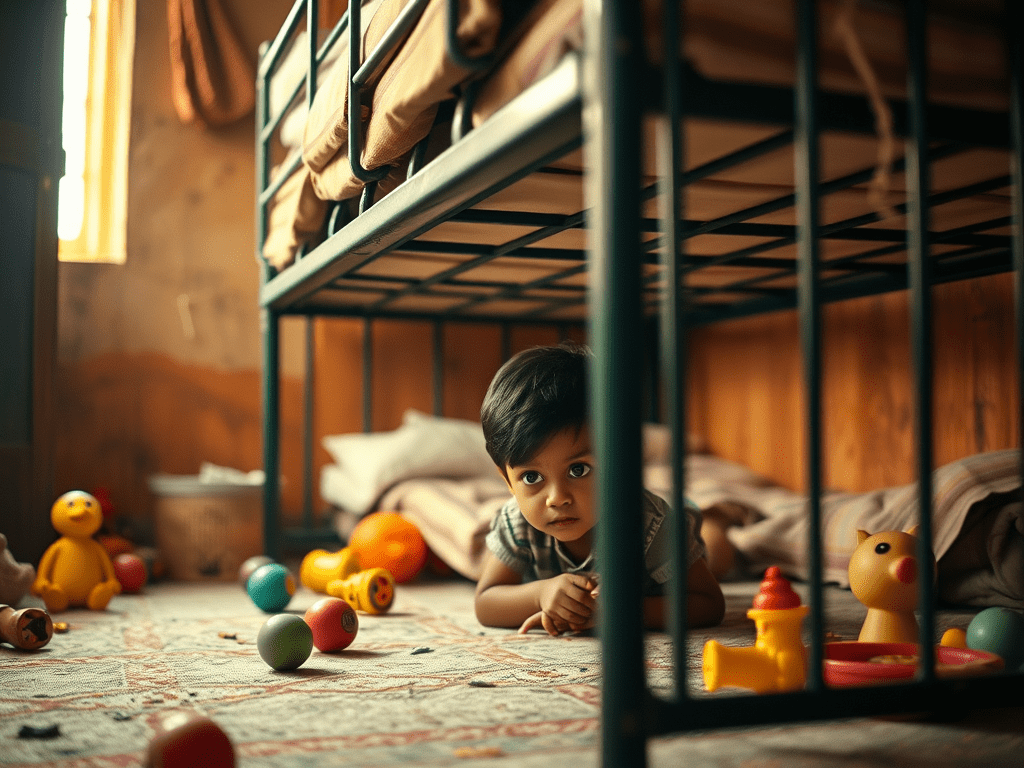
The husband was narrating life in his humble abode as a child to the children. “My ‘room’ ” he said, picking the quotes like the children do, “was under the steel cot. I was the Hero there. If my brother decided to join – then We Were Heroes There, or We Were Devils There. But it was all good fun.’ 

The children guffawed with laughter. This narrative was a familiar one, and I smiled. I remembered those steel cots. Appalling things they were – with steel rods painted dark green with apparently no aesthetic appeal. They were sturdy – I’d grant you that. They were the mainstay in almost every middle class home in India in the 80’s. As children, we had stress tested them by leaping on to them from cliffs on high cupboards, using them as rafts from oceans of swirling creatures below etc, and they did not break. Steel, you know? 

How we carve out space for ourselves when there isn’t any can be a problem. But children seem to find solutions to this problem in the most creative manners possible. 

The husband’s abode growing up was a small house – children did not have separate rooms. “Just the reality!” he shrugged when the children looked at him surprised. 

“Under the bed is a spacious place for a small boy, you know?” he said.

The daughter and son exchanged glances.

The daughter said, “We love having our room!”

“Decorated just the way we want too!” said the son.

“Our room under the bed was too – we had cobwebs in the east-facing courtyards, and well, lizards on the south-facing side. Beat that!” said the husband to his awed audience. 

Raja Kadhais : Stories meant for the King

The husband was reminiscing about his ‘room’ under the steel cot, “In there we listened to all sorts of ‘Tea’ (teenage slang for hot-off-the-stove spicy news). Things we should not be listening to. Things that we should, we ignored of course. Your grandmother was particularly adept at noticing when one ear would dance for the juicy tales. I tell you, she could see the ears squirm, and she would send us out to play  – “This isn’t for you – Raja Kadhai. (Meaning stories meant for the King )” she’d say. Well, she didn’t receive the memo about my kingdom under the bed I suppose! Anyway, those Raja Kadhais were the best!” said the husband grinning from ear to ear. 

I always like the way the daughter finds her space wherever we travel. In the cramped space of a car, she’d make her ‘room’. In a shared hotel room, she’d put up a sheet like a tent and make her ‘castle’. Her ‘room’ is not always a room, but she manages to make it so. Her space.

When AirPods Snuffed out Stories Meant for the King

That day, though, I was annoyed at her for not listening in. Here we were discussing things that would’ve been amazing for her to know, and she had plugged her ears in with noise-canceling headphones, pulled a blanket in the back-seat and gone on to tune us all out. Raja Kadhais, Tea – nothing. 

“Is this how life is going to be with these blasted devices? In one room, yet so far away?”I ranted to the husband later.  

“Leave her be! She is a teenager, and teenagers require space.” he said, taking his daughter’s side (as usual).

I rolled my eyes at this. “Isn’t receiving this kind of input critical while growing up. How many stories we’d heard in this manner? Not explicitly told to us, but enough to give us an idea of the world around us.” 

“They’ll find ways to get it – social media?”

“Instead of stories from adults in hushed tones?” 

Imagine my surprise then when I saw these Japanese headphones that promised to pop the bubble of silence : Popping the bubble of noise canceling headphones. These headphones are supposed to let background noise in, so we can still receive sensory information.

I admit, I rolled my eyes like a teenager at this. Really – all this progress. I wonder when we reach a point of diminishing returns and have to return to the tried and tested good old fashioned ways. You know? Go back to fiddling the knob on the rusty old radio with one channel to tune into.

https://www.newyorker.com/culture/infinite-scroll/popping-the-bubble-of-noise-cancelling-headphones

Which of the current technology trends do you think will bear the test of time? I thought noise-canceling headphones were the thing – but apparently not.

🐘🐘🐘🐘🐘 The Tusks of Extinction 🐘🐘🐘🐘🐘

The Mammoth Tale

Few passages capture the bane of consumerism like this one does. It is from the novella, The Tusks of Extinction by Ray Nayler.

The premise of the book is an intriguing one. 

  • It is set in a future when mankind has figured out how to upload one’s consciousness into the cloud. A manner of immortality. This is very much in the realm of possibility.
  • It is also set in a time where the Siberian mammoths have been resurrected. This has already transcended realms of possibility into reality

The wooly mammoth is being resurrected – being cross bred from the genetic remains frozen in the Siberian Tundra with  the Asian elephants (because they are gentler than African elephants). 

Thus, begins the tale of a doctor whose life was hacked from him moments after he uploaded his thoughts and knowledge to the web. This man, Dr Damira, was a passionate naturalist, a man who studied the African elephants and their ways. He fought for their conservation but failed. This is set in a future where the last of the elephants no longer roam the Earth. 

tusks_extinction

The resurrected mammoths in Siberia are facing difficulty thriving in the wild. They have all been bred in captivity, and do not understand how to survive the demands of living by themselves, caring for each other, and forging paths so they can forage and live through the cruel winters. They are thus being killed by poachers in a cry that reminds scientists of how the elephants were all killed off one by one. 

In an attempt to give them a chance at life, the doctor’s consciousness is uploaded to a mammoth – a matriarch by the name of Damira. 

Bane of Consumerism

There are several aspects of this novella that can appeal to us, but one in particular stood out to me, and that was how our consumerist culture alienates us from the natural world. For we buy things, we want things, we accumulate, we hoard – who is it hurting? I am earning and I am buying. It is all helping the economy is it not?

Extract:

In offices-a tusk in a case, beautifully carved, transformed into a world of its own, worked by human hands into a chain of elephants walking trunk to tail. Beautiful, lifeless elephants carved from the destruction of an elephant, hacked into what had once been a part of a body, a tooth, a tool. A part of a life.

“Among the skyscrapers, there were also older places-little streets of cramped shops, survivors from another Hong Kong. Marginalia that had been missed by the eraser of progress. And there, in the shop windows, so crammed with clever things, there it was. My eyes found it over and over again. Ivory. Ivory jewelry, ivory stamps used to sign decrees that were meaningless now, ivory game pieces of every kind. Ivory turned into useless gewgaws, dripping with the blood in my home. It could be carved into any lovely shape they wished, but all of it began in killing. No-more than that all of it began in killing that took place far away. That took place somewhere the people who thought of ivory as a material could not see. Killing that took place in an extraction zone.

I remember the horror I felt when I first learnt that certain types of leather were obtained from the skin of crocodiles and were thus priced higher. 

Cities like Hong Kong and New York and London at the center, vortexes into which the currents of trade accelerated, into which goods from all over the world were pulled. Places where things became materials. Where things became commodities.

Many of us rarely stop to think of the source of all the things we use as part of our daily lives. In all honesty it is overwhelming to do so. How does the kidney bean come to be in its packet in the grocery store? Once we start down that road though, what about the almond flour, the diamond ring, the leather handbag, the silk scarf, the perfume, the spice, the watch, the gold ring, the ceramic jug? Everything has its tale, its journey, its place in the human chain of wants and needs. 

What Can We Do?

In reality, we cannot give in to an almost paralyzing analysis of source-to-table for everything we consume. Is there economic exploitation along the way, unscrupulous practices, inhumane treatments? Would we be happy to know it all and make informed decisions – yes, (I am hoping that humans have enough humanity to make the right choices if we do), but can we do so? Not always. 

I spent a pleasurable few hours at the mall the other day, and found my fellow human beings doing the same. Glancing around at the happy faces of those of my fellow humans that morning, I did not see malice or greed – I simply saw folks at a mall on a rainy week-end. 

I like that mass production has made life easier, the jobs it has created, alleviating entire nations from poverty. I like that poor children can have new clothes, and that horizons have expanded thanks to the general prosperity of nations. I do not, however, like the ever-increasing pressure to produce and consume more. 

Is the economy to be weighed against the Earth’s resources at every step in the mall? Or just more more meaningful consumption? I do not know.

😇 Even AI Knows 😈

A Guild of Authors

A friend and I were returning from a meeting in which authors from different genres were presenting their works. We fell to discussing the books that appealed to us, and what worked in the format, and what didn’t. I, for one, felt that giving folks a platform to present their books, while noteworthy, could just as well have been done via a YouTube short, but what would have been harder to achieve would have been moderating a discussion about the overlapping topics between the authors. That was something I would have loved to see.

A Company of Authors – Stanford Guild

The sections were grouped together by genre, and topic, so it would have been a good panel to have discussions around. 

Even AI Knows!

As conversations usually go, we meandered, and I said something to the effect of the housework and the truth of an Indian woman having its effect on writerly ambitions etc, to which he mentioned a joke he’d chanced upon, and I guffawed at the truth of it.

“With AI, I thought, it would take over monotonous tasks such as dishwashing and house cleaning, so I could take up Poetry & Art. Instead AI has taken up what little I had of Poetry and Art and left me to do the dishwashing and cleaning!”

Even AI knows to steer clear of household tasks, while humans (women still bear the brunt of the housework) are in charge of these mundane tasks. Who says the universe doesn’t have a sense of humor?

“Really! Of all the things I wanted help with – it was Art that was the least. Give us one tough thing to spend our lives mastering and perfecting!” I said. “Help me with robots – one for the chores, one for help to care for the aged, another with companionship for the lonely etc. Why art, literature and poetry?”

“I do think there are startups for every one of these in the off-ing somewhere.” said he – sanguine as ever and optimistic in the ways of the world’s future.

He was right of course.

Intuition & Instinct?

It did help us loop back to a book that was discussed in which the author spoke about intuition/instinct being a precursor to our conscious thinking, and whether AI would be able to simulate that level of prescience. Which made me wonder, whether that was what made us human, but plenty of us have learnt to ignore these things over time (after all, we don’t need to know when a tiger is lying in the bushes). But would it help us identify dangers in our life?

https://open.substack.com/pub/managingeditor/p/surfin-mia?r=2e6vr0&utm_campaign=post&utm_medium=email

More importantly, if that too can be modeled, what does that leave us with to claim our humanity? Messy emotions and imperfect decisions maybe?

Which brings me to the most important question: What would you like AI to help with, and what would you prefer AI kept is nose out of?

War & Peace, Love & Power

“You need to have either love or war; those are the only ones that can sustain a long running saga!” the daughter said as an off-hand comment one day when we were discussing the art and craft of world building, and she was convincing me to read another series – one with a female protagonist. I was hesitant to start reading a series that not only had 7 books but all seemed to be progressively bigger in size too. She guffawed at this and said,  “You’ll enjoy it, so what’s the problem?”

The problem with wars is that nothing makes sense as time goes on. Even if there is justification in the original act of going to war, the long-running losses and frustrations often eclipse the original intent. It becomes a cascading pile of losses that fuel more losses.

I was reading Haruki Murakami’s book, Novelist as a Vocation. There was one particular section when with the book still open in my hand, the mind started to meander, trying to make sense of what was said, and trying to piece things together as they might have been.

He writes about the time he witnessed civil unrest as a student in college long before he decided to become a writer. Coming from a stable family, and not having endured any significant challenges or wars in his lifetime, he writes about the period in his life when he witnessed strife. He confesses that he felt drawn to the cause originally, but gradually could see cracks beginning to appear. Slowly, he saw how words lost their integrity, and he felt he could not identify with any of it anymore.

“As time passed,.., and internecine warfare between the student factions grew more and more violent and senseless – an apolitical student was murdered in the classroom we often used, for example-many of us became disenchanted. Something criminally wrong had wormed its way into the movement. The positive power of imagination had been lost. I felt this strongly. ….Uplifting slogans and beautiful messages might stir the soul, but if they were not accompanied by moral power they amounted to no more than a litany of empty words…..Words have power. Yet that power must be rooted in truth and justice.”

I felt a heavy sadness settle over me as I finished reading that section of the passage again. Thus it has always been. With war, with power, with long-running angst. It sometimes seems to me that human beings are remarkable for still allowing light to seep through – to be hopeful, happy, joyous, friendly, loyal, trusting, loving and giving. But I am glad of this tug-of-war too, for without one, we may never learn to fully appreciate the other. 

News of war and conflict have always plagued humanity, and exactly a century ago, the whole world reeled from wars back to back that sent the world careening into madness. The insanity of it, the dreariness of it, we hoped would be deterrent enough for at least a few centuries – but I doubt it. For just as ubiquitous as love seems to be conflict. 

In centuries of warfare, there have been gains and losses. All things fragile to begin with (egos, lives, trust, careers), they all seem to shatter in the eternal quest for what? Seldom in war do people win. Maybe countries do, armies do, but never the individual. And yet without collective action, where would we be?

In our very contradictions lies our greatness. 

I eyed the book series on war & love the daughter had given me, and wondered whether to start another saga.

It seems so simple to say: All we need to do is figure out a way to value Peace over War, and Love over Power. Oh well! That is the saga of the human life, isn’t it?

The Past, Present and Future of Jobs

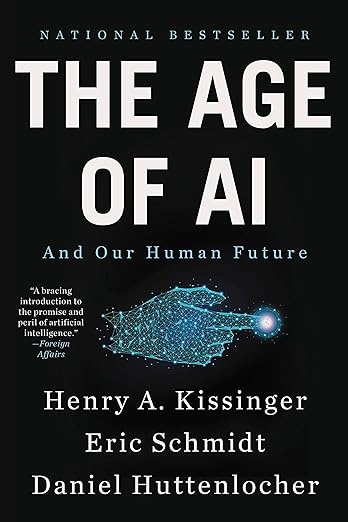
“So, you work at a job that essentially takes away your own job?”, said the son.This is the kind of meta stuff that he finds exciting.

The Thanksgiving week-end was rife with conversations about the corporate drama that in yester years could be equated to the coups of thrones. Would the CEO go? Would the Board of Governors go? Would they both go? Who would be their replacement?

Last year the world popped their popcorns and watched the unfolding drama of an unraveling Twitter with Elon Musk and his hostile takeover of the company, now rechristened X, though the URL still points to twitter.com because the TFE team was probably let go.

This year, it seems much of the dramatic action came from OpenAI CEO, Sam Altman. In modern day Wall Street wars, CEOs, (or C-Staff) and the Boards of companies provide for much of the action. Will the market hold? Will the Sensex drop?

What happens to the interest rates?

One of our friends was explaining to the children about their own roles – technical roles in which they enable AI to be utilized intelligently. One was working on images, another on code frameworks itself. A niece who was majoring in biology told me how they were already being encouraged to use ChatGPT to generate code for them. They only needed to see the results of the datasets fed into the model.

age_of_ai

Fascinating as it all was, I was left musing on the future of work. It seems a rather recurring theme of late. There are image generators to replace artists, code generators for software engineers, of course plenty of writing that can be replaced with intelligent prompting. So, why not the design and maintenance of these systems too?

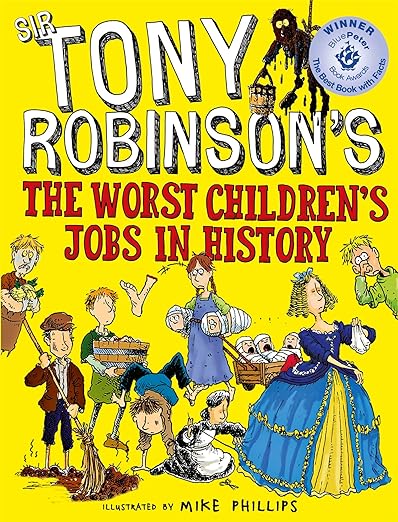
I picked up the book from my recent library pile:

The Worst Children’s Job in History – Sir Tony Robinson

worst_jobs

The book was truly horrific and true. If anyone was wondering about the future of jobs and feeling glum, they could actually be grateful that the past nature of our jobs are well behind us.

Every job not only held misery, but a generous helping of walloping, not enough food, abysmal conditions, no thought for safety etc. Compared to those jobs, the present day conditions of occupying ourselves and our children seems fantastic. I only hope this trend continues for, our current nature of jobs is about to upended again.

It seems with the speed of technological challenges, the cycles with which our jobs are upended seems to be quicker and quicker.

A couple of generations ago, seamstresses, tailors, knitters, bat makers, ball makers, farmers, equipment handlers all saw their jobs upended by mechanization.

Then the next generation saw people’s fortunes needing more specialized skillsets such as coding, scientific knowledge etc.

Recently, call center jobs, desk phones, phones that were in the family room all went away, to be replaced by cell phones. Those of us who remember having to take a friend’s call in the living room with three uncles, five aunts, three cousins of varying age and maturity levels, two grandparents and a maid, will forever envy the children of today who quietly buzz out of vicinity taking their phone calls mysteriously with them. 

The next wave of AI seems to be disrupting industries that I’d hoped would not be. Creative industries that are already hard to make a living in: storytelling, image generation, writing, etc

Will our grandchildren read books about us in this era and feel sorry for us that we had to slave in front of our computers all day long to accomplish certain things, spend days getting tests done in medical labs to determine what was the matter with us?

What would the future of our jobs look like?

More importantly, in this quest for bettering the use of our time, do we hope to become at peace with who we are without being defined by what occupies our time? If so, maybe we should start equipping ourselves towards that, shouldn’t we?

Let me know your thoughts.

Books:

  • The Worst Children’s Jobs in History – Sir Tony Robinson
  • The Age of AI – Henry Kissinger

🤕 Boo-Boos 🤕

Do you know when you start to feel your age? 

An innocuous question popped up on my browsing sites. Really, sometimes I wish these systems weren’t omniscient. I might’ve searched up the best way to dress a flesh wound, but did that mean you use my demographics, cross-reference it with my potentially weak hips thanks to my age, and wrangle up half-baked questions and answers on when you actually start to feel your age?!

Preposterous.

If only someone would sue the internet for this nonsense. 

I feel fine. 

So what if I am slightly wobbly while descending the stairs after a fall two days afterward? It is perfectly normal isn’t it? I mean I am not a teenager anymore or in my twenties or in the decade after that for that matter. But so what?

A children’s book I’d picked up a few days ago from the library beamed up at me. Books: Ever the saviors I tell you.

The Boo-Boos That Changed the World: A True Story About an Accidental Invention (Really!) by Barry Wittenstein and Chris Hsu 

boo-boos

The book is about a man, Earle Dickson, whose wife gets a lot of boo-boos. While a competent enough person with dressing of wounds and such, she is also aware of how hard it is to take care of wrapping the bandages and cutting the reels of cotton etc by herself, especially if one of the hands are injured. 

Thus was born the handy Band-Aid. Husband and wife worked on the design together and pitched the idea.

Luckily Dickson also works for Johnson & Johnson – the business that could take up an idea for boo-boo betterment. 

Despite the brilliance of the idea, it did not take off as easily. People still seemed to prefer the old-fashioned way of tending to their injuries. That’s when they hit upon the idea of Boy Scouts of America – a place where folks regularly hurt themselves, and wanted to get back to having a marvelous time as quickly as they could. (Children! The best boo-boo handlers in the whole world. I remember glorious years in which scraped knees and elbows meant nothing, other than a dusting off before running that next race to the eucalyptus tree down by the road. )

That did it. As Boy Scouts embraced Band-Aid, so did the rest of the nation. I beamed up at the son, who is a proud Boy Scout and had helped me with immediate first-aid with the boo-boo.

He then ordered some first-aid supplies off Amazon, and the site flashed that it would be available at my doorstep in a couple of hours time. We looked at each other, and said, “Wow! We are spoiled brats huh?! We just wait for it at home and peel-and-stick.”

https://www.penguinrandomhouse.com/books/557760/the-boo-boos-that-changed-the-world-by-barry-wittenstein-author-chris-hsu-illustrator/

I stared back at the browsing link being recommended to me: So, when do you start to feel your age?

👻 Maybe when you realize that getting a boo-boo and taking off soon after is harder. 

🤕 Maybe it is when you groan your way downstairs from a simple boo-boo from days earlier. 

😈 Maybe it is when you yearn for that beautiful moment just before the boo-boo.

👻🎃 I Am Hopeful Because 👻🎃

I sat on All Hallows Eve bathed in an orange glow, marking and judging entries for a literature contest. If ever there was a content pumpkin contest, there I was, readymade. It was quite an enjoyable task, and I sat quietly reading stories, poems and essays on the topic, “I Am Hopeful Because”. 

Throughout the evening, I waddled out of my desk to open the door and bellowed, “Who dared to ring the bell? Ho ho ho!”. I thought I was doing pretty well till the son asked me why Santa was ho-ho-ho-ing on Halloween. Oh well!

Halloween is one of my favorite American festivals.  The house was reasonably well decorated. Pretty soon, penguins, vampires, mermaids, peanut butter and jelly sandwiches all come knocking on the door despite the ominous sign by the door that read, “Knock if you dare!”.

img_8351

 The son and his friends had a roaring Candy Exchange Business going on the side I understood later. He came into the house looking flushed from the cold, and bursting with news. Apparently, he’d been able to auction a Kit-Kat for 2 Twix, a Ghirardelli white chocolate piece, and an M&M packet. He also had instituted a monopoly on all the Sour Patch Candy, and found himself bartering and trading like the fellows on the stock exchange. I smiled. 

“How was your evening?” he asked. It had been one of those rare Halloween evenings when I had stayed put inside the home instead of gallivanting with the revelers. I love the atmosphere of Halloween as regular readers know, but this time a minor biking accident had me sitting inside, while the Halloween revelers roamed the candy laden streets. They mapped best routes, best homes to hit for the best candies resulting in rounds of discussion. It was all marvelous.

img_8259

I did miss the magic of the halloween streets with moonlight filtering through the clouds, black cats slinking through the streets, raccoons wondering what all the fuss was about, and chattering children racing towards lit up porches for some Halloween candy. But it was also a surreal, beautiful evening. A reminder of the joys of winter evenings, of warmth drawing in as the evenings became colder. That first feeling of Hygge. 

I told him that I was hopeful because the evening was full of well-behaved children. The children all seemed to be so happy to receive a piece of candy, even though they all live in an economy and a community where far too much sugar is available for consumption. One or two of them even returned a couple of pieces of candy when they’d had a few more than they thought they wanted. 

The sweet honesty of these children in times when we are constantly reminded of our flaws and failures was refreshing, and the gentle interactions through the evening with adults and children alike, was very pleasant indeed.

halloween_ij

“We’re all mad here.”

– Lewis Carroll, Alice in Wonderland

☀️ Energy Sources 🗺️

The son and I were discussing this and that when we hit upon one of our favorite topics of discussion: energy sources. The fellow has been very happy that we now have a solar roof.

“And now – we generate more solar power than we use. Isn’t that awesome?!” he piped up as we were out on a walk one evening after a particularly hot October day. (I wondered if the solar energy could be bounced off our heads too, and that earned a weak chuckle and an eye-roll.) Of course, this led to an interesting discussion on energy sources and we got talking on the recent articles or books we’d read.

“There is one place where they take your steps and convert that into energy. Like you step on the floor and that becomes stored energy. Cool right?”

“Cool!” I agreed, and screwed up my face at the nearby freeway noise. “I am sure if we can just figure out a way to take all that wasted energy from all the fast and noisy cars on the freeway, and use it to power the cars behind them, that would be even better – you know get off gasoline altogether? ”

“They are already working on it somewhere. Life is so exciting in these energy fields!”. he said.

Later that night, he bellowed that he’d left me an interesting article to read on my bedside table on Energy Sources. 

August 2023 Issue of OYLA – Energy All Around Us- Generating Electricity from Dance Floors, JellyFish and more

#33 AUGUST 2023

If I haven’t raved about OYLA before, allow me to. The magazine is a gem of science and mathematical tidbits . I was enthralled by the article and read it all agog, exclaiming at the right intervals. It pleased the son.

  • A thoroughly fascinating article in which the different types of energy sources are briefly touched upon. Piezoelectricity – the technique of using our movements to power energy. 
  • The many ways in which sound vibrations can be turned into electricity (apparently a new generation of architects are working on powering skyscrapers powered with noise energy – so the hustle and bustle of the city, the blaring sirens, freeway noise everything is actually used to power the building – isn’t that brilliant?)
  • In another section, it says nanoantennas are more efficient than conventional solar cells and they have a ‘good chance of displacing conventional solar panels’.

All highly exciting possibilities. I was especially thrilled to read this bit about jellyfish and their green fluorescent proteins. 

Quote: (from the Bioelectricity section) 

“Some jellyfish glow in the dark. This is due to the green fluorescent proteins (GFP) that are present in their cells. Such an element may not need sunlight at all and could instead “feed” on bioluminescent radiation (like in fireflies) and ultimately they might be used in nanodevices.”

It must be wonderful being a jellyfish or a firefly. Were there some jellyfishes who glowed more than others, the same way some human beings are more energetic than others? 

Individual energy levels is a common topic of discussion in our household as we are surrounded by friends and family who seem to be made up of inexhaustible sources of energy and positivity. ‘How do they manage it?’ we say as we admire these folks, but it is something I’d love to gain an understanding about.

Would it make the difference between glowing, glowing less, or glowing more?

Also Read : Life’s Determinants

Source: August 2023 Issue of the OYLA Magazine. Article: Every Volt Counts 

\