When you look up the definition for religion, it states among other things that it is “a pursuit or interest to which someone ascribes supreme importance”
How many conflicts has the world endured, is enduring, and will continue to endure because of this belief to which one ascribes supreme importance? I had written about it here (religion).
Who was it who said that every good kind of learning can be obtained from Childrens’ books? I whole heartedly agree.
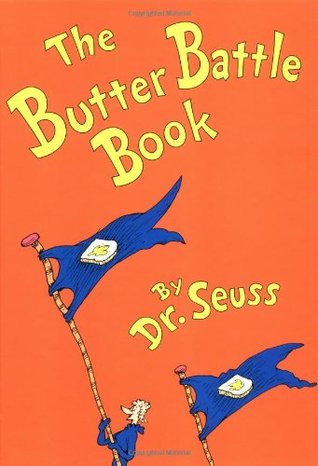
The latest book that I am babbling about is the Butter Battle book, by Dr Seuss.
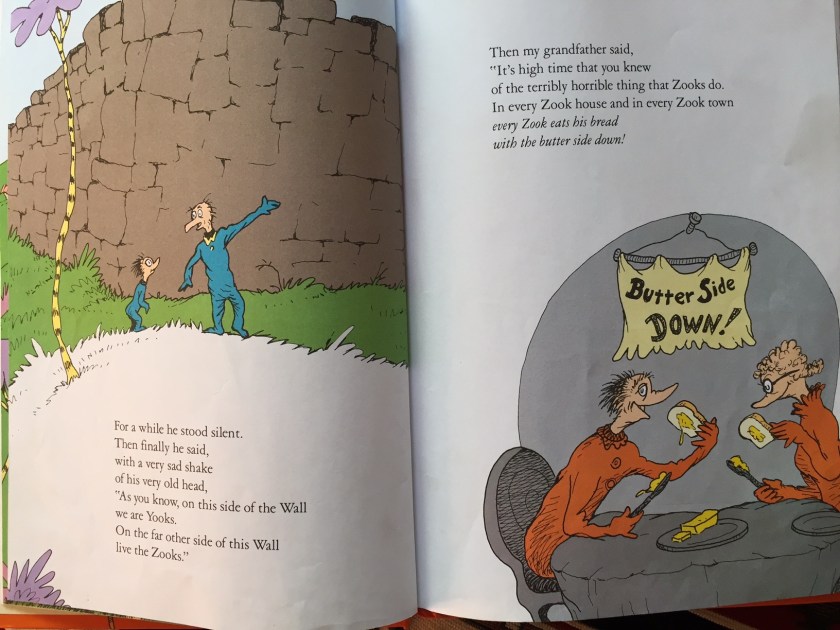
The Yooks and the Zooks live on either side of a long, meandering wall. The Yooks wear blue, the Zooks wear orange.
The Yooks think the Zooks silly for buttering their bread with the butter side down, while the Zooks think the Yooks are somewhat dim-witted for buttering their bread with the butter side facing up. The flags of the Yooks and Zooks represent the belief in buttering bread, and the animosity builds from this bread-butter-theory to which they attach supreme importance.
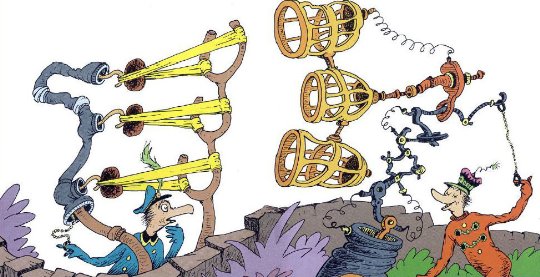
One day, the Yook patrolman is prowling the place with his Tough-Tufted Prickly Snick-Berry Switch, when a Zook pelts him with a slingshot. This sets in motion an escalating conflict, with both sides coming up with more and more exotic and dangerous arms with which to fight each other.
The Triple Sling Jigger, the Jigger Rock Snatchem, the Blue Goo-er, the Kick-a-poo kid operated by a cocker spaniel – Daniel, the Eight-Nozzled Elephant-Toted Boom Blitz.
The last page has the Yook patrolman sitting atop the wall with a Zook warrior. Both of them have in their hands a Bitsy Big-Boy Boomeroo – a small bomb that can annihilate life as we know it, signifying the nuclear threat.
I know we ask of no formal training as a politician: there are no politician licenses, no courses one has to complete to take up public office, but I really think there should be a set of children’s books that they all have to read and re-read as refreshers every year in order to stay in office. We could call it the Butter Battle Course.
The Butter Battle Book has of course given rise to great hilarity in the house. “Do you want to be a Yook or a Zook?”, we ask taking out the butter and the bread. We now butter our bread on both sides so we can be Yooky-Zooks, and sometimes Zooky-Yooks.
The next time any two nations start warring, I suggest thrusting bread buttered on both sides to both parties.
We were at a party of sorts where good friends gathered for the evening with families. Adults, senior adults, teenagers, tweens, kids all jostled together happy to see one another.
The children got eating out of the way as soon as they could, and started playing in that vigorous fashion that makes me want to drop everything and join them.
People with food on their plates drifted like continents and grouped and regrouped for conversations. At one point, I found myself amidst septuagenarians talking about sleep, or lack thereof. “Go on and tell them how little I sleep!”, said the father-in-law to me.
“He does have difficulty falling asleep…”, I said carefully, casting a longing look at the children playing outside.
He gave me a wilting look for this lame endorsement, and decided to stick it out on his own.
“I was never like this. I cannot sleep these days. I used to sleep the moment my head touched the pillow.” he said
“Me too” agreed an uncle.
“It would take sometime to fall asleep, but once I did, I could sleep well without interruptions.” said an aunt.
“How many times can one turn this way and that? How many times to say our prayers?”
“It is such a big problem. What do you think we should do?” they asked, looking at me earnestly.
Sometimes, I get when it is a rhetorical question, and nod. Other times, I behave like a particularly dimwitted penguin, and start telling an ostrich how to bury its head in the sand. I go on to make comparisons between the similarities in nature between sand and snow and how it is all a matter of technique.
“Well, sometimes when I am excessively tired, I find a hot bath before bed helps.” I said.
“I take a hot bath every night. Nothing helps.” my father-in-law said looking miserable. All the senior adults agreed: Baths were elementary stuff.
The squeals from the garden indicated an energetic game of hide-n-seek in progress. I glanced to see a squealing army run towards the washing machine – apparently somebody saw one of them go there to hide, and everybody was running to investigate.
By now, more folks had joined in the conv. Herbal teas were discussed next as aides to that Elusive Soother of Souls, Sleep. Chamomiles, lavenders and orange blossoms wafted their scents in. In time, the topic had slid down the tea slopes and gone on to meditation as a technique.
“I find I worry if I have nothing to worry about”, said an aunt, and smiled wanly. “One day, I saw 2 o’clock and was so disgusted”, said she.
“But it cannot be as bad as mine. The other day, I saw 3 o’clock on the clock. 3 o’clock can you believe it?.”
My father in law said he saw 3:10, while another uncle said 3:30.
They all looked at me to declare the winner. Braver generals could have taken on the task, maybe, but I confess I shrank from the task. These individuals who would happily set themselves to lose in a game against their grandchildren were now competing for The Most Ardent Sufferer Award, and I wasn’t going to be the one to decide. Nu-Uh.
I quietly slipped into the garden, to see the children were all running strictly following the principles of Brownian motion. They ran onto the lawn and tumbled over, and ran again. The setting sun washed them all aglow. The grass on their beautiful clothes, the dirt on their cheeks, the sweat pouring down their faces, and their squeals of laughter made a marvelous sight.
The evening slowly wound down, and we gathered all the folks up and started back on the ride home. The children were giggling still, while the senior citizens in the car were discussing the food in detail.
When I look back upon my childhood, I see that it sparkled with a fine collection of aunts and uncles (most not related by ties of blood) My father was a teacher in a residential school (Lawrence, Lovedale), and all teachers lived on the campus along with their broods like one large, extended family. It is only natural that we adopted some of his close friends for our very own aunts and uncles as well.
“Isn’t she such an inspiration?” said my friend, as we waved to Athai (meaning Father’s sister) one night about thirty years ago. “Poor thing has had such a tough life.” Athai seemed happy enough to me, I thought to myself, why was her life tough? Seeing my puzzled expression, my friend, who was older, taller and wiser (she still is), took it upon herself to enlighten me.
That evening, she told me how Athai was a very well off young lady when she lost her husband unexpectedly. She realized later that she not only lost her husband, but her fortunes as well. Suddenly, she found herself rudderless. She told me how Athai took up the job as matron in her children’s school, and how she had rebuilt her life with dignity and perseverance. She had gone on to raise her three children as a single mother through those hard times.
I never looked at Athai the same way again.
They say children have an innocence that is hard to define, and I understand now what that means. I had known Mrs Ramachandran my whole life spanning less than a decade without stopping to think about her past life: her life beyond being matron to hundreds of children, the person who managed the kitchens and Athai to all of us. In all of these roles, she was gracious, loving and giving. It was as if she had simply sprung into being the same beautiful way in which I interacted with her everyday. Her grey hair framing her round face with a ready smile that dimpled her cheeks.
When I stopped to think of it, I realized that she must have been a stunning beauty in her youth.
It was then that I started asking Athai about her life. She would share bits and pieces of some incidents here and there and I was happy to listen whenever she did. She came home in the evenings some days with her friends and we always looked forward to seeing her if only for a few minutes.
One day, I opened the door looking despondent. She asked me what the matter was, ever ready to deal with the intensity of teenage turmoil.
“This is one of the reasons I don’t like jewelry!” I said as I finished telling her about how I lost one of my gold earrings on the playground. I was feeling miserable.
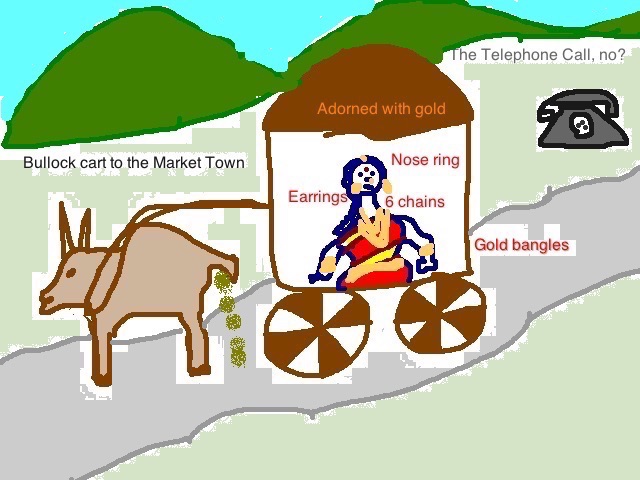
With her characteristic humor, and knowing how much I balked at wearing jewelry, she teased me that I might find myself married to a husband in a remote village, where every woman wore six chains, twelve bangles, sagging earrings, a nose-ring, and that I would have to get into a bullock cart decked up in my finery, in order to take a phone call from my sister on market day. I laughed, feeling better already.
Then, she said, “You should be careful with your belongings, but you must not become attached to them.”
Every bit that Athai shared of her life was beyond inspirational, it was motivating. I sat mesmerized by how without her ever realizing, she weaved her grief, misfortunes, perseverance and joy together as one beautiful tapestry through which her personality shone through. I loved every interaction with her, the attentive companionship she gave, and her unfailing good humor.
Last week, Athai passed away at the age of 88. I wished I lived in a remote village and had to wait till market day to receive the sad news of her passing. But WhatsApp is relentless and swift. The network packets encrypted and decrypted the message the same way it packaged every inane joke and forwarded message: “Athai passed away. “ it said blankly.
Don’t cry that it is over, smile because it happened. – Dr Seuss.
I dragged my children along for a walk that evening. Fresh air always makes it easier for me to think happy thoughts, and I knew the walk would help me celebrate Athai’s life. I do not know whether my children will remember the evening, but for me, it was important. It is a tiny piece of Athai that I wish to share with my dear ones.
I know Athai would have liked to know my little ones. In her heart, there was always place for love.
Dear Athai – may you rest in peace and thank you for everything.
It was a mild and breezy week-end morning. “Yeah! We are going to work in the garden today! In the garden! In the garden!” I heard the song gain in strength as the gardeners thumped upstairs. “Get up amma!”, they called. I was lingering on in bed, savoring the warmth of the summer quilt.
“What is this?” I asked a little later. The husband was back from somewhere brandishing several sinusoidal wave-like sticks of blue. Could they be fancy walking sticks?
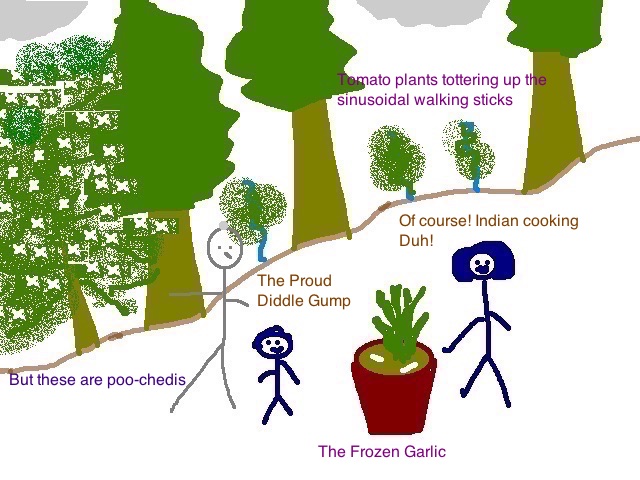
“No – silly. These are for the tomatoes.”
“Yes – don’t you want large tomatoes from the plants? Look, they are already sagging outside.”, said the father-in-law pointing to his pride and joy in the garden. “The rasam can be even tastier with these tomatoes.”, he said with a sly grin on his face.
“Can you make rasam without tomatoes? I just don’t like tomatoes but I like the rasam otherwise.” said the daughter.
This I-Don’t-Like-Tomatoes theme was getting a bit tiring. I rolled my eyes, and stamped my foot in exasperation. “I do not know how to make tomato rasam without tomatoes! Let me know when you make it. ”
“Okay okay! Sheesh kababs! No need to get all cranky if you don’t know how to cook something.” she said and made off to the garden dragging her little brother with her to help her grandfather.
“Make rasam without tomatoes indeed!” I muttered to myself as I gathered the garlic, cumin, pepper, tamarind and tomatoes for rasam. Once the rasam was comfortably simmering, I went back and forth from the kitchen to the garden. Every now and then I was beset upon to give directions and suggestions for the garden. I asked for an old rose plant and the star jasmine creeper to be pruned.
“But they are poonchedis ” said the father-in-law reluctant to cut flowering plants. South Indians have this strange, but endearing affection with flowering plants. I assured him pruning was good.
The children were busy discussing how to plant the other little flowers and herbs in the garden. The son was looking mighty impressed with himself for he was patted with admiration by his elder sister on the gardening tip he had provided.
“If you put a garlic in the herb garden, then nothing will happen – you know? Nothing. Yes. Ms Lara told us that. No insects will come.”
“Really? We can do that.”
“What?! Do we have garlic in the house? I didn’t know that!”
“Of course we have garlic in the house! How else do you think we can do any Indian cooking you little diddle gump?”, said the chef, who wanted to make tomato rasam without tomatoes.
The little brother was suitably impressed and a few frozen cloves of garlic made its way to the patch containing the Thai basil leaves.
I looked at the father-in-law. He was tackling the unruly star jasmine creeper with energy. The jasmine had crept up the adjoining fir and cherry trees and was busy making its way past the garden fence. I saw the intense concentration on his face, and surveyed the garden. He must have taken lessons from the barber in the best army in a past life, for the trees had an efficient crewcut demeanor when he was done with them.
The whole scene reminded me of a short story, Annamalai, by R.K.Narayan in The Grandmother’s Tales. The story is about a gardener who had stopped on with him. The gardeners horticultural knowledge and classifications are simple. All flowering plants were ‘poonchedis’ while non-flowering plants were ‘not poonchedis’. The story writes of his taking charge of the garden and how sometimes he would go on a rampage and prune everything in sight, and the garden wore a threadbare, forlorn look for a few days afterward. At other times, he let things be, and the garden flourished anyway. It is a beautiful story that transports you to a little garden in South India almost instantly.
I smiled thinking of the story. My horticultural knowledge is as woeful as that gardener’s, and my father-in-law’s botanical classification was equally simple. However, I hope our garden too thrives. Maybe we will become the best advocates of the Do-Nothing farming that Farmer Fukuoka speaks so highly of in the Biomimicry book by Janine Benyus.
Quote from Biomimicry book:
A young man named Masonobu Fukuouka took a walk that would change his life. As he strolled along a rural road, he spotted a rice plant in a ditch, a volunteer growing not from a clean slate of soil but from a tangle of fallen rice stalks.
This proved an inspiration for the young boy : how a grain thrived without the need for coddling and soaking in water canals and so on.
Over the years Fukuoka would turn this secret into a system called Do-Nothing farming because it requires almost no labor on his part and yet his yields are among the highest in Japan. His recipe, fine tuned through trial and error, mimics nature’s trick of succession and soil covering . “It took me 30 years to develop such simplicity” says Fukuoka.
Instead of working harder, he whittled away unnecessary agricultural practices one by one, asking what he could stop doing rather than what he could do.
A sizzling sound alerted me to the rasam simmering over its sides. I charged into the kitchen wondering how to better the Do-Nothing cooking technique.
Hiking through the rolling hills one day, I noticed one hill that had the touch of our greed all over it. It was probably a quarry. Set against a state park, this stark mountain made me wince. It was visible from many points in the park, and I moved my eyes away from it as though it was a raw, open, visceral wound. I noticed later in the dozens of pictures I had taken that day, I had deliberately cut this mountain out from my lens. Like my cutting out a mountain from the frame will remove it from my conscience. But it didn’t. I can still see its jagged unnatural edges in my mind’s eye – edges that have been scraped by metal against rock abruptly, not shaped by wind and water over time.
A sight like that got me started on the book called Biomimicry by Janine Benyus, for we have devised a way of life that is not sustainable.
Our corporations, keen on profitability, raced each other to figure out the best ways in which to make us consume more and more. But we have taken the race too far. It is time we stepped away from the treadmill.
As I gurgled on in this vein, I could not help noticing that there was a spring gurgling nearby. I stopped chattering like a monkey and quietened down, and as I did so, I felt a queer feeling seep into me and fill my being. Could it be happiness or gratitude? Whatever it was, I liked it. When birds, butterflies, rabbits, pinecones, free flowing water, trees and mountains jostle in friendly ambience in the early morning sunshine the way that Gaia intended it to be, it is refreshing.
I looked at the vegetation around me, and I found I did not quite know the type of trees or the plants around me. Gone were the days when I could tell you which berries were good, which ones made you itchy, and which flowers you could sip to get a wisp of nectar. How do animals know instinctively what works and what doesn’t, while we do not? I thought of the chimps in Gombe Stream National Park, the most studied species in the planet thanks to Jane Goodall’s work.
Quote From Biomimicry by Janine Benyus: Observing a chimp in Gombe Stream National Park, anthropologist Richard Wrangham, says:A chimp I was observing had woken up sick and instead of rolling over for more sleep, she got up and made a beeline. Twenty minutes later she stopped at an Aspilia plant [a cousin of the sunflower that grows as high as 6 feet]She suckered up her face and swallowed a dozen leaves before she moved back to her troop. It was obvious from her grimace that this was not a taste treat.Though chemical analysis of the ingested leaves showed no conclusive proof of medicine, he saw that a spike in leaf swallowing behavior coincided with the months of host tapeworm infection.
We too had this kind of instinctive knowledge with us, and instead of adding to its repertoire, we have accidentally followed another path.
Most frightening of all reports is that one in four wild species(including all taxonomic categories) will be facing extinction by the year 2025.
All this huffing up hills takes a toll on amateur knoll-climbers, and on the pretext of admiring a giant pine cone, I stopped to regain my breath. The pine cone was beautiful: It’s tough exterior, perfect symmetry and overall shape made me look at it and wonder why we cannot build jam jars like that pine cone.
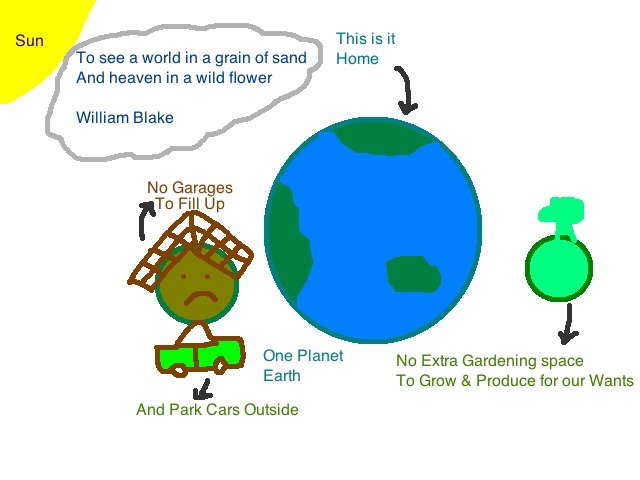
It is hardly the first nor the last time I will come across a Mountain of Greed. We have made extraordinary progress in areas pertaining to the skies, the seas, connectivity etc, but seem to grapple with the simple fact that we have one finite resource on which to live. There are no garages to be built for Earth. No extra closets. This is it.
I sound extraordinarily sententious in this post, so maybe what we need is a reward system for eco-sustenance, so each of us can tap into the Naturalist nestled in us.
To see a world in a grain of sand To see a heaven in a wild flower – William Blake
I recently read a book called Biomimicry by Janine Benyus. A book, whose underlying concept appealed to the very core of my being, for it outlined how little we know of the world around us, and how much more there is to learn from Nature’s processes.
How do we become harmonious citizens of a planet that houses, apart from 7 billion of us, billions of plant and animal forms? It is a question that floats into my mind every so often. How beautifully a bee arranges its hive, how marvelously a dandelion reproduces, how trees take in water, how they produce energy. All of these things make me wonder and marvel at Nature the Tinkerer.
I am afraid I made rather a pest of myself with friends and family. I cornered parents-in-law while they were taking a rest and spoke to them of Do-Nothing farming, I got a children’s book on the subject and read tantalizing bits of information out to the children. I bored friends with it. I could see the scramble-and-run-before-it-is-too-late look on everyone’s faces when I stopped to admire the squirrel prudently checking whether the fruits are ripe before digging in.
‘Why is it wet winter or hot summer, some grasslands thrive?’, I’d ask, only to find that tasks of monumental importance spring up requiring immediate attention for my audience.
Did that stop me? No. If anything, I am going to go and do on the blog what I have been physically doing to those around me.
The book is arranged into the following sections:
Echoing Nature Why Biomimicry now?
How will we feed ourselves? Farming to fit the land: Growing food like a prairie
How will we harness energy? Light into life: Gathering energy like a leaf
How will we make things? Fitting form to function: Weaving fibers like a spider
How will we heal ourselves? Experts in our midst: Finding cures like a chimp
How will we store what we learn? Dances with Molecules: Computing like a cell
How will we conduct business? Closing the loops in commerce: Running a business like a redwood forest
Where will we go from here? May wonders never cease: Toward a biomimetic future
Higher education in Science has arranged itself along silo-ed areas of expertise. Biologists rarely study Computer Science. Mechanical Engineers rarely take up Zoology.
The author writes of her interactions with various scientists who have successfully transcended narrow areas of study to walk the line between disciplines to see where we can benefit from nature.
1) The materials science engineer who combines fibre optics and biology to study the beauty and resilience of spider silk
2) The agriculturist who, over decades, has perfected the technique of do-nothing farming, conscientiously chipping away at unnecessary practices while studying natural prairies and grasslands to see how plants grow in the wilderness, thereby coming up with the highest yield of natural grain per acre.
3) The anthropologist who studies chimps and how they cure themselves to see how we can identify cures for common problems.
Quote: In exploring life’s know-how, we are reaching back to some very old roots, satisfying an urge to affiliate with life that is embossed on our genes. For the 99% of time we’ve been on Earth, we were hunter and gatherers, our lives dependent on knowing the fine, small details of our world. Deep inside, we have a leaning to be reconnected with the nature that shaped our imagination, our language, our song and dance, our sense of the divine.
This about sums up our position on Earth. “In reality we haven’t escaped the gravity of life at all. We are still beholden to ecological laws, the same as any other life form.”
Now is the time for us to take our place as one species among billions in the ecological vote bank, and make wise choices.
Dinner was done, the kitchen was clean enough, and the children were smelling delightful after a hot bath (They looked and smelled like mops after playing all evening just an hour ago). The kindergartner and I had read a children’s book. After a few minutes, I thought I heard the rhythmic breathing that meant he fell asleep and, I started fiddling about with the phone. I had started with the intention of checking my email, and had gone all over the place, finally grazing my Facebook feed.
Every now and then, an article pops up in my feed exhorting me to rise to greater heights and tell me in 10 easy ways how to become a Better Person. Over the past decade, the nature of these articles has changed. At first, it said great things like Manage Priorities in your list and how best to Stick to Plan and all that.
Now, things have been taken down a couple of notches. We will get you effective to the point of Making Lists. Then, you are on your own. Go back to your phone if you like. If you want to stick to the lists, you must already be efficient enough, the articles say and throw up their hands.
This one told me how to Be Productive in the age of notifications.
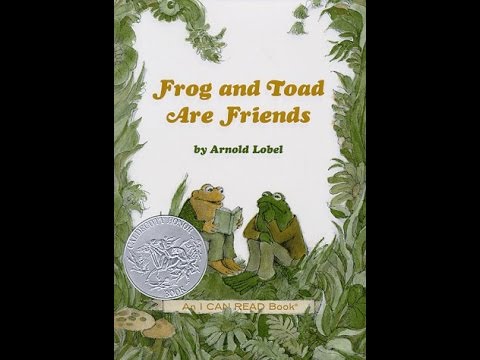
‘It has been a long time since we read Frog & Toad’, said a sleepy child’s voice by my side. I looked up and the pair of us started laughing.
‘You didn’t sleep yet!’
‘No!’ he chuckled.
I gladly set aside my phone – pesky little thing telling me how to be Effective and Efficient. Like I wanted that. Pssk Tssk and Zsssk.
’Let’s read it then!’, I said. ‘Yeah!’, he said, and we settled down together. I love those books. I am drawn to the simple problems, the bonds of friendship that endures between them and the humor in them.
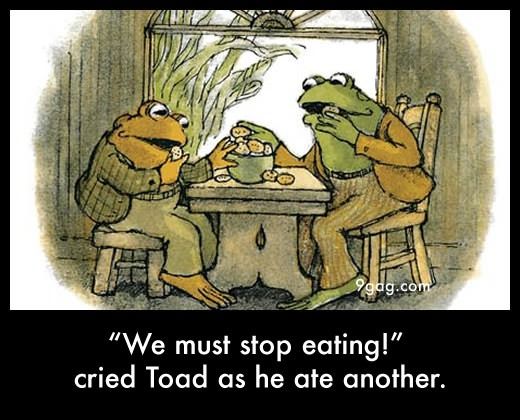
Frog & Toad sat at the tables eating cookies out of a jar. Frog had made the cookies and the friends could not stop eating them.
Hmmm….the brain said, and I glanced at the phone buzzing and blinking with a notification.
Frog and Toad ate many cookies, one after another. “You know, Toad,” said Frog, with his mouth full, “I think we should stop eating. We will soon be sick.”
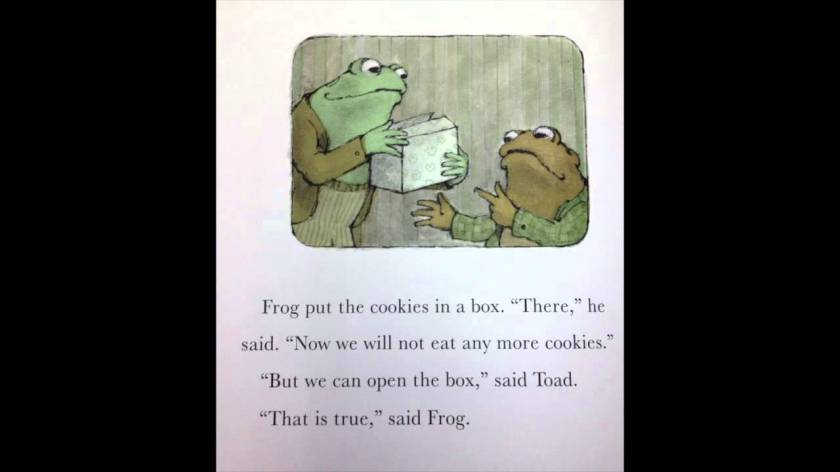
The friends try closing the jar each time after taking a cookie. But they find they can open the jar every time.
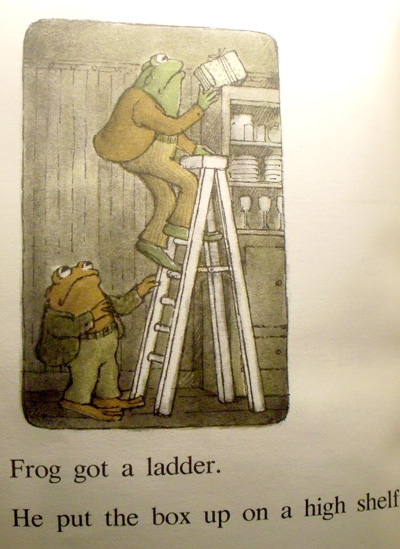
They then try closing the jar, and putting it on a high shelf where you have to mount a ladder. They find that they can climb a ladder, open the jar, and eat the cookies.
My mind could not help drawing parallels to the article I had just been reading. The article told me that the way to stop the habit of grazing your favorite apps was to move the oft-used icons to a different, hard to find area in the phone. I had done that, but found myself, swiping a few screens, opening a folder with the apps, and going after them anyway.
I was Frog getting on a ladder and opening the jar of cookies.
Frog & Toad now figure they are going to get a stomach ache soon, and are desperate to stop eating the cookies. So, they decide that as long as they know the cookies are there, they cannot stop. The best path forward would be to share the cookies with the birds and the cookies are done, they agree, and take the cookie tin out into the Spring evening to share with the birds.
Like the wise friends above, it might be a better thing to do, to just ‘share the cookies with the birds’ and be done with it. I pushed the phone away from me resolutely, and we took to discussing cookies. ‘Yummy- I love cookies. Let’s bake them one day.’, said the little fellow. I agreed, and content with that promise, he settled down and fell asleep almost instantaneously.
I lay musing. It is a good reminder for us to read how our brains respond to the demands of technology (we know the effects of Dopamine, we know how companies gain by making us spend more time, but yet…)
“Never before in history have a handful of technology designers working at three tech companies … influenced how a billion people spend their attention.”
The husband was back from watching the movie Baahubali 2. Indian cinema had outdone itself, and he was regaling us with the story line and the amazing fight sequences. This enthusiastic performance was greeted differently by the household:
(a) Avid interest in the toddler son, who was wondering whether to raise Baahubali to the echelons of Hanuman, or Spiderman,
(b) An eye-roll from the daughter who was doing something with her slime (coming up soon), and
(c) An almost soporific nod from me wondering when would be a good time to get a cup of tea.
“There is one scene where the bulls are all charging at Baahubali and he catches them by the horns like this and flings them – booyang!” , he said reaching for a water bottle, with a loose lid, to demonstrate. I held the water bottle on the other side, and he looked piqued that his bull showed resistance. Baahubali’s cows did not resist, they flew.
I had smartly declined the movie invitation and enjoyed a quiet afternoon in the park with the children.
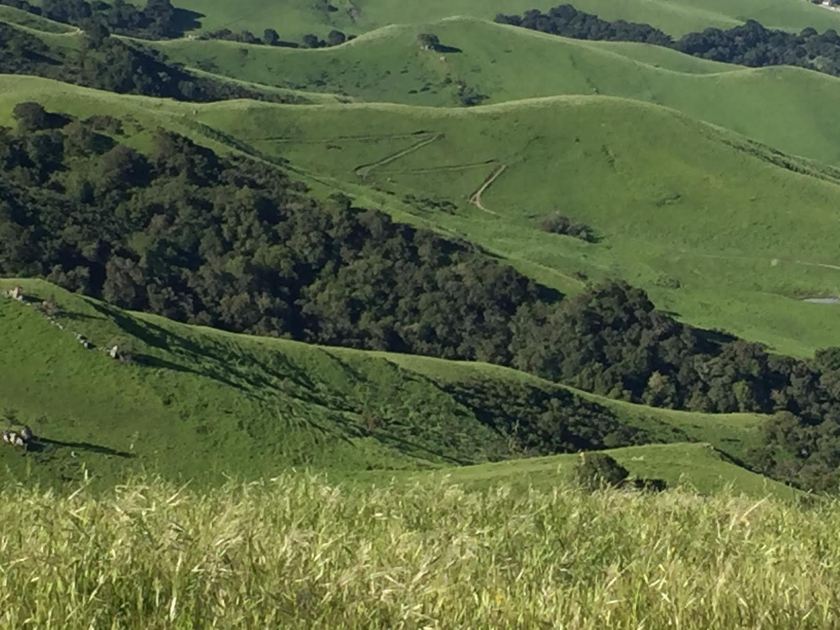
The next day, the husband, friend and I were up early for a hike in the rolling hills nearby. The early morning clouds were scuttling about in a desultory fashion, the grass was swaying to the breezes. Only the birds seemed to be bright and energetic. I was plodding along not yet completely awake, and the husband and friend were talking about the Baahubali movie again. The friend had seen a late night show and was bleary eyed after the movie. But mere mention of that great and able Baahubali seemed to infuse him with energy. I watched the pair of them make animated conversation and smiled to myself as I imagined the daughter shaking her head and saying, “Boys! Amma – they can’t help themselves!”
There was a touch of the English countryside about us that morning. There were cows grazing calmly, and an occasional deer or two were visible far away. I was throwing my mind pleasantly to a book I had read recently, A Road To Little Dribbling by Bill Bryson. There were lovely passages in the book that seemed to match my surroundings at the time. The rolling hills, the slight chill in the air.In the book, Bill Bryson writes about how he took up a road trip across Great Britain without the use of a car, and mostly on foot.
“What a joy walking is. All the cares of life, all the hopeless, inept *wits that God has strewn along the Bill Bryson Highway of Life, suddenly seem far away and harmless, and the world becomes tranquil and welcoming and good.”
As we were ambling along, we noticed several cow-shaped obstructions in our path. Three cows stood in front of us blocking us quite effectively. One of the cows locked eyes with me.
I looked at her, she looked at me.
I looked, she looked.
I blinked, she didn’t.
I looked away, she didn’t.
“I like being in a country where when cows attack, word of it gets around. That’s what I mean when I say Britain is cozy.”
―Bill Bryson, The Road to Little Dribbling: More Notes from a Small Island
The cow showed no inclination of looking away, or moving. I am in for the long haul, she seemed to say.
I can wait, I told her.
Ha! she said. It is you humans who are always in a hurry. I have no problems. I could stand here all day. Want to see? she said and stood there chewing the cud in what I thought was an unnecessarily exaggerated manner. If I had chewing gum, I could have played the game too, but I didn’t have any on me at the moment.
I then actually tried talking to her. “Please – we won’t do anything. We just want to pass you by.” I said.
To this she responded. She stared at me even more intensely, and then donned a positively bored look and looked away. It was like I was giving a teenage kid advice.
The husband and friend were standing nearby in a thoroughly helpless fashion.I looked at the pair of them shuffling their feet and asked them to summon their inner Baahubali and scare the cows away.
The duo guffawed loudly at this, and said the best performance they could come up with was to flex their muscles till it plopped and then fly like Baahubali’s cows in the opposite direction.
I looked back at the cows to appeal to them once again, and started laughing. It reminded me of one of the passages in Road to Little Dribbling where Bill Bryson had gone walking through a field. The field was on a hill, and he huffed and puffed up the hill, only to be confronted by an angry bull or cow(he couldn’t stop to see). One cow-or-bull-snort later, he came charging down the 2 mile hill to the nearest village. He entered a pub sorely in need of restoration to body and spirit. There, in the pub, was an old farmer who listened to his tale of woe, and said calmly, “Oh, That is only Betsy. She won’t do anything!”
The Betsy in our path seemed to derive inspiration from the story, and moved enough to let us pass.
The Baahubalis scampered across, while Betsy got her entertainment fix for the day.
The thing about travel is it lets you indulge in conversations that you otherwise may not have: With car drivers (White Tiger, Driver Shiva or Murugan and Driver KillerMan ) for instance.
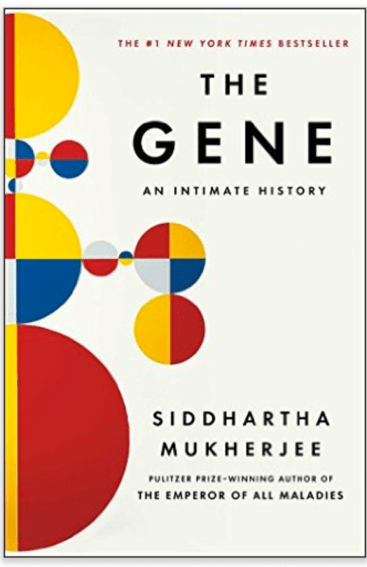
We were returning from a trip to Chichen Itza by van. The drive is a good three hours, and the husband was chatting amiably with the van driver, while we pulled out our books to read. I settled down with ‘The Gene’, By Siddhartha Mukherjee. The book is one that requires concentration, especially for one who made stout Biology teachers quail. The book is held tight by a web weaving historical context, scientific detail and personal insights. It is a fascinating read, if somewhat heavy going in places.
Genetics as a discipline had a number of misdirections and key researches almost lost to mankind, like Mendel’s experiment with pea plants, but for a lucky discovery of his article over 50 years after his death. The book touches upon many such instances. It talks about the supposed brilliance of scientists, how scientists are after all human and how their personalities can sometimes thwart and stifle growth. I particularly enjoyed the little quotations at the beginning of every chapter.
Every now and then, I stopped to take in the rustic scenery outside in the Yucatan province. Up in the front, the conversation was flourishing, if in a somewhat one-sided fashion. The van driver liked his audience and his theories grew wilder, and his tales more grandiose.
The man said he was originally from Canada, then moved to US before settling in Mexico. His tales, at any rate, portrayed a colorful life – a trucker, a pop-star, construction, sound recording. We had niggling doubts as to why his life had followed the pattern it had, but did not dig too closely. (He had the power of the van remember?)
‘How is Gene?’ asked the husband turning his head wife-ward. I had gotten past the horrifying section on Eugenics thankfully and said a thing or two about what all mankind is answerable for. Evolution, I said, better have a good reason for cruelty.
’Ah! Evolution. I don’t believe in evolution as a theory. I have a theory’, said the van driver, perking up since he hadn’t spoken for all of three minutes. He bore the look of a man doing a grand flick off some sad sop’s tale from the internet, ‘My theory is that aliens are responsible for life on earth. I think that the aliens had tried to see if life can flourish on Earth with dinosaurs.’
Four second pause.
‘And then they found them too big. The dinosaurs were too big, you know? I think that the asteroid that hit the Earth was nothing but a nuclear bomb sent by aliens. You see it all the time, don’t you?’
‘Eh… What do I see all the time?’ I asked. I have to come clean and admit that I don’t see dinosaurs all the time. Or aliens if you come to think of it, and definitely hope not to see nuclear bombs sent by the unseen aliens to hit the now extinct dinosaurs. I like a quiet life.
‘I mean, look at the size of those computers earlier on, and look at them now.’ He stopped here for dramatic effect, like one coming with the argument that clinches all.’ The aliens then got a much better model with humans and current life forms and decided to drop a nuclear bomb on Earth to get rid of the dinosaurs.They were just too big for them.’
The husband and I exchanged significant glances in our minds without once looking at each other. “I will take it that you just consider it a theory.”, said the husband, a man who would have obviously done well in the diplomatic services.
“Well…evolution is a theory no doubt,” said the driver, as though conceding a poorly paid chess move by dim witted opponents. “But aliens is a better concept. You know the supposed asteroid that wiped out the dinosaurs fell right here? Yes – right here in the Yucatan desert.” , he said opening his arms wide, and the van jerked alarmingly. I implored him to hold the steering wheel, to which he laughed, ‘Of course, it was a nuclear bomb sent by aliens, and it is funny that centuries later, we are talking about it, and trying to fit in theories like evolution.”
The Chicxulub crater in the Yucatán Peninsula, the site of the impact that decimated the dinosaurs.(Illustration: Detlev van Ravenswaay / National Geographic)
I set out to explain the experiments with pea plants, how the evidence set up the basis for genetics etc, but the man was bored, and said I must open my mind a little and consider the aliens theory. I bridled. I love a tall tale as much as the next one, but… The husband seem to sense my state, and shot me a warning look.
I had to concede that here was a fellow who had obviously educated himself on the Internet, and was proud of it. The Science teachers in his school days had done their best, and I too must learn to accept that he liked his erudition because he understood complex theories like aliens implanting life on earth.
By the end of the trip I needed some time to reflect, and when I did, I realized that travel had once again made sure I met a person so different in ideologies than myself. I hope he thought a little bit about things that could be proven vs things that could not be, when he reflected later on.
I, for my part, was able to understand why it is easy to believe compulsively written theories on the Internet.
Science lessons seem so far off tucked away in the recesses of the childhood brain. What time is left after earning one’s livelihood can easily be spent in the entertainment industry’s efforts to keep us glued: An industry that thrives on blurring the lines between fact and fiction.
As Lisa Randall says in Dark Matter and the Dinosaurs: The beauty of the scientific method is that it allows us to think about crazy-seeming concepts, but with an eye to identifying the small, logical consequences with which to test them.
What we need is to be able to travel more, so we get to see another’s view point every now and then, even if we do not agree. Especially if we do not agree.
I was reading the fascinating piece on Elvar the Dolphin. The daughter’s favorite animal is a Dolphin. She has drawings of mermaids with Dolphins everywhere. The sea fascinates her in ways that amuse us. Dolphins, mermaids and narwhals enchant her mind, and her endeavor is to become one if possible.
So, obviously, I read the whole piece out to her.
Elvar had the brilliant scientist stumped after a brief interaction. Elvar-the-dolphin and Sagan-the-human, on being introduced, started playing a game initiated by Elvar wherein he swam to Sagan, and thumped his tail completely drenching Sagan. When after the fourth splashing, Sagan refused, the dolphin swam up to him and said ‘More’. Completely flustered with this turn of events, Carl Sagan ran to his fellow neuroscientist friend and said he might have heard the Dolphin say the word, ‘More’. To which the neuroscientist said that Elvar the Dolphin knew upto 50 words in English, and could use them in context.
It is of interest to note that while some dolphins are reported to have learned English — up to fifty words used in correct context — no human being has been reported to have learned dolphinese. – Carl Sagan
A marvelous essay that only serves to remind us about the virtues of humility. We can barely understand other languages that fellow humans speak, and are quick to erect barriers between ourselves, but here was a dolphin willing to pick up English in order to engage with human-beings.
“You know Amma? Dolphins are so lovely right?”
I nodded. I did love the little flubberty gibbets.
“I think I know what my patronus is – My patronus must be a dolphin. I love them amma. They are so magical and real too.”, she said her eyes gaining that dreamy quality that often accompanies magic.
So, imagine how we felt when on our recent vacation to Mexico, the husband had booked a ride with Dolphins.
We were first introduced to a pair of dolphins – a charming male and female, called Manta and Sole. We hugged, patted and kissed them. I have never in my life touched something that soft, warm, and plush pulsing with the robust health of life. I coo-ed with that tone of voice I use around babies, and the daughter tried her best to distance herself from me in embarrassment, unlike the dolphins, who seemed to enjoy the attention.
‘Would you like to ride with them?’, asked the instructor, and I got to tell you that I was apprehensive. I mean – weigh the facts. Dolphins can swim at the stupendous rate of 20 miles per hour. I swim, if you can call it that, at the rate of 2 strokes a minute, stopping to gulp water in between, spluttering a bit, gasping, coughing and rasping, then regaining my breath before taking another deep gulp to sustain myself for 2 strokes.
Would a Dolphin for the first time experience condescension? I had to find out.
It took me what felt like 20 minutes to swim a couple of hundred meters out to where the dolphins could meet me. I huffed and puffed, and flawlessly executed the gulped-water, sputter and choke routine before I felt able to say I was ready. The moment I nodded, she gave them the signal.
In under a second, I felt the dolphins streak toward me under water, and they were there wiggling their fins under my arm and assuring me in their playful way that all was well. Their faces looked like they were smiling which I suppose is a gift they are born with. Their demeanor indicated none of that condescension or judgment that I was dreading, but simply an amused curiosity.
In another second or two, they had deposited me on the shallow end. The pictures reveal an ecstatic look on our faces as we were carried gently ashore by the dear creatures. My heart was bursting with joy. Maybe my patronus changed to a Dolphin too.
If we truly were smarter than Dolphins, we would be totally giving you the works in Dolphinese. What I can do is to dance like they did for us.
I only hope their interaction with us was a happy one too. Boink – Thank-You in Dolphinese.












 Elvar had the brilliant scientist stumped after a brief interaction. Elvar-the-dolphin and Sagan-the-human, on being introduced, started playing a game initiated by Elvar wherein he swam to Sagan, and thumped his tail completely drenching Sagan. When after the fourth splashing, Sagan refused, the dolphin swam up to him and said ‘More’. Completely flustered with this turn of events, Carl Sagan ran to his fellow neuroscientist friend and said he might have heard the Dolphin say the word, ‘More’. To which the neuroscientist said that Elvar the Dolphin knew upto 50 words in English, and could use them in context.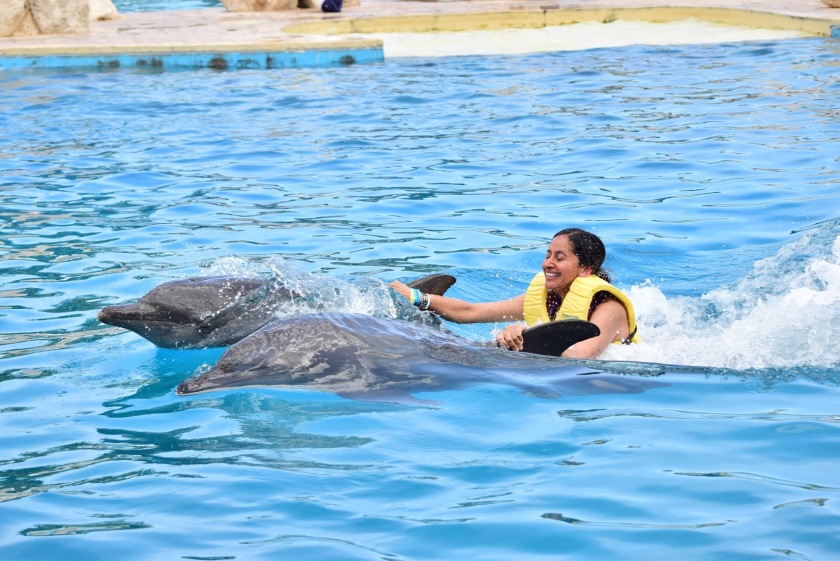
 Nourish-n-Cherish