How To Be a Good Companion

Simba who was introduced me around a decade ago passed away last week. This post was there in my drafts for over a year since I read My Family and Other Animals by Gerald Durrell. Simba’s passing made me acutely aware for the gratitude I feel for these furry friends.

Ask Sanku, Simba, Bogie, Luna, Timothy, Sanku, Tinky and Bolu, and they will all unanimously tell you that I may be a good sort in general, but the best past-time they have is to see me when in their midst. Sanku, Simba, Bogie and Luna have been introduced to me later in life, and though they may not believe it possible when Timothy tells them, they are seeing a mellowed person of years.

Timmy, named after Timothy, the dog in the Famous Five Adventure Series by Enid Blyton. (Timothy (The Famous 5 one) was a raucous, energetic dog who would have done anything for his 4 human companions. ) Having such an illustrious name to live upto, you would think Timmy would have been a better companion to me. Instead, he was a vicious little yip who forever found me atop bushes or gates, where I had scrambled in my haste, squeaking like a rat waiting for help. Timothy has seen the hot stuff. ‘Hot dogs!’, he used to say to himself and go ‘bow-wow-wow’, lackadaisically, sometimes not even bothering to stir from his kennel (which I helped build lovingly with wood panels and nails by the way), and I would find myself scrambling through hedges with spiders in my hair, looking demented and scrappy.

timothy_me_on_fence

One flip of a puppy, Bolu (I remember thinking that self respecting mice would scoff at the name), had me charging up 67 steps at such a scorching pace that the physical education teacher leaning on a tree nearby chatting with his friends, promptly placed me on the relay team, where my performance was nowhere close to what it was with Bolu on my case.

The daughter yearns for a dog, and would gladly give Bolu & Timmy a sharp kick for giving their mother this unreasonable fear of dogs. But my recent canine companions have done much to help me overcome the fear.

Simba, Sanku, Bogie and later Luna, have been marvelous in their quest to make me become less eccentric around them.


I have often wondered how I would react to people who made it clear that they were uncomfortable in my presence. Would I leave them alone, and feel bad at such a seemingly irrational reaction? I must say the deportment of my canine friends in later years have put me to shame. If anything, they have taken the discomfort with sagacity and a grace that we will do well to learn from. They taught me with patience, and took me under their wing with the understanding of having to deal with a dim-witted student.

Patiently, they initiate me into the art of relaxing in their presence. First a small wag to indicate they think I am a good-ish sort, and then a little curiosity followed by an affectionate brush up against my leg was their method. They instinctively seem to know how to be a good companion.

How can one be a good, even perfect, companion? This excerpt from My Family and Other Animals comes close to addressing the question.

My Family & Other Animals is a wonderful read for anyone looking to experience the wondrous world around us with humor and candor. I admire the work of naturalists as regular readers know. The author wrote of his life in Corfu near Greece, and his adventures on the island were magically transformed by his deep affection for his dog, later dogs. He writes:

pets


(Pic my own)

In those early days of exploration Roger was my constant companion. Together we ventured farther and farther afield, discovering quiet, remote olive groves which had to be investigated and remembered. He was the perfect companion for an adventure, affectionate without exuberance, brave without being belligerent, intelligent and full of good humored tolerance for my eccentricities.

family_other_animals

He goes on to say about Roger – who sounds like the ideal companion anyone could wish for, that:
If I slipped when climbing a dew shiny bank, Roger appeared suddenly, gave a snort that sounded like suppressed laughter, a quick look over, a rapid lick of commiseration, shook herself, sneezed and gave me his lopsided grin. If I found something that interested me – an ant’s nest, a caterpillar on a leaf, a spider wrapping up a fly in swaddling clothes of silk – Roger sat down and waited until I had finished examining it.

Reading about Roger almost makes me wistful for a companion like him during my nature saunters in my youth. But in later years, Simba, Bogie and occasionally Sanku have come with me on hikes, and I have never felt more alive in the natural world than around them. No sniff was too blasé for them to consider, no dog they met on the trail deserved the ignominy of no-greeting. The trails came alive with them around. The flowers, grass, insects and squirrels were granted the same courtesy of curiosity and unflagging acknowledgement. When their human companions flagged in energy, they made their intentions known – “You can do it. I am with you.”


How to be a good creature by Sy Montgomery is a children’s book in which the Author writes of what different creatures taught her. The essays on her Dogs and her Pig are particularly good reading.

good_creature

Simba passed away last week, and his passing has made me consider the fundamental question: How to be a good companion?

Classical Whale Symphony

Soft instrumental music was lilting in the background, and the sun’s watery rays were streaking in through the recently rain-washed window-panes. It was a beautiful week-end morning, and the kitchen was bursting with activity. The children were helping by putting away the dishes as noisily as possible. I was making a mess of things by changing the menu nimbly depending on what my refrigerator had. (Grocery shopping had taken a backseat the past few days and rations were thin on the ground)

The children were giggling about something when the teenage daughter said to hearty nods from her little brother. “By the way, what is this blasted toing-toing music you are listening to?”

“Melodious and uplifting for the soul, my dears. Classical Instrumental Music. Changes the way neurons interact.”

She shook her head, “Changes the way my nerves react!”and changed it to something that made my eardrums pick up the dishes and bang them viciously inside my head, while she chatted. Teenagers, I tell you!

“Whales like Classical Music.” , I said weakly.

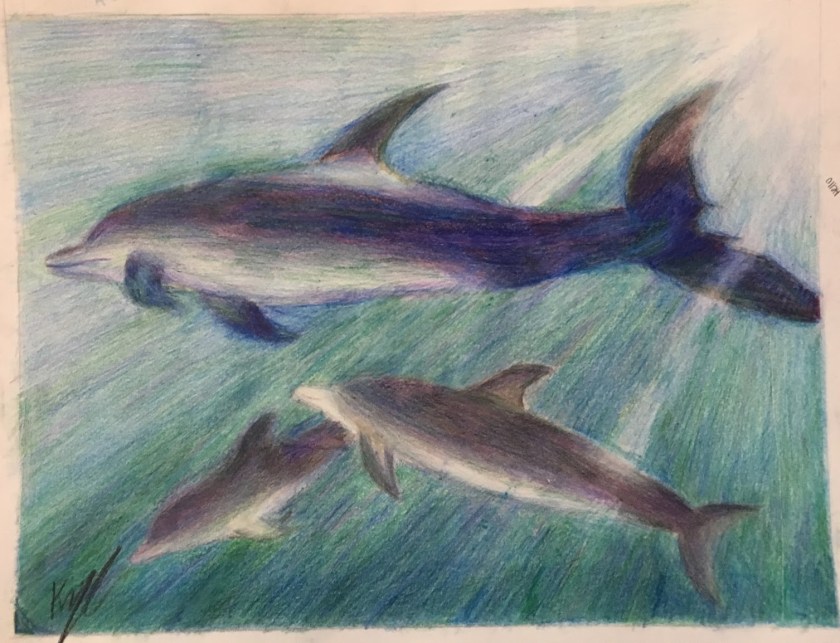
“Well, I’m not a whale am I?” said she giving me a fish-like look- not the fishy look, the glassy gleam. I saw the piscean divergence in the gene and agreed. Though she could be, given her favorite doodles are themes under the sea

Art work by the Daughter:

Ever since I read in Carl Sagan’s Cosmos about Whale Songs, I have been enamored with the language of music, and the myths of the whales.

Quote from Cosmos by Carl Sagan on the Humpback Whale songs:
These vocalizations are complex. If the songs of the humpback whale are enunciated as a tonal language, the total information content, the number of bits of information in such songs, is some 10 to the power of 6 bits, about the same as the information content of the Iliad or the Odyssey.

I was naturally was attracted to the book, The Symphony of Whales by Steve Shuch. It is based on a true story in a village near the Arctic circle. The onset of Winter had been swift, and a pod of whales found themselves iced in near Siberia. Unable to get out in time, the whole pod faced death in the iced-in waters.

symphony_of_whales

According to the book, a child, Glashka, who had always been blessed with the ability to hear Whale song heard them over the sound of the snowy storm. That night, they came to her in her dreams, and she knew they must be in trouble.

The next morning her father gathered the villagers and off they went to a sound over 30 miles away by dog sleigh looking for the pod of whales. It was true. The whales were in trouble. The pod had not anticipated the icing in of the waters so quickly, and were facing death. The villagers from all the neighboring villages started chipping at the ice to cut through the blocks of ice, so that the whales could surface and breathe.

“Look!”, said Glashka’s grandmother. “See how the whales are taking turns, how they give the younger ones extra time for air.”

The village elders had also radioed for help. A ship, an icebreaker, Moskva, was on its way to help.

The story, is based on a real incident that happened in the narrow Senyavina Straits of Siberia. Over 3000 beluga whales had been trapped by the rapidly freezing waters in 1984-1985. For seven weeks, the people of the Chukchi peninsula, and the crew of the Moskva risked their lives to save the whales.

The story does not end there. Once Moskva had cleared the way, the whales had to follow the ship out into the open seas, but they were reluctant to do so. The crew tried playing whale song to lure them. While they reacted to the music, they were not assured of human intent, and were still scared of the engine sound. They lurked in the waters.  Then they tried Classical Instrumental Music.

“The crew found some classical music. First, the sweet sounds of violin and violas, next the deeper notes of the cellos and, deepest of all, the string basses…and way up high, a solo violin…
Everyone fell silent as the music carried over the waters.”

That had done the trick. The ship’s engines started and the whales slowly followed the icebreaker out into the open ocean.

Would this heartwarming episode make it into Whale Song? That humans can be helpful too? I don’t know, but I do hope it makes it into our myths – maybe as one embracing a humane side to humans.

Dum inter homines sumus, colamus humanitatem – Seneca

As long as we are human, let us be humane

Read also:

Cosmic Nature of Living

Weaving The Sequins of Time

New York Times Archived Article on the Incident

Philosophers & Tinkerers

I picked up the book Black Hole Blues by Janna Levin partly because I was intrigued by the poetic title, and partly because I like reading about our dear Cosmos, and its many mysteries. The skies have given me endless joy, peace and continue to do so, even though light pollution in our suburban areas mean that we cannot see the stars, planets and stars as clearly.

black_hole_blues

Excuse me for a while, while I meander to a black hole of my own for a moment: I was appalled to note that a Russian startup intends to sell advertisements that can only be visible in the night sky. Are our products so important that we have to dwarf the shows the Cosmos puts up every night to sell toothpaste and whatever gawd-awful thing we contrive in our numerous factories? (I have a post clamoring and rattling in the brain waiting to get out on the number of contraptions that folks felt I must have, or I myself felt I must have, and now occupy valuable shelf-space in the home somewhere.)

Climbing out of the black hole then, the cosmos has given me endless joy and I indulge in dipping into its mysteries every now and then. What surprised me about detecting gravitational waves is the immensity of human endeavors. Theorizing and coming up with the supporting Mathematics to validate the concept is in itself a phenomenal achievement, but conceptualizing an experiment of such magnitude as to detect a stirring as faint as gravitational waves emanating when two black holes collide millions of light years away is astonishing.

As Janna Levin says, it is a project to fulfill a fool’s ambition.

“An idea sparked in the 1960s, a thought experiment, an amusing haiku, is now a thing of metal and glass.”
― Janna Levin, Black Hole Blues and Other Songs from Outer Space

The LIGO (Laser Interferometer Gravitational-Wave Observatory ) is astronomical in scope and dimensions. Janna Levin’s book takes us into the human dramas and the corridors of Caltech and MIT where much of this played out. While I did feel the flow and structure of the book could have been more crisp, and less about the human politics that plague undertakings such as these, it was nevertheless interesting.

As I read, I was amused at how humans unfailingly bring drama into our existence. At the altar of Science, many have sacrificed their egos, had their egos bruised, and have propelled or obstructed the flow of Science, but like a river it flows on and hopefully propels our understanding forward, not always cognizant of the applications of Science (One of my favorite sayings of Ursula K Le Guin:

When you light a candle, you also cast a shadow).

After the monumental setbacks and roadblocks along the way, it is a satisfying end to the book that the experiment finally paid off. Twice, it detected Gravitational waves as they passed through the Earth from the collision of two massive black holes millions of light years away.

ligo.jpeg
(Image tweeted by @LIGO)

We do not yet know how this will change our understanding of the Universe, and its applications, but we can be rest assured that both are underway. We have come a long way from the Sun God riding the sky every morning on his chariot, though I am reading a fascinating book on this very myth at the moment.

Human-beings are philosophers and tinkerers at the very core, are we not?

Also read: Cranes of Hope (Essay of the Value of Science by Richard Feynman with A Thousand Paper Cranes by Eleanor Coerr).

https://www.youtube.com/watch?time_continue=1&v=kbh_6tQ6nm8

Turtlish Thoughts

When the children are hanging out nearby, I am amused to see they take the phrase literally. I find them hanging upside down from trees looking like bats wondering why the world cannot be more topsy-turvy on occasion. One day, I found them on the monkey bars like this: one fellow upside down, the other swinging wildly. One child cart-wheeling on the floor, (hop, skip, jump, cartwheel),and chatting about Turtles. I don’t think they realize how the scene must seem to adults who have long given in to the expectations of the adult world, and walk upright at a reasonable speed and acceptable gait. I grinned at the unusual scene and they smiled and waved, before resuming their chats.

The scene reminded me of the Kung Fu Panda movie. Thoughts of Monkey, Mantis, Viper, Crane, Tigress , Shifu, Po and Oogway are always welcome.

kung-fu-panda

Sometimes, when a bunch of stuffed shirts are droning on in self-important tones at the tail-end of an exhausting meeting, I think wanly how much more fun it would have been if we had jumped up and down, cart-wheeled a few times and hung from tree branches while discussing ‘Strategic Improvements to Aid And Abet The Committee’. Every bit helps.

That night, with the wind whipping up a mean rhythm outside, I suggested visiting our old friends in the Valley of Peace, and embrace the challenges of the Jade Palace again. The Kung Fu Panda series has long been a favorite in the household, and we all nodded. Movie nights are never an easy democratic process, but I was glad we all agreed on ‘Kung Fu Panda‘ that night.

Oogway, the turtle, holds a special place in our hearts, partly because, measured and slow is not something we do – we are forever racing from one place to another, hanging upside down with friends on monkey bars, competing to deliver the quickest quips and generally making quick pests of ourselves in the home. Oogway, on the other hand is the coolest dude. The turtles: Oogway of Kung Fu Panda fame, Crush of Finding Nemo fame and Toby of Kindergarten fame, have all been much loved and have taught us so much.

img_4965

It was no surprise then that we reached for the ‘Always Remember’ book by Cece Meng and Illustrated by Jago.

It is a beautiful book that talks about an old turtle. After the turtle dies, all of his friends remember him lovingly in their own way. It is a lovely book showing us how far and wide our impacts can be by living a fruitful and useful life, sticking to simple tenets of compassion, loyalty and friendship.

0

The marine worlds always make for the best illustrations, but even so, Jago’s work in he book is mesmerizing. The characters (dolphins, starfish, baby turtles, whales, sea otters) remember Old Turtle, the compassionate companion, the adventurer, the teacher, the explorer. We, by our very being, mean different things to different people and this beautiful multifaceted aspect is illustrated in pictures splashed across the ocean in hues of blue and green.

Side note: For adults, a similar book about the far and wide reaching impacts we have on others, is a book by Miss Read, Emily Davis. A school teacher by profession, her life is remembered fondly by those whose lives she affected. Often times, we think of these large sized impacts but the most powerful ones are right by us all the time.

miss_clare_remembers

Our companions on Earth have always fascinated us. I remembered fondly watching a baby turtle sun itself on the rocks in Spring  a few months ago. A friend once told me that once we start paying attention to the world around us, it tells us in so many ways what we need to hear and how.

So, what does it mean when a turtle enters your thoughts so apparently suddenly and steadily? Does it mean that we need to synchronize our movements with the animal companions that are paying us visits? In this case, s..l..o..w……d..o..w..n ? Well, my turtle teachers will be proud of me indeed to see me following their example so well. I am sitting cosily in bed as I write about these dear creatures, and look forward to slowly drifting into a world of quiet contemplation, and gently falling asleep while the Earth slowly but steadily hums and thrums on outside. The flowers may bloom or they may not, the shoots may grow or they may not.


“Your mind is like this water my friend. When it is agitated, it becomes difficult to see. But if you allow it to settle, the answer becomes clear. “ – Oogway

Nature’s Shows

This article was published in The Hindu Open Page: The Art & Charm of Shoshin

If anyone has spent time watching pebbles make ripples across ponds, they will know what I am talking about. If not, I encourage you to take on your person a couple of pebbles and hike up the high hills and mountains, or cut through the pristine forests, in search of a puddle, pond or lake of reasonable size to cause ripples. Then, with the hand held flat, proceed to skip the pebbles into the water. The skillful amongst you may get the pebble to skip and skim the waters in the first few attempts causing beautiful rippling waves as they go along. I did not. Watch for the word skilled in the sentence – pebble throwing is an art that isn’t appreciated enough.

The son attempted a large stone throw and I held onto him lest he launch himself with the stone. Size matters: large stones and small boys could cause the cannon to fly with the missile. This is the kind of thing that would have made Newton come up with complex mathematical calculations to support the theory of pebbles and ripples, missiles and cannons, and extend it to comets and stars. We, on the other hand laughed, and substituted a flattish stone is his hand. Father and son threw pebbles and I sat watching mesmerized at the beautiful rippling effect it had on the water.

img_1781-effects

It was a lovely bright day, one of those gems that present itself in the midst of a rainy stormy week. Much as I adore watching the storm rage around me, and the wind whip the bare branches to breaking point, it doesn’t make conducive walking environments. I tried. I went out for a walk during the raging storm that had flights circling the air space multiple times before attempting to land, and I must say that I was wetter than water. It took 3 days for my shoes to start feeling damp again. The daughter shook her head sternly and said I was going to come down with a pneumonia if I continued on this idiotic path of loving the rain. “Are Pluviophiles Pneumoniophiles?” I asked her, and told her to be crazy and feel the rain, love the rain and watch the rain. She watched me with love, and a strong feeling that I was crazy. Oh well.

IMG_0726

I raised my face upwards towards the sun and my thoughts drifted once again. As I sat there thinking of this and that, a beautiful thing happened. The mind snapped out of the mundane and omnipresent things that occupied it, and went into a lovely, meditative state. Watching the sun sparkles drift meditatively on the waters was marvelous. The world seemed to be throwing these tiny diamonds into the water for our enjoyment and they drifted obligingly with the tiny waves, Little shimmers bobbing up and down, dancing and shining in the sun’s rays, set to the perfect rhythm of the breeze rustling through the bare winter branches of the trees nearby. The earth was bursting with new shoots and moss lined pathways.

Ducks, coots pelicans and geese were bobbing on the waters in the distance. Birds were chirping and swooping -I enjoyed the swift elegant swoops of swallows as much as the impressive regal swoops of the hawks overhead. Some people were biking, some others walking. The clouds – white today, drifted lazily across the skies, as though they too enjoyed the sunshine and did not want to hide the sun. The air smelt fresh and clean with little wafts of eucalyptus and fir scented drifts.

img_1769-effects

Nature’s shows are marvelous. For a moment I forgot about the to-do lists, the worries and tensions that a concept of a New Year brings, and enjoyed the free show in front of me feeling revived and refreshed in spirit with every passing moment. All my senses keen, alert and marveling at the wonder around me. I looked at the little fellow enjoying himself by the waters, and hoped that he would remember these simple pleasures as he grows and takes his place in this frenetic world.

img_1763

Edit: After I wrote this post, I saw this excerpt by Mary Oliver on one of my social media feeds: it is from the book, Upstream, and I look forward to reading the book, but this piece of writing spoke to my heart (bolding my own):

Teach the children. We don’t matter so much, but the children do. Show them daisies and the pale hepatia . Teach them the taste of sassafras and wintergreen. The lives of blue sailors, mallow, sunbursts, the moccasin flowers. And the frisky ones-inkberry, lamb’s quarters, blueberries. And the aromatic ones-rosemary, oregano. Given them peppermint to put in their pockets as they go to school. Give them the fields and the woods and the possibility of the world salvaged from the lords of profit. Stand them in the stream, head them upstream, rejoice as they learn to love this green space they live in, its sticks and leaves, and then the silent, beautiful blossoms.

Attention is the beginning of devotion.

My hope is for everyone to savor a moment like that every now and then, to keep the capacity to wonder alive in us. The beauty of Shoshin.

The Domestic Explorer

There are things every explorer wants to do. Whether it is as drastic as Thoreau spending 2 years, 2 months and 2 days in a cabin in the woods, or Kate Harris finding herself in the process of exploring the Silk Road, there are aspirations for us to reach that state of mind where we can look past the hustle and the bustle of our daily lives. A form of reflection that one gets to experience once in a while, but has no idea how to sustain. (At least I have had no luck at it.)

Quote from Lands of Lost Borders:

“I’m not sure where I go when I spin wheels for hours on end like that, except into the rapture of doing nothing deeply.”

I think Kate Harris’s moving, poignant, lyrical, poetic, beautiful meditations on being, belonging, and living is well on it’s way to becoming one of my favorites. I have re-read sections of it soon after finishing it. Hers is a marvelous mind (I am grateful she penned her thoughts and found a publisher for us to enjoy). It does make me wonder sometimes how many others there are out there, who have similarly exalted thought processes, a Being larger than being squashed into narrow compartments that we seem to slot ourselves into: A Higher Order Thinker.

Kate Harris’s work is one for every traveler’s soul. Every body who has ever dreamed of adventures, ever dreamt of being bigger than your circumstances, hers is an invitation to sample what is possible. For everyone who is unable to sample the world with all its worries and problems, Lands of Lost Borders is there.

lands_of_lost_borders

The author writes of her journey across the oldest and possibly most famous road in the World, The Silk Route. Wanting to lose herself in the other worldly, she lands up finding herself on the oldest roads known to civilization.

Along with her friend Mel, the two women cycle through Turkey, the Stan-countries after Russia’s disintegration (Turkemistan, Kyrgystan, Uzbekistan), China, Tibet, Nepal and finally India – camping along the way, accepting the kind hospitality of friends and strangers along the way, navigating authorities, paper work and visa restrictions that make us want to throw our hands up in despair. A true voice of an explorer.

Her voracious reading sparkles in the form of quotations and anecdotes – Carl Sagan, Marco Polo, Charles Darwin, Russell Harris, Wright brothers are all in attendance adding their rich experience to the journey. Her clear heart blurs borders while sizing up people. Sitting up in bed with the wind roaring outside, the rains lashing, it is bliss indeed to pedal relentlessly through the high mountains, past lakes, punishing deserts and sketchy neighborhoods. Two women alone in an alien world.

As she quotes every so often,

“Every explorer dies of heartbreak.”

This is one of those books that will stay with me for a long time. I had the privilege of reading this book alongside another of Miss Read’s comfortable, cozy book. This book of travel and adventure was the perfect pairing to the domestic pleasures that a Miss Read book conjures up.

In Miss Clare Remembers, Miss Read writes about a young child of 8 or 9, who was excited and flushed after seeing the snowdrops when they went out on a school nature walk. Afterwards inside the home of the local farmer, where the farmer’s wife had kindly laid out biscuits, milk and cut fruit for the hungry children, she realizes how much she requires both pleasures in order to thrive. With a clairvoyance that children sometimes possess, she appreciates the vast spaces that nature provided for her soul to soar; and the cozy domestic pleasures where she can feel nurtured and at home. A safe haven from her flights of adventure.

Quote from Emily Davis – By Miss Read:

“One was her nest. The other was the place in which she stretched her wings, and soared, as effortlessly as the lark outside, into a different dimension.”

miss_clare_remembers


I felt that way while reading the Lands of Lost Borders together with a Miss Read book. I savored the stars kindly drawing the constellations out for the explorers to reach out to every night; as much as I enjoyed the domestic problems of a normal life. Ensconced in the modern comforts of living, reading both the books in parallel left me with a deeply delighted sense of having both adventure and comfort, and feeling grateful for it.

I am not sure my blogs can do justice to the books, but it seems a perfect way to begin winding down the year.

The Elephant Keeper 

I had been on a short trip to a Green island staying at a Purple hotel with White Christmas decorations in a city center. While there, I decided to make the most of it, and hopped on a tour bus to take in the sights of Ireland. It had been a dry few months in … Continue reading “The Elephant Keeper “

I had been on a short trip to a Green island staying at a Purple hotel with White Christmas decorations in a city center. While there, I decided to make the most of it, and hopped on a tour bus to take in the sights of Ireland.

It has been a while since I went meandering off on my own. As I boarded the day trip for Wicklow mountains and Glendalough lakes, that wily Master of Doubt was trying to work his way into the old brain stand, and I was becoming a little unsure. Most people had come with at least 1 travel companion. I saw the knots of people comfortable in their own little groups as we waited for the bus to come and pick us up.  I wondered whether I shall be alone. Not that it mattered much since I had a book about a jolly esoteric family to keep me company on the trip.

Sitting tentatively in the van, I was reading The Garden of the Gods by Gerald Durrell on the kindle. I giggled before I could help it. I was peeking out at the passing scenery every now and then, and imagining the little household at Corfu. The author, Gerald Durrell, then a boy, lived with his ‘Family and Other Animals’ in the island of Corfu. A budding naturalist, his boyhood is a most interesting one in which no living creature escapes his admiration. His bedroom plays hosts to barn owls, field rats, bats, along with the more traditional form of pets such as cats and dogs. He also has a donkey named Sally, and I could not help laughing at the resulting antics this menagerie produced with his esoteric family.

corfu_3

The Corfu Trilogy is set in the island of Corfu, and since I read each book in the series a few months apart, it was most satisfying.

I could barely believe that it was possible for somebody to live the way he described it. The Universe is not always kind to doubting dunlins, but this time it was.  Within the hour, I was to meet someone whose life was remarkably like the one I had just read about.

The tour bus dropped the folks who had opted to spend time at a Garden. Only two of us had opted for a hike instead of an amble around the Gardens to the dismay of the tour guide. The look we exchanged affirmed that we would be far happier being buffeted by the roaring winds, and gazing longingly at the rolling hills around us. I recognized a kindred nature loving spirit in her, and soon we got walking and talking.

As we loped up the trail with an enthusiastic whoop, she told me a little bit about herself, and I was so glad she did. She loved animals, she said, and lived in a home teeming with pets. I truly did not believe that Gerald Durrell’s family was possible, much as I loved reading his books. But her answer astounded me. She said they had a donkey, 2 geese, 2 cats, 2 dogs and 12 hens. Her business trip was the most interesting one I have heard to date. She worked as an Elephant Keeper in a Zoo in Holland. She was here, she said, on an week-long program to work at the Dublin zoo’s Elephant department, but would be going back to her own zoo at the end of the week.

elephant_keeper

I told her that the children would love to meet her, and she nodded understandingly. Looking at the excitement of their mother, she very kindly sent me some pictures and videos of the animals she worked with in her work spot.  She too had come alone, and the pair of us spent the whole day together – on windy hillsides, amidst towers and remnants of castles looking like giant rooks and bishops on a chess board.

img_0044

I was so glad that my earlier doubts had not stopped me from having a wonderful day: the serendipity of finding companionship, the beauty of learning of another way of life, and above all, the opportunity of shaking oneself out of the familiar and the tried and tested.

The universe finds a way of showing us the rainbow if only we stick with the rain.

Boarding the Flight of Fancy

A version of this post was published in The India Currents Magazine: On a Flight to a Land Without Borders

I boarded the flight at the end of a long week. I was going to be away for a week, and I had spent weeks trying to get things in order for the week I was gone. It felt good to finally stretch one’s legs (as much as an economy seat would allow anyway), relax one’s senses, and stretch one’s mind.

The flight was strangely beautiful. It left in the evening, and as it took off, I left behind a sparkling firework of lights. The vast, urban sprawling city and surrounding areas looked kindlier from above. The freeways glowed like veins throbbing with cars as they crammed their way home for the week-end along the packed highways. I have watched ants with interest as they scurry about their daily duties and I felt we must look the same if someone were to be observing us. Maybe those monitoring satellites do have the feeling every now and then.

Bay area at night is beautiful from an airplane, however else it feels when one is on the road.

img_08171

I fell into an uneasy slumber once we passed the populated sections and darkness fell. I looked out the window hours later, to be pleasantly surprised by the beauty that greeted me. The plane was gently reverberating with the satisfied sighs of sleep from most passengers. A few were watching the brightly glowing screens. I peered out of the window, at first unable to see anything since my eyes took some time adjusting to the sudden lack of light. Once I did though, it was marvelous.

I have always loved gazing at the moon while traveling. The feeling of us moving, and our beautiful cosmic neighbor giving us company even though we are moving so fast is surreal.

I could not see the moon just yet, but I recognized the belt of Orion. We were flying along side the big hunter as he made his way in his pursuit of the seven sisters across the skies. It is a strange feeling to watch the stars and a familiar constellation accompany us on the trip while we journey through the stars.

cd

The Pale Blue Dot, as Carl Sagan so beautifully christened our lovely, if sometimes crazy planet, seems wonderful from high above. It helps us forget how judgmental, critical, harsh and war-mongering a species we are. While up there, borders and countries seem like a strange concept, like a tiger marking its territory. Can the tiger determine where life can flourish, where the weeds grow, or how many gusts of wind may swish through the bamboo groves? Our borders mean much the same especially when surveyed from the stratosphere: Meaningless asks from an arbitrary marking.

Musings from the wonderful book, Lands of Lost Borders by Kate Harris, took me to an uneasy land of half slumber in which strange dreams accompanied unknown stars through a flight that even a 150 years ago was nothing but a flight of fancy. Kate Harris’s work is one for every traveler’s soul.

lands_of_lost_borders

I got up to see the moon looking slightly alarmed at still being up and about when the sun was rising. The pink, and orange skies twinkled benignly upon the clouds below, and all the world was still full of promise and expectant. The blush of joys unknown.

flight_clouds.jpg


The Degree of Shoshin

I wonder sometimes how the brain works. I mean, some references make us link to something else across the bridges of time and space where no ostensible link exists. Was astronomy the link? But that seems weak given that I ogle at the stars every opportunity I get. Could the 12 degree landing of Insight be the link? But the slopes that my mind linked to were at a 11 degree incline. And we were very proud that our little corner of the world could provide just the right 11 degree slope too – that is why I remember the incline so clearly.

Ignorant men raise questions that wise men answered a thousand years ago. Johann Wolfgang von Goethe

Maybe it was something to do with the specific angle at which the Insight can land on Mars that brought back memories of a trip to the Radio astronomy center in Mutthorai in Nilgiris – who knows?  The radio astronomy telescope on the slopes of the Nilgiris was magnificent and awe-inspiring. It still is. I remember hearing that the Tata Institute for Fundamental Research (TIFR) had scoured plenty of slopes in India and this humble village was deemed just the right one to capture radio waves. It had the right level of incline(11 degrees), minimum light pollution at nights, and we were proud of our unassuming Nilgiri hills for providing such a marvelous slope.

By Own work – Ooty Radio Telescope, CC BY 3.0, https://commons.wikimedia.org/w/index.php?curid=7463023


I remember going to visit the center with the father one rainy afternoon during the monsoon season. We often piled onto his scooter that the kids had lovingly nick-named Street Hawk given it tore through the streets with a ear shattering noise, even if we could run beside it. (I often wonder how it must feel for someone who goes to India for the first time from a country like the US or Canada, and sees a family precariously making their hazardous way through the haphazard traffic – obviously uncomfortable, but looking joyous and confident. Even cars here seem so cranky – “departing lane, departing lane” it goes on like a parrot on caffeine. Fine – relax! Talk about sticking to the straight and narrow path – sheesh kababs.)

Anyway that is how we toured the Nilgiris during our school holidays. We would start out on a supposedly clear day, the brother standing in front, his feet making sure not to come under the brakes foot pedal, the sister on the pillion seat, and self squashed between the driver’s seat and the pillion seat, my face turning a ninety degree angle to make sure I could breathe, and off we would go on our adventures. Sometimes, our Street Hawk could not quite pull up the intense slopes of the Nilgiris such as the Katteri falls, and we would all good-naturedly pile off, let the pater go up the slope on 1st gear, trudge up there, and pile on again. What was life without these little pleasures?

street_hawk

Invariably midway through our trips somewhere, the skies would attempt a volte-face: the sun would dip behind the clouds, a brisk wind would start around us, and the first raindrops would start. Sometimes, if the downpour got heavy, we would shelter at a random farm or village and nibble into the ample snacks packed for the trip, and head out again after the fierce downpour stopped. The dubious weather reports then were listened to with the amusing attitude of one indulging a child, and if it all went towards building the weather reporters’ confidence, it was time well spent was the general attitude. Ours was a forgotten corner of the world, and we loved it just the way it was. 

Off I went meandering around the countryside when I should have been sticking to the Radio astronomy tower as usual. The point is, I remember thinking as a child standing on that steep incline with the monsoon winds buffeting us from all directions, struggling to stay upright, and thinking for the first time how we must be standing at all. We are spinning on a very fast ball after all, gravity is all very well, but what would happen if Earth decided to just let us go for one instant? It was a terrifying thought, I clung a little harder to the pater’s solid hands and redoubled my wonder at how we exist at all. 

That is the beauty of space exploration isn’t it? It rekindles wonder. If retaining wonder in our day to day living is the mark of a meaningful existence to paraphrase the German philosopher, it is no wonder that we marvel childhood with its fresh perspectives, and its great capacity for wonder. The beauty of #Shoshin

“The highest goal that man can achieve is amazement.” ― Johann Wolfgang von Goethe

To All Astrophiles

“Did you know, the Voyager Insight is going to land on Mars tomorrow?” said an excited son. T’was the night before school reopened after a joyous 10 day Thanksgiving break, and the night before the much anticipated Insight landing on Mars. I looked at his shining face when it should have been a sleepy one.  The sparkle in his eyes did not smack of eyes wanting to make the journey into the Land of Nod any time soon. So, I sat down next to him and said, “Really? How do you know?”

That’s better, his posture seemed to indicate, and said, “Yes…Appa told me. It has to land at an 12 degrees angle it seems.”

“Why 12 degrees?” I asked intrigued. 

Space.com article : Mars Insight Landing

Quote from article:

“InSight hit the thin Martian atmosphere at about 12,300 mph (19,800 km/h), nailing its entry angle of exactly 12 degrees. If the lander had come in any steeper than that, it would have burned up; any shallower, and it would have skipped off the atmosphere like a flat stone across a pond.”

After chatting a little more on the impressive Mars voyage, I asked the little fellow if we should read a book on Space exploration. He nodded. Anything to keep from falling asleep.

So, we picked up the sweet little children’s book, “Also an Octopus” or “A Little Bit of Nothing” 

also_an_octopus
Also an octopus : or, A little bit of nothing / Maggie Tokuda-Hall ; illustrated by Benji Davies

Also an octopus : or, A little bit of nothing / Maggie Tokuda-Hall ; illustrated by Benji Davies

The book is about an octopus who plays the ukulele, and wants to get on a purple spaceship. Who can help it build one though? Why a rabbit scientist of course!


We laughed as we read the book. As different as it was from Counting on Katherine by Helaine Becker, Illustrated by Dow Phumiruk, it stretched one’s imagination in a thoroughly whimsical manner that made us giggle at the very thought of the Octopus on the spaceship. If ever we need to convince ourselves of the diversity of life that we seem to be threatening, we need look no further than the impressive marine life we host on Earth. 

counting_on_katherine
Counting on Katherine – by Helaine Becker, Illustrated by Dow Phumiruk

All space lovers should definitely read the beautifully illustrated children’s book, Counting on Katherine. Based on the scientists featured in Hidden Figures, Counting on Katherine illustrates the love for Mathematics and its application to space travels in the most endearing fashion. A child who has the inclination towards numbers cannot help deepen their fascination with them, and hopefully, those who do not share that fascination, will develop a curiosity towards them. I have always loved the look of a blackboard with neatly written mathematical formulae and calculations: this book captures the aesthetic beauty of the blackboard beautifully.
img_0287
Counting on Katherine – by Helaine Becker, Illustrated by Dow Phumiruk

Anyway back to Voyager Insight I said, “Do you think we can watch it land?” 

“Yes….it will be on You-tube.”, said the little fellow, positive that the image transmission from the Insight landing on another planet can make it to the nebulous internet without any trouble at all.

Here is a video link prepared by LockHeed Martin in collaboration with NASA’s JPL:

Automatically, my mind harked back to the old times when an image was work, precious work, with days in between clicking the pictures and getting them developed. When they came out, you saw the lighting could have been better the framing better, the shake a little less, and solemnly swore that you were up to no good, and waited it out till the next film roll proved it. 

I still marvel at any photographs we receive from Space. 

Human minds can adjust to improvements so easily – if only, we had the sagacity to adjust just as quickly to hardship.