Leonardo Da Vinci’s Horse

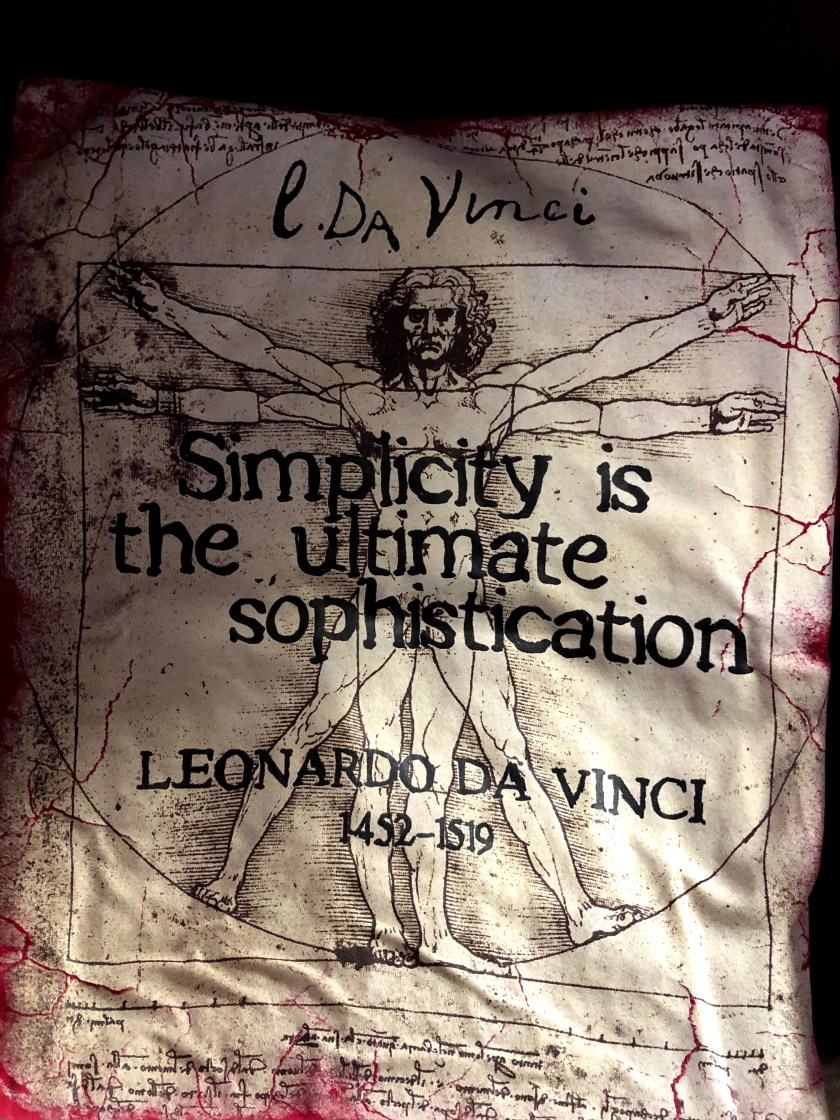
The husband was wearing a red t-shirt that had Leonardo Da Vinci’s drawing on it, that said, Simplicity is the ultimate Sophistication.

He was particularly fond of the t-shirt, especially as he was reading the biography of the great man.

img_4057

“Be like Leonardo Da Vinci guys. Be simple and eh… persistent.”, I said.

“Oh! I don’t know about that! Did you know about Leonardo Da Vinci’s horse? “, said the husband. He was reading the biography of Leonardo Da Vinci by Walter Isaacson, which is to say we almost read it. The book is a lengthy one, and as he made his way through it, he shared tidbits of things that fascinated him.

Time has probably been kind to the memory of Leonardo Da Vinci. Most of us only seem to be remember his genius in art, his legendary stature as a polymath, he said. The husband chuckled as he read and told us about Walter Isaacson’s portrayal of him – a tempestuous man who often did not complete the commissions given to him. Leonardo Da Vinci’s horse is an excellent example.

He then went on to relate the tale to much mirth and chuckling from the children. Apparently, what was commissioned to him was to build an epic statue of the Duke’s son riding a horse. He then went off to live on a farm, to study horses. The farm life yielded a treatise – an unpublished book, on different kinds of horses, equine surgeries to understand horse anatomy etc. He had originally planned to create a statue of a rearing horse.

This is an image that is much popular in the art forms at Italy, I remembered. The raw power of a horse rearing up on its hind legs is both attractive and magnetic. I am not sure how riders feel when they are about to be bucked off, but it makes for good Art. The prince would have to look brave while clinging onto dear life.

Study_for_the_Sforza_Monument
Abandoned Design. Image Courtesy: Public Domain, https://commons.wikimedia.org/w/index.php?curid=59580

Anyway, after a few years studying horses, their physiology, their movements etc, he started developing models for his statue. Clay, lead and bronze made its way from the armies to Da Vinci for his great statue. Then, he figured that the greatest statue of the magnitude he had in mind would not be supported by the hind legs structurally, and he went on to make it a standing horse. The prince riding the horse resplendently was forgotten!

These things took time, but it did not seem to perturb him. His sponsors may have been antsy, the bronze supplies may have been running low, the armies getting fidgety with not having enough new armor, but that was their problem, seemed to be his opinion.

In time, a large clay model of a beautiful horse may its way for the Duke’s inspection. The model won Da Vinci much critical acclaim. It truly was beautiful. If the Duke was slightly upset about not seeing his son on the horse, he did not show it. The royalty raise their children well.

Soon, war broke out, and no longer could his rich patron commission bronze and lead to be diverted to the most magnificent horse statue of all time. The clay model was put up in Milan, and was used as target practice by the young lads joining the army.

“But isn’t there a big horse in Milan or Florence? Da Vinci’s horse? I remember seeing a picture somewhere.” said I.

“Yes, but that was not done by him. Years later, somebody else finished it. “, said the husband.

By now, we were all laughing.

“What is remarkable is his insatiable curiosity and creativity however, and though he went off down rabbit holes, it was from a deep motivation to understand the world around him “, said the husband.

Read also : Gates Notes on Leonardo Da Vinci

“These days it is so easy to take a picture of a horse, model it, and run a simulation for structural evaluations. We sometimes forget how hard studying movement must have been!” I said, remembering the essay by Oliver Sacks on the Elephant’s Gait, in the book, Everything in its Place.

everything_place

He writes about how more than a century ago, Etienne-Jules Marey & Eadward Muybridge pioneered the study of animals running using 24 cameras along a track where the shutter would be tripped by the horses themselves as they galloped past to capture the movements of the horse as they raced.

Persistence comes in various forms, we all agreed. Muybridge and Marey were examples in a long list of people for whom a problem was intriguing enough to delve deeper and deeper into things that may or may not yield results.

But we never know the breakthroughs possible, and how things will change. That is why I am vary of futurists. A few centuries ago, to study the muscles straining for a horse running, one had to have an almost eidetic memory, along with a decent understanding of anatomy.

Today, photography has come so far as to allow us to snap a thousand pictures, take slow motion videos, and analyze everything from a butterfly flutter to the swift flying of hummingbirds. People are still extraordinarily creative with photography, and as long as we retain curiosity and creativity, I suppose we shall thrive.


The Art of Breathing

A colleague caught me mid breath one day. It was one of those days that butterflies would have looked on me with mixed emotions.

On the one hand with pride: When did this caterpillar learn to flit like this?

On the other hand with amused tolerance: The half-wit seems to be forgetting the sweet joy of collecting nectar amidst pretty bright flowers, with all the fast paced flitting. Forfeiting the sweet thing about flitting – tut tut!  Flutter tutter utter nutter! (I am not high up on the poems caterpillars learn to sing about when still creepy crawlies; and the butterfly metaphor only goes so far!)

Anyway, it was one of the many days in which I flitted about the old work spot tasking, multi-tasking, sub-tasking, reminding others about their tasking, setting reminders for my own tasks and so on. Thoroughly immersed in my second self that Mary Oliver so succinctly calls the Social Self…yes, it was one of those days.

Mary Oliver’s, Upstream, is a book of many marvelous essays.  The essay, Of Power and Time, talks about the three selves in many of us:

•The Child Self

•The Social Self &

•The Eternal Self.


upstream

Though in the essay, Mary Oliver, refers to the Eternal Self as the artistic self, I like to interpret it as the Creative self.

• The Child Self is in us always, it never really leaves us.

• The second self is the social self. This is the do-er, the list maker, the planner, the executer.

• Then, there is the third self: the creative self, the dreamer, the wanderer.

T’was during one of these trying days that I remembered the deep breath technique my Yoga teachers had tried to teach me about. Take deep breaths, and concentrate on it filling your stomach, feel it coming in and out of your nostrils and so on. So, I started my deep breaths as I was walking from one meeting to another. Deep breath, exhale, deep breath, exhale and so on. I had thought no one watched, but one colleague caught me, and grinned. “That should be your GIF you know?” he said.

I nodded sheepishly, and went back to my brand of breath-less flitting within minutes.

Later that week-end I ran into this beautiful children’s book in the library. A book that was just waiting to be written. A beautiful capture of all the different types of breath, Alphabreaths 

Written by : Christopher Willard (a clinical psychologist) & Rechtschaffen MA, Daniel (a counselor)

Illustrated by:  Clifton-Brown


The book is a lovely read urging us to Breathe like a Dolphin taking a dive, or our favorite one, The Ninja Breath – silently and slowly. The illustrations too make for a marvelously relaxing read. Please check out their Youtube clip : here


Mindful breathing and Yoga are excellent concepts to teach the children, and I am always in awe of those who can take complex concepts and make them palatable for the consumption of young and old alike.

If you happen to come home and find the son and I swimming like dolphins or getting ready for a Star Trek mission on the floor while Yoga-ing along with the Cosmic Kids Yoga series by Jaime Amor , do not be alarmed. Her yoga videos are appealing and fun. If, along the way, we do something to calm ourselves down – then great, else, we have had a great time.

There are so many aspects to the Philosophy of Being (I am amused it has such a strictly medical sounding name: Ontology)

Ontology is the branch of metaphysics dealing with the nature of being, and reading the Wikipedia page itself boggles my simple mind (A post on the Study of Philosophy is sitting up on its hind legs and begging to be written). Maybe, what is required is a Ninja Training on Ontology. Excerpt from the wiki page:

Such an understanding of ontological categories, however, is merely taxonomic, classificatory. Aristotle’s categories are the ways in which a being may be addressed simply as a being, such as:[9]

  • what it is (its ‘whatness’, quiddity, haecceity or essence)
  • how it is (its ‘howness’ or qualitativeness)
  • how much it is (quantitativeness)
  • where it is (its relatedness to other beings)

*** Taking a Y for Yawning Breath before a Z for zzzz breath about now ****

img_4049

Keeping ontological explanations aside, if The Nature of Being comes down to simple techniques of breath, fluidity and movement, it makes the simplicity behind it all brilliant.

It was one of those ‘Simple is brilliant’ types of  quotes that I went looking for. I know many brilliant blokes and blokees have said marvelous things about simplicity -I know old Leonardo Da Vinci said something about it, so did old man, Einstein. In any case, looking for one of those made me fumble on this one by Norwegian explorer, Thor Heyerdahl

From Wikipedia: Thor Heyerdahl became notable for his Kon-Tiki expedition in 1947, in which he sailed 8,000 km (5,000 mi) across the Pacific Ocean in a hand-built raft from South America to the Tuamotu Islands. The expedition was designed to demonstrate that ancient people could have made long sea voyages, creating contacts between separate cultures.

thorheyerdahl1-2x


Continue reading “The Art of Breathing”

Music & Gardens

It is always a delight to pick up a set of essays written by prolific writers  who are also curious intellectuals. These authors make me feel like I am reading the perspective of polymaths, and that in itself makes for a wondrous experience. The latest book that had me thinking and reading about things I had not thought about for a long time was the book, Everything In Its Place by Oliver Sacks.

everything_place.jpg

Excerpt from Wikipedia:

Oliver Wolf Sacks, CBE FRCP (9 July 1933 – 30 August 2015) was a British neurologist, naturalist, historian of science, and author. He believed that the brain is the “most incredible thing in the universe.”[1] 

He reminds us in broad strokes of his pen, the number of areas in which we can be curious. He reminds us about the vast capabilities of the human brain, even while reflecting on this particular author’s exceptional one. Reading about the brains many failings and flaws is both fascinating and eye-opening. (Oliver Sacks was a Neurologist who specialized in many neurological disorders, and writes from a place of curiosity and compassion for his patients).

His description of Tourette’s syndrome, for instance, certainly makes me think less critically of people I encounter on the public transit who have the need to shock the whole compartment with their absurd, rude and obnoxious statements, every few minutes. Sufferers of Tourette’s syndrome often find themselves cursing and shouting loudly, without being to help themselves. The shocked attention they gather seems to be the reward for their impulses.

He writes about a certain individual who exhibited severe symptoms in Vietnam and would make shocking exclamations in Vietnamese every now and then. But when he moved to the United States, his Tourette’s calmed down because people did not react as much as he thought they would in a country where his language was not understood.

I can now learn to see the person different from their symptoms, and for that I am grateful.

How can I not be fascinated as I read his sure voice confess that as a neurologist the only therapies he knows to work surely are Music & Gardens? I read his meditations on Why We Need Gardens and the words Biophilia and Hortophilia leap out and grab my attention. Nature is my soother, has always been my favorite soother, and it is refreshing to hear his perspective on the effect of nature.

img_3991-effects

Clearly, nature calls to something very deep in us. Biophilia, the love of nature and living things, is an essential part of the human condition. Hortophilia, the desire to interact with, manage, and tend nature is also deeply instilled in us. The role that nature plays in health and healing becomes even more critical for people working long days in windowless offices, for those living in city neighborhoods without access to green spaces, for children in city schools…..

The effects if nature’s qualities on health are only spiritual and emotional but physical and neurological, I have no doubt that they reflect deep changes in the brains physiology, and perhaps even its structure.

As he says in one essay, his patients even in advanced states of dementia always look forward to an hour outside amidst nature, and not one of them has ever planted a sapling upside down when given a sapling. It is almost as if we intuitively know what to do and our learnings from time may fall away from us, but our affinity to nature will not. 

In fact, he writes of one of his close friends, Lowell, who suffered from Tourette’s syndrome, that while hiking in the deserts of Arizona, his ticks and urges almost completely disappeared.

https://www.brainpickings.org/2019/05/27/oliver-sacks-gardens/ : Oliver Sacks

In forty years of medical practice, I have found only two types of non-pharmaceutical “therapy” to be vitally important for patients with chronic neurological diseases: music and gardens

The Animals Within


The evening was a beautiful one. The children played looking like little angels in the glowing sun, and I threw affectionate glances at the noise in the playground.

I was mooning about the streets admiring the shabby looks of late summer. The same hills that looked brown and uninviting in the distance during the day, now looked ravishing bathed in sunset’s golden glow. Little specks of clouds in the sky were blushing to different degrees. The purple, red, orange and pinks poufs flicked about looking snippy and sharp. The oleander trees and the crepe hyacinths lining the streets looked prettier than ever before.

The approaching week-end seemed inviting, promising in its possibilities: my outlook was cheerful; my spirits soaring with the multi-colored clouds up there; and no must-dos competed for attention in the old brain.

T’was after a little growl came from within that I stopped to wonder what was amiss. I had completely missed the making-dinner task at hand, and the growl was reminding me, that I had not just 1 growl from my stomach to contend with, but the whole family’s as well. The husband trundled in, the children trooped in to say hi, and I whisked them all off for a dinner outside.

‘Forgot to cook?!’ cackled the teenaged daughter, looking indulgent and proud that I was not being the conscientious cook, and filling her plate with healthy muck. “Didn’t the sunset fill you up?”

“It filled me spiritually my dear. I could not be fuller!”, said I patting my heart, “but the stomach still asks for its due, Alas! “ I said remembering a poem my mother-in-law often references about what an irascible taskmaster the stomach is. I always smile at the wisdom of the poem. Loosely translated, it means
“Oh stomach!
What an irascible creature you are!
I ask you to eat a lot at one meal, and you rebel, and push back saying you are full.
So, then I ask you to skip a meal, but that too wouldn’t do for you.
What a slave to your demands have I become?
It is very difficult to live with you!”

So, off we went to a Chinese restaurant in various states of hunger.

This is one of those places that believes in keeping you engaged while they prepare the food for you. In front of each was a sheet of paper containing the Chinese Zodiac Animals and their characteristics. We started off in typical fashion:
You are a monkey!
Really? A snake – ha!
How could you be a tiger?
I don’t want to be a pig!

For those who moon about on Friday evenings without considering the demands of the stomach, here is a tip: Don’t! Friday evenings beckon all mooners-about, and restaurants find themselves busier than usual that day. As we sat around with hunger gnawing at the insides, the sheet of paper telling us about our characters based on the year we were born in looked inviting. Soon, we started tabulating and cross-referencing the listed characteristics against the personalities in the family.

It is an interesting exercise, and really makes everyone stop and pause and think about oneself. There are characteristics that the whole family gave a miss to. There were some that we hoped we did not have, but found we did. There were others we hoped to have in a higher degree. The tabulations were derailed every now and then with questions such as “Why are hippos not there in the Chinese calendar?”, After going into habitats and biomes with glaring holes of knowledge, seeing as none of us had ever to China, we got the animals back on track.

The resulting diagnoses has us giggling uncontrollably:
“You are most like a rabbit, but also have the tongue of a dragon, and the heart of a pig!”
“Snake hissing and pouting maybe, while galloping like a horse, and snoring like an ox.”

It turned out that we churned out more fantastical creatures in that half hour than a whole mythological genre could in a book. “Imagine if these creatures were sitting in us, wouldn’t that be something?” I said.

inyo_20q

Humanity’s capacity to imagine strange and wonderful creatures has always been remarkable, though there are precious few creatures left for us to imagine. No one is bringing another Clara to our midst any time soon.

Clara the rhinoceros, was brought to Europe on a tour in the 18th century. No one had yet seen any of the creatures of the East, and had not even heard of such an animal. Clara became an instant darling of the masses – her gentle demeanor, her love of oranges and her sheer size endeared her to all those who had the privilege of seeing her. I can well imagine the wonder and curiosity such a creature brought to human society, and the number of children in whom the wonders of the natural world was rekindled. How many Gerald Durrells, who imagined the beautiful world of their family and other animals?

500px-Clara_1749_Oudry.jpg
Image title
Rhinoceros Clara
Author
Jean-Baptiste Oudry
Copyright holder
PD

Today, we silently add more and more creatures to the endangered species list, watch in alarm as forest cover disappears and wait for magic to happen in our lives. Anthropologically, will we hear the news of a Middle Earth tucked away somewhere with hundreds of majestic creatures again?

Maybe one day, our space explorations will yield something. Till that day, we shall have to content ourselves with imagining the various creatures and creature traits within us.

Books:

Clara the Hippopotamus – By Emily Arnold McCully

My Family & Other Animals – By Gerald Durrell

Sketching Freedom

It fell to the teenaged daughter to keep her little brother and nephew in line during our forays into the forest. While they generally listened to her, they also enjoyed pulling her leg. Smarty pants that she is with me, it is sweet indeed to see her stumped by her little brothers. One such time when she was speechless, she said something wise and insightful. I looked at her with awe – “So, you finally got around to reading Marcus Aurelius’ Meditations I see!” I said beaming. Pride shone through my pores though I tried my best not to show it.

“Nope – still boring! Siri told me.” said she and laughed at my expression.

“Confucius, Buddha,  Marcus Aurelius, and a thousand other philosophers in your Kindle, and you go for Siri?”

I shook my head and went off to do some philosophizing of my own. The walking philosopher if ever there was one. I walked into the sunset philosophizing, as I said.

Sunsets are beautiful things anywhere – enjoy them with a rustic feel, and they can be few things more poetic or romantic. That evening’s sunset had been particularly fruitful – it isn’t everyday that one gets to see a dozen peacocks take flight into the horizon, witness the chirp-filled fooling around of parrots, cuckoos and at least a dozen different kinds of birds, and encounter the folly of frogs skipping and narrowly avoiding one’s feet.

I traipsed indoors, happy with life, still rattling on about the beautiful image of the peacocks and parrots taking flight together in the evening light. “I wish I could be a bird sometimes! So Free!” I said, and walked straight into the trap.

“What is Freedom for you Amma?” said the daughter. She was sitting on the bed, looking happy and sketching.

“Well…errmm, eh?” After this coherent response, I decided something more was warranted and fumbled a bit more. ” Well…umm…it is the ability to be able to live without fear I suppose. ”

“So, is a free country a place where people aren’t scared?”

I paused – my answers were shaky. Why did I think birds were free? Because they could take to the skies when they wished? But they also take flight when startled or scared. Hmm. I have never been one of those lawyer types who could cover all angles, and espouse something that if examined from all angles will hold water. This needed thought.

So, I did the next best thing, and reached into the recesses of my teenage brain. I remember a song we used to sing at morning assembly in school, and a particular set of phrases that I liked at the time without fully realizing the impact of it all. It went something like this:
Blah Blah Blah-dee-blah
Freedom from Want & Fear
Freedom of Worship
Freedom of Speech & Thought
Blah-Blah-Blah

That was it. The husband said – “Hmm – good answer!” with the tone of one who wished he had thought of the answer himself.

Pretty soon, the discussion on Freedom took on multiple angles, and the whole family was there weighing in with their take on the concept of Freedom.

Is Freedom of Choice a thing?
What of the rules and laws required for a free society?
What about Freedom to Live? Is Immortality a worthy goal then? If so, is the opposite a freedom as well?
Freedom to Dream? Is there a limit on one’s dreams?

I remembered Trevor Noah’s narrative in Born a Crime on dreams,

“We tell people to follow their dreams, but you can only dream of what you can imagine, and, depending on where you come from, your imagination can be quite limited.”

Born_a_Crime_by_Trevor_Noah_(book_cover).jpg

The concept of our Imaginations being limited by our circumstances is an interesting and clairvoyant one. It got us discussing the dreams of women in far flung places like the toothless old lady we had met earlier that evening – what were her dreams for her life? In her book, Moment of Lift, Melinda Gates gives us a sneak peek into the lives of hard working women struggling in remote places. What were their dreams and ambitions? Do our dreams all follow Maslow’s triangle and what then for those who have reached the zenith – is there more at the end of it.

moment_of_lift


The daughter continued sketching looking strangely amused by the heated and fast pace at which Freedoms were galloping in the laid back villages of South India. It seemed to be the only thing galloping at the moment.

“So why do you ask about Freedoms my dear?” I asked.

“Oh, I was thinking of drawing a girl who was free, and I kept imagining a happy one. But free is not always happy, is it?!” said she.

I looked around at the serious faces of the gathered folks and burst out laughing. “Really! Gotten us arguing on freedom to dream and imaginations and the Lord knows what else. You sketched us all having a good go I suppose – Well, my dear, what did Wise Siri tell you that Freedom was?” I said

She laughed raucously, and swished her long hair freely.

“Show us what you’ve got and we’ll see which face looks Free!” I picked two random ones from the 5 or 6 she showed us.

Which one looks free?


Galactic Plumes

I had been mooning about the fields outside in the village where we stayed near Topslip National Forest. People told me to be careful about venturing out far – “There are Elephants nearby, and they love the fields. “, they said emphasizing the word, Elephants. My eyes lit up. The villagers exchanged looks that doubted my sanity and hurried on, “It isn’t Good seeing Elephants in the fields – you never know what they will do. If you hear fire crackers in the distance, come straight back here!” said one toothless fairy godmother, and her husband (I think) nodded in agreement vigorously.

img_3588

Off we went then, sauntering through the fields, listening to the loud orchestra of birds, crickets and frogs, accompanying the beautiful colors that nature was setting forth for us to see. It is magical indeed to see a half dozen peacocks take flight into the sunset. By the time, we fumbled for the phones they were gone, and I was glad I did not waste those precious moments of seeing them start off awkwardly and then gain elegance in flight by trying to get a picture. I have it in my mind’s eye, along with the indescribable moment of feeling your heart soar with the peacocks’ trajectory.

Screen Shot 2019-08-16 at 9.52.43 AM.png

Peacocks have long feathers, and while they know how to fan them out and preen in front of peahens looking splendid in the process; when they fly, it looks like it can feel like long hair feels to women.

Gather your tresses,
Of plume and multi-colored beauty
Tuck them in,
Letting it stream behind you elegantly while
Trying not to let it look messy
And all the rest of that.

It was then in the distance that we heard firecrackers go off in the distance. I don’t know about you, but this is the sort of thing that holds mystique. It is what inspired my Mother’s Day in the Jungle tale. Trumpy elephant going off to Farmer Hasalot’s farm – there is such an element of thrill and romantic mysticism to this kind of thing, though I think the elephants and farmers in question disagree.

Screen Shot 2019-08-23 at 10.06.10 AM

I spent dusk in a similar fashion enjoying the fading sunlight, the rising moon, the fields, the clouds, the village, the children, the adults and creatures of beautiful Earth. Every now and then, crackers went off in the distance – elephants in the distance we whispered. Though, why we were whispering we had no idea. Dusk seems to call for these things. A laid back village in South India tucked away in the recesses of the Western Ghats with all the fascination of the bucolic. An occasional rumble of a vehicle is all there was to remind us of civilization, corporates, power tussles, wars, micro/ macro economics, nuclear heavy-lifts, and motives of profit.

Post dinner, I traipsed indoors, happy with life, still rattling on about the beautiful image of the peacocks taking flight together in the evening light. We stayed chatting happily into the night (Part 2)

It was well past midnight when the electricity went out, and the husband said, “Outside now! Completely dark – yes!”

Off we went, self carrying the son piggy-back to see the stars in all its glory outside. With the electricity gone, it was pitch black outside.
Oh!
My foot!
Not there.
Ouch!
We bumped into one another spectacularly and I tripped on a chair outside in the verandah, carrying the little fellow on my back. Both of us went crashing down, self trying to save the poor fellow from being dropped from my back. One splendid moment later, I truly saw what ‘seeing stars’ meant.

The pair of us dragged ourselves off our feet and took our eyes skyward. The light pollution we have unleashed on our planet means that there are very few places in the world that humanity can stand and gaze at the sheer immensity of the universe in which we live. On an average dark-ish day, we can see about 3000 stars, on a day like this surrounded by mountains, forests and fields for miles around us, we could see tens of thousands of them lighting up entire bands of the sky with their luminance. The stars and galaxies are always there, and maybe because of this very permanence, it is seldom appreciated.

Standing there in the surrounding darkness with people I love, I felt light-headed. There we were, standing on an Earth that was spinning incredibly fast in its journey around the sun; the sun was swirling around the Milky Way galaxy; and the galaxy itself was spinning and whirling away into vaster expanses. Carrying us all: our ethereal thoughts, wishes and desires; and our solid physical selves on a solid planet.

The galaxy tucking its star-studded plumes behind it gracefully, and taking flight with all its organic and inorganic components streaming gracefully along its path. Huge balls of gas and flames hurtling through space, and some spots in this beautiful expanse sanguine enough to cool down for a spot of life to flourish. #The Pale Blue Dot.

pale_blue_dot

The beautiful image of the peacocks taking flight earlier that evening came to me, and in that moment, the galaxies above looked like peacocks taking flight into horizons unknown.

Do the dreams of galaxies have limits? Do they have purposes?

Thinking back on that beautiful spin through the gathering darkness, I am reminded of this quote by Ursula K Le Guin:
“Things don’t have purposes, as if the universe were a machine, where every part has a useful function. What’s the function of a galaxy? I don’t know if our life has a purpose and I don’t see that it matters. What does matter is that we’re a part. Like a thread in a cloth or a grass-blade in a field. It is and we are. What we do is like wind blowing on the grass.”

Ants in a Cosmic Universe

The children peered into the list of ideas I had for my blog while on the whirlwind trip to the other side of the world. Predictably, some of my better ideas drew a smirk from the teenager. When pried she rattled her laugh and said, “Maybe add an article or two on lame titles? Really! What is all this with the Ants and the Cosmic Universe? Who writes stuff like that?”

“I do!” I said. “I was pretty happy that morning when I got up early and went a-walking through the woods by the resort. There were jackfruit trees, pepper wines and uh, many other trees.”

I threw my mind back happily to that early morning saunter in the Western Ghats. How beautifully the little creatures had turned my haughty look skywards to ground wards and then back again? The saunter of humility it turned out to be.

img_3587

The best part of the walk was the fauna that was up with the sun ready to greet a new day. There I was sleepy still, but happy that I had not wasted this glorious morning in bed. I had to do a double take when I saw dry leaves croaking and leaping about. Was I dreaming that I was up and walking while snuggling up cozily in bed? It has happened before. (When one wakes up and finds that that early morning jog by the lake never actually happened except in one’s dreams, it is disappointing.) It turns out these were clever frogs who had mastered the art of camouflage. They were the ones who attracted my attention ground-ward.

Till then, my spirits and outlook were sky bound – admiring the suns rays filtering through the tree tops, looking for butterflies, and the clouds flitting lazily. The clouds had opened up a few minutes earlier, drenched the hills, and then having done their job, decided to flit and laze for a while.

The teeming life on a tropical forest floor is endlessly entertaining. The temperatures were not too high yet, and many creatures had decided to get their spot of exercise, fresh air and Vitamin D before it became too much Vit D. The ants were bustling. Really, if ever we need motivation on a dull day, look no further than the role ants play in this cosmic universe.

They bustle, they plan, execute and deliver, they seem goal-oriented even when walking off with your bread crumb two hundred times their own weight from under your nose. Hundreds of them, in apparent harmony, with a shared vision of some kind, and an indomitable spirit.

This remarkable combination of spirited vision and lack of personal ambition is a balm to souls who mire themselves in the human world. Humans value competition as the means to make us better, but in the grand scale of the cosmic universe, wasn’t shared vision a loftier goal? I suppose Leaders try to cry themselves hoarse with speeches dripping with this sort of guff, but their own personal ambition thwarts the message somehow.

Everyone must spend a day every now and then in the forest re-aligning our spirits, and learning a thing or two from every single organism.

I said something like this to the children, only not as coherently and got another eye-roll as a response. I tried another angle.

star_trails
Star Trails of the Milky Way Galaxy

Imagine these ants come out at night, and probably admire the stars. The beautiful canopy that changes. That was us isn’t it? Even as recently as a few hundred years ago, even while territorial battles were being fought, we admired the changing skies and built myths around it. “The myths you guys seem to enjoy so much!” I said.

“Remember, I came back from the walk and pulled all you children out for a walk through the woods? To see the beautiful forest in its glory?”

“Yes! We remember! There were no cosmic universes – just Appa giving his flora and fauna tour. He didn’t even know the names, just making up some stuff, and pointing to the dry leaves and saying – Imagine these as frogs.”

“Well, by the time you guys came, the frogs had gone back into their burrows or wherever? I don’t know – where do frogs live? ” Soon, we were discussing the abodes of frogs and I told them, “But you saw so many more butterflies!”
coorg-COLLAGE

“So, Butterflies in a Cosmic Universe?”

“Or, moths in a cosmic universe more like. The butterflies go to bed. Where do you think butterflies live? Their cocoons must long be gone.”

I decided to let things rest. We are in a Cosmic Universe. We must live and let live and you know, share.

Golden Memory Bubbles

I was excited beyond measure – I was going to see my dearest friend after almost two decades. It didn’t feel like decades had passed since I last saw her. The flutter in my stomach was the same as when school reopened after the holidays. I was eager, expectant and a little nervous.

As I took her in, the years fell away from us. I was so happy to hear her voice, see her smile and take in the movements that were so familiar to me as a girl. After watching me spend the evening with my dear friend, the daughter said, “You know I have never seen Amma this giggly and happy! It is like she is a teenager!”

“You know? There are a few moments that will shine in every one’s mind. It is one of the dearest moments in life when I sat next to the girl with wavy hair and a blue hairpin in Second grade. She stoutly stood by me even in ugly situations such as me being threatened with worms 🐛 and I hope I did the same for her. ” I said with a dreamy look in my eyes.

The next morning, I was lazing in bed, when a memory rose unbidden from the depths pushing aside decades of adulthood and surfacing the teenage self. It reminded me of Mole, Rat, & Badger in The Wind in the Willows.

wind_in_the_willows

We had been “bunking class” as it was called. It was technically no more than taking a circuitous route to the restroom and back. But for some reason, our teachers did not like to see us “loitering” around the corridors as they so inelegantly put it. I would have preferred the term “musing along the corridors”. So, it was no surprise then that we were hailed in stern tones, almost as soon as we left class, by one of our milder and more patient teachers.

Inexplicably, we decided that the prudent course of action is to run to the girls toilets instead of back to our classroom. A dumber choice I cannot think of, for the girls bathroom was a good way off. Off we ran – charging down the corridors, and skating down hallways to the safety of the girls bathroom, giggling and encouraging each other to keep up.

When finally we locked ourselves in, we burst out laughing, heady with relief at outwitting the poor man, though it must have been glaringly obvious to him who the miscreants were. We were also dumb enough to call each other by name just in case he had any problems with his sight. Really! The collective intelligence of teenagers is to be seen to be believed.

I laughed in my sleepy state, and the teenage daughter gave me a quizzical look, “Why? what happened?” I sheepishly told her.

“You bunked class? ” she said a little incredulously. “Well…actually it shouldn’t surprise me that much. Thaatha (grandpaand paati (grandma) said that you were the naughtiest of the three children.” said she with a newfound respect in her voice. This summer was a revelation of sorts for her.

Within minutes, this confession had the most marvelous effect I could have wished for. The children and nieces piled on to the bed I was lounging on, and each one narrated their own school tales to much hilarity and pride. A glimpse into their world with no inhibitions is a marvelous gift. I looked into their shining and mischievous eyes, and listened to them. Amusing escapades revealing their beautiful personalities – fun-loving, good, loyal, sharp, sincere, and witty.

These golden bubbles to be treasured come unbidden, spontaneously and genuinely.

The feeling of being in a Wind in a Willows sort of world deepened:

wind_in_willows

“A book of youth, and so perhaps chiefly for youth and those who still keep the spirit of youth alive in them; of life, sunshine, running water, woodlands, dusty roads, winter firesides, free of problems, clear of the clash of the sex, of life as it might fairly be supposed to be regarded by some of the wise, small things that ‘glide in grasses and rubble of woody wreck’.”

I wished for these children nothing more than the warmth and strength of the gift of lifelong friendships that allow them to smile just thinking of them.

Symphony of the Chelonian Steam Engine

The mater has the unfortunate habit of behaving like a speeding steam engine.

The pater holds his side of the matrimonial agreement by acting like certain chelonian species fond of using foghorns. He is not a turtle or tortoise – far from it. I do not know the voices of turtles, but I am sure they differ drastically from the fathers. The similarity ends with the hearing alone.

Let me explain.

The mother, though the decades in between have slowed the steam engine somewhat, still retains that shrill whistle that characterizes a good steam engine.

Her tracks change quickly as she steams about the place letting out steam and words as she moves. She charges about saying a million things and if you happen to be in the vicinity, you can pick up about 30% of what was delivered and what Mr Christian Doppler thought you should hear depending on the speed of the train and the distance and all that lark. This steam engine type of behavior is most trying when you have good hearing.

Doppler Effect : Wiki Link

chelonian_steam_turtle

The father, unfortunately, partially lost his powers of hearing about 3 decades ago, and relies on the sound waves that directly hit his hearing aid from a certain angle, a delicate  reading of facial cues, and leaves the rest to the benign deities of the universe assuming that mankind is in general good and kind.

Good violinists have been known to fiddle about with their pesky instruments – they can be seen on and off stage twisting, turning, pulling and tuning, to get that delicate balance that produces beautiful sounds. The father, though not a violinist, treats his hearing aid with the same delicate charm. The precious hearing aid whistles, squeaks, and sometimes amplifies the sounds in the vicinity. Between these squeaks and blurbs, he reconstructs what he can and astounds those watching with coherent answers.

If you were to google for animals that cannot hear too well, you will come upon a link similar to this one: Animal Planet.

Quote:
“Certain turtles and tortoises lack an ear opening. It’s true that chelonians can’t hear anywhere near as well as humans and many other species can. But they can detect certain types of sounds. “

The father can certainly detect the annoyed shriek amidst the chaos in the home.

Therefore their lives exist in a delicate balance where the Laws of Physics are trying their best to hold their own. The sound waves bounce along with the moving mater train, the pater looks bewildered, and then realizes ten minutes later that he is being given a dressing down for not listening to whatever she said over the past 10 minutes. In response, the pater cracks a joke, which grates the mater like ginger in their evening tea.

Standing amidst this chaos one evening, I felt a surge of affection for the pair of them steadily marching on in years, their sounds of love producing sounds of a somewhat haphazard orchestra – sometimes discordant, yet when you skate over these spots, harmonic.

Magical Garbage Collection

I plonked myself in bed one night and stretched the tired frame. The feeling of the muscles relaxing against the mattress is a welcome one. The thighs and calf muscles let out a small moan of gratitude at being allowed to rest. How lovely it would be if I could just sleep for another 12-14 hours? I knew the alarm had different plans for me though.

It had been another long day in a series of long days. The relentless nature of the days, and the things that were occupying them had me feeling somewhat jaded. 

Annie Dillard whispered her wisdom “How we occupy our days in how we occupy our lives.”

I really need something to rekindle the magic of life, I said to myself, and then remembered that a task lay ahead of me that had little to no magical appeal. I had forgotten that it was the night to put out the garbage cans for collection the next day. My muscles screamed in protest as I got up to take care of the unsavory task. 

I tried to silence the sound track of the amount of garbage we generate and push out just for this moment the heart -rending images of the garbage floating in our oceans that I had seen in the National Geographic magazine. I tramped from garbage can to garbage can in the various rooms in the house stumping listlessly and loudly. The sounds of my footsteps loudly registering my exhaustion and irritation at the same time. 

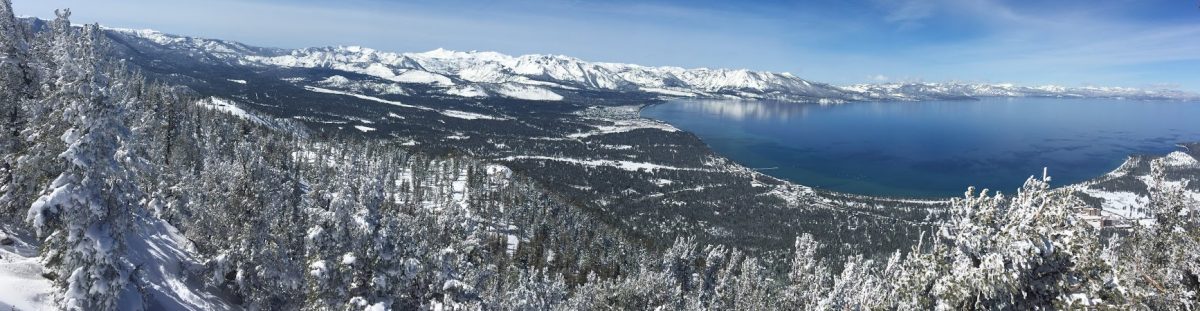
I dragged the cans out to the curb. A cool breeze gently caressed my tired frame. I stopped at the end of the curb, and lifted my eyes. I stood there caught in the moment of transformation. There was Jupiter shining down brightly near the Scorpio constellation in the summer sky. I veered my eyesight to the right and there was Little Dipper. It had been a long time since I glanced up at the night sky. The advent of summer meant that by the time the stars twinkled down gently at us at night, I was too tuckered out to exert myself to gaze longingly at the planets and the stars. ✨ 

I stood there for sometime. A few neighbors had stepped out on similar errands looking equally spent, and we had a curbside-garbage-can chat. I showed them Jupiter and the constellations I recognized. Really! How such a simple thing can invigorate us all is amazing. Soon, we were whipping out the Skyview app and looking for constellations and stars, familiar and unfamiliar. 

It was then I saw the artificial satellite orbit the Earth – shooting much faster than the remaining stars, steadily moving across the night sky, like a little star out for a run. In a matter of minutes, we were talking about the kind of data the orbiting satellites send us. No surer reminder of the Pale Blue Dot than an orbiting satellite is there?

pale_blue_dot.png

I traipsed back to bed after this welcome interlude of the magic of the skies. Who knew? Garbage collection could turn magical after all.

To quote Herman Hesse, “My advice to the person suffering from lack of time and from apathy is this: Seek out each day as many as possible of the small joys.”