The Moments of Weather

We had been to the mountains for a short reprieve from the demands of routine. There was no agenda. No plans or schedules. This was us taking Serendipity, that wild temptress of adventure, on a ride with us. Music was chosen by different occupants in the car and went from Carnatic music to ear-splitting yelps to Disney songs (Behind the clouds, the sun is shining!)

The weather app was equally co-operative. You are in for some rains, snow, cloudy days and possibly some sunshine was the gist. For a moment I relished that weather app. This was how our weather reports were while we were growing up, and it all added to the fun. We indulged the weather-man as he came on Television showing whisky clouds over large swaths of land, making possible probabilities with a doubt that ensured us if we rained we could thank him, but so what if it didn’t? Carrying an umbrella never hurt anyone, did it? This certainty of the weather takes the snuff out of the thing. 

I.t WILL be a 100 degrees today! *Dire Dire!*

I digress. 

Anyway, a few small-ish hikes during the day had left us with a satisfying feeling and a benevolence towards nature. The rains had materialized into little hailstones hurling themselves like joyous confetti. Then, just like that the hail stopped and the clouds scudded away revealing a smiling sun.


The next morning, I lay in bed, my plans for a walk at dawn forgotten. I snuggled in bed looking at the soft snow falling outside. The rains overnight had given way to snow in the wee hours. The grass outside was covered in a white sheet before long. I could not say how long I lay like that.

A lovely idea of all things being out in nature in all sorts of weather teaches us came to me – maybe it was a children’s book I should write, I thought. It is often the case, I get ideas, and then they go, or someone else writes them because I let it simmer too long. Oh well!

The hail taught me to wonder and squeal with joy

The mild rains made me stick my tongue out and get a few slurps in

The snow made me content for the simple pleasure of being in a warm bed as the flakes swirled around outside.

The clouds taught me to lift myself up and float

The sunny skies showed me that behind the clouds, the sun is shining (Cars movie song)

Weeks later, I sometimes found myself thinking of that morning just lying there watching the snowflakes flutter down; my heart fluttering lightly with the pleasure of thinking up another Children’s book to write. A moment in time when all of life’s little worries and tensions were pushed aside. A few golden (or silver) moments when there was nothing but the feeling of warmth in bed, beautiful thoughts, and the snow falling outside.

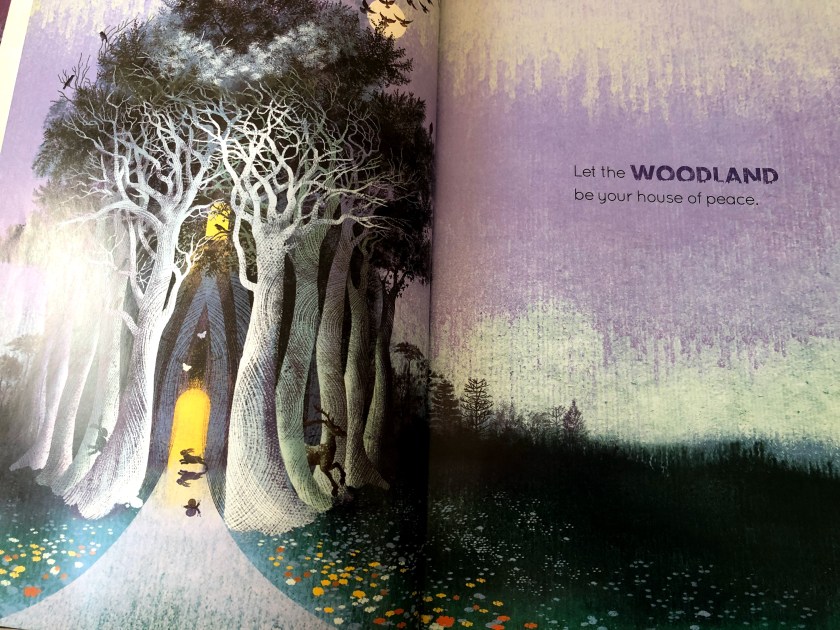
Then one sunny afternoon while the Sun scorched the Earth outside, I read the children’s book, Make the EARTH your companion by  J.Patrick Lewis illustrated by Anna & Elena Balbusso
img_3024-1img_3023-1

A truly marvelous book with engaging illustrations. A book of simpler times and more lasting moments to relish. Maybe I should get cracking on that book of mine soon.

The Power of Belief

“Göbekli Tepe!”, I said swirling the name around my tongue for the n-th time. Göbekli Tepe had a nice ring to it. A satisfying crunch right in the middle.
The daughter tutted impatiently.
“What is this Göbekli Tepe?! Going on and on about Göbekli Tepe! ”

“Glad you asked!”, I said and started on an explanation to her loud eye-rolls and dramatic groans.

I was reading a book on the origins of God through Anthropological history: God by Reza Aslan. His theological musings date back to the first homo sapiens. He sets forth theories and tries to piece together the origins of the concept of a soul separate from the body. A consciousness higher than one’s own that probably gave rise to the concept of Gods.

god_reza_aslan

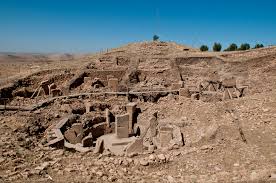
Reading about the ancient humans trekking to Göbekli Tepe is fascinating. Built over 10,000 years ago, it is the oldest known temple. Shaped to match the shape of the old hunter in the skies, the pillar of Sirius is especially tall. I can imagine not only the lure of the night skies for the hunter gatherers of yore, but also the seemingly curious rhythms of day and night. The location of the constellations themselves shift by season with the movement of the Earth around the Sun, and therefore, deriving any sense of regularity in itself must have felt divine.


gobekli_tepe

The Temple of Göbekli Tepe: Oldest Temple Built to Worship The Dog Star

I said as much to the children as we were hanging about the kitchen doing this and that. “Isn’t the concept of God a leap of faith? Huh! Get it? Leap of Faith! Get it?”

A low moan revealed that she got it, and then she tried to pivot the conversation to areas of interest to her.

“Which of the Greek Gods is your favorite amma?”
The children are ardent fans of Rick Riordan’s Percy Jackson series, and they often come up with questions like this. I read some of his books in order to keep up.
I looked at their faces, and said quite truthfully, “I don’t know whether I have any favorites. They all seem to be such jerks, at least in these stories!”
“Amma!”
“Well it is true. Aren’t Gods supposed to let go of their own Egos and all that? I mean they spar so easily. Oh! Oh! Did you say that? Okay! Okay, I am the God of Thunder. Here is a Thunder Bolt to strike down the mountain on whence you stand! – I mean, Come on! What is that even supposed to mean?” I said theatrically throwing hammers Thor-style.

The son laughed raucously. His eyes widened a little at the conversation. I know the little fellow took to the concept of a God without being led to it in any form – a trait we found highly amusing. We are not a religious household by any means, so it was clearly not a case of nurture. The daughter has a more lackadaisical view somewhat akin to my own.

The concept of a God – one or many Gods has always intrigued me. I am an amused, and sometimes annoyed, spectator when it comes to seeing how the religious peg themselves on a pedestal higher than others by virtue of their beliefs.

I am curious how different people take to the concept of a God more easily than others.

I am also humble enough to accept the Power of Belief.

I told them about how the concept is so intertwined into our collective consciousness from so long ago, that one can’t really try to imagine all the ways the concept finds its ways into our thoughts.

“It is everywhere!”, I said, and told them about how I remember the mother telling me as she looked on lovingly at the then newborn baby of mine smiling in her sleep. She said the story is that God came and gave the child a lotus in her dreams. Hence the newborn smile.

“If that were true, how would we know? You certainly weren’t saying it. In fact, you probably contorted your face into a spasm that we thought was a smile.” I said.

I have often wondered what the first thoughts of consciousness are for human-beings. Is it being self-aware, or is it in the feeling that we are one among the great biosphere? Do mosquitoes think that way? Do trees and bees?

What, Why and Where is God to you?

Read also: The Beauty of Questioning

To Fall In Love With Earth

 “Good going amma! You are doing well. Just try riding a little faster, okay?”, said the daughter, and then the children gave me a thumbs up, and smiled encouragingly. We were out cycling on a relatively flat trail in the mountains nearby.  I was amused at the encouragement. It was true that I was in worse shape than I expected. 

lunch_box

It had been decades since the days of pointless cycling up and down the hills, and the old spirit was reviving with every pedal stroke. I looked up yearningly at the tree-tops, and the pinecones hanging from them. All Earth looked and smelled inviting, reminding me of the gratitude for having such a beautiful planet on which to live. Today was not the day to rue the state of our laws, or how fast climate change is creeping up on us. Today was a day to feel grateful for what we have, so we may learn better to conserve what we have for future generations better. It was in this moment of great gratitude that I was admiring the tree-tops against the clear blue skies when I promptly veered off the bicycle path and crashed into some brambles nearby. 

img_2846

I tottered back to the path to chuckles from the daughter.  The husband in the meanwhile, was acting as though as he was in his teens again and cycling with both hands off the handle bar. The elementary school going son, gave me a shrug and said, “Show off!”. But I caught him trying to take his hands off the bar one at a time, and smiled to myself. 

The son had graduated to a bigger cycle for the first time and his face registered joy, and a little trepidation, as he stopped pedaling and went whizzing downhill. The adrenaline was pumping, and his cautious nature was kicking in at the same time. When we stopped for a break a few minutes later, he looked happy, and ready to start pedaling again. 

Out amidst nature that day was a wonderful balm for the soul. The air still felt nippy – there had been a light snow and rain at night, but the clouds had scattered nicely and the trail had some wet patches through which we went zipping with joy. The skies were blue, and the glistening snow and raindrops on the trees in the path brought about a pristine joy. 

The fresh, moist, clear air reminded me of Kate Harris when she wrote in the book, Lands of Lost Borders:

lands_of_lost_borders

“I’m not sure where I go when I spin wheels for hours on end like that, except into the rapture of doing nothing deeply—although ‘nothing,’ in this case, involves a tantrum of pedal strokes on a burdened bicycle along a euphemism for a highway through the Himalaya.” 

― Kate Harris, Lands of Lost Borders: Out of Bounds on the Silk Road

We were not in the Himalayas. We were on safe biking paths with brilliant nature folding us lovingly in its embrace on all sides, and yet the feeling was the same. There was harmony there between human souls and the Earth, and I could only hope that we never truly lose touch with that feeling. This is our only home after all.

We stopped for a while to take in a small hike around a place that has the wonderful combination of meadows, marshes, forests and river. A more Wind in the Willows kind of setting I could not have imagined, but there it was, and like the rest of the surreal day, I found myself feeling increasingly happy at being there. As we walked listening to the surging snow melt in the fast flowing stream nearby, I felt a sense of clarity, and I thought of Mary Oliver’s words:

I walk in this Earth to fall in love with it. – Mary Oliver

A Pluviophile’s Song

The night lamp was on, and I had a harried, desultory look on my face. It had been one of those days in which a lot had happened, but nothing had really happened. Days sent to try stout persons souls. The husband came and told me that I should probably try meditating for a bit, but I shook my head stubbornly. What if I fell asleep? 

He looked at me amused. His eyes danced with the unspoken words: Who are you and where is my wife?

I laughed, and understood the look. A Lover Of Her Sleep if ever there was one. I  told him I wanted to read a little, since I have been falling behind in my reading, and he shook his head indulgently. I really do think you should sleep though – you look so tired!, he said, a line creasing his forehead as he looked at me. I swatted at the idea like a pesky fly, and surveyed the bedside table. 

I don’t know how to use the word Tsundoku correctly in a sentence, but I had Tsundoku-ed the local championship leagues. Piles of books were stacked – children’s books, fiction books, non-fiction books, and all looking enticing and inviting. 

Tsundoku is a beautiful word denoting the piles of unread books by one’s bedside.

Tsundoku (Japanese: 積ん読) is acquiring reading materials but letting them pile up in one’s home without reading them.[1][2][3]

The term originated in the Meiji era (1868–1912) as Japanese slang.[4] It combines elements of tsunde-oku (積んでおく, to pile things up ready for later and leave) and dokusho (読書, reading books). It is also used to refer to books ready for reading later when they are on a bookshelf. As currently written, the word combines the characters for “pile up” () and the character for “read” ().[4]

I picked up a serious tome, and settled in. I had no idea I had been scowling till I started smiling a few minutes later. It was the musical patter of the rain. The beautiful rain was coming down in bucketfuls. I opened the curtains, and reveled in the beauty of the rain lashing down against the windows, soaking the tree tops, and flattening the flower beds. There is nothing prettier than the night skies sending torrents of rain. 

I loved the word Pluviophile. Meaning a lover of the rain, it seemed to have a nice ring to it, a word meant to bring a smile to one’s face.

IMG_0726

I opened the door, and watched the rain. I felt the cool breeze caress my face, and felt a surge of gratitude. I had said to my friends only a few days earlier that it will be lovely to have another bout of rain before the summer months set in and the neighboring hills turned brown. The Earth had already started emanating a slightly thirsty aura, and I yearned for the smell of rain against the hot Earth. 

I have been looking for the word that captures that welcome scent, and found one recently. 

Petrichor (/ˈpɛtrɪkɔːr/) is the earthy scent produced when rain falls on dry soil. The word is constructed from Greek petra (πέτρα), meaning “stone”, and īchōr (ἰχώρ), the fluid that flows in the veins of the gods in Greek mythology.

The Pluviophile in me smiled at the word and tucked it away for future use. 

The weather forecast had predicted a Storm. In the US, it is never Rains but Storms. The rain I had watched was not a Storm. A Storm is when the rain huffs and puff and stomps its weight around. But this was no Storm. The street lights cast a lovely light on the clouds overhead and the raindrops pouring down. The world looked mellow and in that moment of watching the rain, a calm descended upon me.

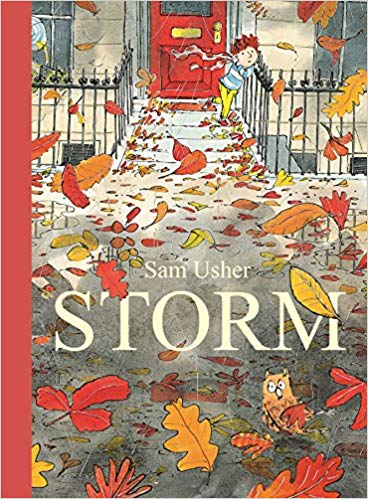
After a few moments, I traipsed back to bed. I lovingly surveyed my Tsundoku pile again, and set my tome aside. It was time to read a Children’s book. Storm by Sam Usher beamed up at me, and I snuggled in with the lovely book.

storm_sam_usher

A beautiful book that captured the joy of playing outside after the rains and storms. I have never flown a kite successfully, and the book made me want to. The illustrations are mellow works of Art, and after admiring all the pictures in the book, I slept the sleep of the tired but happy.

A Mother’s Day Gift

I walked into the classroom to read my story on Mothers Day to the children. I was a little nervous. Would the tough audience respond well to the story? It is always the surest test. If their attention dithers, you have lost, if they are enthralled, nothing else matters.

The teacher told me that they will be settling down soon. I watched amazed as she quietly got all the children, who were, less than a minute ago, tumbling and hanging upside down in the playgrounds outside to sit on the rug in the middle of the class, and settle down to Reading Time.

Now..Now..Ian, what did we say about sitting quietly facing me?
Ardvash, sit with your bottoms on the floor please.
All of you, sit with your bottoms on the floor and look ahead. We have a very special thing happening today. Can anybody tell me what it is?

A flurry of hands shot up into the air, and several people started talking at the same time. A minute later, they sat chastened by the fact that they had talked over each other without waiting their turns. There is no greater joy than seeing children respond sweetly to their teachers. A mellow voice bursting with pride at being picked said, “We are getting story-time”
“Yes!” Said their teacher. “And we are lucky have an author, a real author, come to read us her book.”

I took a deep breath, had the children do the same, and launched into the story. I read to them how the animals had planned to celebrate Mothers Day in the Jungle. When Potini Elephant was in tears because she could not find her dear child, Trumpy Elephant, there was a hush. The story built on, and every now and then I stole a glance at the faces of the children. The sweet sincerity with which they bestowed their attention made my heart sing.

Screen Shot 2019-05-10 at 10.11.29 AM.png

Mothers Day In The Jungle – By B S Bumble

When the book was over, the children clapped and their teacher gently asked them if they were forgetting something. “Thank you!” they all chorused.

It is Teacher Appreciation Week, and the importance of a loving, firm but gentle influence on the children day in and day out is not lost on me.

We do not need to be told to sit on our bottoms when we get to work, or go to a restaurant. But I wish somebody would tell us to sit on our bottoms and listen to the wind rustling through the trees or the geese quacking their way home every night, and we listened with the heart-warming sincerity of children.

When you get the opportunity to read your Mother’s Day story to a class of children sitting “with their bottoms on the floor”, and they listen with rapt attention, there is no better gift for Mother’s Day, is there?

#HappyMothersDay to all you wonderful mothers and mother-like figures.

Screen Shot 2019-05-10 at 10.12.30 AM.png

The Sandpiper’s Wisdom

I had finished my lecture on the unnecessary stress being online gives after the daughter told me about streaks. She had taken a picture of her left nostril for a streak, and I was appalled. “IF you are going to send a picture, at least take one worth remembering.”

“Relax! It is just for a streak.” Streaks are apparently how many days in a row you have sent pictures to each other. The pictures themselves are deleted, so it doesn’t really matter is what I was told. I was having trouble stomaching something like this. Pictures were important were they not? They were little bubbles of memory. You took some bubbles and relished them again and again. I appreciate my left nostril but do not revere it with a picture! I said somewhat indignantly.

When we take family pictures, we write sagas about them.

Challenges here: The Saga of the Family Photos

Precursor here: The Family Photo Saga Part 2

Motive Matters here: The Spirit in the Photograph

The daughter told me that times had changed, and asked me if I wanted a picture of my left nostril too. “This little thing has changed a lot of stuff mama” she said waving her precious phone, and gave me that look that makes me feel like a T-Rex fumbling on an aeronautical console. I blew my nose in disgust, and went about preparing for the picnic by the beach.

“Can you take a pic of me like this?”, said the teenaged daughter, handing me her smart phone, the matter of the left nostril forgotten for greater things in life, such as the tranquillity of a beach. She looked happy and contented. Just the right kind of picture that will satisfy social media gargoyles, her expression seemed to indicate.
I took the picture, and showed it to her.
“Ugh! Lousy picture! Gosh! Okay….okay…let me show you. See…just have me look out into the ocean and take it from this side.”
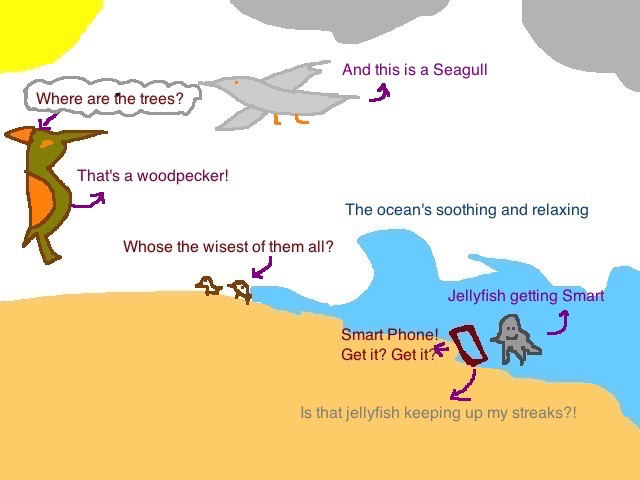
“Makes you look like a silly woodpecker wondering where the trees have gone while looking into the ocean.”, I said.
She laughed raucously, and said “Just take the pic!”

the_edge_of_the_sea

After a few pictures and videos of the waves lapping the shores, she sniffed the air like a horse raring for a race. “Interested in a race little dobucles?” she said, and tousled her little brother’s hair. I looked at the promising noses twitching with competitiveness, and I offered to referee as I set the pair off on their race.

It was on the way back that it happened.

A wave with a little extra force knocked the pair off their feet. While the gangly teenager managed to regain her balance, the little fellow a few feet behind her in the race was wrapped around snugly by the wave and fell sliding with the waters into the wave. I ran to lift the fellow. He had managed to sit upright, but was sputtering sand and spouting saltwater like a little dolphin. It was several minutes before he started laughing. I herded him back to drier patches, changed his clothes, rinsed out his mouth etc.

dolphin

It was then we noticed the daughter’s cellphone was missing. It had probably popped out of my pant pockets and washed into the ocean, while I was running towards them.

I don’t know how many teenagers will take lightly to having their cellphones dropped into the ocean. Mine took it stoically. All those pictures at various angles for her instagram feed, pictures of her left nostril for streaks, sound tracks of the waves, videos of the edge of the sea- all gone. Had we been anywhere else, the disappointment would probably have been keener. But we were surrounded by a sunny day at the beach. Nature calmed and soothed, and it seemed to the daughter as if the dear ocean need not have tried that hard at all. She was stoic enough.

“I called the number at night again, and there was a glug-glug sound in response. “ I said the next day.
“Too soon Amma! Too soon!”, she said giving me a wan smile, but brightening at the thought of her quip. “But the jellyfish is a smart one huh?!”

Days later, I patted my pockets looking for my cellphone. I hollered to the children to get my phone as I headed out.“You know? The ocean has taught me that we don’t really need cellphones. Life is just fine without it! I can remember the sound of the waves, and the beautiful images of the day by the beach if I just close my eyes.” said she donning an expression of experienced wisdom.

We then burst out laughing. “Running by the beach is always a wise thing to do, that is probably why the sandpipers are the wisest of them all.” I said, and she agreed. Those little birds running up and down with the waves were a sight worth remembering.

img_2465-effects

The human race is challenged more than ever before to demonstrate our mastery, not over nature but of ourselves. _ Rachel Carson.
The Edge of the Sea

The Edge of the Sea beckoned with increasing urgency. 

We can technically reach the sea shores within a couple of hours drive, but the routines of life mean that we rarely do so. I looked at the pleading look in the daughter’s eyes as she pumped for a day at the beach, and consented. And so, it was with considerable energy that the children and I packed our picnics for the day. The entertainment bag with books, snacks and sandwiches were ready, soul filled up to the brim with good hearted spirits, and we set off to the cold shores of the Pacific Ocean on the Californian coastline. 

I must admit it is a beautiful thing to do. It is especially sweet when one has taken the day off. One can imagine the rest of the world working in drab offices, spouting theories, pouting about the myriad tasks that occupy one’s day, while we gaze contentedly at the ocean, listening to the sound of the waves lapping the shore. Wildflowers bloomed creating a kaleidoscope of color a short distance away. Birds and butterflies flitted around them gaily.


img_2484

Out on the beach, there were a couple of families who were also enjoying a small Spring break, and there was harmony between land and ocean dwellers alike.

Kites were being flown by some, and the little dragon and butterfly shaped kites took off with an ease that is hard to get in landlocked parks. The sea gulls were making pests of themselves over an upturned packet of someone’s carefully packed picnic. Every time someone came to shoo them, off, they lifted themselves with a grace that the man-made kites could never quite get.

img_2465-effects

A little farther away from us were a couple of small birds, who I have since learned are called sandpipers. And what a fitting, poetic name for the little marvels?! They darted in and out with the waves looking for whatever it is they eat from the foam that washes up. They inspired us to play the same game of keeping as close to the lapping waves as possible but not getting wet. We did, but we were nowhere as elegant and nimble as those little busy sandpipers.

Days later as I bustled about the day, a quick darting image of these little birds would flash before my mind’s eye, and I would indulge in a small smile. A smile that reminded me of the bigger gift of life that surrounds us, a life and planet so marvelous that our daily tensions can in an instant be gone just by stopping to think of them.

The edge of the sea is a strange and beautiful place – Rachel Carson

Regular readers know that the teenaged daughter should have been born a mermaid. Since she is a human being, she makes up for the shortcoming by thriving on all things ocean related. Her reading is generously sprinkled with mermaids; her drawings of coral reefs, fish and dolphins reached a point where her teacher said she had to choose a land based theme to draw so she learns the techniques for drawing different scapes; her favorite myths involved the Greek God of the Oceans, Poseidon. And it all started early. She watched Finding Nemo & The Little Mermaid 666 times.


Every time, I crave for the forest, she craves for the beach. “A quiet day at the beach is a wonderful thing. Most importantly, you don’t have to do anything. No hikes, no walks, no did-you-see lists Amma!” she said, and as I watched her loll on the beach with a book in her hands, I must admit that the appeal is infectious.

The edge of the sea is fascinating. Watching the shoreline move in accordance with the tides and waves is engaging. The sandpipers and seagulls can entertain you all day. Who needs phones by the beach? (Coming up next)

img_2480

Books: The Edge of the Sea – By Rachel Carson

Duck, Duckling, Dolphin

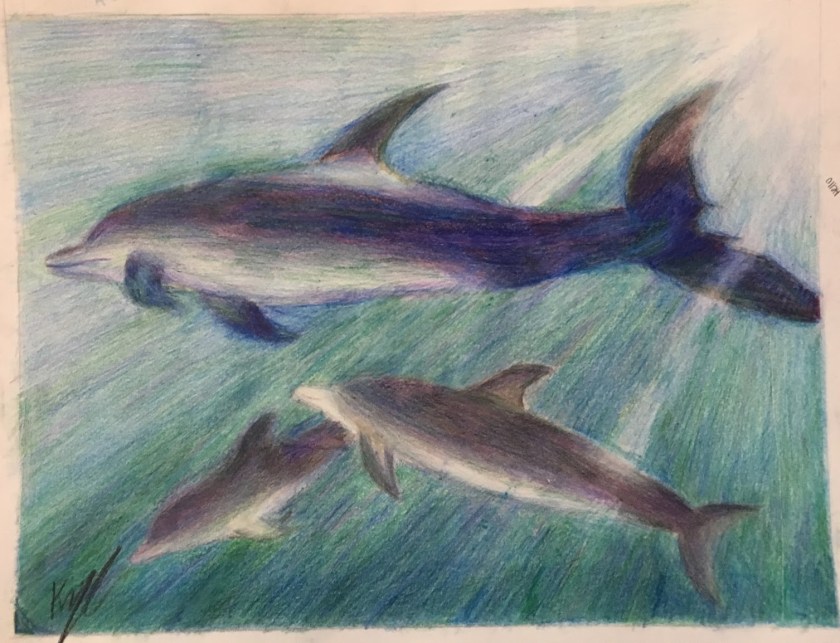
I recently read a book titled Dolphin Parenting by Dr Kimi Shang. It was an antidote to the Tiger Parenting by Amy Chua book. Dolphins are intelligent, social and playful creatures, and therefore, we must model our behaviors after them is the gist of the book.

Keena_drawing
Art work by Daughter

Nature provides us with amazing parenting models every now and then.  Spring time is especially wonderful as this is the time for new life, a transformation of sorts. The butterflies are out and about, snail-lings venture forth, squirrels come out of their hibernation, eggs hatch and, in general all of life is abuzz with beauty and purpose. One day on a walk near our local lake park, I noticed Mrs Duck go to her nest, and Mr Duck gave her a nod as if to say, “Go on dear, I’ll ensure no one disturbs you.” Mr Duck then went on to aggressively protective their little nesting area by quacking loudly and doing sentry duty.

img_2341

Just in time for Earth Day, the ducklings have hatched, and they look beautiful. There is something in the innocent, puzzled looks on their little fuzzy bodies that tugs your heart. Of course, it is amazing to see Mr & Mrs Duck take care of them. I can watch them for hours. How they slowly introduce their young to the big, bad world; how they watch their little ones play for hours; and how they only intervene when important,  is a lesson in parenting for us.

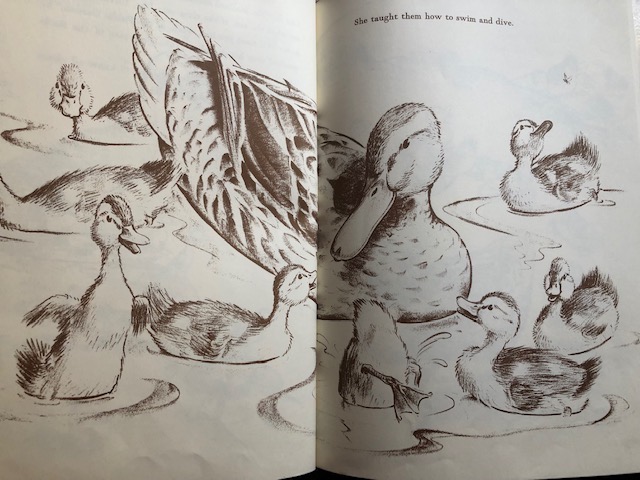
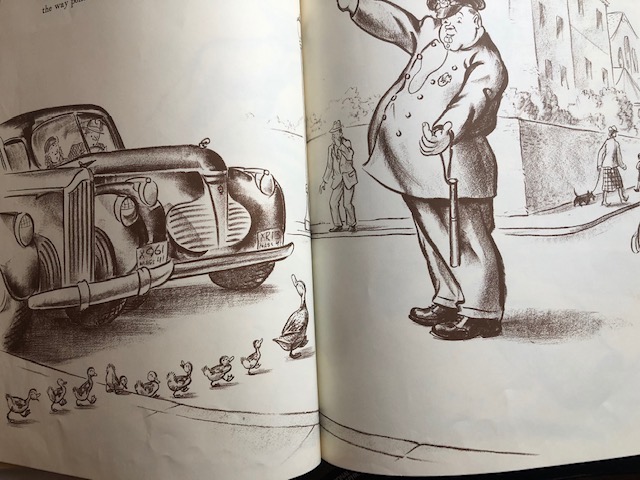
They take them gingerly out into the shallow waters first, then as their little bodies grow stronger, take them for longer fishing trips. They teach them how to cross the road – the ducklings are protectively looked after by Papa & Mama Ducks. The parents in front and the rear, the line is a marvel. The noisy bunch then head on towards wherever they are going. I don’t know how disciplined the ducklings are when they grow up, but when babies, it is an adorable sight to see them toeing the line obediently and happily. 

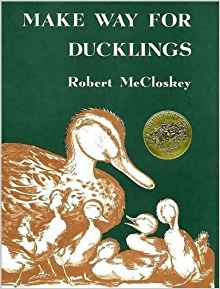
It is that time of year to read Robert McCloskey’s adorable book, Make Way For Ducklings.

make_way_ducklings

The books starts off with Mr & Mrs Duck looking for a place to live and raise their babies. They fly great distances before they arrive at a little island that looks just right.

There, the ducklings hatch and the conscientious parents are busy in providing for the young, teaching them to survive in a tough world, and learn to be independent. 

ducklings_3

Once they are strong enough to swim longer distances, it is time to move to a bigger island, that involves a few perilous road crossings. Who should come to their rescue but the local policemen?

ducklings_4

A heart-warming tale that I can read any time for a quick dose of sunshine. Illustrated in a simple brown ink, it is a wonderful book for Parent Ducks and Ducklings alike.

I remember being amused and amazed when I first came to the United States on seeing Duck-Xing signs. Coming from India, where traffic flows on, and people cross on and share the road with dogs, cows and goats (nobody particularly stopping or giving precedence to another); it was wonderful to see that the traffic did not only stop for pedestrians crossings, but for ducks as well.

The Half-Baked Philosophers

T’was a philosophical sort of day. I had not the mood to do much other than go on long walks, and when at home lie down and read. The children indulged me, and were secretly happy that nothing else was being asked of them. 

It was in this philosophical vein that I dragged the husband along for a walk that evening. The glorious Spring evening had me mooing about the tree lined streets, sticking my nose in flowers, inhaling deeply the scents of lavender bushes and roses. My nose was covered in pollen and I started an impressive bout of sneezing.

pets


“Really! When folks say, “Stop to smell the roses. 🥀”, you don’t have to do exactly that you know?” said the husband. His manner seemed to indicate that it was only a matter of time before a couple of butterflies started sitting on my nose to do their bit in the whole divinity of spring exercise.

img_2318

“But, it makes me so happy! “ I said.

He deftly diverted the conv. to safer grounds. “If happiness is a feeling or an emotion. Where do you think it emanates?”

Was it the endorphins that made that happen? We went on our walk discussing half-baked theories on serotonin, dopamine, oxytocin and some-other-in, that would have made WhatsApp forwarders proud. By the time, we had circled back on whether there is enough neuroscience based research on the subject of brains, happiness, and its link to depression, we were clearly out of our depths.

Minds far superior to ours have pondered the essence of an emotion. Does it originate in the brain, then how does one feel one’s stomach clench when anxious, or one’s heart fill out when happy? Sometimes, I think we are nothing beyond the carriers for the emotion rivers that decide to course our bodies.  As we age, we are supposed to grow more sanguine, but I feel that only happens for the positive emotions, not the negative ones. We do not whoop with joy, but we still feel intense grief. It is all highly muddling.

“Maybe happiness as an emotion can only be meaningful when one knows the opposite. You need to be sad at times to feel joy, feel angry to know the beauty of peace.” said the husband looking as Zen-like as it is possible for his spirit to be.

Later, I reached out for the one place where I know all of Life’s great questions are answered,  a children’s book. Titled Cry Heart, But Never Break, by Glenn Ringtved, Illustrated by Charlotte Pardi, Translated by Robert Moulthrop.

cry_heart

In it, Death comes knocking at the door to claim the old grandmother dying upstairs and spends the night with her grandchildren. The children ask Death why their beloved grandmother must die. Death tells the children a story. A story of 4 children: 2 sunny sisters, Joy & Delight, who fall in love with 2 gloomy brothers Grief & Sorrow. He explains how each complements the other. Without grief and sorrow, one does not find true joy and learn to enjoy delight in life. Without Death, one does not enjoy Life, he says.

Written by the Author when his mother was dying of cancer, the book is beautifully narrated, and the illustrations are emotive. It is a book about Emotions after all.

And there in a nutshell was the gist of our half baked philosopher’s walk-and-talk. As good children’s books do, the book in one fell swoop, captured the nub of a 3 mile saunter in 10 pages, far more effectively. I tell you, Children’s book authors and illustrators are the truest custodians of the Human Spirit. 

The Appalam Pounder’s Daughter

This article has been published in Open Page of  The Hindu.

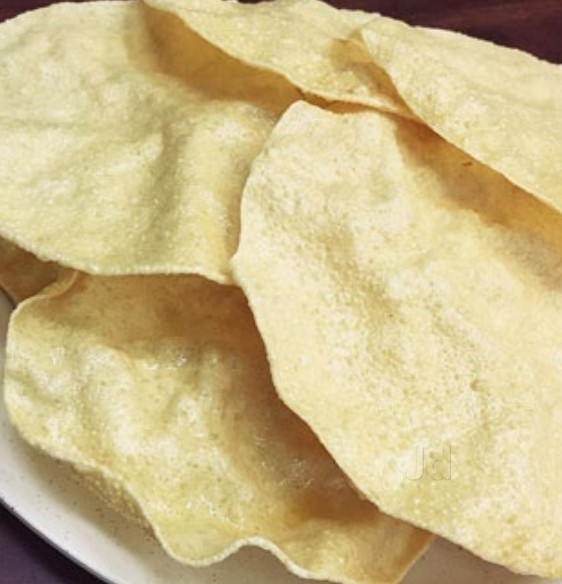
An Aunt was visiting, and her nieces had all gathered around. Lunch was in progress, and though some of the dishes had not turned out quite as expected, they were well appreciated by the folks at the table. Crisp, creamy white lentil snacks called appalams or papads, were passed around with aplomb, and I got approving nods for frying them. 

appalam

The husband had been jesting around the aunt that he had last eaten fried appalams about a year ago.  The aunt gave me a distinctly doleful look.  How could the niece she loved so much have denied her loving son-in-law appalam for this long?

We sat around a distinctly large meal with the fried appalams being passed around, and I looked on amused at the satisfied smiles on the faces of all around. “Any meal becomes special with fried appalams!” my father used to say whenever he spotted them gracing the table.  He truly became a child beaming happily while breaking them off with a joy that is quite disproportionate to the humble appalams.

I said as much to my aunt, the pater’s sister,  and she chuckled happily. “Yes, appalams were your father’s favorite. Three days every month was dedicated to making appalams“, said she, and I sat back to enjoy the nostalgic look that lit her eyes.

We sat enthralled as she narrated the story of how her mother, Visalam Paati, would roast the dhals and set them out to dry. My grandmother’s life has always fascinated me, A mother to 9 children, that generation was responsible for the burgeoning population we have on Earth today thanks to rising health and lack of birth control. 

Feeding and raising such a large family must have been a herculean task, but Visalam paati seemed to have been a competent taskmaster, planner, forecaster, chef and mother. As the appalam making tale unfolded, it was evident that those three days were filled with important buzz. Everyone had work to do, and everyone’s task was equally important:

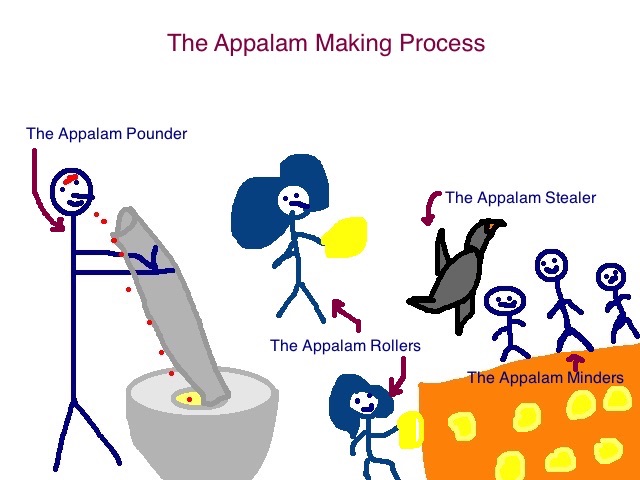
  • The younger ones had to shoo away the birds while the lentils dried in the sun. #AppalamMinders
  • The older boys would have to pummel and cudgel the dried lentils with an iron cudgel. “No grinders, and mixies or any machines in those days, remember?”, my aunt said. #AppalamPounders
  • The older girls would then have to take the powdered lentils, mix them to cookie dough consistency and roll them out into neat little circles before setting them out to dry again. #AppalamRollers
  • The younger ones took up their sentry watch to shoo away the birds while the appalams dried in the sun again. #AppalamMinders

appalam

“One time, my mother was alarmed to see the appalam dough below spotted with blood and looked up to see that while pummeling, your father had accidentally hit himself on the forehead with the pummel a few times and his forehead had started to bleed. Poor fellow. That month, we had a little less appalam stock because we had to throw out that batch, but your father got his full share because he liked appalam so much, and of course he played the sympathy factor the whole month!” she said and giggled.

Three days a month set aside for appalam making, so that the children may enjoy fried snacks every once in a while seemed to be a lot of planning and processing, Obviously, fried appalams held a special appeal in the hearts of the children. Each one felt they had contributed to the process, and the satisfying crunch must have had a special meaning.

Going to the supermarket and picking up a packet of papads or appalams has become so blasé a task, that I rarely stopped to think about how it was prior to mechanization and automation. 

“Automation has changed so many things hasn’t it?” said one voice, and we all piped in.  The topic of automation took us for a bumpy ride down the river of time. While automation has helped feed and clothe the billions of us, it has not really helped the global climate very much. Mass production and capitalism have also blurred the lines between needs and wants. 

It was a lot to process. Sometimes, in our rush to simplify things, we do rather complicate them don’t we? I loved the mental image of appalam making in a small village house in South India. When was the last time, the whole family pitched in on one activity together that contributed towards something meaningful? Maybe when we painted the rooms a couple of years ago.

Probably that is why the Little House in the Prairie by Laura Ingalls Wilder remains a much loved American classic. It talks of a time when every body helped each other in order to live. 

little_house_priarie

I read the book recently, and found myself ardently wishing I could sit with the deer in the prairie even if certain wolf-heavy nights were scary. A simple tale of building a log cabin in the middle of the priarie is a marvelous read, and I am grateful for the fact that I read it as an adult. 

“I am beginning to learn that it is the sweet, simple things of life which are the real ones after all.” – Laura Ingalls Wilder