The Art of Judging Art

The husband showed me an episode on White Collar – a drama series based on an FBI agent who takes the help of a conman he arrested to solve art crimes. A fascinating series, it soon caught the fancy of the household primarily because it is one of the few shows that we can watch with the young son in tow.  Of course, modern television has taken gripping drama to an art, and we found ourselves enjoying the show together. 

In one episode, the protagonist goes to great depths to explain how he found a particular piece of art was counterfeited. The light of the shadows in the painting, he says, were at an angle that could only have been possible if the museum lighting were shining at that angle, not something that Rembrandt or Van Gogh or Picasso (I forget which artist) would have had to contend with in his work of art. 

I remember being awestruck at this. Of course, art aficionados would not find it marvel-worthy, but I did. My simple mind appreciates the beauty of a good work of art, and it stops there. The critical eye, the keen observations, they all seem a work of wonder to me. 

It was, after we had watched this episode that we bundled up and drove through the lush hills shining in the sun-dappled valleys and plains of California for a short trip to the Getty Museum in Los Angeles. The Getty Museum turned out to be a wonderful outing for Covid times. It was not crowded, and the artwork was good without being overwhelming.

As I stood in the Van Gogh section, I could not help wondering how that many works of Van Gogh were in Getty’s Museum when we had seen numerous others in galleries across Italy. Apparently, in his last year of life, confined to an asylum for mental illness, Van Gogh created around 600 masterpieces.
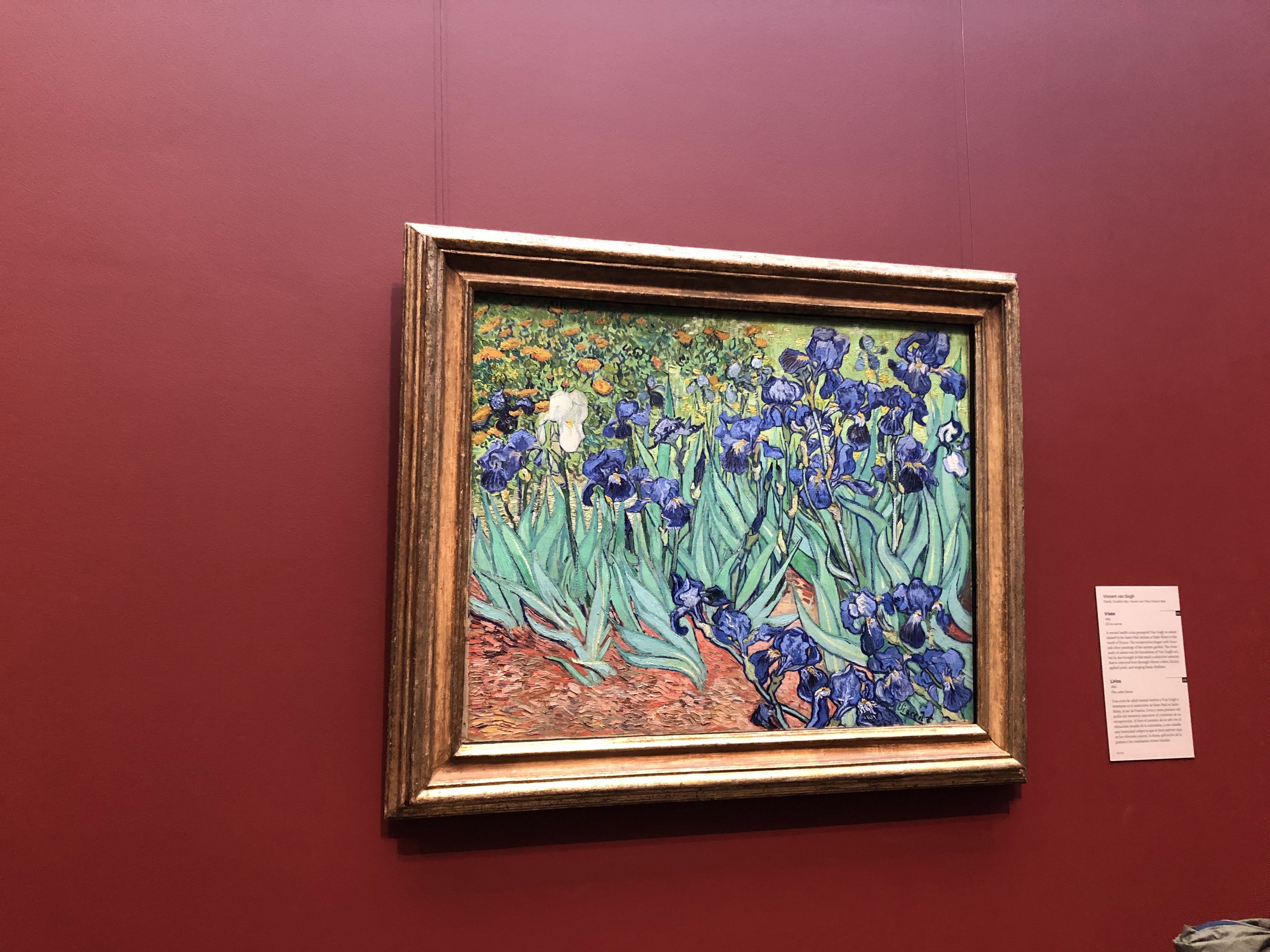
I snapped a picture of the Irises, and made my way down to the gift shop afterwards. It was there that the awe of what we have done dawned on me, There were mass produced pieces of merchandise with the exact nuance of the irises on purses, scarves, tote bags, books and magnets.

What is the true worth of a masterpiece? I am sure there are hundreds of paintings, true masterpieces, that do not go on to have this enduring sense of appeal and capture the imagination of generations. 

I tried fumbling some of these sentiments to the children, and the children piped up in style, “If Neal Caffrey tries to steal it, it is worth it. If not, forget it!”

Regardless, the urge to paint is encouraged by Van Gogh himself (according to the Internet)

“If you hear a voice within you say ‘you cannot paint,’ then by all means paint, and that voice will be silenced.”

– Vincent Van Gogh

When Musings Are Amusing

It haș only been about a hundred years since humankind gained the knowledge that the atom is made up of protons, neutrons and electrons. In the intervening century, what all we have done with this knowledge – slowly building upon the cumulative knowledge of mankind? It is astounding, and I shivered a little – partly due to the cold, and partly due to awe.

It took humankind 200,000 years, or at least about six millennia of civilization to discover subatomic particles, and somehow in the intervening century since, the pace of technology and the possibilities of the future seem to have raced forward. Every generation has had to live with phenomenal changes. Barring huge setbacks, where would humanity be in another 100-200 years? 

The stars spun around in its merry dance around the universe ,while I had the same sensation in my head trying to make sense of the world we have built for ourselves. The simple observation on the atom’s makeup led us on a merry dance of our own – that of financial markets, world economies and much more.

The husband was explaining the concept of NFTs, VR worlds that is already beginning to manifest in the world.  Our great grandfathers would not have understood. We are not going to understand things of perceived importance in our grandchildren’s lives, forget great grandchildren’s. The mind boggled. 

It all started with my fretting about the Economics of the world getting increasingly complex – how did stock market indices, per capita incomes came to be built one upon the other? Currency fluctuations, led to the discussions on crypto currencies, and we went on to how people claimed ownership to stars. Apparently, one could pick a star and name it after yourself for a fee. ( Star registry )You essentially ‘owned’ the star from then on. The only problem was that there were multiple star registries, and so multiple people could pick the same star to ‘own’. Also, there is the real problem of the star not knowing it is ‘owned’ by a human on a faraway planet.

I looked up and laughed out loud – the stars seemed to understand and winked back.

I could not help thinking of the parody of The Little Prince by Antoine Saint de Exupery. In The Little Prince, the Prince visits different ‘planets’ each hosting one human being – a geographer, a banker, a king, a drunkard and so on. The banker never seems to spend any time enjoying the stars around him, but spends his time counting them all, as he claims that the moment he counts a star, he owns it. (Carl Sagan’s Quote on Astronomy being a humbling profession is completely lost on the poor, rich banker!)

It has been said that astronomy is a humbling and character-building experience

Carl Sagan, Physicist and Astronomer

Really, human beings are the most remarkable beings if you stop to think about it. We want to own the first digital signatures, the most coveted things on earth (Napoleon prided himself on his Aluminum vessels, and it was considered a luxury till someone found how to produce it enmasse: https://en.wikipedia.org/wiki/History_of_aluminium), the best paintings that cost millions, and so on. We want our egos fed and nourished all the time by a universe that largely does not seem to care whether we exist or not. 

But, simple things that mattered before the composition of the atom was discovered still remains important. We still value our loved ones, yearn for contentment and peace, and want to live on a bountiful planet that allows us to thrive.

There is no doubt about it: The musings of our importance on a cold, starlit night is highly amusing.

This Beautiful Earth

2022 started off with a marvelous opportunity to read poetry at the Coimbatore Festival of the Arts. The theme was to choose a poem that immortalizes a place you love just as T S Elliot immortalized London in his writings. I wracked my brain, and tried to find one place – but found myself dithering. I had a book of 150 poems open on my lap as we made our way to one of my favorite places on Earth – a peek under the ocean waters (Monterey Bay Aquarium).  But there was no poem on the oceans in the book. 

“How about this one? “, I asked and read out one sparkling piece after another.

The trick with poetry reading is to get the whole family shut inside a car, snag the front seat so the car’s audio controls are with you, and then to start reading poetry out aloud. It is a good strategy as long as one knows to gauge moods and cheese it at the right time. I had a thoughtful audience, an audience that gave me suggestions, and even recited some of their favorite ones for consideration. What more could one ask for?

The more I thought about it, the less I was able to zone in one place. Many places seem to hold something special – places we’d lived in, places we’d made memories in, and places we’d visited and fallen in love with. 

The more I tried to narrow down, the more I found myself drawn to the planet Earth. After all, I love almost every river I see, wish upon every stream and fountain – man-made or natural, love every tree, admire every flower as is wafts its scents through my senses, and adore the play of the evening light amidst the clouds. How could one place be selected? I did wonder about Mary Oliver’s poem on the unknown pond. The one in which she just refers to a nameless pond, since it could work for any pond, and I agreed with the sentiment. How many ponds have I since pondered over with that beautiful poem in mind. In fact, I have my own version of Walden’s pond, which is nothing close to Walden’s Pond that so inspired Thoreau in size or stature. But it is reachable from my home, and every time I glance upon its water, a new delight unfolds. Whether it is the pelicans, geese or ducks swimming there, or the play of the reeds movements upon its surface, every glimpse offers something lovely for the soul.

So finally, I settled on Planet Earth as my favorite. We Belong on Earth, is after all, a popular theme on the blog. Therefore, the poem chosen was A Grain of Sand – By Robert W Service

A GRAIN OF SAND

If starry space no limit knows 

And sun succeeds to sun, 

There is no reason to suppose 

Our earth the only one. 

by Robert W. Service

Followed by Carl Sagan’s ode to the Pale Blue Dot (written almost 45 years after A Grain of Sand – this ode is one for the ages) and then finally with by my own humble ode to our beautiful Earth.

As we walk upon this Earth, there is much to be grateful for, and much work to be done to fix our footprints on the sand.

The Human Earth

I was reading frantically the other night. I wanted to finish the book before the New Year. Earth’s History – 4.5 billion years in 8 short chapters by Andrew Knoll. I had galloped my way to the last chapter: Human Earth, when the eyelids lodged a formal protest, and refused to stay open.

A Brief History of Earth: Four Billion Years in Eight Chapters by [Andrew H. Knoll]

So, I did the next best thing. First thing in the morning, I came downstairs reading. There wasn’t much chance of reading in the mornings with the general comings and goings of life in the nourish-n-cherish household. But I live in hope. I sipped my coffee for all of three sips reading about Human Earth when I detected a faint fracas among the humans in the household. Cautious pricking of the ears is no use in the house. The father-in-law is steadily losing his hearing, and the mother-in-law was yelling at him for something and wanted him to know it. All the fathers-in-law in the street heard it, and so did I. 

I tried to read on, but before I knew it, I was called upon to act as referee. If one can shy away and gallop back to bed while sitting in the chair, that was me. Past performance seems to mean nothing. I mean if I were a batsman who has shown time and again that I didn’t know how to bat, would benign fortune keep giving me batting opportunities? Why then was I being called to referee a fight between them yet again? I had been given scathing reviews in the refereeing-department by both sides on every occasion in the past few weeks.

You see? Diplomacy doesn’t help. I find myself agreeing with both their points of view, much to their disgust, and annoy them both equally. Neither feels supported once I agree with the other, and I am given up as a bad job. They do seem to be united in this assessment of me, and I take that as a small victory in the peacekeeping operations. But beyond that, there is nothing I can claim to help with.

This was another day in the life of humans, and it seemed everyone was intent on huffing and puffing and blowing the house down. 

Though, I am not directly involved in all of this (thank goodness!), I tried to look mildly interested. It turned out to be nothing (quite literally nothing as is mostly the case) I clutched the coffee cup and sipped like the gods downing ambrosia, till the well of coffee ran dry. 

After some time, I declared I needed some fresh air and took myself off on a walk. 

As I walked on beautiful Earth on that cold winter’s day, I felt a fresh appreciation for the planet. The book talks of Earth’s geological clues that helped us resurrect the planet’s early history. Theories as to when the planet was really formed, half lives determining the age of species and their evolution etc. Beautiful timelines explaining the australopithicus and when homo sapiens came aboard.

Illustration from A Brief History of Earth by Andrew Knoll

In 8 chapters, it explains many things that we know in different contexts, and ties them up to Earth’s history. Oxygen Earth, Biological Earth, Geological Earth, and finishes with the chapter on The Human Earth – which is to say our influence on the planet. The most recent impacts of the last two centuries, accelerating climate change, and so much more.

As I sat there on a rock, looking at the river waters flowing, and the ducks and geese gliding on the waters, eating when they wished, I cast the mind back to The History of the Earth. In 4.5 billion years, so much has happened. One can only make educated guesstimates of the lives of all the creatures that preceded us. 

In the book, Forgotten Beasts by Matt Sewell, he uses his imagination and creativity based on the fossilized shapes of the bones found and tries to give us an image to work with.  How were their eating habits, their social constructs? We don’t know.

In the book, Life in the Garden, by Penelope Lively, she makes interesting observations based on tree rings, to figure out the years in which the trees had to endure drought, and the years they had an abundance of rain. 

But the human life? Short as it is on the timeline of some trees, it is minuscule on the timeline of the Earth. 

Would future generations of neonids or whatever-name-they-give-themselves try to look back at 2020 and 2021 as Covid years? Would they reconstruct the social dilemmas, and habits of homosapiens? We seem to be leaving an outsize impact on the planet now, but how will it manifest hundreds of years from now?

I walked into the home, and found the parents-in-law diligently cutting the fruit of the banana tree. An arduous task, requiring immense patience, and concentration. The father-in-law was peeling the layers of the banana flower and extracting the seed within. The mother-in-law took these, and rubbed it against her palm to expose the edible pieces of the vegetable. 

Vazhapoo – the banana flower

I watched them amused – working harmoniously, their morning spat forgotten, united in the making of the banana flower dish (vazhapoo paruppu usili) that would’ve stumped any species on Earth thus far. 

The House of Dreams

Finding a nest of your choice is no mean task in the Bay Area, but we managed it thanks to patience and resourcefulness on the part of the husband.

We moved in to our new nest this year, so it seems only fitting that I read Anne’s House of Dreams by Lucy Maud Montgomery twice in 2021. Once, as soon as we moved in earlier in the year, and again, when I have been flitting to Prince Edward Island in Canada later in the year.

It seemed too much to ask for all the things dear to one in a home, and so we kept on looking for years on and off. The new nest, may have some things that realtors, buyers, and property assessors don’t seem to take into account, but these things played a big role in my mind. Our realtor stoically bore with refusals of homes based on reasons that drive statisticians up the wall.

‘But’, they say, ‘proximity to freeways matters more than proximity to a stream.’. I see them exchanging looks that suggest worry on my behalf. 

‘Trees? You can plant as many of them as you’d like – why would you look for trees near your home? I mean. Just trees. ‘ I disagreed. I loved the sycamores, fruit trees, and the cypress trees in our small strip of land in our previous home, and insisted on having many trees nearby.

Walking paths for elderly people? One person asked me why I did not consider putting elderly visitors up in a hotel when they visit and buy that mountaintop house anyway. I gasped. No – a flat, safe area would be required for the visiting grandparents to take their walks in.  

So it went. 

One was rambling, one was tumbling. 

One had a nice backyard, but one did not live in the backyard. 

One had a swimming pool, but no trees. 

Really, it is curious to see how houses have developed over the years. 

Our new nest is far from perfect – the kitchen has a wine cooler in prime real estate territory (for teetotalers most of the time, this feature is being used to store yogurts and juice boxes for the children). I need a stepping stool to get at the closets with spices. 

But there are things past closets and wine coolers. Trees, for instance, or a home library and a ledge with a window looking into a marvelous tree for another, and, the best gift of all – a walking trail by a river nearby. Reminds me of the passage in which Gilbert Blythe tells Anne of Green Gables before their wedding about a little house he found for them at Four Winds Point. That is how I felt. There was no other way to feel. 

“So far, good,” said Anne, nodding cautious approval. “But, Gilbert, people cannot live by furniture alone. You haven’t yet mentioned one very important thing. Are there trees about this house?”

“Heaps of them, oh, dryad! There is a big grove of fir trees behind it, two rows of Lombardy poplars down the lane, and a ring of white birches around a very delightful garden. Our front door opens right into the garden, but there is another entrance–a little gate hung between two firs. The hinges are on one trunk and the catch on the other. Their boughs form an arch overhead.”

“Oh, I’m so glad! I couldn’t live where there were no trees– something vital in me would starve. Well, after that, there’s no use asking you if there’s a brook anywhere near. That would be expecting too much.”

“But there is a brook–and it actually cuts across one corner of the garden.”

“Then,” said Anne, with a long sigh of supreme satisfaction, “this house you have found is my house of dreams and none other.”

Anne’s House of Dreams – By L M Montgomery

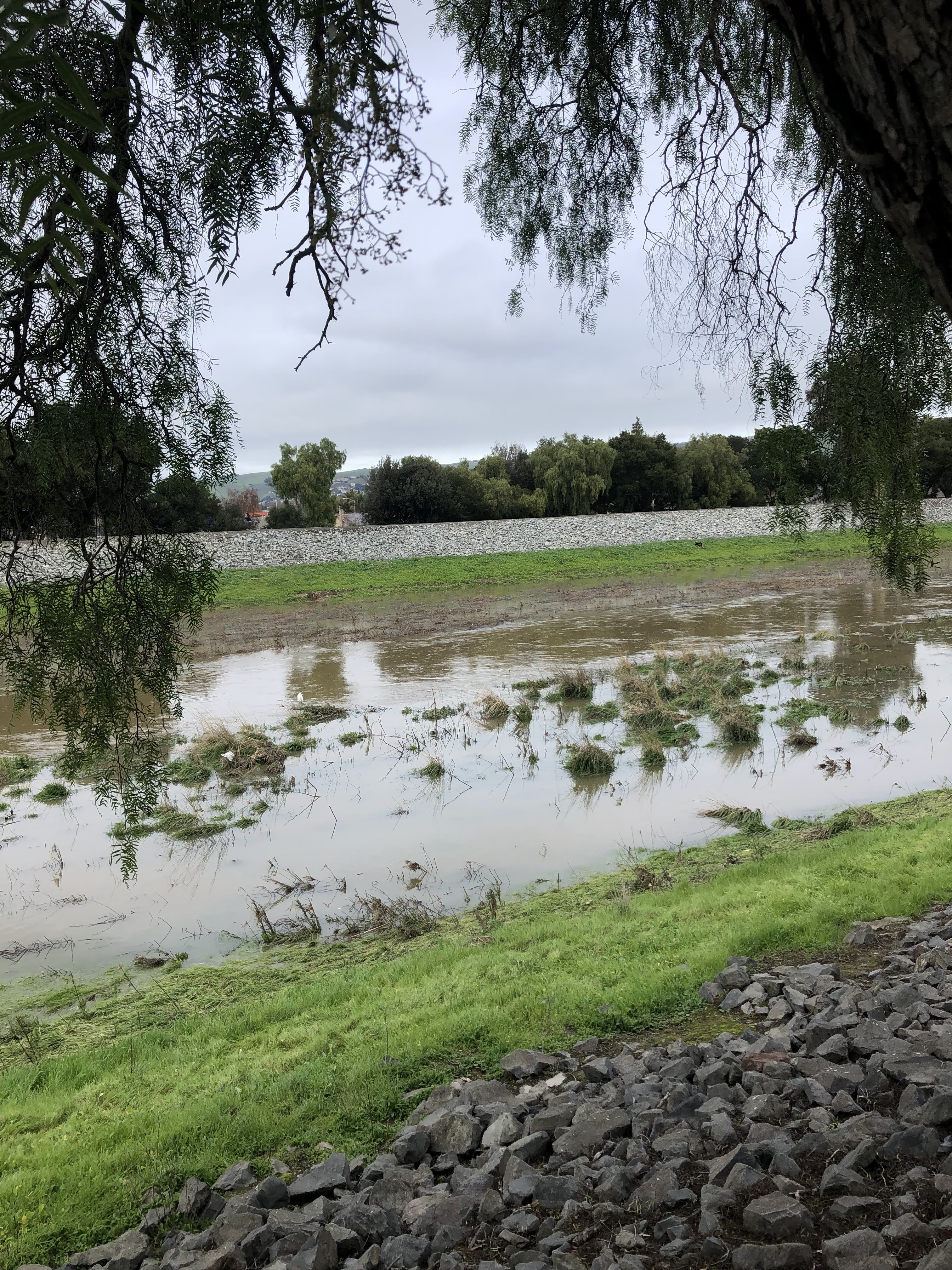
The river near the home has nourished us in several ways. It is very like the stream in the passage above, although it isn’t exactly in our backyard. We live in a suburban area built up by such factors as Strong Economic Growth, Silicon Valley culture and all the rest of it. The river is a few blocks away, but it is there. Just flowing, and relaxing us whenever we can get away from it all to take a peek.

The trees don’t form a bough, but they rustle and tousle with the winds. And the chirping of the birds is quite enough to charm one.

Slowly, but steadily, the laughter, companionship of friends, and love is transforming the house into a home. To that, I am grateful.

The Librocubilarist’s Dilemma

Folks were visiting the new nest. I was cleaning to ensure that the humble abode impressed them favorably.

That is to say, I was scrubbing beneath sinks, and behind blenders as though they were health inspectors who walked in with those examination pads in their hands, wearing steel rimmed glasses, censorious expressions, and a tough grading point scale for house inspections. Of course, like most people who visit the home, they were perfectly warm folks who cared more about the smiles on our faces as we greeted them, than the scrub factor in the sink. But.

The inspector general in me commanded everyone in the home to smarten up too.

“Put away all those books, crayons, papers and toys – your floor should be clean.” I said looking into ‘Imagination Island’ the name the son has given his room. He gave a compliant nod gallantly suppressing a scowl. He knew this mother. She would flop back into the loving one in a few minutes once she felt the warm companionship of the folks visiting the home. But till then, it was better playing along. 

The daughter, competent and nonchalant as always, set off on a brisk walk saying, “I’ll run a vacuum over the place when I come back – don’t worry!” Her back registering duty deferred, her ears twitching to music, and an almost imperceptible nod to her little brother that she understood just how he felt when the cleaning-amma-before-guests-arrive made an appearance. 

I looked in to see how the husband was faring. He stopped what he was doing and said using his rare tone of exasperation, “You really need to get a hold on this mess here! Should I get you a bookshelf?”

I nodded – looking sheepish, guilty, and every bit a hypocrite after my instructions to the children to put away their books and toys. My bedside was a Mess. The number of books tumbling over each other were appalling. There were children’s books, non-fiction books, fiction books, and comic books, all jostling amiably together, and trying to keep on the make shift shelf (We had not yet furnished this space).

Some of the books were on piles on the floor – all in all an admirable spot to pick one up and start reading, but I resisted strongly. The clock was ticking, the payasam was boiling, the heater whirring working steadily to raise the temperature to that sweet spot of comfort, the rasam simmering, the fruit ripening. It would not do to read just then.

Tsundoku looked like a cute Japanese word evoking warm feelings of people with their list of unread books, chipping away one book at a time. Gluggavedur – that beautiful word that invites one to sit cozily inside and read while the weather outside is colder than it seems from inside the house. I am sure I picked one up and put it away with enormous willpower.

Illustration of Gluggavedur from the book: What A Wonderful Word – By Nikola Edwards

But these books were past all these sweet words. This suggested a problem. Order was in order. 

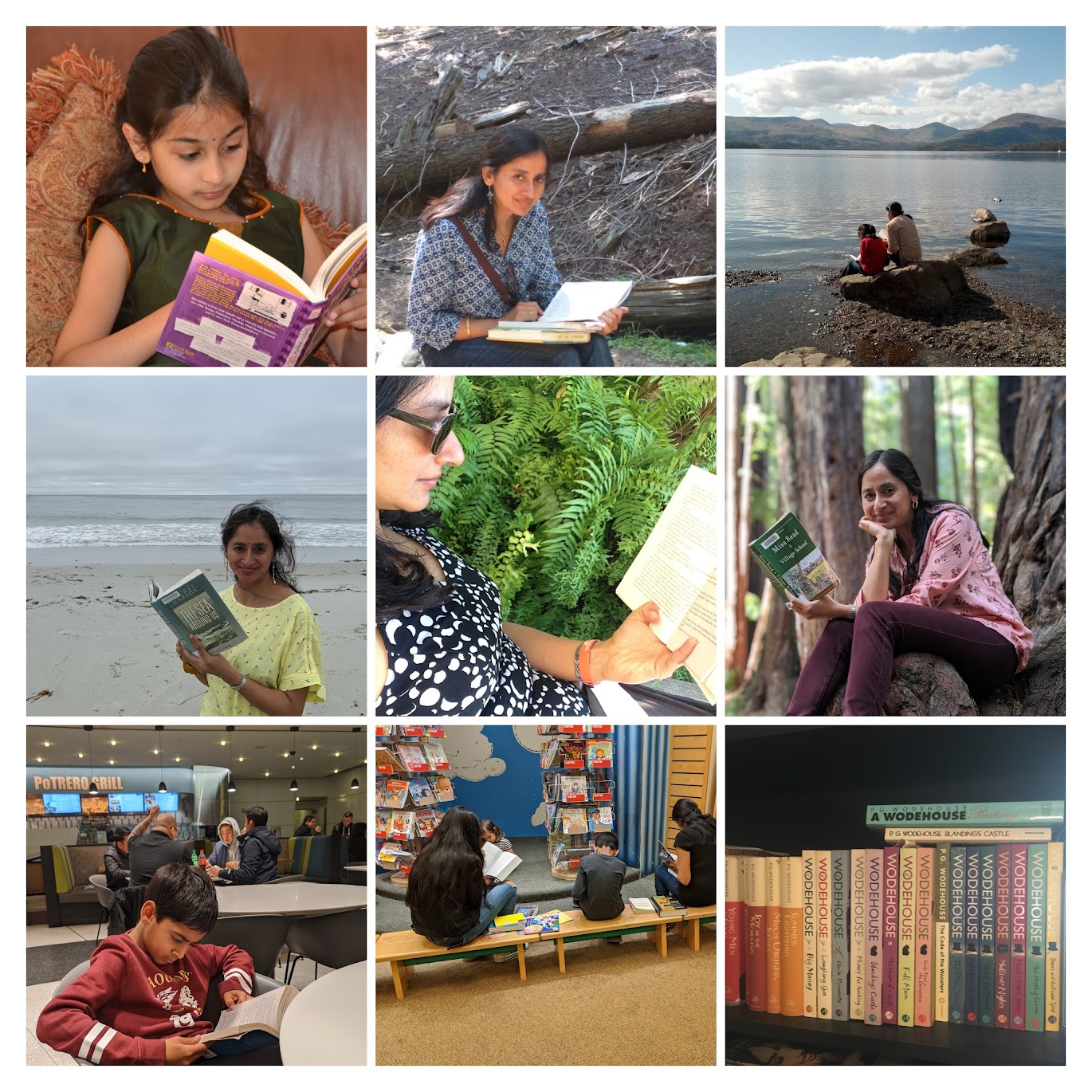
Wish this librocubilarist (one who enjoys reading in bed) luck.  The more I read about words like librocubicularist and lectiophile (one who loves reading), the more I am grateful for the reading habit. The ability to dip into a different dimension, learn something new, and roll beautiful ideas around in the head before sleep is precious. No matter how humdrum the days, how mired in the human aspect of living we are;  a good sip of ideas before bed can uplift the spirits before blessed sleep claims our consciousness.  By virtue of being in a better spot, aren’t our dreams that much sweeter? I suppose they are.

Reading with the children

Amidst the chaos of earning a living, and living the life one has earned, sundry to-do lists get longer and longer. The bedside still needs managing. 

Imagine my surprise then, when a friend stopped by on Christmas Day with a gift for the home. One she said reminded her of me. An antique piece of furniture – a desk that could hold my piles of reading material, and shaped like an encyclopedia.

I plan to wear the pajamas that another kind friend had gifted me for my birthday saying: “My week-end is all booked up”, and get my bedside in order.

My dear indulgent friends and family spoil me so, and I am grateful for it.

Next up: 2021 Reading List

In the Infinities of the Desert

Driving on deserted roads through the desert can be quite unnerving if you haven’t the right company. I remember thinking of those brave folks who ran marathons across the Sahara desert with nothing but a compass for company, and I must say I felt all the more grateful for the companionship that I did have in the bleak desert just then (Girls trips have a joy of their own!). There are times when one feels alright alone with a compass and the stars for company, but that day it felt just right to have your friends about you – squealing and laughing at the jokes and the non-jokes with equal joy.

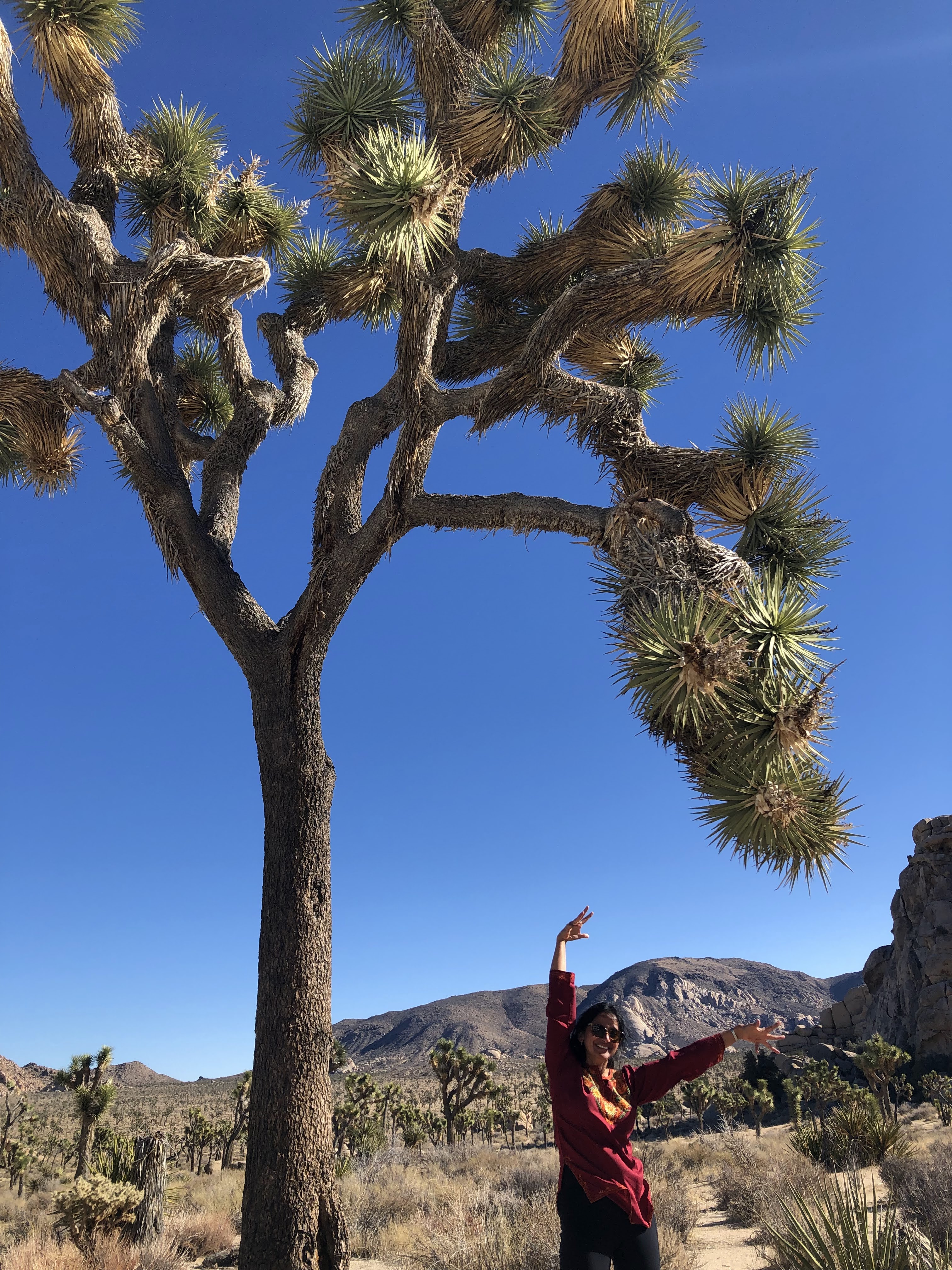
We had been to Joshua Tree National Park during the day. The park literature spoke highly of Cholla Cactus Gardens, and I must say I was yearning to see them too. After the tall tree-like cacti of Sedona, Arizona, I was curious to see their west-side cousins. Would they be dwarfish like their tree brethren? The Joshua trees were nothing like trees, but were trees alright. What would the cacti be like?

The cacti, it turns out, were beautiful. They sort of creep up on you when you least expect it. There are miles and miles of desert, punctuated with outsized boulders on all sides. The boulders! Really – some of them were the size of buildings just sitting out there with the wind whooshing past them, and the sun beating down on them.

The Boulders!

Desolate, barren, comical. I suppose they would make marvelous spots to star-gaze in. (It is a desperate thing to yearn for the night skies on a bright, windy day, but the signs for star gazing were there everywhere. It sounded marvelous,. I have seen pictures of star trails in the Joshua Tree National Park area, and could only imagine the thousands of stars visible in the night sky from there. ) 

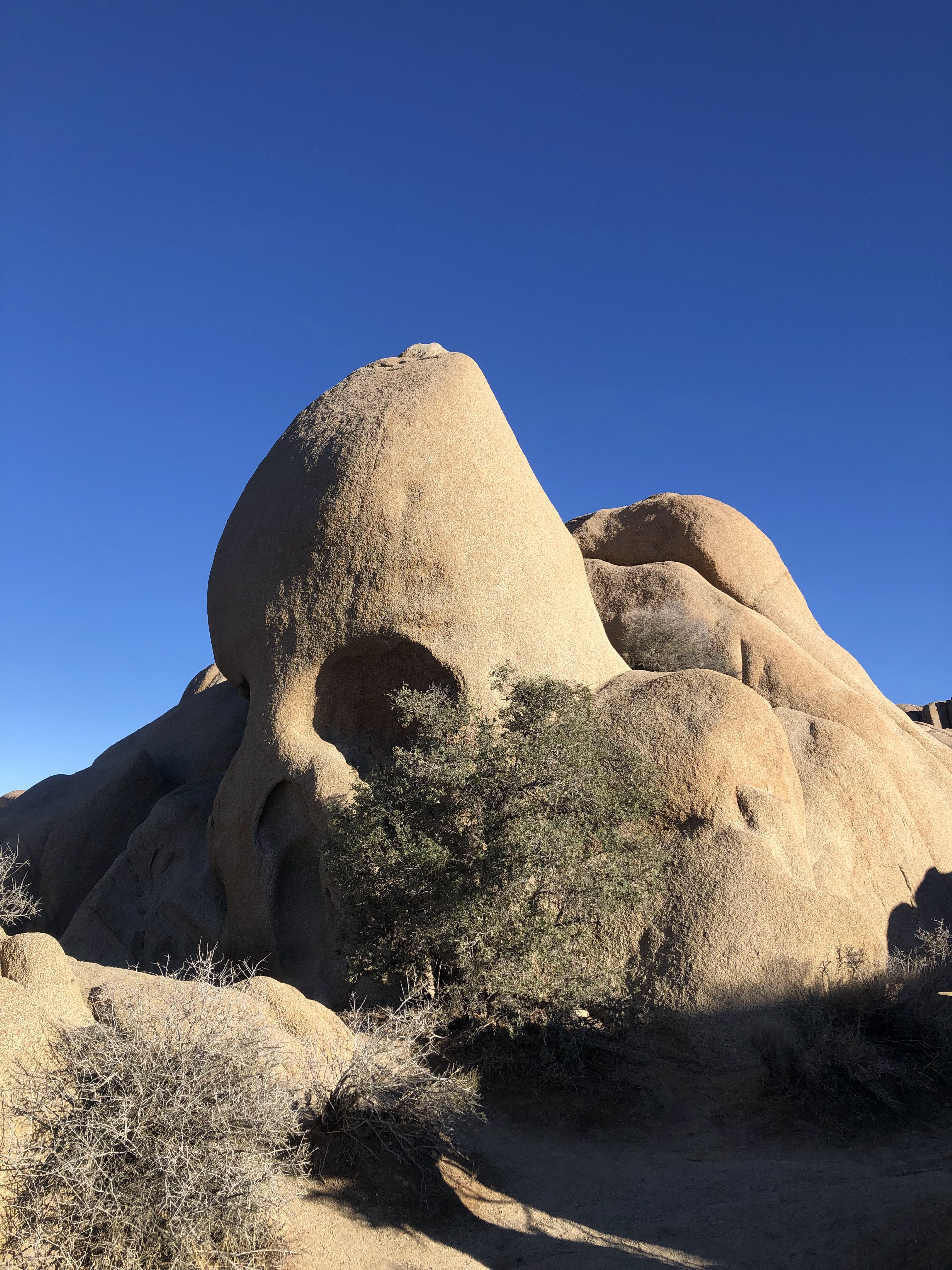
Skull Rock

The cactus gardens grew there in the middle of the desert, elegantly shimmering in the rays of the sun. Round a bend, when you’re least expecting it, the cactus gardens open up (not the same beautiful as William’s Wordsworth daffodils of course, but a different kind of beauty altogether). A beautiful array of life – glinting in the desert sun, reminding you of the resilience of life on this planet. There were beautiful in their own way. They reminded me of coral reefs – only in the desert and bathed in brown hues. 

We approached a happy couple coming our way to take a picture of us. They glowed in the setting sun, and beamed. They had apparently gotten engaged to each other a few minutes ago, and were bursting with happiness to share this with us: fellow human beings, who were there at the time. We wished them both happiness together. It was a beautiful feeling of strangers sharing their happiness and good wishes. We may never meet again, but that moment of their happiness was ours to remember. 

The cactus bore testimony to human paths forging a life together, the boulders : indifferent, but providing the backdrop for a proposal and an engagement, the Joshua trees branches of every shape delivering a message of love. 

In the infinities of the desert, there was a small pause: punctuations of happiness, and joy. 

Where the Wild Girls Are

Every once in while we get to step in to a world different than our own, and the only thing that reminds you of your earthly existence are your earthly companions. Would space travel be the same way? Would an exotic alien world be made habitable with our companions? I know not, maybe our future generations will find out.

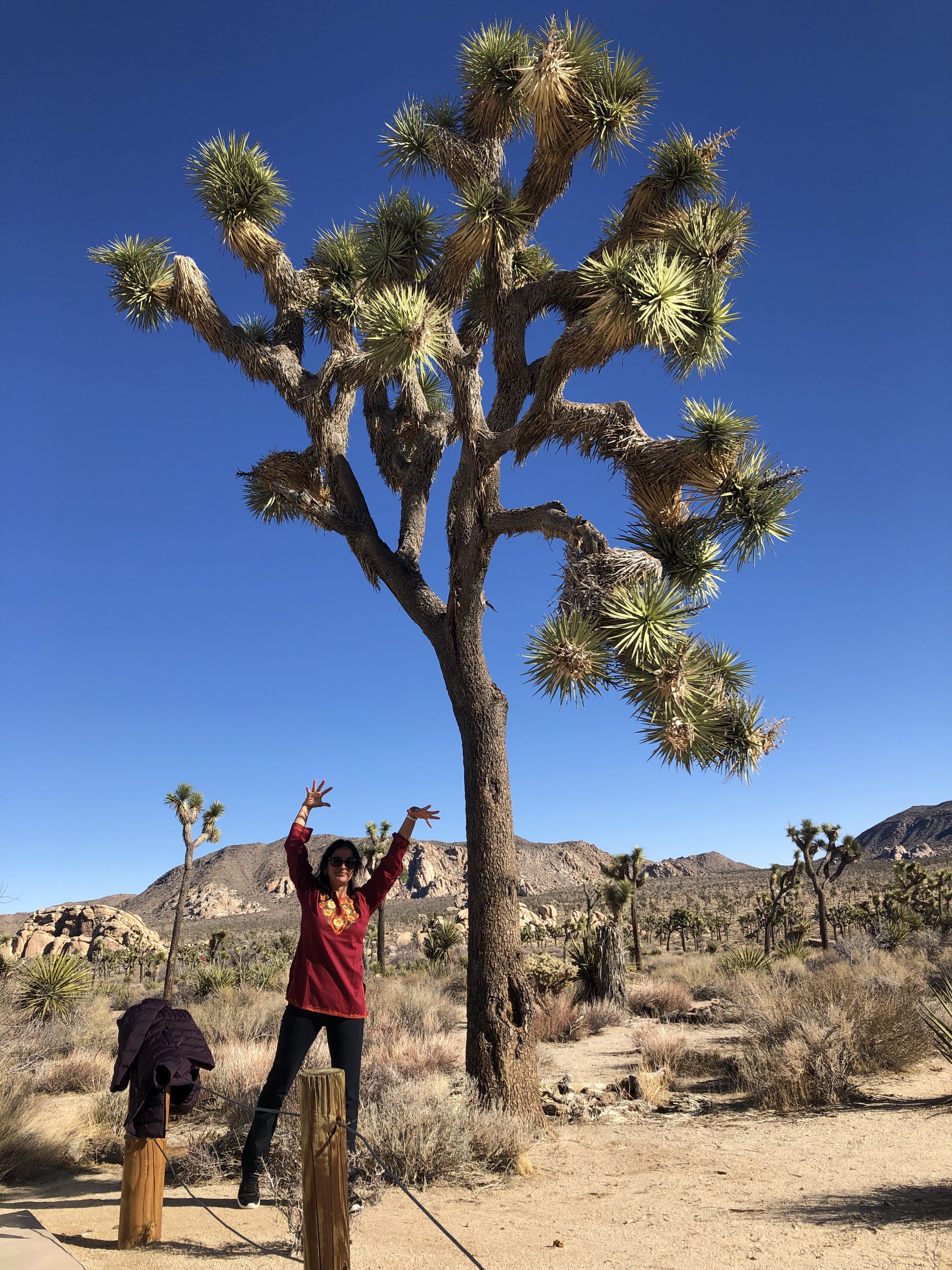
Traveling to a place Where the Wild Things Are or to one of Dr Seuss’ landscapes is a unique opportunity. I have to admit I had not read the National Park Service’s description of the Joshua Trees on their site. They called it Dr Seuss’s trees. I felt the same. Dr Seuss lived not far from Joshua Tree National Park after all, and I am sure he took inspiration from these curious curvy alphabetic trees for his many books. (The one on alphabets, On Beyond Zebra. The Wum, Humpfm, Thnad that seem to go past the twenty six that we do know; or the trees that Horton the Elephant sits on while hatching his egg for instance.) 

The Joshua trees have a life lesson or two to impart. 

Each tree seems determined to leave an imprint on the planet. Like the illustrious bristlecone trees up further north, the Joshua trees seem to chart a unique path for themselves. Each tree resorted to a rule of no rules. I saw no two trees branch out similarly. Some took to elegant and simple forms, while others reveled in the complicated heiroglyphics to decode the essence of living.

They seem to have taken Mary Oliver’s poem to heart – every one of them.

Tell me, what is it you plan to do

with your one wild and precious life?

Mary Oliver, The Summer Day

How does one become a tree? Like this 

Or like this?

I know not. All I know is that life holds precious moments for those who attempt to become one, and the resulting camaraderie and joy of dancing and chatting in the deserts with one’s dear companions takes on a refreshing feeling that one can savor and smile at when Google Photos reminds you days afterward. 

Where the Wild Girls Are

If life is meant to be lived, live them like Joshua trees or Bristlecone trees  – hardy, beautiful, resilient, joyful and in the quiet companionship of your fellow souls journeying with you through this exotic world. 

Windy Day Adventures

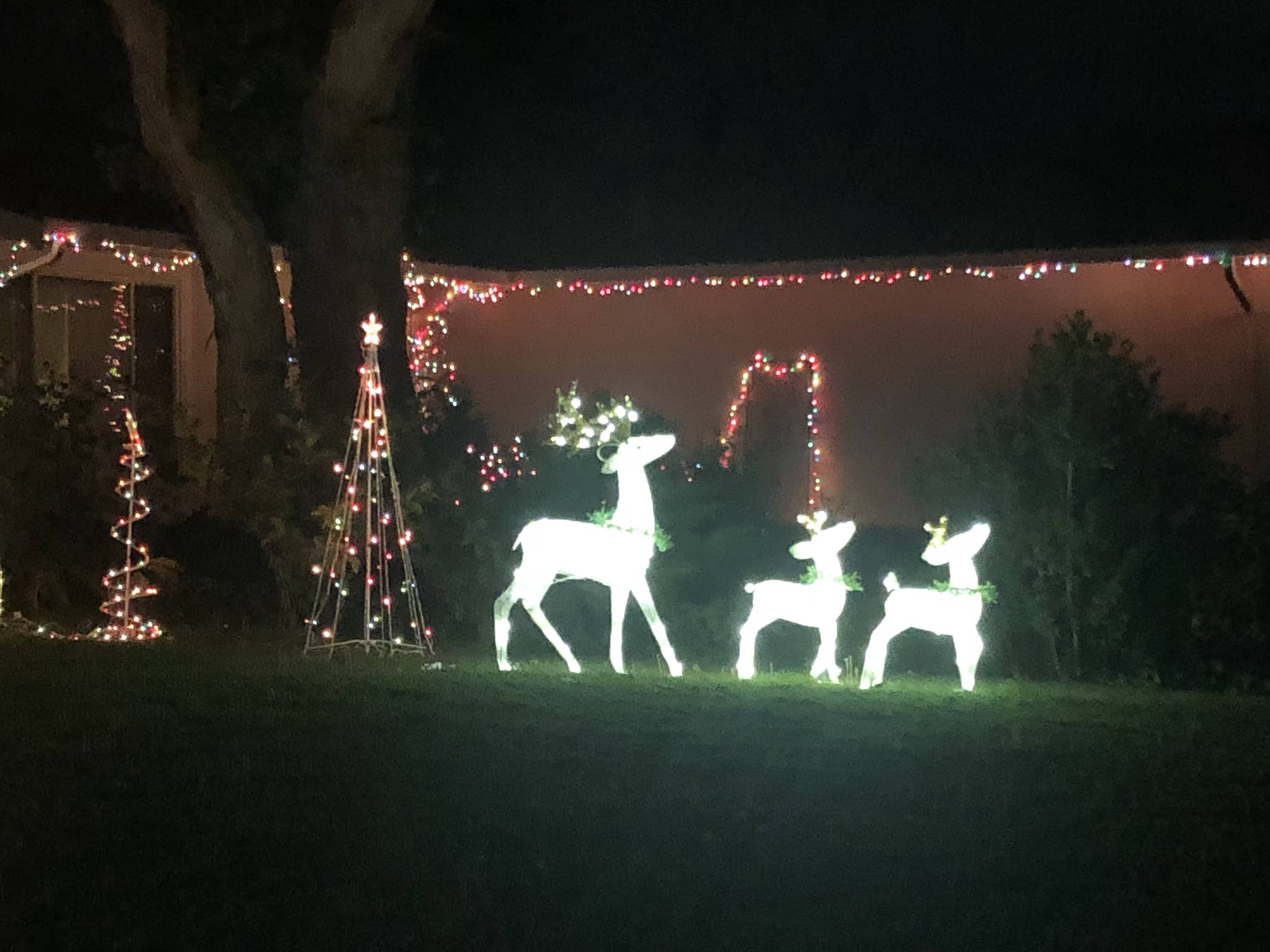
An evening walk during the Christmas season is uplifting for the spirit even if one’s nose glows like Rudolph the red nosed reindeer’s with the cold. I stop here and there admiring the lawns lit up with reindeer. They remind me of the patronus charms in the Harry Potter series and make me smile. If there were this many patronuses around us, the dementors would have no chance would they?

One particularly wind whipped evening, I was out on a brisk walk. Brisk, partly to get warm, but partly because the winds were pushing me along with vigor. I was trying to keep my umbrella from flipping, and I was more distracted than usual. I did not stop to admire the trees swaying in the winds, and only managed to skittle away when a largish twig or two broke off from the branches above. 

When I stepped into the house a few minutes later, I said to the son, “ I saw the drunken polar bears lying on their sides, while the penguins huddled together like they do during the harsh winters in the Antarctic!”

“What?!” He said laughing. He looked happy and warm epitomizing the Hygge sentiments the Eastern Europeans gave us a word for. He was reading a book, listening to music and munching cookies with warm milk. His hair was plastered down and looked almost kempt (not unkempt but not exactly tidy).  I, on the other hand, came back with half the hair on my head pointing towards Iceland and the other half making a distinct beeline for Patagonia in South America.

It was after a dog out on a walk with its owner gave me an annoyed bark that I snapped to my senses and folded the umbrella. I had been wielding the umbrella like Captain America and his shield, and having as much success as a muggle producing a patronus charm. The winds were making me stagger and I hadn’t noticed the poor dog out on its evening walk till I almost walked into said dog. I stopped and looked contrite enough for the dog to give me a lopsided nod of the head before proceeding. The absence of the umbrella dance, and the amused expression on the dog’s face seemed to tickle a nerve somewhere, and the rest of the walk took on a gentle humor of its own.

The Christmas decorations were having a whale of a time in the gale force winds, and I was bursting with the joy of this whimsical take on the Christmas decorations in the neighborhood. I wondered what the deer that usually graze nearby thought of their patronus like brethren. Were they worried by the bright polar bears, chipmunks and Santa Clauses? How would it be to really fathom what the animals thought of us and our customs, and our lifestyles? I remember reading a short story by Louisa May Alcott a while ago on a girl who could talk to birds.

“Here is a riddle for you! The polar bears are lying drunk, while the penguins ..”

He gave me a mock-sorry look, and said, “Let’s get you warm – the cold has gotten to you maybe?” he said shepherding me away from the door lest I ask him to step out.

I pointed to the window and the son guffawed at the drunken-bear-penguin-dance take on the Christmas decorations on the lawns in the neighborhood. 

P.S: Wind Classifications

The wind classification charts that I managed to look up once I was safely tucked in bed after feeling had crept back into the extremities said that the winds outside had been either a level 7 or level 8 wind meaning gale force winds.

Dream Boats

Oh! Books! Marvelous Books! 📚

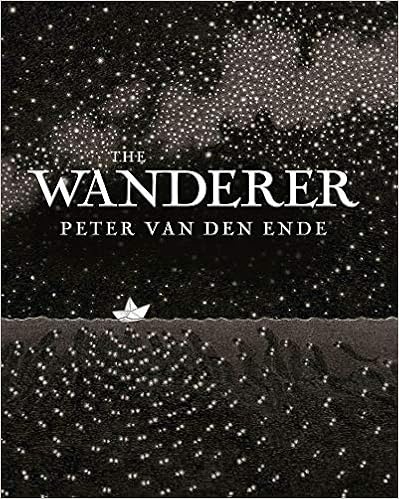
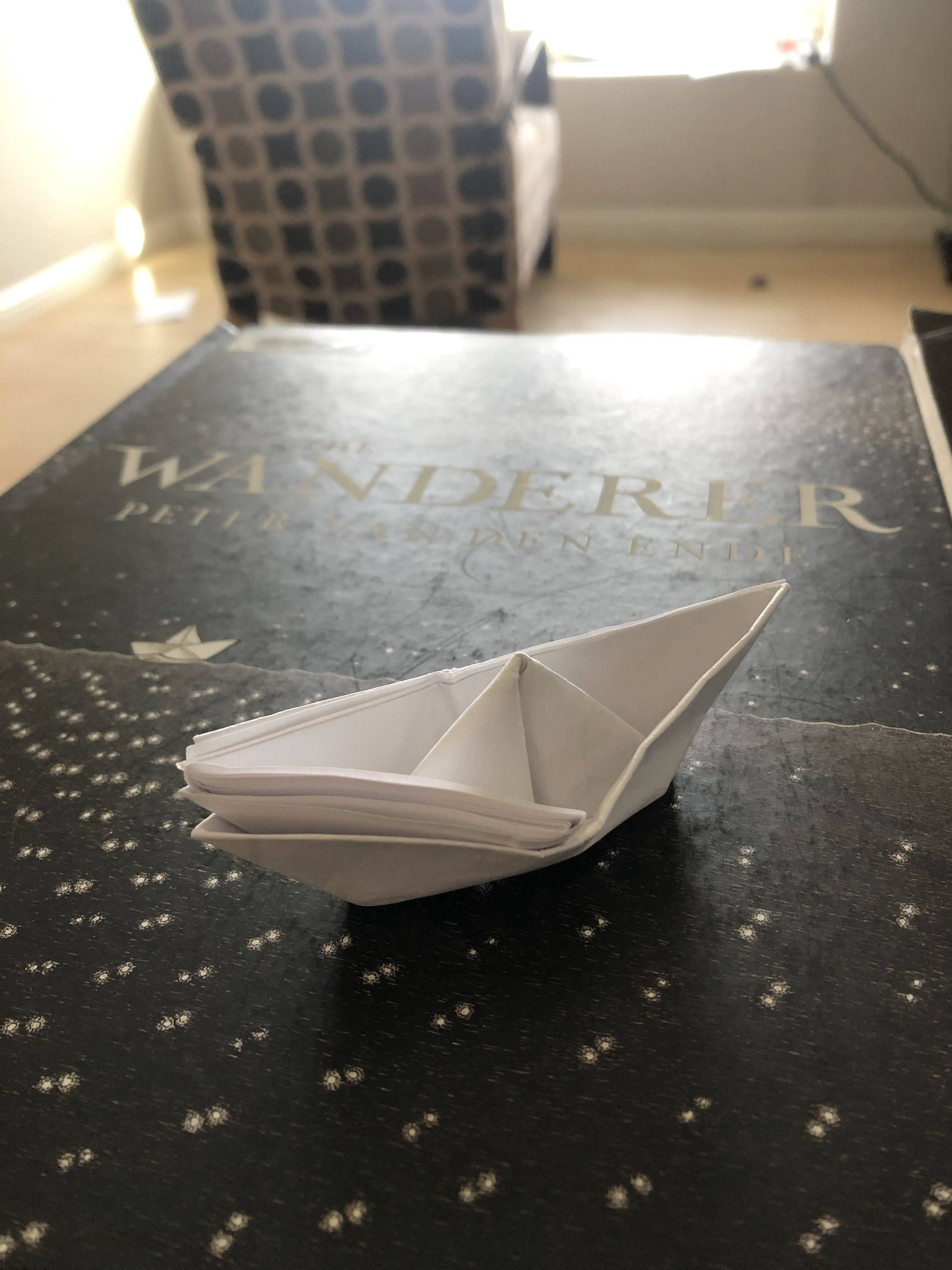
I am so grateful to live in a world that has an abundance of books. Take this one for instance: The Wanderer – By Peter Van Den Ende.

Paper boats have held a fascination all its own. The oceans must’ve been the first great frontier that humankind was enthralled by. How we came to design boats in the manner we do now must be an interesting journey. Why this shape – why not in the shape of a whale, or a swan with paddlers underneath? 

How long have boat designs stayed in this cup shape that floats? 

I remember making paper boats all the time. Setting them to sail on little puddles or watch them scooting along with a fast flowing rivulet of the rainwaters. Either way, the joy is never dampened, though the paper may be (please pardon the pun). Some folks made paper planes pretty well, but the paper boats were my little special things. I made them out of napkins in restaurants, out of spare paper in schools and work spots, and chocolate wrappers. I wrote poems on Puddle Boats, The Dream Weaver. A boat has an endless fascination: a mystical vessel with its ability to journey into places unknown, and encounter adventures unimaginable. Which child has not enjoyed the finale of The Adventures of Dr Doolittle even if the rest of the book did not enthrall?

Imagine my joy then in seeing this book. I had no words, and neither did the book.

Some books capture the heart’s yearning with no words at all. The Wanderer by Van Deck Ende is one of them. A simple concept, one that any one who has played with paper boats in rain puddles, rivulets and streams has often dreamed off. It takes a true artist though to capture those dreams and meanderings onto paper for others to enjoy. And an exemplary one to make the possibilities even better with monochromatic themes.

The little paper boat starts its journey off simply enough. As it traverses streams, rivers, oceans, and peeks into lakes, the pages come alive.

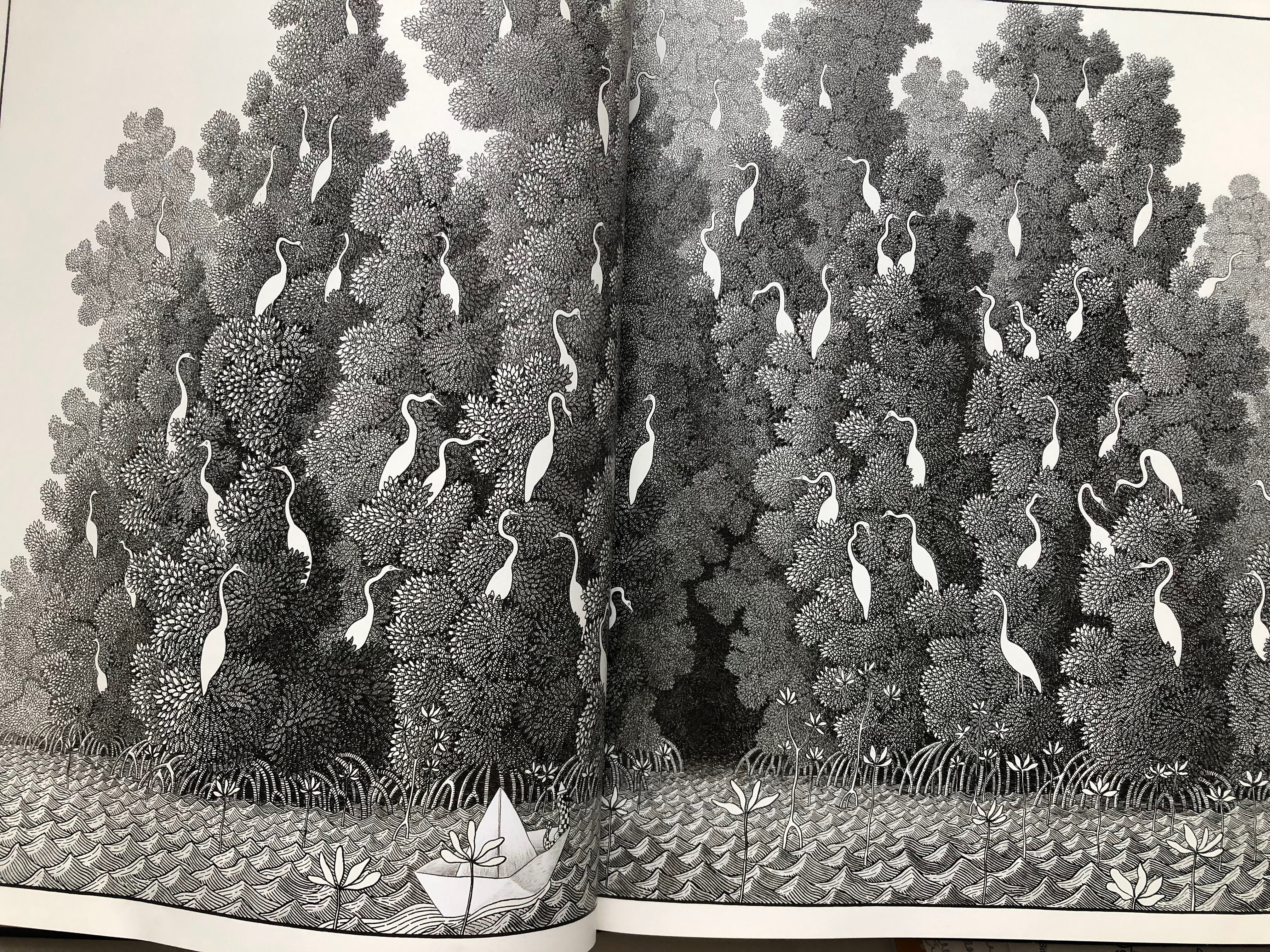
Whether you look around above the waters and take in the egrets and herons by the lake

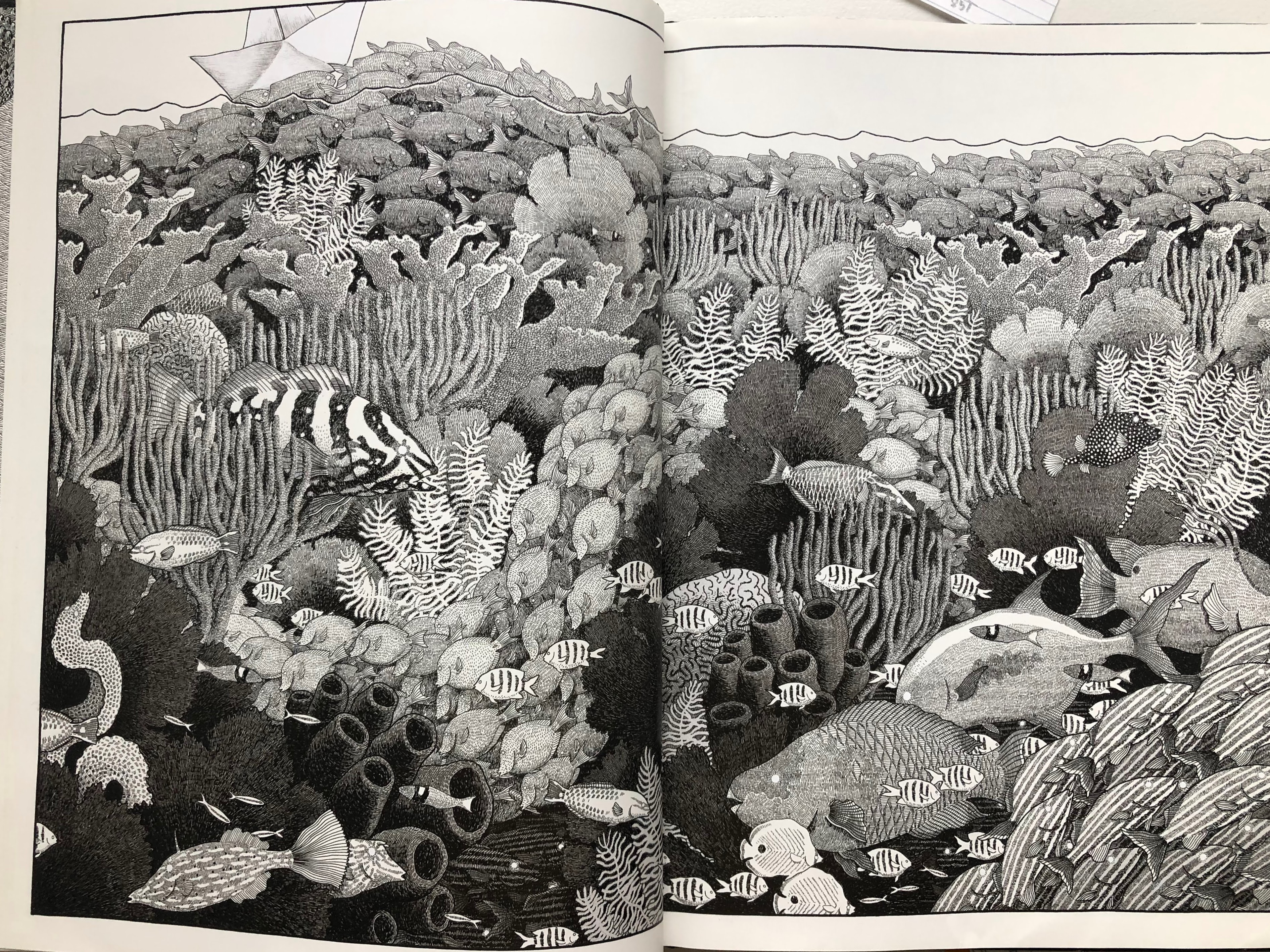
Or peek into the depths of the ocean below and take in the sights of the reefs and whales below, this book is sure to take us on a journey of a lifetime. 

Every page is a different destination on its own, and every stop along the way adds unto a wonderful journey.

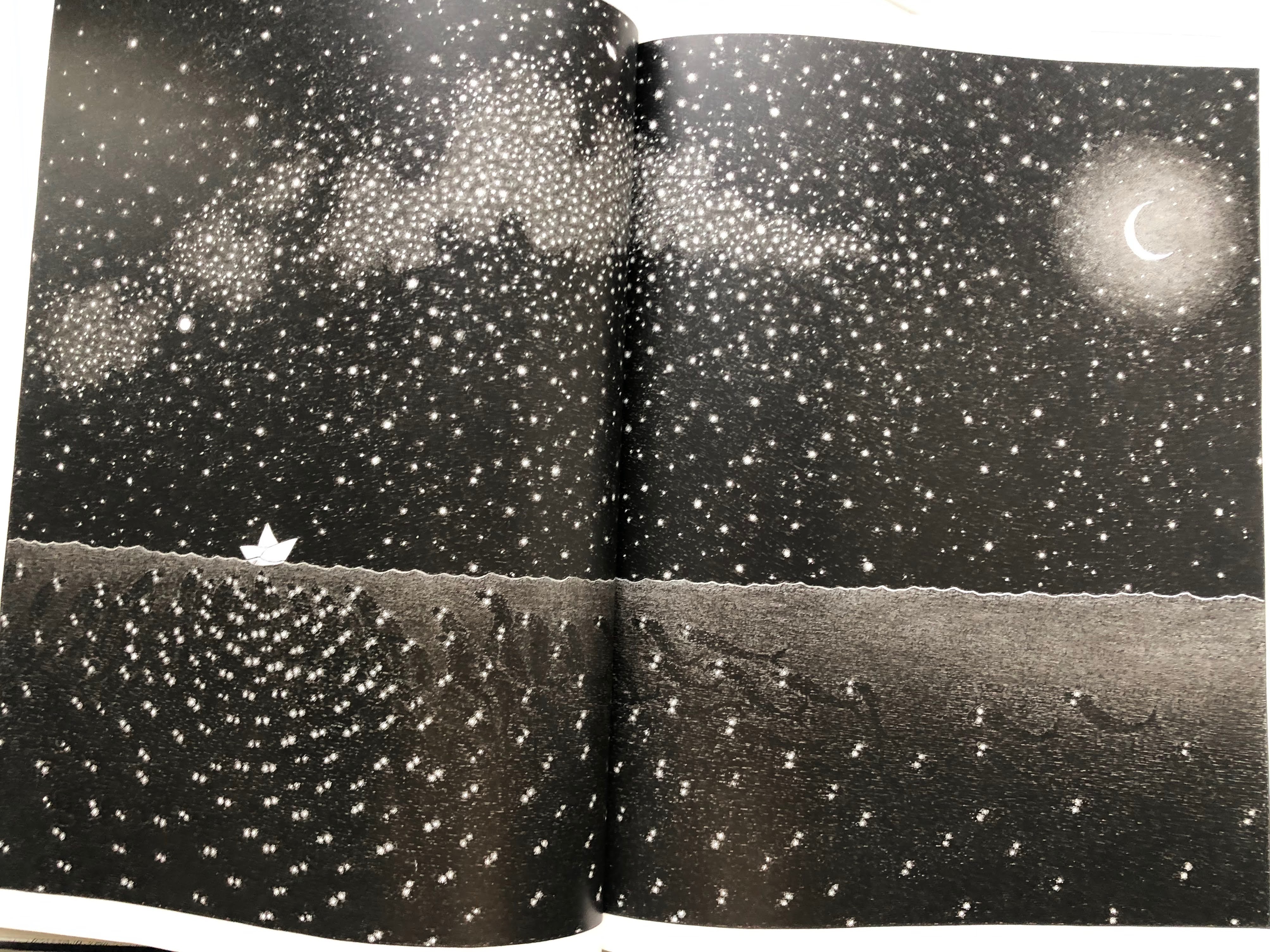
What a marvelous book! The above are a few sample pictures taken from the book to enable a review. The book has many more.

Tonight, after all is quiet, and the world can be left to its own devices, and the land of dreamlands can be entered; these images should help us along to the beautiful lands of possibility.