Essential or Eternal Communication?

I recently read a book called The Hidden Life of Trees written by a forester, Peter Wohlleben.
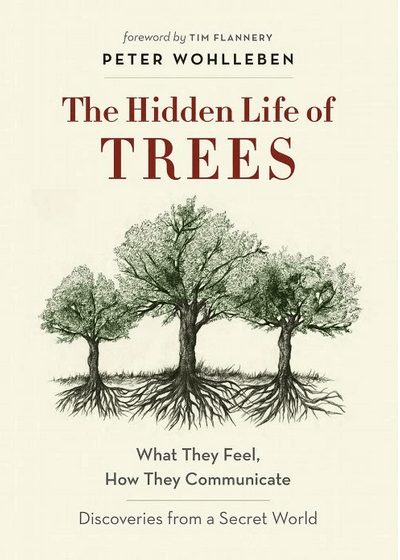
Screen Shot 2017-03-14 at 8.59.19 AM

Trees have always fascinated me. I have tried becoming one with little success.

Their calm, stoic essence of being is reassuring. Trees are social beings, and they are capable of immense internal processes that not only sustain their lives, but also those of others around them.

Reading the book is like dipping into a life that we as a race can barely contemplate for as the author reminds us in the book, trees live life in the slow lane, and that is what made the reading experience refreshing. It is largely based on observations and of the forester’s study on the forests he helps to manage. Throughout the book, he cites relevant research studies that have been carried by botanists.

Trees are social beings and know that they can thrive if they look out for one another. Many interesting anecdotes dot the book such as the one with the giraffes chomping down the leaves of the acacia trees in the Savannah.

The giraffes there were feeding on umbrella thorn acacias, and the trees didn’t like this one bit. It took the acacias mere minutes to start pumping toxic substances into their leaves to rid themselves of the large herbivores.

The acacia trees that were being eaten gave off a warning gas (specifically, ethylene) that signaled to neighboring trees of the same species that a crisis was at hand. Right away, all the forewarned trees also pumped toxins into their leaves to prepare themselves. The giraffes were wise to this game and therefore moved farther away to a part of the savannah where they could find trees that were oblivious to what was going on. Or else they moved upwind.

How beautifully nature equipped the trees and giraffes for survival.

After reading about how effectively and essentially Trees communicate, I could not help comparing and contrasting our lives with those of our stoic friends. This frenzied communication lifestyle we have adapted as our own, often leads to amusing outcomes, but sometimes to questionable ones.

One morning, I set out to enjoy a leisurely week-end breakfast with the children. When the menu card says ‘Noodles’, the beaming sous chef in the home is more active than is called for. I doubt restaurant kitchens have sous chefs standing on chairs next to the chef gabbling instructions for all to hear, but our kitchen does.

AF1QipPGhzxZ4rpk1xkI0U0emQ8aWQ9bWbIm6mGj3v3r=I.jpg

Minutes later, we clattered down with our bowls of steaming instant noodles – there is something deeply satisfying about slurping the long noodle strings noisily, and reveling in the liberating feeling of not being governed by the ticking minutes of the clock for a change.

I was doing my best to ignore the incessant modes of communication that is our bane today, but I was still interrupted with the International Phone Call.  On the call, I was given the shocking news that Facebook, Twitter, and WhatsApp had been vying to give me, and told to check it all immediately. Apparently, the noodles I was eating that very day had 17% lead content. 17% lead. Funny because I did not feel like I had a metal tube lodged in my intestines after eating it, nor did I feel like an old ceiling waiting to be torn down. What it meant to say of course is that there were supposedly 17 parts per million of lead in the offending food item, a claim that in itself proved to be baseless later on.

lead

Quote from link: http://nextdraft.com/archives/n20170310/leaky-gut-reaction/

The wrongness of the initial stories is the result of a perfect storm of three factors: Technical subject matter, a master of disinformation, and always on race to publish stories quickly. It’s yet another reminder of the Internet’s five least common words: Let me think about that.

Should we learn the art of essential communication, and develop the ability to chaff it from the demands of eternal communication? Maybe learn a lesson or two from our stoic friends.

For a quick read: https://www.brainpickings.org/2016/09/26/the-hidden-life-of-trees-peter-wohlleben/

How To Become Dandelions?

I have wracked my mind to find what it is I would like to share about Women’s Day. Surely, I have something to say. Everyone had something to say: We celebrate women, we demand equality and abhor the crimes committed against womenkind. Yet, there I was on the sidelines still twiddling my thumbs and looking lost. Some said ‘Happy Something’. The day passed, and I must say critics would call the tripe I had written ‘pedantic and whiny’, and what is more, I would have to agree with them wholeheartedly and shake their hands for the right choice of words.

I mostly like being female.

Except when I am told not to laugh too much because I am a girl #Direnkahkaha anyone?

Or when I am told not to apologize. I am sorry, did I step on your toes? Tough Luck Buddy! Hee Her Haw Haw….

NY Times: When an apology is anything but

Or being told to be a man to be a woman. Huh?!

Medium: Leveling both sides of….

I mostly like being female. I say mostly because there are times when I feel being a dandelion would be better. You know a gust of wind would take care of reproduction, and one does not have to worry so much about being a female dandelion or a male dandelion, and policy makers do not have to concern themselves about dandelion population. We don’t yet know how to interpret dandelion communication, but when I see a circle of dandelions, I see a beautifully androgynous group reveling in each other’s company – till a deer comes along and chomps them down of course. (We recently read this sunny little children’s book.)

Screen Shot 2017-03-08 at 9.35.01 AM.png

So, what is with reproduction? Human beings are obsessed with reproduction though it is established beyond doubt that the human race is in no jeopardy. We are always in danger of nuking ourselves of course, but that is idiocy not procreation – quite different.

I remember clearly one hot summer afternoon several years ago.  I had just had the son, and his doting older sister was casting adoring glances at her infant brother. She told me that her first grade classroom had sang congratulations for her that day when she told them she had a baby brother. ‘Though, it is a lot of work Amma.’ she said looking solicitous. I was touched by her observation and told her about imagining a lifetime of hot summers with a new baby every other year. She whooped and said golly and giggled like elementary school children do, and I went on to tell her about my stellar grandmother who had nine children, all bawling, healthy and hungry.

Why didn’t she stop with two or even three? Nine seems like so much. she said in a matter-of-fact tone, and I told her in terms as best as I could about how the concept of planning one’s family size itself was a luxury only afforded to the past two or three generations. How many children to have and when to have them was not things women controlled then, I said.

grandma

I am saddened indeed that on International Women’s Day (about a century after this day was officially set up), this news item pops up.

Planned Parenthood rejects Trump proposal to stop abortion services – CNNPolitics.com

What will it take for reproductive choices for Women to become a civil liberty?

Back to the Dandelion theory, wouldn’t it be nice to just have have a storm knock the wind out of us, scatter and reproduce thus – all of us men and women. I’d like to see whether men will control the wind intensity and direction of the wind then.

I can barely state things better than Melinda Gates though:

https://www.gatesnotes.com/2017-Annual-Letter

Towards becoming Dandelions then!

Of Hailstones & Laundry Baskets

“I have a great idea! “, said the kindergartener. His face was shining with excitement. I braced myself and nodded for him to go on. I had between my teeth, a clip that threatened to tie my tongue together, my hands were yanking a large unruly mess of hair into a pony-tail for the daughter, and the stove was hissing ominously.

“Why don’t I wear the red laundry basket to school?” said the kindergartener. That tied my tongue, the daughter yelped because I pulled on the hair making her pony tail look like a sausage through a tree, and the stove boiled over.

The past week has been a whimsical one. It was ‘Read Across America’ week to honor Theodore Seuss Geisel’s birthday and the little world around us lit up. In Elementary schools, everyday of the week, it seemed, was a special one, and fliers exhorted all of us to jump in. I love the Elementary school age-group when the human mind is at its most creative, supple and fertile and is bursting at its seams with curiosity and enthusiasm.

Wear As Many Colors As You Can Day
Crazy Hat Day (the red laundry basket is always being worn as a hat by the toddler at home, and he thought it was a marvelous idea to go like that to school)
Favorite Story Book Character Day
What Do You Want To Become Day (What do you want to be?)
Mismatched Fox in Socks Day

Somewhere along the line, we lose that element of fun, and I admire how children can help us tap into it at times. The past week was a hectic one, but I must say that I enjoyed wearing mismatched socks on purpose just as much as the children did. There were times during the stern day when I smiled to myself thinking of my striped sock and my polka dotted mismatched socks that had resulted in so such mirth in the morning rush.

I had with all good intentions gotten a biography of Dr Seuss to read before his birthday, but in my typical feather brained inefficiency had not so much as moved past the Prelude to the Introduction (why do books do that?) So, the Dr Seuss post would just have to wait.

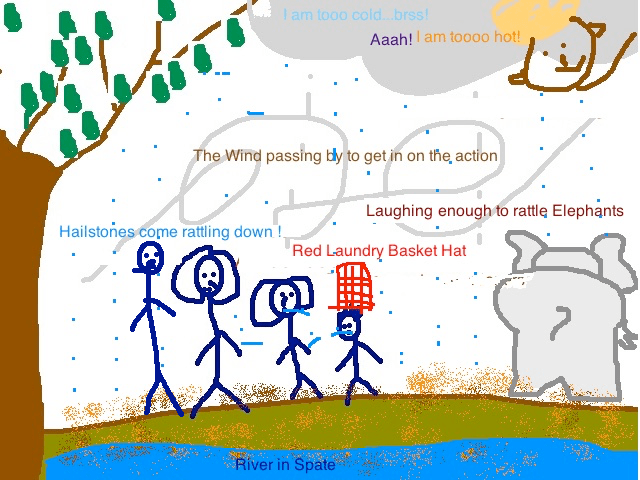
Dr Seuss was very much on our minds as we stepped out for a walk by a river to wrap up the week. There we were, ambling along a roaring river with the backdrop of the mountains in the distance. It was also a deceptively cold day(I am too cold), for there were patches of sun(I am too hot), patches of dark grey clouds scudded past the cumulonimbus clouds and the wind whooshing at times knocked off our hats (not laundry baskets.)

drseuss.jpg

Minutes into the walk, we were stringing together nonsense Seuss-ian style and cackling:
I am too cold
I am too hot
Why are you always too something?
I thought you were five
No I am not five cold
I am not five hot
I am too cold
I am not two but too
I thought you were five

And so it went….

You know how they tell you in these be-calm lessons not to do anything suddenly? Ignore it. For suddenly, the rain pelted down, and not just that, it pelted down with hail stones. Silly or not, being pelted with hailstones is amusing and annoying especially when the good intentioned mother did not bring an umbrella on a walk. But the toddler tackled the problem with a whining grace. He ducked under his jacket and we raced to a tree, and stood under the tree sticking our tongues and hands out to catch the hailstones.

“Eat it”, I said as I popped a hailstone into my mouth.
“What? No! Amma! You cannot do that. “
“Yes you can – you may like it. Try it Try it if you may.”
“Say! I like Green Eggs and Ham”, finished the toddler and popped in the hailstone looking amused.

Colors

It is perfectly normal to be mistaken for normal if you wear laundry baskets and eat hailstones, thanks to Dr Seuss.

https://www.brainpickings.org/2015/07/29/what-pet-should-i-get-dr-seuss/

Good Food Mood

This article was published in The Hindu 

Some of my articles, especially ones that involve the night sky have me pondering on the nature of our existence and how minuscule we are in the scheme of things. The precise sequence of things that led to this particular form of life on this planet and so on. Generally, the night sky is simply a becalming experience that inspires humility, and some vague musings.

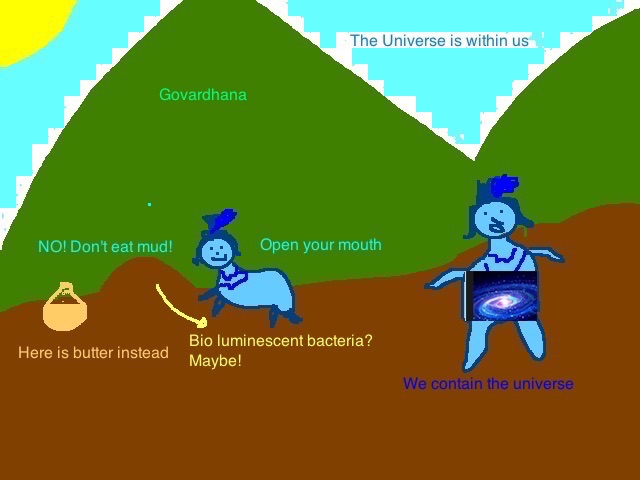
The scale of the universe is one that is awe inspiring. We are minuscule compared to the universe, but we also contain millions of minuscule particles compared to our own size. As far as the microbes are concerned, we, each of us: deer, goose, humans are a universe unto ourselves. There is something deeply spiritual in that : we contain multitudes and we enable multitudes. The diversity and beauty of the microbial world is immense, and one that is still emerging in our understanding of it. With the sound of rain pattering outside, I was sitting snugly inside reading I Contain Multitudes by Ed Yong, stopping every now and then to read out an interesting piece to the children.

Ayar padi maligaiyil thaai madiyalil kanrinnai pol
ஆயர்பாடி மாளிகையில் தாய் மடியில் கன்றினைப்போல்
maya kana thoongugindran thaalaelo
மாயக்கண்ணன் தூங்குகின்றான் தாலேலோ
Avan vaai niraiya mannai undu mandalathai kaatiya pin
அவன் வாய் நிறைய மண்ணை உண்டு மண்டலத்தை காட்டிய பின்

Roughly translates to: Here is little Krishna, sleeping like a little calf after eating a handful of mud and showing us the universe within it.

The son played the video for the nth time on the television, and the daughter said, “Oh no – not that again. How many times will you see that video?”

“See…see here – when baby Krishna opens his mouth, his mom can see the whole universe inside it. The whole universe!” he says his eyes widening, quite unable to comprehend why this fact is not as astounding to his elder sister.

“Yes – but you said that already.”

“I always watch what you are seeing!” said the fellow stung at this accusation of hogging the television. His sister scowled, the toddler tensed and I sensed it was time for dinner before the situation escalated, and rivers of tears joined the gurgling rivers of rainwater outside.

Inside the house, we sat down around the dinner table with hot food and slurped at it. We kept getting interrupted by alerts giving us flash flood warnings, and it increased the gratitude for being inside, relishing warm food and enjoying one another’s company. Minutes into the meal, the situation had considerably lightened and the children were rolling off their chair giggling at something inane. I watched them bemused.

Countless writers have written about the effects of good food. Jerome K Jerome from Three Men in a Boat goes on to describe the effects in great detail:

It is very strange, this domination of our intellect by our digestive organs. We cannot work, we cannot think unless our stomach wills so. It dictates to us our emotions, our passions. After eggs and bacon it says, “Work!” After beefsteak and porter, it says, “Sleep”. After a cup of tea(two spoonfuls for each cup, and don’t let it stand for more than 3 minutes), it says to the brain, “Now rise and show your strength. Be eloquent and deep and tender; see with a clear eye, into Nature, and into life: spread your white wings of quivering thought and soar, a god like spirit over the whirling world beneath you, up through long lanes of flaming stars to the gates of eternity!”

What is it with food and mood? Is there a direct connection between the gut and the brain?

It turns out that there is. In ‘I Contain Multitudes’, Ed Yong goes on to write that there are now studies directly linking gut bacteria with mental well-being. We have a long way to go in understanding the role of gut bacteria.  Some studies indicate reduced symptoms of depression in people with irritable bowel syndromes after consuming certain types of probiotics.

If research advances enough to diagnose certain types of borderline psychiatric patients and is able to treat them with specific types of probiotics to enable well-being, would that not be great?

An excellent article on the topic by Maria Popova here: https://www.brainpickings.org/2016/08/10/i-contain-multitudes-ed-yong/

The future could hold in store for us enough advances in microbiology & genetics, to enable personalized treatment options that aims at holistic healing. That is a promising, if distant, future to strive towards.

Quote:
It is estimated that every human contains 100 trillion microbes, most of which live in our guts. By comparison the Milky Way contains between 100 million and 400 million stars.

Maybe the mud that baby Krishna swallowed contained bio luminescent bacteria that made the universe inside of him light up when he opened his mouth.

krishna_universe

Whatever it is, like Jerome K Jerome says: “We are but the veriest, sorriest slaves of our stomach, Reach not after morality and righteousness, my friends; watch vigilantly your stomach and diet it with care and judgement. Then virtue and contentment will come and reign within your heart.”

Blame The Toxos

Every once in a while a book comes along that changes the way you fundamentally view things. I Contain Multitudes by Ed Yong is one such. In the book, the author covers various types of microbes, bacteria and pathogens that we carry within ourselves or encounter in the world. A fascinating adventure awaits the reader on this microscopic journey.

The book shows us how each being is a complex symbiosis unto itself. A concept we know vaguely but appreciate deeply when we read the book.

screen-shot-2017-02-20-at-1-04-57-am

We have heard of parasitic infections that control the minds of hosts like rabies. Rabies makes its carriers aggressive and the only way for it to spread is by biting and scratching another being. ( Rabies is probably the basis for the myth of the werewolf.)

There is one particular type of parasite that is chilling in its tale. Toxoplasma Gondii or Toxo is a single celled organism that latches itself onto brains. It is also referred to in the TED talk linked below for further information.

Quote : Toxoplasma Gondii is a brain parasite otherwise known as Toxo. It can only sexually reproduce in a cat; if it gets into a rat, it suppresses the rodents natural fear of cats and replaces it with something more like sexual attraction. The rodent scurries towards the cats with fatal results, and T.gondii gets to complete its life cycle.

Toxo has been known to manipulate mammals. It makes rats run towards cats and offer themselves as prey just so toxo can reproduce. Classic tale of self destructive behavior, wouldn’t you agree? It is also proven that many humans play host to Toxo.

TED Talk by Ed Yong

The book led to many happy, wild conjectures such as:
(a) Could that be the reason Cat videos are so popular on You-tube? I mean, I have always wondered: Why Cat Videos? Why not hippo videos?

(b) Humans affected with Toxo also fare differently on personality tests, showing different trajectories when it comes to risk taking and pleasure seeking behaviors. Could a combination of Toxo and Dopamine releasing behaviors such as increased reliance on social media have engineered the elections?

It sounds like a weird sci-fi scenario: Toxo encourages self-destruction, dopamine clamors for fake news, and the world falls prey to single celled organisms manipulating mammals (us), while we run around like zombies thinking we have free will.

The understanding of human biology has fascinated mankind for centuries. But advances in microbiology itself is less than 200 hundred years old. Even then, our narrative surrounding the understanding has been harsh: Bacterial infections, germs, plagues, survival of the fittest. While there are numerous examples of these, the truth is that we also play host to a large number of helpful microbes and bacteria.

Theodore Rosebury, a microbiologist, wrote in 1928, during his research that:

“The knowledge that micro organisms can be helpful to man has never had much popular appeal, for men as a rule are more preoccupied with the danger that threatens their life than in the biological forces on which they depend. The history of warfare always proves more glamorous than accounts of co-operation.”

A fact so timeless that we ought to have it framed in halls of learning if it isn’t already.

P.S: Please watch the TED Talk by Ed Yong – it is only 13 minutes long.

Stop and Look at the Snails

After enduring a particularly long spell of drought, we are relishing the rains lashing down on us this year. The clean, fresh air after the rain is one we relish. As the toddler son and I make our way to school every morning, our heart lifts at the marvelous rainbows, the cherry blossoms starting to bloom and the beautiful snails out on the roads.

img_5103

Sometimes, we come up with silly names for the little creatures we find on our path. Turbo the Snail is always a welcome sight. Earthy Worm invokes the same curiosity if not adoration. Toby Turtle is remembered with affection, and we wonder aloud how we can find ways to hobnob more freely with turtles.

Watching the snails leave a shiny trail behind them one rainy day, we squatted there wondering whether that trail left behind by snails is poisonous. That innocent minute squatting on the sidewalk looking at snails criss-cross our path raised so many questions. It looked to us like a snail could not get very far if it had to flee a predator.

Where do they live when it is not raining and can’t move?
What if we had slippery slopes for snails? said the toddler always keen to help.
Do only snails walk the slippery slope? (completely lost on the toddler of course) and so on.

pets


“Amma, we will be late! Hurry up.” said the conscientious fellow and we galloped past the snails wondering how much there was to do in the world, and how little we manage to do.

The thought that there is so much more to be done can sneak up at you in the most unexpected moments. Like the time I was reading a love story written by Alexander McCall Smith in the book Chance Developments. The story imagined the life of a young man in Scotland using a vintage photograph of a young man helping to change a car tire in the presence of a beautiful young lady in a cream colored coat.


In the book, the young man is taking a stroll around a loch and is fascinated by some plants that many ignored because they were believed to be poisonous, but he nibbles at them lovingly almost, since his father had tried and demonstrated to him that these particular plants were not poisonous at all. He had studied the properties of the plant, and traced the origins of the myth to a Celtic folktale, and though most tales started off with a kernel of truth, this one probably did not.

How is a story as innocuous as that supposed to make one feel like there is so much to be done? Because they are so many ways in which we can remain curious, to question the this-is-how-it-is-done-s of the world. The fact that we can bust one myth just by questioning it is good. And it proves that we pave the path for one more myth to be broken and then one more.

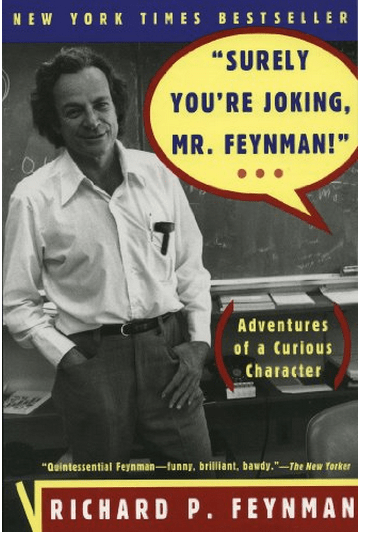
It has been a few years since I read ’Surely, You’re Joking Mr Feynman – Adventures of a Curious Character’ By Richard Feynman. I remember one passage in which the celebrated scientist talks of watching ants as they made their way around his backyard. Marveling at how they navigated obstacles placed in their path, and admiring the innate steadfastness of the species.

Screen Shot 2017-02-16 at 10.28.43 AM.png

The quest for knowledge can be a curious, interesting journey, if only we take the time to stop and look at the snails.

Richard Feynman on the Meaning of Life – Brain Pickings

The Mute Painter

A version of this post, The Colour Blue, appeared in The Hindu dated 30th January.

I had written in an earlier post about how the daughters room looked like the Flying Zoos of Babylon. It was time for a radical change.

Multiple trips to the hardware store had yielded one decision: the room was to be painted in shades of blue. It is funny how an unassuming speech-impaired mute painter influenced our choices three decades on, on the opposite side of the world.

Years ago, when I was about the daughter’s current age, we were having our house painted. Regular readers know that I lived in a small mountain village nestled in the Nilgiri Hills. One of the advantages of a small place like that was that everybody knew everybody else. The local barber came home to cut hair, the tailor stopped by our place on his way home from work. The maid knew the milkman’s wife. The train driver waved to my mother and waited while she skated down the slopes to catch the train. When the postman’s daughter wanted to marry the station master’s son, the mediating talks for the cross religious marriage were willingly handled by all of the above people.

Therefore a matter such as painting the house was just handed over to a genial pair of fellows who everyone knew did a good job. One of whom was mute – not being able to speak hardly deterred him however, and he used guttural sounds, shakes of his head and hand gestures to communicate. And when we finally got the import of what he was trying to say, he gave us one of his beaming, innocent smiles that made you want to smile too.

My father, always had a soft spot for those less abled, partly because he was hard of hearing himself, and used a hearing aid. Consequently, all of us have developed somewhat loud voices in the house: When we ask for the cereal to be passed across the table, cereals are passed across tables in all houses in the neighborhood.

When the  painter and his assistant showed up to paint the house, they asked us the colors to use to paint the house.

Cream was boring, and it showed dirt. Maybe the living room could have cream, but all other rooms could use a different color, the father said in his stentorian tones. The  painter nodded indicating that it was sound logic and that he approved of it.

Yellow for one bedroom (nod from painter.)

Light brown (beige) for another room (nod from painter)

Light pink for girl’s room (vigorous head shaking and bah-bah sounds with his hands gesturing NO)

Clearly, he did not approve of pink for my room.

‘Why?’, said the father and I in unison.

Gesturing and loud interpretations followed. Anyone who did not want to listen to what the other man had to say could simply have wrung his hands and given up. The easiest route would have been for the father to say ‘Pink it is!’ since the choice had been mine in the first place, and for the painter to just shrug and paint it since that is the way we wanted it. But all of us wanted to hear the other’s viewpoint, and even though it was difficult and somewhat hilarious to a casual observer, it was well worth it.

dumb_painter

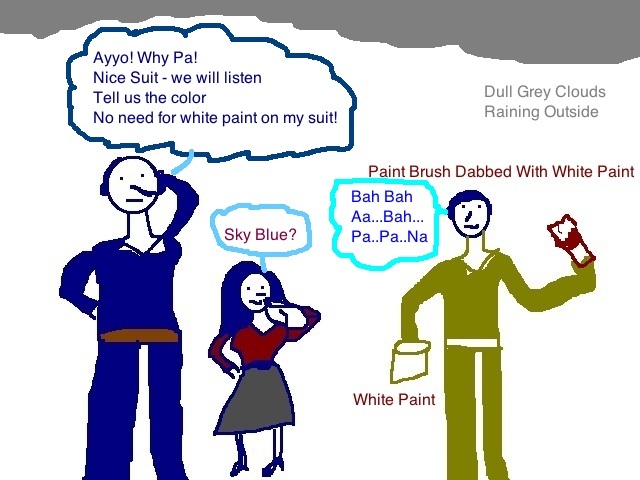
The father was wearing his favorite Navy blue striped suit. The painter used that for starters. Bah – bah, he said pointing to the dress.

‘Navy blue? Too dark pa. We want the child’s room to be bright.’ , shouted the father.

More frustrated nods greeted us at this, and the painter went and brought in a tin of white paint which he carried with him at all times by the looks of it.

He took the paint and indicated painting white over my father’s navy blue suit. I can’t say that pleased my father very much, but he managed to leap back from the paintbrush and crack a joke.

He tried several other things to make us see reason. It took a while but the painter finally huffed out towards the door, and we quizzically followed him. It was not like the good-natured fellow to huff off like that. He opened the door, braving the pouring rain outside, and he pointed up at the grey, cloudy sky and the wall and then me.

‘Sky blue?’,  I asked.

He stopped, look at me and gave me one of his beaming smiles that blessed my intelligence when it should have been doing just the opposite.

Sky blue it was. Ever since, almost every house we moved to within the campus had at least one room in light blue.

I noticed that as we were looking out color choices for the daughter’s room, I was gravitating towards the light blue, and maybe I managed to convince the daughter too, for she too was leaning towards that. In today’s world, the painter would whip out an app and show us the room in light blue, and we would have nodded our assent, the whole thing from start to finish taking less than a minute.  But, I am glad we didn’t have an app. That smile he bestowed on us would not have been half as wide had we not tried that hard to understand each other, nor would the sight of a light blue wall have any meaning.

Sometimes, hard is good. Life is after all a string of memories held together by strands of time, and the strength of the emotions in our interpretations and recollections.

IMG_4955.JPG

I do not know whether the painter remembers this, but I remembered him in the room that day as I regaled the tale to the family. We dabbed on the first stroke of sky blue paint to test the color, and smiled at each other, as wholeheartedly as if the silent speech-impaired painter had convinced us.

Would You Rather?

On a recent trip, we were caught up in a snow storm. Fresh from the battering of the storms, as we drove through the pouring rain in the gathering darkness, I sat looking out the window when the husband turned and looked at me.  Have I told you about the husband giving me work to do? I must have. It is a common enough gripe in the car. If you peer into the car as we tootle along somewhere, you will see the daughter lolling around in the back seat with a pillow, several books, a quilt in the winter etc – (Queens in their palanquins could not have lolled in such comfort), the son looking out the window unnecessarily excited by those trucks carrying precariously perched cars, and self trying to soak in the passing scenery if the husband is driving.

The husband, far from contenting himself to driving, feels the need ‘occupy’ our time. We have tried telling him that we don’t need to be entertained, and that we are quite happy left to our own muses during the car-ride, but that does not seem to deter him.  You see, I do not enjoy checking the route to see whether the road ahead shows a red stretch on the Google maps app. If there is heavy traffic, it will be red being my sagacious view of the thing. What can one do about it? But the husband demurs. He wants me to check if there is red ahead, what alternate routes we could take if there is a red ahead, for how long does the red stretch – is it like a quick spot of kumkum worn to appease a priest or the devout kind that streaks the entire span of the forehead parting like in Tamil serials? Is there also a touch of the turmeric before and after the red? (Baboons in Tamil Serials)

haldi_kumkum

The skies had turned into an inky blue and the dark grey clouds hung heavily over us as the rain pelted down at us. The traffic ahead slowed down a little bit and the brake lights glowed red against the dark skies. The husband looked at me, I avoided his gaze and said with aplomb. How about we all play the Would-You-Rather game? We had just learned of the game from our friends and this seemed as good a time as any to try.

Would-You-Rather check the traffic or play a game?

Would-You-Rather is a sterling game in which one asks questions such as :

Would-You-Rather be (Rich & Unknown) or (Poor & Famous)?

Would-You-Rather be Hunted or be a Hunter?

Would-You-Rather be a Teacup or the Tea?

When played with the right set of questions, it can be quite a stimulating game, since it really makes one think.  Some of the questions were creative and some humdrum, but it was interesting to see the range of questions.

The daughter’s were creative and sometimes invoked magic.

Would-You-Rather  be a famous scientist who invented the most powerful thing that can destroy life, or be an unknown scientist who increased food production?

Just when you beamed at her and felt like it was a good-question, she’d say:

Would-You-Rather  be on a hill with unicorns or in a city with pixies?

Since we had been crawling through snow and getting through mountain passes, the bulk of the little son’s questions had cars, snow, super-heroes (super-heroes are always there!)

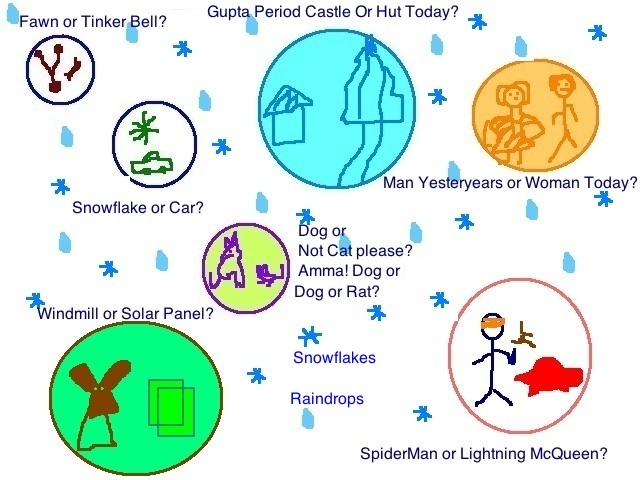
Would-You-Rather  be a car or a snowflake?

Would-You-Rather  be Spiderman or Lightning McQueen?

Would-You-Rather be a car in the snow or a car in the rain?

Parents true to form can never really pass up any opportunity, and so ours had science, history, economics or magic:

Would-You-Rather  be a windmill or a solar panel?

Would-You-Rather  be Tinker Bell or Fawn (Engineer or Zoologist basically)

Would-You-Rather  be a Woman in Today’s Age or a Man in the Golden Age of the Gupta period?

would-you-rather

Most questions segued (segwayed) into interesting discussions and we were rather enjoying ourselves. Maybe I looked too relaxed in the passenger seat, for the husband’s angel tapped him on the shoulder and reminded him of his stern duty to give me work. He glanced at me in that swift appraising fashion that I know spells trouble for me. ‘Look up some questions on the internet to see what they’ve got.’  he said, and I moaned.

“What is wrong with the set of questions we have now eh?’ I asked heatedly. ‘Here we are having a perfectly good time and you want me to see what the great folks on the internet with their bulbous brains have for the game.’

‘Just check – maybe there are some really good ones in there.’

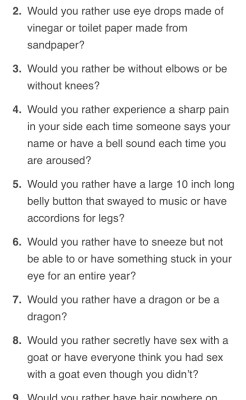
So, I checked and this is what I got.

fullsizerender

Would you rather snort into toilet-paper or tissues – my foot! That should teach us that the internet is only as good as our weakest link.

The Would-You-Rather is a jolly good game to play in the New Year as we are being pressured into taking New Year resolutions.

Would-You-Rather try to fix some aspect of your personality that is bothering you, or learn something new?

Would-You-Rather resolve to exercise more or improve your well-being

Would-You-Rather Dance or Run?

Would-You-Rather learn to entertain yourself or be entertained?

What Would You Rather Do or Not Do?

Scoff at Coffee Or Chess With a Super-Hero?

This winter has been a time of amazing road trips:

Dodo, Dragon, Dinosaur Dis-apparitions
In Boysenberry Jelly & Mistletoe Jam
The Wind, The Snow & The Rain – Part 1
Weaving The Sequins Of Time
The Curious Curvy Trees
The Salons of Bodie

With all the excitement of the trips and the experiences therein, there is also the time in the car. Audio books and songs compete for time with games in the car. Playing games with children is an experience unto itself. Peacekeeping forces are deployed every now and then, council meetings to determine rules and regulations, are required. Who said the family isn’t a mini-government unto itself? In spite of all this, hiccups arise in the most unexpected quarters.

I remember the time we were playing hangman. I was wondering what the words were and how I was getting them all wrong before I realized that for playing hangman properly one needs to know the spelling of the words, and foneticaly speaking, that is a very different game for kindergarteners.

‘Let me give you a hint’, the toddler son said one day as I was waiting for a cup of coffee en-route to somewhere. He was trying his best to mask his frustration, since my A, E, S and I, had all gone to nearly hang the man. He then coughed and sputtered and then beamed up at me expectantly. Could that be C-O-U-G-H?

‘O?’

‘Yes! Very good amma,’ he said and added O at the second place. I was frazzled. He had 4 dashes laid out. What could mean ‘Cough’, but be spelt with 4 letters?

C? I got another very-good, and after that nothing. The G finally got the man’s throat and he gasped and croaked. After another few trying minutes, in which the brain felt fairly rattled, the fellow wrote C-O-F-F.  Cough, see? He beamed rather freely at this, and the doting tween sister of his scoffed and ruffled his hair.

‘Scoff all you want, but cough up the dough for my coffee. ‘, I said to my unappreciative audience as I went to get my fortifying cup of coffee.

‘Would You Rather Coff Or Have Coffee? Get it?’,  said the daughter and I rolled my eyes.

I was reminded yet again of a charming book written by Miss Read. The book, Farewell to Fairacre,  written by Dora Saint,  is based in the imaginary village of Fairacre in the English countryside. The protagonist and narrator, Miss Read, taught at the village school, and said of her children.

‘More worldly children require computers and video games to occupy themselves, but the children of Fairacre are quite happily engaged with paper and pencils’

playing_games

I am glad we are able to derive our pleasures in simple ways still.

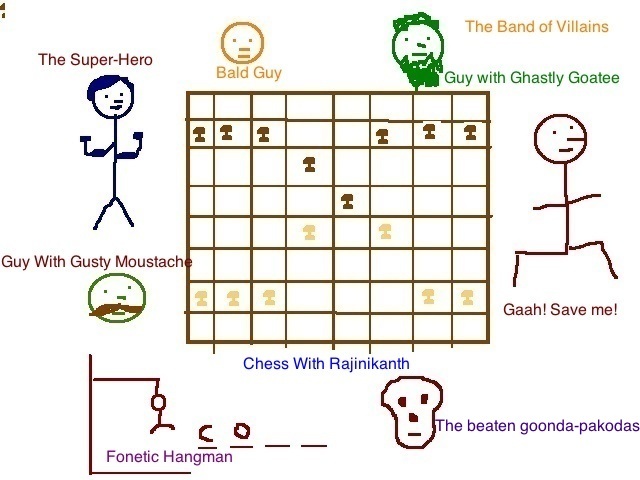
Then of course, if ever anyone wants to see how Rajinikanth plays Chess, you can come by and watch the toddler play chess with his imaginary friend when bored. If one has watched the old Tamil movies, one knows how villains attack Cinema heroes. The villains would stand around the hero. Cornered. See? Then, they’d go on to scowl, growl, grimace and crack their knuckles on the sidelines, touching their bald heads, caressing their unshaven beards and glaring like tigers given melons for lunch.

The hero stands there sizing them up and then one fellow comes and aah! He gets beaten up in a giffy. You’d think that would knock some sense into the remaining goonda pakodas, but it doesn’t. They all roar and then send another huge guy into the rink. Thulped. Another grimace and still no learning here. All fourteen idiots would go one at a time and get beaten up.

All known laws of Physics are also massacred in the process. Thermodynamics, laws of motion are all left begging for reprieve along with the band the villains.

Apply the same principle to the Chess board and you have the game: Every pawn comes one at a time and gets beaten up by the toddler’s side of the chess set. His shining knight battles on destroying his opponent’s pawns and his brave army thinks nothing of thumping Queens and locking bishops in with his own pawns.

Would You Rather be a Villain in a Tamil movie set or a pawn in Rajinikanth’s Chess? Get it?

Which brings us to the stimulating Would-You-Rather game (Part 2)

Weaving The Sequins Of Time

This article was published in The India Currents magazine dated 17th Feb 2018: The Magic We Miss Every Night

Taking a drive up the mountains is always a nostalgic experience for me. Regular readers know I grew up in a small village nestled in the mountainside and every time I spot a pine cone or take in a whiff of Eucalyptus scented air, I get a gleamy look in my eyes that prompts the daughter to ask me for a story about my childhood. I comply almost gleefully and she sits back and imagines her mother as a little girl, a person who is vastly more interesting than the adult version. One loopy enough to jump across streams, build mud tree houses and make a wish against a shooting star.

I was thoroughly pleased to do that again during our recent visit to the Inyo Canyons. Not build a mud tree house, but to make a wish against a shooting star. One of the best things about going out to the vast expanses of nature that we urban dwellers completely forget is how the dark the sky is at night (duh!) and how many stars we can see against this backdrop.

We were blessed with remarkably clear skies during our time there, and we headed out bundled up like Eskimoes in Winter to see the night skies. We made our way up a winding mountain road that overlooked a vast plain thereby giving us a wonderful vantage point for seeing the skies. Maybe it was the enormity of what was in front of us, but it subdued our normally stentorian voices temporarily. We stood there in companionable silence for a while just gazing at the outer arms of the Milky Way (at this time of year, apparently, we do not get to see the whole Milky Way).

My, it is so dark – it can be lonely here, we whispered to each other after some time.

The stars tousled our hair gently teasing us : of course it is dark, what did you expect, and look up at us. You are not lonely unless you wish to be. You have a universe unto yourself. ( I have an idea brewing here: it may be laughably inadequate, but that has not stopped me from publishing before)

The sun groaned from the other side : Duh, everyday I give you the gift of night, you know?

For the first time, I saw Ursa Major or Big Dipper drawn large against the night sky, with nothing to impede its view. It is amazing how many different civilizations managed to study the skies in varying yet similar ways.

There is the North Star, that was known as the Dhruva Nakshatram  in the early days when the Indian civilization named it (Story here: https://en.wikipedia.org/wiki/Dhruva).

Can you see Arundathi? Did you know the story about Arundathi being a twin star to Vashishta and rotating around each other? That is why it is a wedding ritual.  Alcor & Mizar known as Vashishta and Arundhati. Really?

So it went.

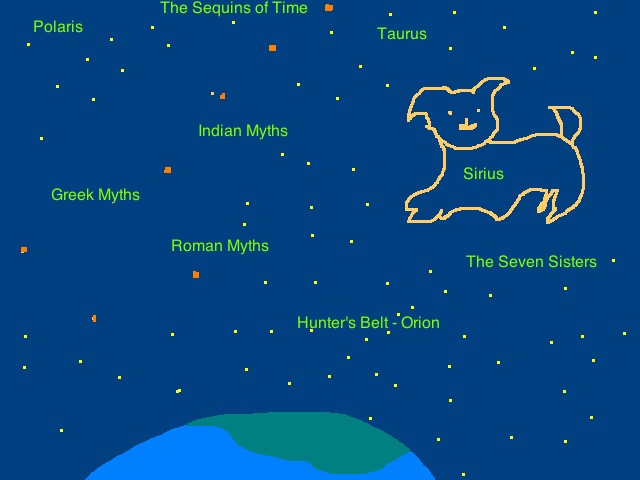
The daughter rattled stories from Greek Mythology that we tried to find Indian equivalents for. The magic of story-telling under the stars came alive for us that night. Sirius barked and Taurus ran. The hunters belt was bright and gleaming, the Plaeidis cluster was there, the Seven sisters were being relentlessly chased by the Big Hunter, while the same Krittikai sisters raised Karthikeya in the plains of Indus Valley millenia ago.

sequins_of_time

Lest you run off thinking that the daughter has sat down with the classics and pondered the deep recesses of ancient cosmology, let me assure you that Rick Riordan and his Percy Jackson books formed the basis for the bulk of her knowledge.

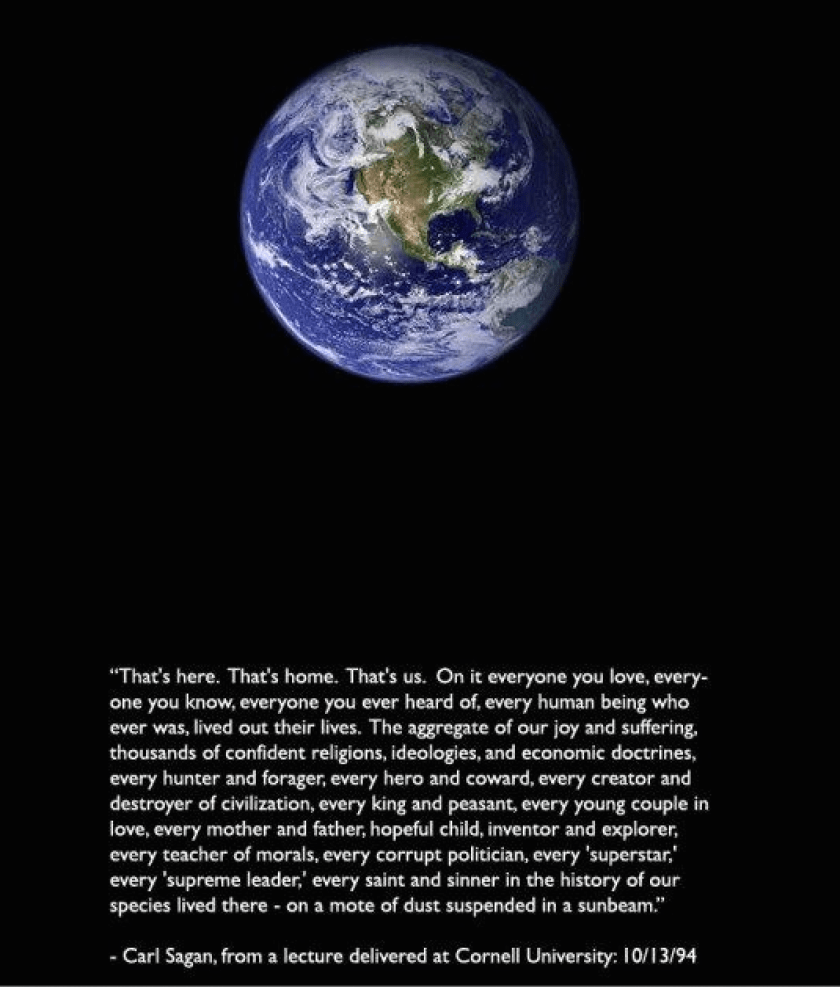
The white cloud that we never really see in urban areas was visible – consisting of millions of stars, the cosmos probably is home to millions of Earths fostering life and intelligent lifeforms. I was reminded yet again of Carl Sagan’s words  about the pale blue dot.

pale_blue_dot.png

It is true, every tyrant, every usurper of power, every chaser of money, every person with cares in this world, should stand beneath the blanket of stars everyday, and look at our souls in a detached manner. See ourselves as specks in a dark world where the only place for us to find light is by looking inwards and capture the feeling of light in our hearts like Earth captures sunlight and warmth in its atmosphere.

As we stood there with the children bundled up in the cold on a mountainside overlooking a vast plain with the stars shining down, we saw in the distant horizon seven or eight shooting stars.

Magical moments come in various ways, sometimes it comes in the form of shooting stars, sometimes it comes in the form of a fluttering leaf falling upon you and other times it comes in the warmth of a lazy winter morning when all the world outside seems bleak, but you feel warm inside. Even these cold winters can be translated to a warm feeling that the Danish have a wonderful word for: Hygge. ( pronounced – Hoo-ghey)

Embracing Hygge – The Danish Secret to staying happy in the winter

It is the feeling of warmth and coziness even when the world outside is harsh and cold.

As Louisa Thomsen Brits, author of The Book of Hygge: The Danish Art of Living Well says, “It leads to a sense of a rich inner life that radiates out through bleak days.”

What better way to weave the little sequins of magical moments into the fabric of life?