Nature’s Adventures

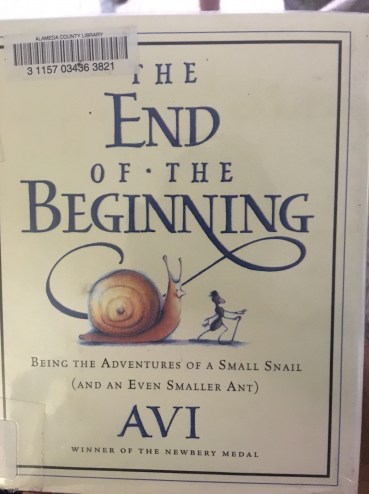
The son and I read a chapter book together. Hitherto, we watered gardens with Liam in The Curious Garden, or ate cookies out of a tin with Frog and Toad. This time we decided to spend several days with Edward and Avon in ‘The End of the Beginning‘. Avon, the snail wants an adventure and he seeks it with the help of his friend, the ant Edward. Over the next twenty odd chapters, the pair of them meet salamanders and have perilous snail crossings on narrow bridges. The beauty of the whole thing is that they had never really left their tree branch. At the end of their long and arduous journey, the pair of them find themselves facing the end of the branch and turn back. The Beginning of the End. Or does the end signal a new beginning?

The book had many philosophical sayings, and the next time the son and I observe a snail, we shall wonder what goes on in that animal’s brain.  Adventures do not need exotic settings or the need to traverse large oceans. It is all right there on the tree branch.

a447d33d-4ce1-48e8-b5f9-e437cc08e6de

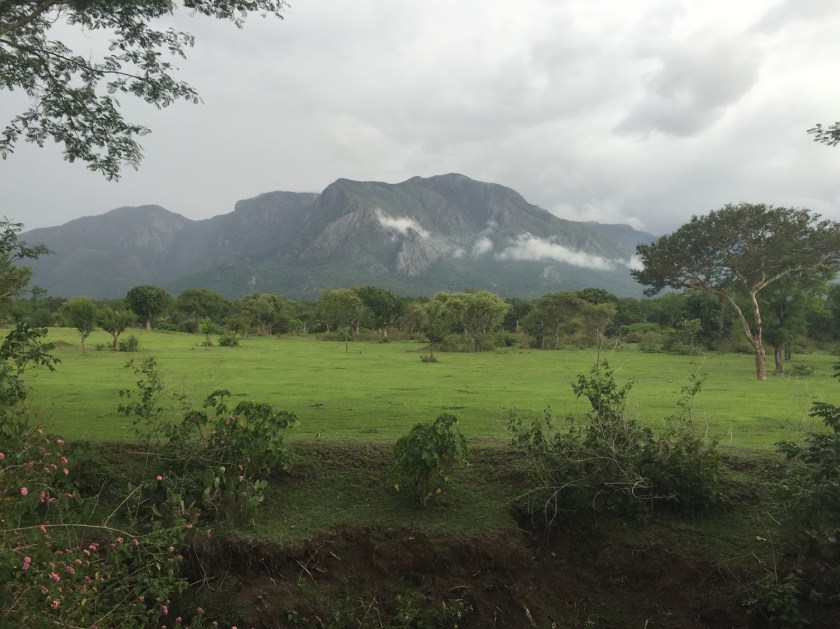
It also brought back some of the best adventures I had had as a child in the Nilgiri Hills growing up in those wonderful surroundings cradled by Mother Nature. Everyday from our Elementary school a few kilometers away, we took a different route walking home. One day we stuck to the narrow roads laid out by the municipality as an occasional vehicle passed us. Another day, we slid down the hills, picked some berries at the bottom of the hill and found another narrow footpath leading home. There were days when the walk took us twenty minutes, and days when it took us an hour. The whole place was tiny enough to not merit a marking on the map of the state, but it held adventures enough for a lifetime for us.

sultan's life

The toddler son and I enjoy taking a walk in our neighborhood and finding little by lanes within our neighborhood. For us, it is a revelation of sorts. One path leads you to the shaded path with oleander trees sagging with the weight of the summer flowers.

img_3410

Another path in the neighborhood has an plum tree that shows you how squirrels thrive near that tree. We see clusters of plums flung to the ground with nothing but a bite taken off of them. Every time I see those little eaten plums, I think back to one glorious summer afternoon spent in a friend’s garden. We had a blue quilted comforter laid out on the lawn and were watching the breeze gently ruffle the grass and skim the trees  as the children played. The son was then a baby and sat up in that adorable fashion that made him look and sway like a bowling pin used to prop open a door. Pretty soon, the topic turned to squirrels and fruit trees. Our host then set about plucking plums from his tree before the squirrels got them. We sauntered over to inspect, suggest and generally hinder the fruit picking process when I heard a slurp. Turning around we saw we’d saved the plums from the squirrels, but the baby human squirrel in our midst was looking triumphant: red-lipped, red-cheeked and red-chinned having bitten into the plums himself. Talk about being caught red-handed .

Night Life

There are wonders galore in our own little branch, if only we set out to find them.

9/11 Fifteen Years Hence

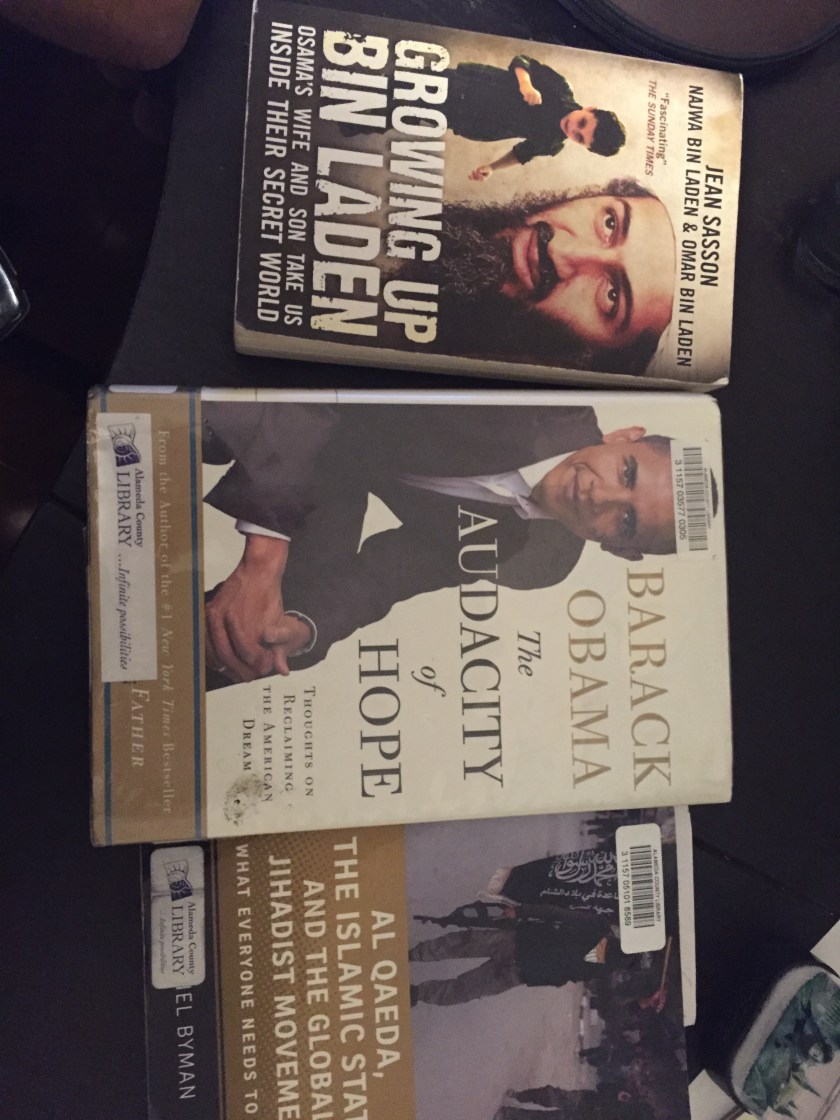
On a recent vacation to the Middle East, I chose from my sister’s pile of books, an intriguing book titled, ‘Growing Up Bin Laden’. It is a book about Osama Bin Laden as told to the author, Jean Sasson, by Osama Bin Laden’s fourth son, Omar Bin Laden, and his first wife, Najwa Bin Laden. From accounts of his first wife and fourth son, Osama seems to have been a kind husband to Najwa, and a strict, tyrant of a father to his children.

I have always felt sympathetic towards children of tyrants. Given that tyrants aren’t particularly loved by their subjects, this opens the children to endless persecution not to mention the harrowing experience of living with the tyrant themselves. If one does not agree with any part of their philosophy, how can a young child carve out an ideology for themselves? When it isn’t easy to fall out with a parent as an adult, it must be phenomenal to do so as a teenager, especially in the Arab world where obedience and respect are weaved into the culture for good or for bad.

The Bin Ladens lived a sheltered, rich, privileged existence with little knowledge of Osama bin Laden’s activities in Saudi Arabia. When they moved to Sudan, it was evident his fortunes were waning. By the time they were in Sudan, Osama Bin Laden was banished from Saudi Arabia, and his anger at the West was already seething. It is interesting to see the genesis of Osama Bin Laden’s hatred towards the West. Ironically, it was Saudi’s reluctance to continue to parade him as a war hero (after his efforts against USSR in Afghanistan), and take US help with the Iraq-Kuwait issue that seemed to have finally caused the rift. It was during the period that the family lived in Sudan that Omar bin Laden as a growing teenager first got whiffs of his father’s nefarious activities. The hectic activity, feverish planning and the subsequent euphoria in his father’s camps after the US embassy bombings in 1998 were his first clues.

As for Najwa Bin Laden, I must say that she sounds like a phenomenal lady. Her calm and un-quavering mind seems to have been the one place of security for the children. Probably the reason that none of them as adults sought to follow their infamous father in his footsteps. Hers is a sheltered and domestic life that few can imagine. A mother to 11 children of Osama, she was also his first cousin and first wife. Osama went on to marry 5 times in his lifetime, one ended in divorce. As the eldest wife, it was Najwa’s lot to maintain harmony: between wives, between her children and between the children of the various wives. She seems to have done so with her characteristic grace and charm. Osama went on to have 23 children, and towards the end of the book the author tries to figure out the fate of each of them. It was thanks to the persistent Omar bin Laden who had broken away from his father at 19, that Najwa left him mere weeks before the 9/11 attacks with her last three. Neither of them had any idea as to what was planned, just that something bad was going to happen.

The book does not condone any act nor do I. The truth is extremism has no rationale. Why do certain buy into extremism? No one knows.

It is a common malady of the West to try to bring everyone to their view of thinking. Often times, it is done with little understanding of the cultural forces in these places and that results in enmity and animosity that is quite baffling to the West. It is why I find it fascinating to read about other cultures. Diversity in reading. The conviction that different people bring to their way of life, the belief that works for them.

img_3444

I am now following up with two books that offer food for thought:

  • Al Qaeda, The Jihadist State and the Islamist State by Daniel Byman &
  • The Audacity of Hope by Barack Obama.

The Audacity of Hope was written by Barack Obama when he was a Senator in 2006. While some of the chapters are pedagogical, one chapter that is worth reading is the one titled ‘The World Beyond Our Borders’.

There are some questions that are worth pondering about through they are not the mainstay of the chapter. Why did US invade Iraq and not North Korea? Why intervene in Bosnia but not in Darfur? What about countries that are liberalizing economically but not politically like China?

Daniel Byman is an academic with a focus on Middle Eastern policies and his book analyzes the organization Al Qaeda to see how the organization profiles its recruits. But it is baffling to the point of no coherence. Students in western universities who feel alienated are just as good candidates as a rich businessman’s son in Europe. How this ideology appeals to people no one knows. How they drift towards extremism, no one knows.

The truth is that our actions are too complex. The ripples of our action interweave too intricately with other ripples to determine one cause and one action. Having the humility to know that we know not what the consequences are is worth cultivating.

The Dalai Lama’s world view in this article could possibly help us.
https://www.brainpickings.org/2015/06/09/pico-iyer-the-open-road-dalai-lama/

Quoted from the article: Book by Pico Iyer on The Dalai Lama and how he erupts so often into his famous giggles:
Seen from the vantage point of one who meditates several hours a day, traveling to the place where everything is connected, much of our fascination with surface or with division seems truly hilarious.

An Asian Reading Fest

Regular readers of the blog know that we recently returned from an Asian vacation. Every time I take a vacation with the sister in the Middle East, she has a set of books ready for me to read. The books she had laid out for me this time included books written by Jean Sasson, who happens to be one of her favorite authors. Jean Sasson  was a nurse by profession and spent a little more than a decade working and living in Saudi Arabia. One of the princesses of the Al Saud family solicited Jean’s help in telling the inside story of a Saudi princess’s life. She has since written eleven books dealing with various problems faced by middle eastern women.

This time, the book I chose from her pile was ‘Growing Up Bin Laden’. It is a book about Osama Bin Laden as told to Jean Sasson by Osama Bin Laden’s fourth son, Omar Bin Laden and his first wife, Najwa Bin Laden. She uses their alternating voices in the book to tell the story of his life. It is the first book of the kind and is an interesting read.

I am following up this book with two books that I hope to write about soon in conjunction with Growing Up Bin Laden:
Al Qaeda, The Islamist State And The Jihadist War by Daniel Beaman &
The Audacity of Hope by Barack Obama

I suppose I expect to get a glimpse of the view from within Bin Laden’s family, from a professor on Middle Eastern Affairs and a President who finally caught Bin Laden, but is abetted by a world that is still host to a variety of terrorist organizations.

Serious fare thus far you will agree, so I followed it up with delightful fare.

What better mode to release those endorphins than by paying a visit to Malgudi?

IMG_3150

I fell in love again with R.K.Narayan and his writings. Every time I read one of his books, I am amazed at how simply, how nonchalantly he takes you on a stroll along the Sarayu river after passing through the tantalizing wares on Market Street or on quieter days muse and saunter along Vinayak Mudali Street, passing Albert Mission College on the way. The charm of Malgudi never stales. I have come back and scoured the local library for books on R.K.Narayan and find very few.

Note to self: Buy some books by this great writer and donate to the library the next time I visit.

IMG_3304

While I visited the hills of Dehradun with Ruskin Bond, or Malgudi with R.K.Narayan, the husband took off on his own into the Tamil world of Sujata.

Blissful are the days when one is visiting another world while sipping tea in a cool room.

Counting Hadadas in East Africa

For as long as mankind could dream, birds and flying have held a fascination for us. But the kind of flying we do in airplanes that start with a roar like a hadada, is far from the soaring of the soul that the birds seem to enjoy.  Fascinating creatures, birds. Every time I set out on a walk, my ears pick up trilling and cooing and cawing of the birds. One evening, I gazed upon two pretty swallow-like birds with maroon plumage on their chests. Such beautiful little things, and yet when they trilled, I could not believe the volume that emanated from them. I also realized, to my dismay, that I could not identify them. When I do identify birds, I seem to get them wrong quite cheerfully and confidently. Like the last time I called a Canadian Goose a Duck. Both species took umbrage, not to mention fellow human beings.

I needed to rectify these aspects, I thought to myself severely.  That is why you would have seen me with my beak buried in a book called ‘A Guide to the Birds of East Africa’ by Nicholas Drayson. I see your puzzled expr. Why East Africa? Why not America. Well, for one, the book cover looked better, and for another, I thought why not East Africa? I might visit Kenya one day, and that time, I shall be prepared to dazzle and stun all with my ornithological knowledge.

guide_birds_east_africa

As it turns out, the book turned out to have quite a few bird names, but little to identify species. It was, however, a thoroughly delightful tale about an upper class club boasting members of the rich Indian community in Kenya, called the Asadi Club. In the book, Mr Malik takes the bird-watching tour every Tuesday morning with Ms Rose Mbikwa, after his doctor ordered him a hobby if he wished to spare his old heart an attack. That is how efficient, quiet and sincere Mr Malik learns to enjoy bird watching, and his guide to bird-watching Ms Rose Mbikwa.

I feel I must tell you the short tale of counting hadadas to entice you to read further or not, depending on your sense of humor. Some people like that kind of thing, some others screw up their noses, look dignified and turn away with a disdainful look on their face.  Neither can thrive while the other survives.

In the book, the members of the Asadi club are reading the newspaper which carries a research article that states on average man farts 101 times a day. This fact is hugely debated by members of the club. Member #1 cannot understand how that is possible purely from a mathematical point of view, since that amounts to 4.208 farts an hour, and he is pretty sure he has not let off 4.208 farts just in the past hour alone.

Valid point.

Member #2 feels that an average takes the high frequency hours with the low frequency hours and the past hour cannot be a reliable indicator.

Also valid point.

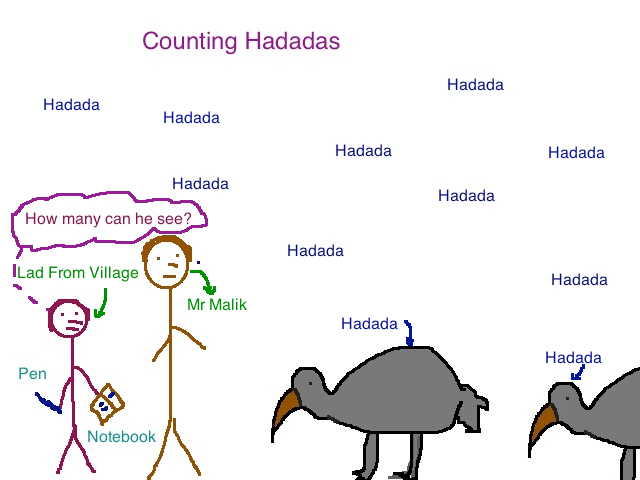
Enter Mr Singh, a retired magistrate, and the betting vein is tapped. Mr Singh gets the bets going, and sets terms and conditions to decide the condition. Since one cannot count the flatulence levels or fart frequency during sleep, all parties agree that a count during a 12 hour period should suffice. If a member is able to notch up 51 in 12 hours, Member #2 wins, if not, Member #1 wins. As they look around for a reliable person for the actual counting, poor sincere Mr Malik is roped in. Everybody agrees that if it has to be an unbiased outcome, it has to be vetted by someone with the efficiency and sincerity of Mr Malik’s calibre.

So it was that Mr Malik’s help in the house, a lad from a nearby village, is assigned the task of noting down the farts. To spare the boy the details, Mr Malik, an ardent birdwatcher tells the boy that he will tell him every time he sees a hadada, an ibis like bird that makes a loud noise haa-daa-daa hence the name, that is native to the African savannah. The boy dutifully notes it down, though seriously wondering how on earth Mr Malik saw several dozen hadadas, when he himself saw at most 4 or 5.

hadadas

It is a tale with many diversions and one thing leads to another and before he knows it, Mr Malik is up against Harry Khan, in a bird watching competition to see who can ask Ms Rose Mbikwa’s hand for a ball, and the hadada-counting boy from the village lends Mr Malik a hand (As it turns out, the boy has superior ornithological knowledge by virtue of growing up around plenty of birds).

A delightful read, if you don’t wish to exercise the bean much, and one in which you get to know the names of many birds even if you cannot identify them. As you amble along with these characters, you get to take a peek into Kenyan culture and life.

Also, Counting Hadadas is a useful euphemism to employ in public. You are welcome.