The Quixotic Birthday Gift

Family and friends enveloped me with love and showered their kindness on me for my birthday. In the words of Oliver Gold Smith, I often think our lives are lived out in what is called the ‘vale of obscurity’, but this essence of living and giving bathes me in gratitude. This Thanksgiving, I counted my blessings with joy, thanked everyone for enabling a fruitful life and continued to ponder on the mysterious power of love.

I don’t care what physicists have to say about it, or whether the teenagers in my life roll their eyes, it is love that makes the world go around.

“So, what do you want as a birthday gift?”, asked the children dancing around me excited. I had seen and marveled their cards, and they looked on expectantly as I struggled to find a wish they could fulfill.

IMG_7166.jpg

Finally, I said,  “Sometime this year, I want to go a national park I have never been to before.

“Ugh! I don’t want to go another national park!”, moaned the daughter.

“Well…thank you for that marvelous gift my dear. Like Jane Austen says: They are much to be pitied who have not been given a taste for nature early in life. ”, I said.

She had the grace to blush and said, “Good job at the sarcasm Amma! But another nature themed vacation? Seriously?”

I nodded unabashed at this less than enthusiastic response. I had my eyes set on two national parks that I had been planning and dropping for the past 10 years: Zion National Park and Bryce Canyon National Park.

“Why? It will be lovely, we can go hiking, running and playing.”, said her little brother skipping at the prospect of the great open.

“Oh please!” was the only response she deigned to grace us with. Not one to mince words, she made it clear that she was a reluctant camper, and that I had pulled a low trick in asking for a National Park trip as a birthday gift. I chuckled. A grunt told me that the matter was under consideration, and I left the matter to rest for the time being.

The next morning we scrambled to school in the usual fashion. One snack pack lay forgotten on the kitchen counter, two clean socks had flown through the car window hitting the car-driver squarely in the cheek (Appa! Duck your head, Socks incoming!) , and three sheets of loose paper trailed the way to the car. I tootled cheerfully as the car left the garage, ‘Have a nice day! Remember – next week is off!’

Leaving For School
Leaving For School in the morning

That evening, the daughter came back beaming benevolently. Nibbling on a cheese sandwich of her own making, she said, “You know? It might be lovely in Zion national park this time of the year. “

The son and I exchanged quizzical looks at this volte-face.

Apparently, one of her close friends in school had said that the national parks in question were beautiful and that she would love an opportunity to go back there again. That evening, the banal national-parks-again tune had changed to a vibrant symphony of Zion-is-beautiful, but Bryce-is-much-prettier. I smiled to myself. Oh! The beauty of friendship. I only hope she continues to have level headed and smart friends, was my private thought.

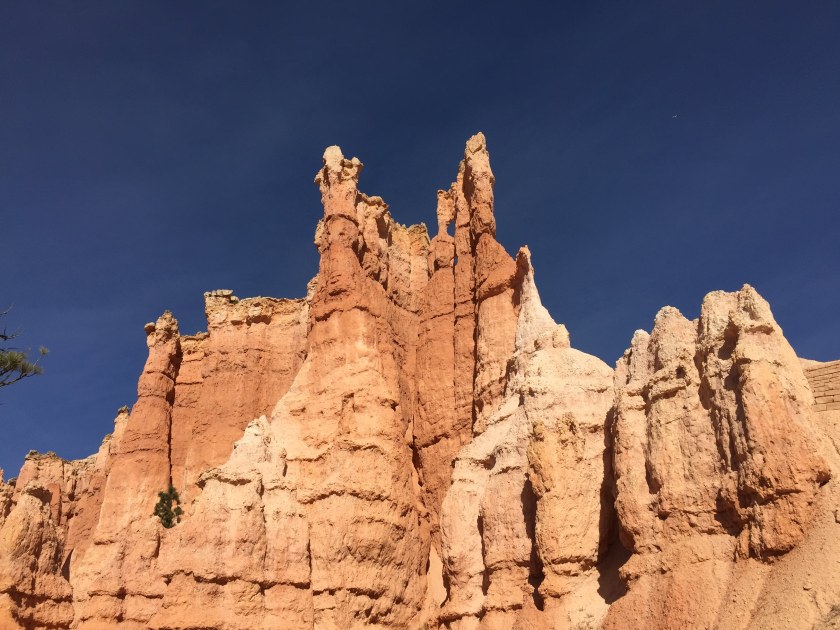
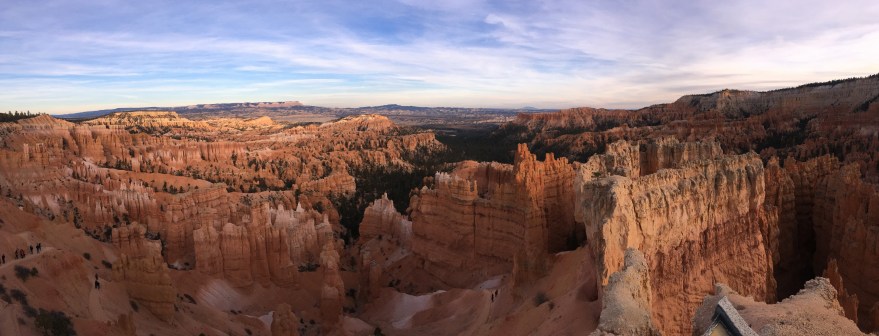
The daughter’s friend was right: Zion had a majestic grandeur to it,  while Bryce Canyon can only be described as breath-takingly beautiful. I had never imagined sparse vegetation and sheer rock face to be this splendid.  I have always been more a lover of trees, and streams. But Zion and Bryce made me think of beauty in a whole other manner. It was as if in one short trip across 4 states(CA, NV, AZ & UT), we had been transported to another planet.

IMG_4979.jpg

A land where hoodoos made magnificent shapes against the blue sky, 

A place where bristlecone trees cling to cliffs

Towering over the abyss of erstwhile marine trenches, 

Where overhead, peregrine falcons swoop swiftly upon their prey 

Hundreds of feet below in the rust colored labyrinths. 

It is a vibrant diorama sparkling underneath the weak wintry sun in the desert

An ecosystem that has seen it all, and still persists. 


Can Mammoths Stop Thawing Arctic Permafrost?

“Let’s not watch this – it is depressing, and some of that stuff makes my blood curl.”, I said as the daughter suggested some gothic fiction. It was the week-end before Halloween, and we were picking our Friday evening entertainment. Never an easy task.

“Fine! What do you want to watch?”

Cosmos” I said without flipping a heart beat. (Watch the you-tube video introducing Cosmos here)

To her eye-roll, I said “No really! You see, there are so many things in there that I wanted to understand as a student.  I plodded along to the library and I got to admit, the Physics books in there. “ I gave a shudder here, and I fully meant it. “I suggest you curl up with one of those tomes in our library looking jaundiced, pale, and excellent cures to Insomnia. I thought some of them needed vitamins, sunshine and exercise to regain what Doctors call a healthy glow. “

geek_world

So, we sat together and watched a Cosmos episode by Neil deGrasse Tyson on global warming. In his slow, sure voice, he rumbled like the volcanoes on Venus that set the poor planet into an irreversible green house cycle.

The World Set Free (Cosmos: A Spacetime Odyssey)

http://channel.nationalgeographic.com/cosmos-a-spacetime-odyssey/episodes/the-world-set-free/

We have twenty years at the current rate to stop us from going into an irreversible state like Venus.

The daughter gave me a significant look .I gave her a more sig. look, and we sat there looking like stuffed frogs with s. looks etched on our faces digesting the info. “How could you think this was okay to watch, but that movie was too scary. This is the scariest thing I have ever seen. How do you think it will all end?” said the daughter sounding worried, and deeply stirred.


A few days later, I read out a passage from the book I was reading. Woolly: The True Story of the Quest to Revive One of History’s Most Iconic Extinct Creatures. (Related post: Mankind trying to resurrect the woolly mammoth by impregnating Asian elephants with mammoth genes.)

Screen Shot 2017-10-27 at 4.37.00 PM

Pleistocene park  – Using 160 square kilometers of Siberian Tundra given to him by the Russian government, Zimov’s goal was repopulating the area with modern equivalents of prehistoric animals that had adapted to Arctic conditions (moose, Yakutian horses, Finnish reindeer and even North American bison.) … To re-create the effects of the Woolly Mammoths on the land, he’d bought in a World War II tank …. Punching holes in the snow, … , using the tank treads to mimic the continual stomps of Mammoth feet, he’d worked the land, year after year. And along the way, he’d accumulated data that were staggering in their implications.

Within his 16- square kilometers refuge, he had lowered the permafrost temperature by an average of fifteen degrees. 

We change the world just be being. I remember watching a video by National Geographic in which they chronicle how 41 wolves introduced in the Yellowstone park, changed the ecology and even the physical structure of the park.

Introducing Wolves in YellowStone National Park – National Geographic Video

If that was the case with 41 wolves, what would introducing Mammoths do? Would it save us from the brink of extinction or introduce problems of the kind we hardly envisioned?

We never know the ramifications of our creations. I mean we are a species who has unintended consequences from a ‘Like’ button on Social Media.

The Physics Of Myth

“Which is your favorite tree?” asked the children one day.

I am often asked questions like this, especially by the elementary school going son. Your favorite color, your favorite food, your favorite flower and on and on till I shriek in agony, at which point he flips to – when was the first time you ate with a spoon, when was the first time you touched a frog, when did you first climb a tree?

I thought about the favorite tree one though: which one was my favorite tree? Is it the oak tree that I plonked my satchel under every day in school, or the flowering jacaranda trees under which we had steaming hot cups of tea with friends, or the tall eucalyptus tree that edged our street towering majestically against the skies signaling home was nearby, or the fir & pine trees that contributed to many an amateur flower arrangement lending beauty and joy to the surroundings, or the willow that made one want to relax just by its shape and allure, or the gingko tree that makes me smile on a evening walk, or the oleander trees that sag with flowers in the summer, or the fruit trees in my backyard that are so hospitable to squirrels ,or the redwood trees that urge me to be like them: strong, resilient and upright, or the curious, curvy bristlecone trees that remind me they are older than our oldest myths, or the pine tree with an elephant head that reminds me of the time the son as a toddler tried to fit his understanding of Physics into Myth?


It was a tough question and I told them so. The son scenting a ‘wild’ story from his childhood asked for the story, and I mock-sighed before telling him:

“One day a couple of years ago, when you were very much a toddler, and had just started attending a preschool, you picked up a book from the library about Lord Ganesha. You were thrilled with the find because Indian mythology is hardly found in the libraries in America, right? Lord Ganesha Curses The Moon – was the title. Appa and you settled down to read together at night.

Anyway, so, remember the story? It went something like this:

The moon used to beam as a full moon every night. One day, the moon laughed at Lord Ganesha when he tripped and fell in the forest.  Ganesha promptly got angry at the moon, and cursed it into oblivion.The whole world plunged into darkness (this was before electric lights remember?). At this, the book painted some gory pictures of the problems faced by the population because it was completely dark. People fell, people bumped into each other, people were robbed. Soon, everyone begged Ganesha to take back his curse. But he couldn’t. His word being law and all that. 

So.

An impasse was reached, and soon the king of Gods, Indra, came to him and asked him to do something about it. Ganesha thought and thought, and finally reached a compromise. He said the moon could grow from no moon to the full moon, and then shrink back again to no moon. That ought to teach him not to laugh at people. The moon agreed, and that is how it remains to this day.

ganesha_moon

After the story, Appa asked you, “What do you think of the story? Do you really think that is what happened?”

You had that serious look on your face as you thought about it, and you said, “Yes, of course. That’s when the moon must have started going around the Earth, and the Earth started spinning, so the moon could grow bigger and smaller.”

“Appa told me what you said later, and ever since I think of that story and remember how you fit your understanding of Physics into that mythological story when I see that fir tree with an elephant head.”

“Did I really do that?” asked the son laughing heartily, and I smiled.

It was true of course. His response had us flabbergasted, for we hardly ever consciously think about how we continually shape our worldly views and understanding. We subtly and subconsciously incorporate the stories we hear, choosing to consider which ones to digest and which ones to leave.

“So, as you see, I cannot only name one favorite tree. I love them all. Just like…”

“We know…. we know! Just like you love us both!”, said the children, and I smiled my favorite smile.

Godly Superheroes or Super-Heroic Gods?

The clocks had been changed, and the evenings suddenly signaled the arrival of Winter. The stars shone, the moon beamed, and the crickets clicked much sooner than usual. I was pottering about the kitchen when I overheard an interesting conversation between brother and sister.

“What is the difference between a Super-Hero and a God? “

The question was obviously the son’s. The young fellow had a curious look on his face, and he wanted to learn the truth, and nothing but the truth from his older, wiser, newly minted teenage sister. His sister looked discomfited, and said, “Dude! Seriously?”

I tried my best to keep the stuffed frog look about me, and acted non-committal. A vitally important step if you want to see how the discussion proceeds.

The son is a great lover of mythological tales. Hanuman, the monkey god, who could jump across seas, carry mountains with one hand, and fly with the mountains is a positive hero. This is such a change in pace for us for the daughter was never one to ask for super-heroes or Indian mythological tales.

Her philosophy matches the Roman poet, Ovid’s, thoughts on God:

It is convenient that there be gods, and, as it is convenient, let us believe that there are.

“Hanuman is my favorite super-hero.” said the son. “Was Hanuman a super-hero?”

“Yes …. and … no. Well…Hanuman is a super hero, but he is also a God. Most Gods are also super-heroes, you know?”

This must’ve felt like a tantalizing puzzle to the fellow, for he continued with the quizzing.

“But not all super-heroes are Gods right? Superman is not a God. “

“Yes…he is not. Definitely not. Nor is Spider man, and Captain America and all the rest of the fellows you watch.”

The son gave a raucous peal of laughter at this. It amuses him that the super-heroes who mean so much to him, mean so little to his sister. He looked at her with that look artists paint on disciples waiting to hear some Saint giving life-advice.

“Well… Gods don’t die, but super heroes do.” She sounded tentative, quite unlike her usual self.

“But Rama died, and he is a God right?”

super-heroes

The daughter looked at me with pleading eyes, and I threw up my hands. This child asks the kind of questions that spiritual speaking the Dalai Lama could answer. Me? I sputter and stutter and look like a duck stuck with duct tape in her throat.

His world has super-heroes, and if in the olden days, they were Gods, they must have been the super-heroes of the day.

To ruminate consciously is a privilege: Who are our super-heroes today? Which ones will be the Gods and which ones the Demons?

P.S: I recently read a book titled The Delight of Being Ordinary by Roland Merullo. It is a book chronicling an unlikely trip taken by the Pope and the Dalai Lama together. It is an opportunity for them to escape the fanfare that is constantly around them, and delve into what their sub-conscious has been telling them. I don’t usually read forewords, but after reading this book, I felt happy enough to go back and read the foreword. The author said that the concept of having the two world’s most prominent religious leaders, who also have a wonderful sense of humor appealed to him, as so many leaders today are so devoid of this important ability to laugh and delight in little things.

Part 2: Incorporating Physics Into Myth

Teapot Spirituality

Sheesh kababs! What is with Amma – is she tired and cleaning again?” said the daughter, when I acted like a teapot sliding off my tea spout.

I whistled my protest with as much dignity as a teapot sliding off the tea-sp. could when caught in the act. “There is nothing wrong with me. Merely that a lot of work needs to be done, and I cannot come and play a game of Life now. I have Life to deal with now.” The queenly dignity sounded overdone like these actresses who act for 10 dollars when paid 3. I waved my hands impressively at the surrounding environs.

It was true, at least in my mind. Pots and pans needed washing, the floors needed scrubbing, the ….

“You said you are tired at the end of the week, and it has been a tough week. You just said we escaped a fire, and we should just be thankful for Life huh? Get it. Get it? Come on now.”

teapot

I could not argue, and after a flimsy protest, waved down by the children who helped me get the kitchen to a state of relative cleanliness, we sat around playing the game of Life. There was a serendipitous beauty to it. The evening had made me nervous and jumpy, more conscious of the gift of Life, and as usual the children had led me to the calm instead of the frenzy, with their customary élan.

Northern California had been reeling from the effect of wild fires. After an unnaturally hot summer, calamity struck too close to home for comfort. This time, it was people we had lunches with, people we holler out to when we catch a glimpse of them in crowded places. People who will slowly extend that quizzical look into a slow, wide smile as they recognize you, these were the folks asked to evacuate.

Luckily the fires had been contained, and I felt like we could look forward to a quieting down. I had spoken too soon.  That evening, flames leaped higher than trees behind our home, and smoke billowed from nearby. The bags were packed in the car: documents, some cash, a change of clothes, laptops, water bottles, snack bars, and a few pictures. When it comes to it, that is all there is, isn’t there?  Nothing else matters.

That night, everything felt keener. The comfort of putting away the dishes, the joy of playing a board game, the delight of being ordinary, the familiarity of the mundane, the contentment of a bedtime story, the gratitude for the simple act of breathing.

“I just got twins Amma.” said the son after rolling his dice.

“There goes your quiet retirement!” said the daughter, and the children went into peels of laughter, and I joined in noticing how much better it felt to laugh with abandon. I felt the 17 facial muscles work as the laughter gripped me. I observed the act of laughing together as if I was perched atop the roof, looking at us having a good time. Is this what consciousness is?

I finished the piece on resurrecting the Woolly Mammoth using genetic samples obtained from the pristine Arctic Tundra, and impregnating an Asian elephant with the questions on consciousness, and whether or not there is a Soul. I love it when a work of fiction explores the questions posed by futuristic Science, and I finished the post by tying it up with Never Let Me Go, By Kazuo Ishiguro.

Everyone knows, teapots are far from spiritual, and my understanding could make a teapot sing. If you were to explain the concept of consciousness, conscience and soul, how would you do it?


The Concept of Conscious Conscience

“Appa got me the Cheetos”, said the daughter sounding gleeful over dinner.

Cheetos, I had explained to her that morning, was full of food coloring, and therefore not a good idea.

“You went and asked him for that after everything I explained to you this morning? Carcinogens. You know what? I think you should look up Mammoth DNA sequences and compare and contrast it with the genome of an Asian elephant.”

“That is the world’s worst punishment ever!” she said pulling an impressive teenage affront with ease. “I don’t think anyone has been given that.”

“Well..there are several reasons you are being given that, “, I said. “One: I am reading the book that is all about resurrecting the woolly mammoth by impregnating an Asian elephant with mammoth genes. Two: Did you know that the elephant, that large an animal as it is, does not suffer from cancer? Maybe there is something in it’s genetic makeup that prevents malfunctions during cell reproduction.” I said giving her my Idiot’s Guide to Genetics lecture.

It’s true. I had just finished reading the book called “Woolly – Bringing a woolly mammoth back to life” by Ben Mersich. For someone who does not know the first thing about genetics and genome sequencing and such, this is a good book to read. It is written like a fast paced novel, moving between the lives of reclusive scientists, Sergey and Nikita Zimov in the Russian Tundra and Jy Minh’s work in Hwang Woo-Suk’s Sooam Laboratories in South Korea to George Church’s lab work in Harvard. All these efforts are working towards resurrecting the woolly mammoth using DNA samples obtained from mammoths preserved in pristine conditions in the Arctic Tundra.

Screen Shot 2017-10-27 at 4.37.00 PM

If that feels like Jurassic Park, it is, though the book explains why it is not exactly like Jurassic park, but sort of. It is Pleistocene Park – a concept that beat Jurassic Park by 2 years in conception.

If you are looking for a scientific explanation of techniques, and theory, this isn’t the book. The book is to be made into a movie, and is written as such: I can imagine the scenes leaping off the pages. Following the Russian scientists on a quest to resurrect life in the Arctic life makes a thrilling tale. Combining that with the race by Korean scientists to engineer and reverse engineer life, and scenes from a research laboratory down in Harvard makes for brilliant movie scenes. Only as the book assures you, it is not fictional. It is true. You will pause and think of ramifications, of the evil that can be wrought when powers like this fall into wrong hands, of political leaders with no qualifications dictating the genome factory.

Life from life, Minh thought, as he moved past the implantation table. Still, he couldn’t shake the chills he felt as he thought of those 3 dogs, lying supine, tongues hanging to the side around the breathing tubes, as the surgeons did their work. He chided himself for his own backward thinking: of course, futuristic science always seemed unnatural – until it became routine.

The discussion that evening over supper bleated over to the world’s most famous sheep, Dolly, who had been cloned in 1995. Sheep, Mammoths and Dogs make good cloning subjects for they do not yet touch the uncomfortable topic of human cloning.

http://www.businessinsider.com/sooam-biotechs-is-bringing-back-the-mammoth-2015-9

Human cloning, however, is a topic you can rely on authors to explore.

The thought provoking work by Kazuo Ishiguro, Never Let Me Go is worth a read in this context. The book talks of a future in which clones are generated from a master copy, and are raised separate from mainstream society, just so that they can function as ‘givers’ and ‘carers’ – a euphemism for organ donations. It is a heart rending read, as it centers around three young people, who have the same feelings of love, jealousy and friendship that ‘mainstream’ people do. Their art work is collected by a lady, who is trying to petition the state against this barbaric practice as Art shows the soul, and clearly the ‘spares’ have souls.

Never_Let_Me_Go
By Source, Fair use, https://en.wikipedia.org/w/index.php?curid=15168925

Human beings are tinkerers – we always have been. What have we in store this time?

  • Is there a concept of the Soul that is separate from the engineered parts of cells, muscle, tissue and genes?
  • Is Consciousness something that can be engineered?
  • What role does our conscience play while tinkering consciously?

Related read: Of Dinosaurs, Genes & Aliens

Squirrels, Berries & Fringe Myths

We had been on a trip to Crater Lake over the summer. Among other things, we hiked a little bit around the lake, taking in the marvelous view. The lake is a mesmerizing sight sparkling in its deep, pristine blue. We indulged ourselves in small hikes that afforded us beautiful views of the lake and the surrounding Cascade mountains merging into the Sierra Nevadas in the South. It was one of those places where nature cures, nature soothes and all that. The son is my ardent nature companion, and the pair of us went looking for pinecones and acorns.  It was steep going.

squirrel_hike

We stopped at one place to take a few breaths at a spectacular rock placed there for the purpose and we saw a little squirrel. We may have been nervous during the hike, but it did little to wrack the squirrel. Up close the son noticed that unlike the squirrels near where we live, these fellas were smaller and had stripes across their back. He said in his excited voice that these were the ones that had helped Rama build his bridge and nearly gave the poor squirrel heart failure with his excitement.

I peered closely, and so it was. Here were little squirrels that looked like the squirrels mentioned in the ancient myth of Ramayana. According to the story, the little squirrels were helping Lord Rama’s army build a bridge from India to Lanka so that he could save his kidnapped wife, Sita, from the clutches of the evil demon-king Ravana, in their own small way, with little rocks and acorns.  Lord Rama was so impressed with them, that he picked one of them up and stroked its back lovingly. The legend goes on to say that is why squirrels have stripes. The son had heard the story before, and  was understandably excited when he saw the stripes the squirrel’s back. I suppose the story must have sounded silly to him when it said, “That is why squirrels have stripes on their backs.” Because the ones he sees do not have stripes on their backs, and that is the sort of discrepancy that will keep the fellow puzzled and curious for days.

<Squirrels with stripes on their backs>

Chipmunks or Squirrels
Pic obtained via google search

I was reminded of that little story when I read the news items that Remains of the Day had won the Nobel Prize. Remains of the Day examines the concept of work, and why it is an important factor in man’s life. Screen Shot 2017-10-26 at 10.08.53 AMHow often have we been asked our names, followed by a what-do-you-do? How does one attach a sense of importance to one’s work, and feel purposeful about it? Sometimes, it is by means of attaching ourselves to the goal of the entity you work for like the squirrels did. But maybe, it is to the concept of work that we need to attach our purpose to like the bees do.

This year Deepavali – the festival of lights came like the coat-tails of a comet after a string of tragic events – fires, shootings, floods: catastrophes both man-made and natural shook the populace. But now is a good time to throw our mind back to these oft forgotten little mythological tales, the fringe stories that provide food for thought. I must remember to tell them the hilarious tale of the old lady, Sabari, tasting the berries before giving them to Lord Rama.

I looked forward to the chat with the children while drawing up a rangoli outside the house using colored chalk. It is a beautiful feeling of light. The triumph of good over evil, a call to nurture our inner light and so much more.

IMG_7077

Mythology, fairy tales, and magic are all so beautifully interwoven in our magic of story-telling. Heroism and quests for the inner self are never jaded. Starting from the Epic of Gilgamesh, the Avatars of Vishnu,  Ramayana & Mahabharatha,  Odyssey & Iliad, the Bible and right down to Harry Potter, it is a story line that always enthralls, and is ever relevant.

I’ve come to the conclusion that mythology is really a form of archaeological psychology. Mythology gives you a sense of what a people believes, what they fear. George Lucas

In all these millennia, it seems little has changed, and so much has.

Please share some of your favorite fringe tales – I would love to hear them.

The Nest

Summer had spread its warmth and happiness in myriad ways. It had browned the state of California, made children cherish a vacation spent in the warm company of cousins, friends and grandparents. It had also led us to discussing a pair of swallows or robins who had raised their family over a friend’s garage recently. The excitement over this last item was palpable, if second-hand. I have told the children lots of tales before of growing up amidst nature, and their favorites are the ones featuring fauna of various shapes and sizes. The time we ran from a mouse, the time the panther came, and so on.

Amma – have you really seen a nest before?”

“Yes. Of course.” I replied.

They had the look of expectancy about them, and I did not disappoint.

I told them that not only had I seen a bird’s nest before, but was so shocked at having seen it, that I almost toppled off the tree in fright. They guffawed at this, as though nothing amused them more than mothers falling off trees, and I mock-pursed my lips at this misplaced joy. But I had to admit, if I imagined my mother falling off a tree at their age, I would’ve guffawed too, and genetics cannot be helped and all that.

I cleared my throat and continued with the thrilling tale of the nest. They listened with rapture.

We were playing what loosely passes for badminton out in the rushing wind just to see how to play when the gusts of wind took the shuttle askew. One time, the shuttle caught in a tree, and we tried retrieving the thing with hockey sticks,  shouting (our sound waves generate sonic boom to dislodge shuttle – duh), and a myriad other techniques before placing a stool on a chair and hoisting me up to the nearest branch. It was then, I saw the dear home. It looked just like I liked it: haphazardly thrown together, a comfortable haven from a stormy world. Cozy, if a little messy. I stood there for a few seconds delighted at my find, and prudently did not holler the finding to my playmates below.

nest

I have always had a soft spot for babies, and there must have been some being raised there. I almost clambered down without the shuttle-cock in shock.  I kept the information quiet from some of the more cruel children, and expertly diverted our game elsewhere.

The children gave a wistful sigh, “Hmmm…..Wish we could see a nest!”

Every time we go to a wooded area, we look for a nest, but so far we have been unsuccessful in our quest.

A few days later, I was meandering around the lanes, when I spotted something on the floor. The pine trees in the lane had shed plenty of its pines, and the brown pine needles and the pine cones make an interesting scene partly because we are always on the lookout for lovely looking pinecones. It was then I spotted what was unmistakably a nest. There it was – perfectly shaped to house little birds (an ornithologist could probably look at the nest and tell you which birds planned to raise a family in them, but I could not) I picked it up and saw the nest must have fallen a good 10-15 feet even if it were on the lowest branch. Luckily, no eggs were in the vicinity, and I gingerly picked up the nest to show it to the children.

IMG_7055.JPG

After the initial excitement, I was told that I had been heartless in bringing the nest home. Why could I have not put back on the tree? While I admired the sentiment behind this, I felt that expecting me to scramble up that large a tree to put a nest back was a bit much. So, the nest was housed in an adjoining tree whose branch was accessible to my height, and we hoped some bird who had procrastinated nest building would be able to find and use it.

“How will any bird know to look for a nest?”, the children asked. I was doubtful too.

A few days later, I picked up the children’s book, A Nest Is Noisy. The dear book assured me that there were plenty of birds that look for built nests, and the nest I had picked up could one day become a home again.

To find the universal elements enough; to find the air and the water exhilarating; to be refreshed by a morning walk or an evening saunter… to be thrilled by the stars at night; to be elated over a bird’s nest or a wildflower in spring – these are some of the rewards of the simple life. John Burroughs

Hola Amigos! Tres Bien Nachos

This article appeared in The Hindu’s Open Page Section dated 15th October 2017

“Hi Amma. Konichiwa!”, said the little fellow as he pranced home from school.

Konichiwa?”

“It means Hola! Hello in Japanese.” said the fellow beaming.

“Oh that’s nice. Konichiwa. It sounds like a tinkling windchime. Koni-chiwa. “

Ni Hao is Hello in Chinese.” said the Hello expert.

“How did you know these things? Did they teach you in school?” I asked.

He pulled out a beautiful children’s book called ‘Say Hello’ by Rachel Isadora, and said he picked that from the library that day. That night we snuggled into bed with the Say Hello book. I must say that it is a most beautiful inclusive book and includes illustrations as a little girl walks through town saying Hello to the various people she meets.

The Shalom Aleikkum, Ni Hao and Konichiwa-s roll out with ease, before she finally finds her Abuela and says ‘Hola!’

The daughter sometimes joins us for story-time, and this time the two minute read turned into a twelve minute reminiscence into what is lovingly known as the Hola Snafu At Cancun.

The fellow at the gates to the resort in Cancun was looking morose, and wondering whether there was any purpose in going on sitting at the resort gates like this. There were folks inside going about their duties sipping a whisk of margarita as they were preparing some for the guests at the bar inside, while he had an iced water bottle that had long since melted the ice and left a puddle around it. Our van pulled up after a day’s trip to Chichen-Itza, and I poked my head out.

Hola! Uno nuevo nuevo deux.” I said and smiled. I gave him the room number allocated to us at the resort, so he could let us pass. It had been a long day with dinosaurs, asteroids, nuclear warfare by aliens from another galaxy, hobnobbing with the spirits of those who built the pyramids centuries ago.

The fellow chuckled to himself and looked uplifted in spirits. Just for this performance of Spanish, it was well worth giving up the spot to work at the bartenders backyard. He waved us in cheerfully, and I said in perfect Spanish. “Thank you Amigos. Have a tres bien day!

I turned around to see the daughter who incidentally learns Spanish up at the school rolling in the aisles and laughing with her little brother. “Did you just think you spoke Spanish?” she gurgled when I asked her what the matter was.

Our van was trundling in toward the resort, so I must have said all the right things, I said Oui with confidence.

“Have a tres bien day! Tres Bien is French Amma, not Spanish!”

It sure was. I had not considered the possibility that French and Spanish occupied the same area in the old brain. Amazing what all happens inside the walnut isn’t it?

“Well Spain is near France, so I am sure they will understand. “, I said miffed that my marvelous attempt at Spanish was being given the rip down by the children.

Screen Shot 2017-10-05 at 10.44.52 AM.png

“Yes! But Mexico isn’t near France. If I were him I would have asked for the room number again, and keep you there till you got it right.”

I was on solid ground there. Our room number was 1-9-9-2. Uno Nuevo Nuevo Deux.

Nuevo means ‘New’ ; Nueve means 9”, said the Stickler for Spanish Perfection.

“Why didn’t you say anything then, eh? Hola?”

I hola-ed and tres bien-ed and buenos nachos and muchos gracias-ed my way through the Mexican resort much to the delight of the staff there. Some of them taught me that Buenos Nachos means ‘Good Nachos’, not Good Night but smiled along indulging me in my Spanish dreams of fluency.

We all laughed, but the husband said that the important thing is that I made the effort to communicate with them all, and they understood that. Even when I said Muchos Nachos Tres Bien, and Google translator had no clue what that meant, the server who had laid out dinner for us with amazing vegetarian fare knew I meant well, and bestowed an avuncular smile on me.

The recent mass shooting at Las Vegas has horrified America yet again, and the press has said the latest terrorist attack was because the terrorist was a lone wolf. (Yes, when an act is calculated and carried out to spread terror, it is a terrorist attack, ask any fellow who works up these places that curates dictionaries and so on. The press seems to have this curious idea that the word can only be applied to certain sub sects of people, though the feeling of terror is universal.)

Anyway, as I was saying the Lone Wolf – I read a book by Daniel Byman a professor on Middle Eastern studies who tried to see the correlation between how terrorist organizations recruit and train towards extremism and any other factor (economic, academic, geographic), but came up with no correlation whatsoever. It was baffling. There was only one unifying factor among each of the recruits: They were all Lone Wolves. 

That got me thinking that every time we spot someone feeling lonely in our community, why not send a Hello or Hola or an Konichiwa or Ni Hao or Namaste or Salaam Alaikkum their way? We never know when a simple smile and word can change the course of one’s day. A smile is as universal as loneliness after all.


Ma With Fahrenheit 451

As I took a walk one morning, I tried to identify the flowers and trees in the neighborhood, and found myself humbled by my meagre botanical knowledge. A bird or two chirped nearby, and I tried my best to enjoy the quiet by zoning out the drone of the constant hum of traffic from the main road. I looked up at a tree that I loved, a Gingko tree, and sat myself down nearby watching the suns life giving rays upon a garden just watered. The tiny water droplets refracted the suns rays, and the world around me felt magical.

As if to complete this picture of serenity, two butterflies danced into view. Their dance around the flowers on that sunlit morning with the rays of the sun coming in through the Gingko trees leaves was enough to mesmerize anyone, and I found myself smiling and lapsing into a contented silence. It is not often that I get to slow life down enough to sit and watch butterflies in the garden. In those few blissful moments, I experienced the beautiful concept of Ma. Ma is the Japanese concept signifying the space between moments, and is a practice in the Zen art of being present in the moment. Ma is the pause between sounds.

Ma is beautifully explained in the children’s book written by Katrina Goldsaito and Illustrated by Julia Kao titled, The Sound of Silence.

IMG_6954

In the book, Little Yoshio looks for the sound of silence after he hears an old koto player on the street tell him that her favorite sound is the sound of ma, of silence. Intrigued, Yoshio looks for the sound of silence in the streets of the city around him, he looks for it in the bamboo garden, but finds other noises are constantly present, and is wondering whether he can ever find Ma.

Then one morning, he enters his school earlier than usual and immerses himself in a book, he experiences it for the first time. “Suddenly in the middle of a page, he heard it. No sounds of footsteps, no people chattering, no radios, no bamboo, no kotos being tuned. In that short moment, Yoshio couldn’t even hear the sound of his own breath. Everything felt still inside him. Peaceful, like the garden after it snowed.

The butterflies cavorted higher and higher and then swooped down with joy to the lavender patch. I let my mind flitter about like the creatures I was watching. Reflecting upon life is increasingly becoming a luxury, I thought to myself. I had just finished reading Fahrenheit 451, and could not help thinking of some of the things in the book that Ray Bradbury had the foresight of seeing 50-60 years ago, long before we were addicted to technology and lured by the concept of busyness. Fahrenheit 451 talks about a future in which all books are burned by firemen. (451 F is the temperature at which book paper burns. )

Screen Shot 2017-09-28 at 10.44.29 AM

People live in homes where the Televisor is on all 4 walls, signifying constant stimulation. One fireman is curious to see what is there in the books that those who love it so much are even willing to die to keep them. He steals a random book here and a book there with every burning, and he tries his best to make sense of it, but is unable to grasp the beauty of random poetry. He tracks down one person whose books he had burned and asks him to explain. Excerpt from the book below:

“Books were only one type of receptacle where we stored a lot of things we were afraid we may forget. There is nothing magical in them at all. The magic is only in what books say, how they stitched patches of the universe together into one garment for us. 3 things are missing

Number one: Quality, texture of information. They show the pores in the face of life

Number Two: Leisure”

“Oh, but we have plenty of off hours.”

“Off hours yes. But time to think? If you’re not driving a 100 miles an hour, at a clip where you can’t think of anything else but the danger, then you’re playing some game or sitting i some room where you can’t argue with the four wall televisor. Why? The televisor is real. It in immediate, it has dimension. It tells you what to think and blasts it in. It must be right. It seems so right. It rushes you on so quickly to its own conclusions your mind hasn’t time to protest, ‘What nonsense?’

Summing up, he says the books give you three things:

Number one: quality of information.

Number two: leisure to digest it.

And number three: the right to carry out actions based on what we learn from the interaction of the first two.

Complement with Dandelion Wine by Ray Bradbury

From Botany to Ma and Fahrenheit 451, I was flitting about like a butterfly myself, and could not have asked for a more pleasurable show in my head had I planned the thing.