The World of Pure Imagination

The daughter pranced into the home one evening a few months ago, her eyes agog with excitement. She had auditioned and been cast as Willy Wonka, the eccentric chocolate factory owner in Willy Wonka Jr (the musical based on Charlie and the Chocolate Factory). They say Art is Transformative, and it is true. Every time I see the children pull off something spectacular, my heart soars. 

Come with me and you’ll be 

In a world of pure imagination

We’ll begin with a spin 

Traveling the world of my creation

What you’ll see will defy explanation
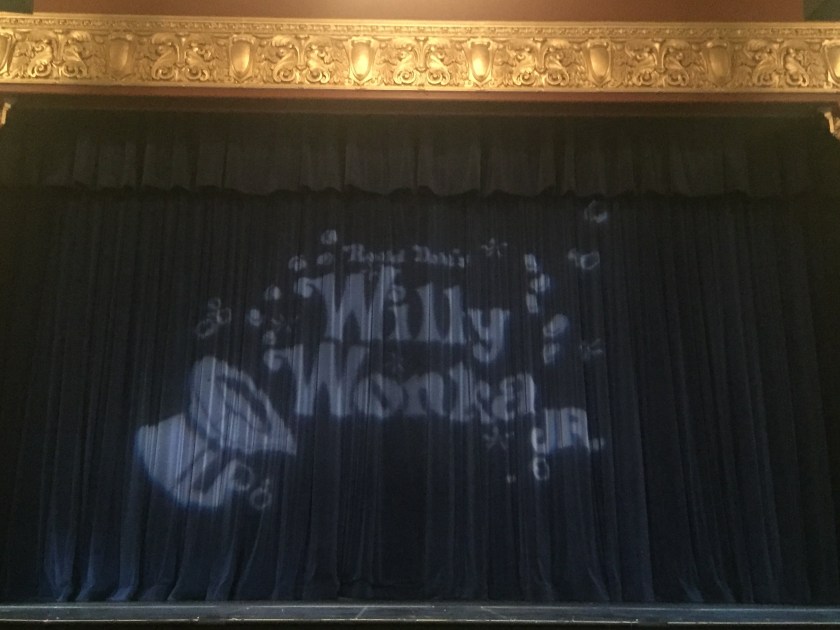
IMG_8469.jpg

As she sang her songs from Willy Wonka around the house, there was a pleasant hum in my brain too. I remember reading the little book with her when she was in elementary school. The years in between have smudged into a blur in which I remember doing a lot of things, cherishing a few memories, and before I knew it, my little girl towered over me in height and ability. 

In a world of pure imagination: how would that world be? It must be a world in which all things vile are wished away, and only pleasant striving has a place. A canvas on which the best is to be painted and awaits the strokes of our creation. Maybe that is how we must view life. Every aspect of ours a stroke on our canvas – the true nature of the painting ever changing to be revealed to us as we go along, giving us a subtle choice here and there on whether to put in that jarring, wrong stroke or a mellow, right one.

There are many marvelous things that I can attribute to imagination (and immigration). One that ranks highest is the fact that I get to read American Children’s literature as an adult. As a child, in the lovely hills of South India, I loved curling up with Enid Blyton’s books, and often escaped into fairy lands on wishing chairs and ran into magical forests. It was easy imagining an adventure, while swinging on tree trunks that had fallen in the last storm. We had plenty of time, and had no one but ourselves to rely on for entertainment. State television made its entry a few years later, but it was agreed fact that our own flavor of entertainment was far superior to what we saw on Television. I sometimes played alone, but not once did I feel lonely. There were always imaginary friends who’d drop in for a cup of tea and we’d bake some scrunchy scones and whip up some tea cake, though I had never seen the inside of an oven. 

The Indian comic books, Amar Chitra Katha, Chandamama added flavor and beans to the curry pot of imagination. It was a wonderful time in the head. The pressures of wanting to make something of oneself had not yet begun to exert itself, the only lures were those of nature as it enclosed us. The trees were friends and frequently doubled up as props in our adventures. Many a scraped knee was soothed away with scratches from brambles. 

I entered my teenage years, and my imagination left some of its whimsy behind. The teen years and the early twenties were dedicated to much serious reading, and I spent a good portion of my time striving and wondering what to make of myself.

“That’s the worst of growing up, and I’m beginning to realize it. The things you wanted so much when you were a child don’t seem half so wonderful to you when you get them.”

L.M. Montgomery, Anne of Green Gables

Then, I realized that all those years that I had spent wondering what to make of myself had actually made me. Just like that, I could embrace all that happened to me. It was liberating, and then the more whimsical side of my imagination swooped in once more. I took tentative steps into Wonderland when I became a mother in the United States, and indulged the child in me with my growing children. 


Dr Seuss graced our tongues and teased the brain (What if I had duck feet? Did the elephant hatch the egg finally, will Zooks and Yooks ever become friends?), we sang poems by Robert Louis Stevenson set to the tunes of the old hymns in our school hymn book (To be written), we giggled with Bernstein Bears, hoo-hoo-haa-haa-ed with Curious George, and marveled at the friendship between Frog & Toad. The children and I read Charlotte’s Web when I was in my thirties, but I enjoyed it even more than I would have as a child.  

dr seuss

For a long time, I had meant to read Anne of Green Gables, but for some reason, did not. The daughter had not shown inclination towards this series, and there was no one to tell me how I absolutely must read it. Then, one day I read a quote from Anne of Windy Poplars, and I was intrigued. I have always loved that style of uplifting writing weaving the tendrils of imagination with subtle humor: the gentle breeze of the soothing powers of nature to nurture our soul wafting through every page. It is why I like Miss Read’s writing so much.

I identified keenly with how much Anne prized the gift of imagination. Somehow, we lose that streak of imagining as we grow older, much like we forget to skip while walking.  I now have that pleasurable thrill of reading all the remaining books by Lucy Maud Montgomery. It is a sustaining thought.  

Margarita Engle’s poem:

No giant or dragon

Is bigger or stronger

Than the human imagination

P.S: If you have not already listened to J K Rowling’s commencement speech, it is definitely worth listening to: The Importance of Failure and Imagination

 

The Lord of the Trees

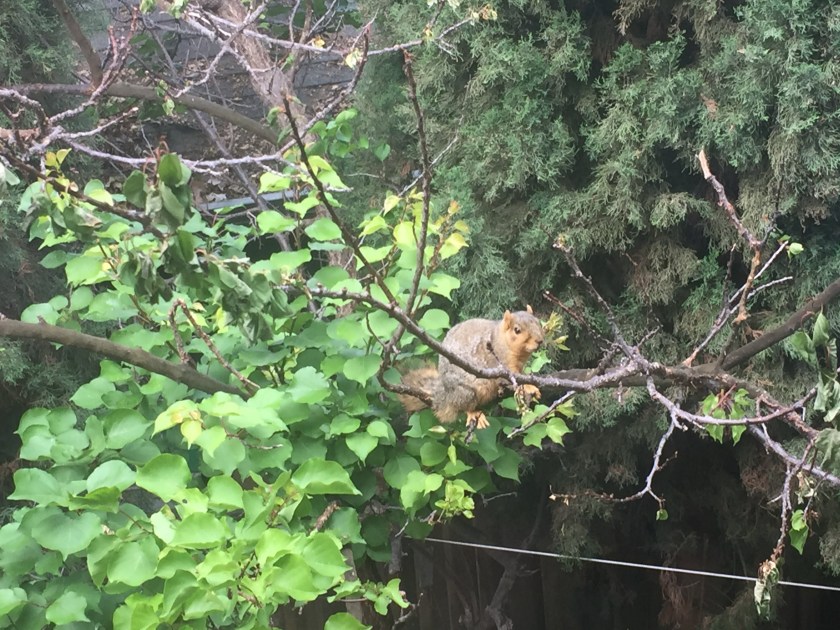
I gazed out of the window feasting my eyes on The Lord of the Trees working hard so early in the morning. The trees went past their blooming-flowers phase to the sprouting-young-leaves phase in the past few weeks.

“How can anyone who has spent any time observing life like this, feel like not preserving it?” I asked. Us not looking after Earth well enough for future generations is a pet peeve that regular readers of this blog know.

“Because I don’t think people stand and gaze at squirrels like you do when one is already late for school in the morning”, came the crisp reply and I nodded sadly hastening to bustle about for the morning tasks.

IMG_7860

The squirrels have resumed lording about the trees like they own them, which I suppose they do, since they are in them so much. I see them lovingly scraping bark, and checking out the fruits . I fight a losing battle every year trying to save the fruits from them. Friends have suggested fruit nets, but I haven’t the heart. They are the ones that live there, and sometimes I like to think of them sunning themselves on the branches while I am in a drab looking conference room surrounded by tonnes of concrete to pay for the land that these trees rest on. I only wish they would eat the whole fruit before tossing them to the ground, or hiding them away somewhere for the Winter months.

IMG_8683.jpg

I cannot deny that it is nice to see the little creatures busy again. The winter months are a little slow for them: though they do not hibernate much (apparently, they do not have enough body fat to sustain them through long cycles of hibernation), they sleep a lot. I wonder how their burrows are, and whether they feel the difference between night and day when they emerge from their deep burrows into the spring time bursting with flowers, fresh leaves and the promise of fruit. 

A few days later, the son and I picked out a book in the library called Morris Mole by Dan Yaccarino that dealt with a similar subject. The book was about a mole who was a wee bit different from his brothers and sisters.

IMG_8550.jpg
Morris Mole – By Dan Yaccarino

One day when the moles ran out of food in the deep deep burrows, the eldest moles wanted to dig deeper down, but Morris had an idea that nobody listened to. So, he “dug deep down in himself and found courage”, to dig upwards.

IMG_8553.jpg
Morris Mole – By Dan Yaccarino

When he emerged into the spring time, he is enamoured and baffled by the big wide world up there. 

This world also offers him the rare gift of friendship with creatures unlike himself such as a fox. 

IMG_8554.jpg
Morris Mole – Dan Yaccarino

The book made me think of how some seemingly little occurrences and thoughts have the power of transformation in them. Would Morris Mole have discovered this wondrous world overhead if he had not paid heed to that little crazy idea and acted upon it?

A few days later, I stopped to observe a squirrel again. This time, it was sitting by the roadside, and sniffing a mustard yellow flowery plant with a contented look on its face. The photographers up at the National Geographic magazine would have been able to get a picture of just such a thing. As it turned out, by the time I fumbled in my pockets, and took out the phone, dropping the keys in the process and finding some tissue marring the phone screen, the squirrel scampered probably laughing to its burrow. But I have the image in my mental eye: I hope it will remind me to enjoy the present when plans shadow life, or life overwhelms reflection. 

All good things are wild and free – Henry David Thoreau

I wish we could all dig deep down inside us to find the determination to set aside some time to spend with living, growing things that are very different from ourselves – observe a bird sing, marvel at a squirrel on a tree, look at ants carrying food, watch a spider spinning a web, or feel the wind against our faces knowing that it just rustled that beautiful tree top nearby. Maybe that will open up a way of living that is much more rewarding and satisfying like the world Morris Mole found overground.


The Big, Little and Half Domes at Yosemite

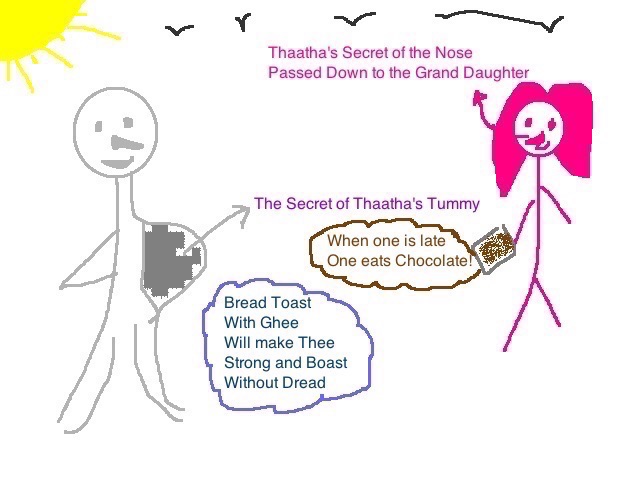
The grandparents arrived, and the grandchildren are reveling in the attention, food and companionship that grandparents bring in their wake. The pater is the Self Appointed Head Counsel for Advice in the household. When you take out a slice of bread, and don’t know how to bite it, he is the authority to seek out: Bread is best eaten when toasted with ghee on both sides in a frying pan, not toaster, and then you must liberally spread jam or even condensed milk. This new fangled chocolate on everything is not good for health, and one must keep away from large doses on chocolate on everything, he says to the children who have perfected the Art of Pacifying Thaatha (Thaatha – Grandpa) with a smile, and fleeing with the chocolates. The teenaged daughter is particularly adept at this. One time, he was advising her on how to leave the house for School without causing mayhem in the morning. “Remember, I went to School for 60 years!” said the old man. (He was a school teacher.) 

“Clearly, it wasn’t enough!” said the tongue-in-cheek grand-daughter to much mirth on Grandpa’s side. I don’t quite understand the rhythms of relationships between grandchildren and grandparents.

Bread_secret

Anyway, point is: Thaatha can give life advice on anything. Grandchildren can ignore life advice on everything. So, an easy truce prevails with each doing exactly what they want to do, with affection and love. It is a sight to behold.  

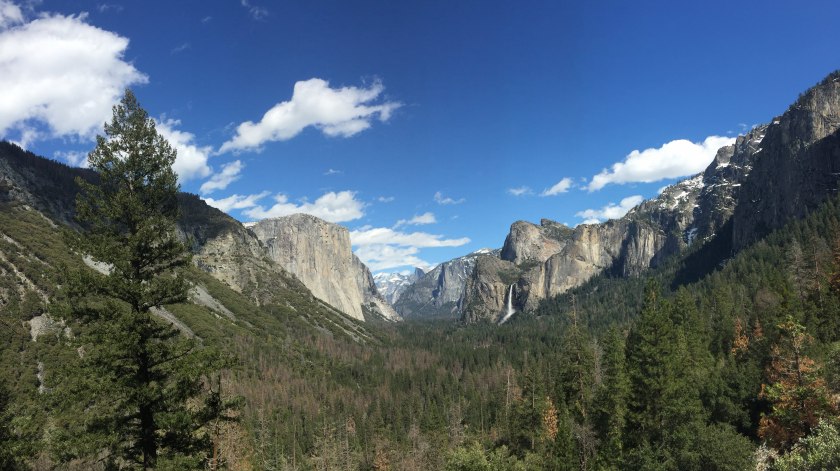
In other news, April rolled along, bringing Spring break in its wake, and off we went to Yosemite National Park for a few days. Gazing over the rain washed Yosemite valley, makes one think yearningly of the phrase: Where every prospect pleases and only man is vile. 

IMG_8356.jpg

Yosemite is a poet’s heaven, an artist’s dream, a hiker’s paradise, a parking headache, and a last minute accommodation seeker’s nightmare all rolled into one.

Luckily for us, we found a beautiful house about an hour away from the park’s valley. The second day of the trip,  the grand (children and parents) opted to stay in the house enjoying the environs nearby. This gave the husband and I an opportunity to sneak off on a hike, and we enjoyed the day and the views it gave us.

That day, the former school-going grandfather and current elementary-school-going grandson also set out on a hike of their own near the house.  

They were asked to take a phone along, and this suggestion was advised away saying the younger generation relies too much on technology, and that good common sense will always lead you in the right direction. “Especially on a walk, just note down the important roads and junctions, and you will increase your memory, …

“Okay okay Thaatha – you come back and teach me how to take a walk okay? I am only going to lie down and read today. Sure, you don’t want the phone? Okay! Bye! “ said the teenager and plonked herself on a couch that looked like it was made by fairies, and stuffed with dandelion twinkles.  She ruled the heavens of her imaginations with queenly delight and grace the whole morning.

Out in the streets, the walk started out sweetly enough. Grandpa advising his grandson on how to notice all the road signs, and distinguishing features, so they don’t get lost. About 2 hours later, the pair of them rolled up to the home in a police escort vehicle to much agitation in the household. The grandfather got himself out, somberly shook hands with the young officer, and his stentorian voice could be heard “ Thank you very much Officer. May God bless you. I am very sorry for the inconvenience caused to you, and we very much appreciate you bringing us home. ”

The son was seen shyly high-fiving the officer. 

“What happened?”, went the collective pry, and after a weary sigh, the duo set out to explain their walk.

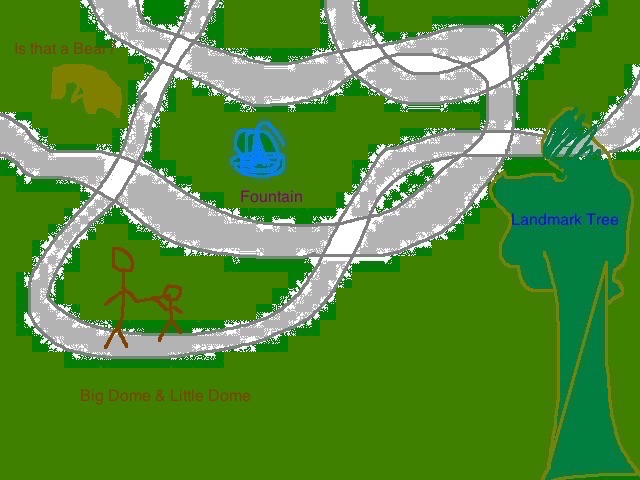
The grandfather had started off by advising the little fellow about how not to lose his way. “Take note of the road name, and you can always find your way back.”, said Big Dome to the Little Dome. The Little Dome said, “Oak Dr, Oak Road, Oak Trail, Oak Grove, Fountain Road, Fountain Circle. “

“Don’t remember them all, that would confuse you.”

“But you said …”,  and off they went giving and imbibing life lessons for all of us.

About a mile afterward when they decided to come back was when the fun started. It was a confusing place to get to, and several times the same road names looped one over the other. Was it Fountain Circle, or Fountain Drive that they had passed last. What about Lion Cove? Was Lion Cove parallel to Fountain Drive or perpendicular to Fountain Circle? The poor things went round and round in circles, till Officer Dave had driven by. The Little Dome helpfully rattled all the street names he remembered, and Big Dome apologized for having forgotten the route, though he remembered the name of the street the house was on. The police officer was most gracious and helpful to the grateful duo, and gave them a ride to the house on the prairie.

Roads

Thereafter, for the rest of the trip, Big Dome was teased about remembering the names of the streets, and landmarks. “Thaatha – this is Half Dome. Always remember that rock, and you will not get lost in the valley. If you get lost, keep walking towards Half Dome. From up there, you can see everything clearly, and can find your way.”

Never a dull moment, and that is just as life should be.

Henry David Thoreau At Walden Pond:

I am convinced, both by faith and experience, that to maintain one’s self on this Earth is not a hardship but a pastime, if we live life simply and wisely.

Also read:

Slay The Dragon, Not The Parrot

On The Ribbons of Wonder

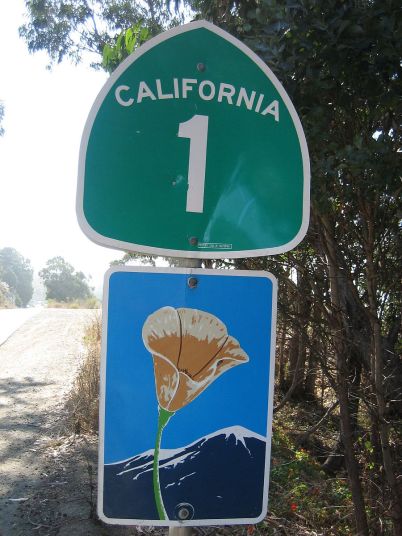
The ‘Scenic Highway’ sign brings about an overwhelming goodness of heart; a promise of something worthwhile; a yearning for the treat ahead.

Nuts? (Absolutely – especially near the symmetrically placed Almond plantations on Californian highways.)

Cuckoo? (Of course! Who wouldn’t be to the musical trilling of the birds?)

California_State_Route_1_All_American_Road_sign
https://en.wikipedia.org/wiki/State_Scenic_Highway_System_(California)
The image was created by Mario Salje from Greifswald, Germany. (Wikipedia)

I poke my head out to inhale the scent of fir, pine or eucalyptus, only to be chided by the children. Amma – stop that! It is cold, or it is hot or it is windy. I try to look repentant, but the joy in my face is a give-away. I become a child collecting wildflowers for the vases that spot every side table in every room in my childhood abode again. The same vases that the father used to roll his eyes at before gingerly moving them out of the way, for they had a tendency to fall and spill onto his ubiquitous newspapers. These tastefully collected possums of wildflowers, interspersed with pine or fir with a sprig of Eucalyptus is joy in a vase. I never learnt the art of Ikebana but my grasp and plonk technique gave me as much joy. 

Even on days when childhood woes and worries weighed heavy on the mind, a saunter in the hillsides with a wildflower bouquet in my hands was enough to get me looking at the world benevolently again.

Adulthood has cured me of this eternal optimism and benevolence, but it has had no luck when it comes to the joy nature can give me. I still potter about the neighborhood sniffing at primroses, admiring cow-slips, and reveling in the wild grass as it pokes its shoots out of the cracks in the pavement. I don’t know the names of the wildflowers, but when I see a squirrel sniff at one, it doesn’t seem to matter whether one knows the name of the flower or not. On road trips, I relish the beauty of the highways, the trees and flowers beside the highways, and thank Earth for its natural bounty. 

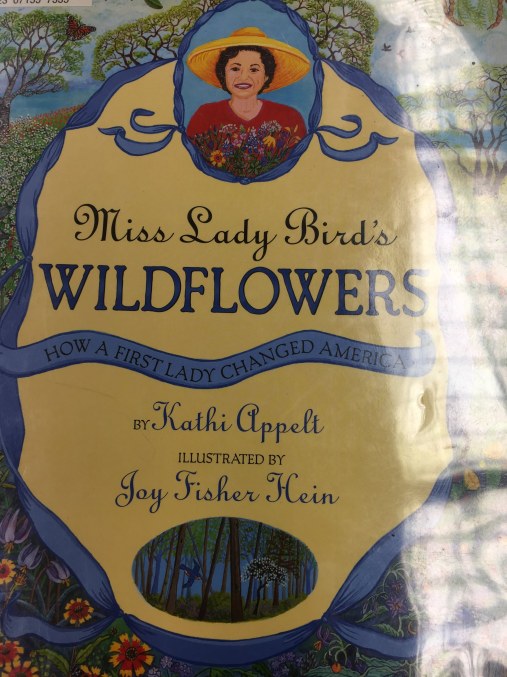
Little did I know that I really needed to thank Lady Bird Johnson for this bounty in USA. Having grown up in a small town in Texas, she enjoyed nature and its calming influences first hand. When her husband, Lyndon B Johnson, became President, one of the things she did as First Lady, was to get the Highway Beautification Act underway.

IMG_8394
Miss Lady Bird’s Wildflowers – By Kathi Appelt, Illustrated by Joy Fisher Hein

The nation was still pained at John F Kennedy’s assassination, and she wanted to cure the nation with the remedy she knew best. Natural beauty.


I am grateful to Lady Bird Johnson for this foresight. I belong to the class of people who derive spirituality from Nature, and wholly agree with the feisty Anne Shirley (Anne of Green Gables by Lucy Maud Montgomery.)

“Why must people kneel down to pray? If I really wanted to pray I’ll tell you what I’d do. I’d go out into a great big field all alone or in the deep, deep woods and I’d look up into the sky—up—up—up—into that lovely blue sky that looks as if there was no end to its blueness. And then I’d just feel a prayer.” 

― L.M. MontgomeryAnne of Green Gables

The next time you see a scenic highway stretch out like a wondrous ribbon unravelling itself from its spiel, send a wave of gratitude out to the thriving beauty of life out there, and the person(s) responsible for it. 

Beautiful highways are not a quintessential American feature either. There are accounts of beautiful tree lined roads, hugging mountainous roads with marvelous vistas, roads by rivers and through deserts, built as early as 300 BC. The most famous ones I can think off are the Silk Road(https://en.wikipedia.org/wiki/Silk_Road), and sections of the Grand Trunk Road (https://en.wikipedia.org/wiki/Grand_Trunk_Road) 

“The world calls them its singers and poets and artists and storytellers; but they are just people who have never forgotten the way to fairyland.” 

― L.M. MontgomeryAnne of Green Gables

How Windmills Became Giants

No giant or dragon

Is bigger or stronger

Than the human imagination

– Margarita Engle

That was the first poem in the children’s book, ‘Miguel’s Brave Knight – Young Cervantes and his Dream of Don Quixote‘. It acted like a magnet on me – not that iron had entered my soul, far from it, but you get the gist. Silly thing to say that magnets work on people, what I mean is that the book appealed to me. 

Screen Shot 2018-04-12 at 5.13.22 PM

The son and I read it together a few days later, and he cackled, “My goodness! This boy thinks of Knights on every page. “

“Yes. Doesn’t he?” I said, bemused that one who introduced car and ninja motives into everyday speech should find it amusing that another young boy was fixated with knights. I told him so, and he laugh good naturedly. “Yeah – but how come he sees knights everyday? I have never seen a knight.” said the little fellow.  We then had an illuminating discussion on the lure of the knight in the olden days. How ubiquitous he seemed, and what enamored thousands of boys to sign up as knights. Could it have only been a means of livelihood or a quixotic quest for glory? 

Back in the book, the story of Miguel Cervantes flowed along poetically.

The book is artfully written, and tastefully illustrated (Pen,ink and watercolor – sample below) . In short poems, titled Hunger, Imagination, Comfort, Daydreams; the story takes one through the life of Miguel Cervantes, the poor boy with an indifferent education, who made the world a richer place by imagining the modern day novel into existence. His flawed, grandiose, knight, Don Quixote lingers on in human imagination centuries later. 

IMG_8390

Miguel’s Brave Knight – Young Cervantes and his Dream of Don Quixote

The poems really talk of the life of Miguel Cervantes, but are lucid enough to be relished on their own. Miguel Cervantes lived during the sixteenth century, and had a far from easy life. Born to a barber cum surgeon, his early life was in constant turmoil as his father was frequently in debt, and was arrested for it several times. They had to move often, went to school if he could, but throughout all his travails, his imagination was his best friend. At a time when books were rare, and imagination frowned upon, the young Cervantes managed to learn to read and write, and carefully hone his imagination: a gallant knight on a magnificent horse was ever ready to rescue him and the world.
Daydreams  

My daydreamed knight

protects farmers and maidens

from ogres, goblins and trolls

The Ingenious Nobleman Sir Don Quixote of La Mancha was the original title of the book that was eventually published in Spanish. 

He sees windmills as giants 

with enormous, spinning arms

The first time I saw a windmill, I stood transfixed, even as an adult. It is no wonder that it appealed to the imagination of a young boy.
Beautiful poetry, mellow illustrations and the story behind Don Quixote is truly irresistible, and I have read the book several times already with joy.

Also read: The Boy Who Harnessed The Wind

Lord Float A Duck!

I remember the first time I heard the Duck-with-an-F word in public. I was horrified. It was in a meadow where we had convinced a gullible teacher to take us out on a nature amble instead of listening to the stern and necessary work that goes into maintaining a civic society. The middle school children far from being lambs and observing nature were trying to play a game of Kabbadi instead. Kabbadi for those who don’t know, is a game where one runs saying the word Kabbadi Kabbadi Kabbadi Kabbadi Kabbadi Kabbadi Kabbadi Kabbadi over and over again till you want to shriek in agony.

sheep_dog

What horrified me was the fact that far from shouting Kabbadi Kabbadi Kabbadi, the boys were insisting on shouting Mucking-an-F or Duck-with-a-letter-that-comes-after-E and this seemed to incense the whole lot of them unduly.

As they looked around in that male-hen-y fashion, I was appalled that something this crude was expected to draw admiration from the girls. I cannot say the girls admired the swearing nitwits very much. We felt a little sorry for the new teacher who was flailing his arms like a shepherd who had just let a puppy loose in the herd by mistake.

sheep_dog_1

The Fabbading went on and on till another resourceful teacher hovered in sight, saw the plight of the poor new recruit who had completely lost control of his class, and showed the fellow how to regain control. Under this stern shepherd, suddenly the fowls spitting F’s became lambs again, bleated a little pathetically, and quietly headed back to the classroom. But I had altered that day.

Then, I remember reading the first “adult” book, and gasping for air every few minutes. For something strange happened: contrary to the adults I knew, the folks in the book hissed and puffed and cussed all over the place. I was wondering whether being adult meant puffing like a penguin in a desert.

I can’t say things have changed much since then.

Society far from growing out of this trend seems to have taken this to alarming extremes. Presidents freely use S-*-*-* words, and worse the news agencies gleefully repeat them.

I wonder how many of you remember cackling at the Tintin comics by Herge: Tintin comics are great fun. I read a few last week, and found myself giggling like a preschooler being tickled by the carpet on which they are rolling. Captain Haddock was my favorite. When he lost his temper, which he seemed to do on every alternate page, he swore in the most imaginative manner possible. The bumbling-bashibazouk made me smile every time he swore. He made one think. He made one use one’s fumbling brain and every swear was one in which you smiled at the brilliance of it.

IMG_7849

Would he call you a jelly-fish or a marinated eel? One never knew.

Imagine yourself facing off a street punk who looks ready and willing to punch your nose. If you call him a Mucking-Duck with a double F, he has to stop mid punch with his hand drawn back and ask himself, “Whaddideesay?” and it gives you valuable time in which run away like krill fleeing the direction of the whale’s rumble. Fumble, tumble, rough and scramble.
So, here is a plea – make people work out their insults. Give them work. Mucking a Duck is far too easy. Call a fellow who does not like his vegetables a squash-nibbling centipede. Tell a fellow who is proud of his batting that he is a bat-bungling bamboozle. Think nonsense and regain the pleasant sensibilities of being in one’s senses.

As Theodore Geisel, or Dr Seuss says, “I like nonsense, it wakes up the brain cells. Fantasy is a necessary ingredient in living; it’s a way of looking at life through the wrong end of a telescope. Which is what I do, and that enables you to laugh at life’s realities.

The Dance of the Butterflies

Magical March gave us the immense satisfaction of walking to school under magical rainbows,  leprechauns had wreaked havoc and left treasures, my mother got to see her father for the first time at the age of 73, we had a beautiful trip playing in the snow, the doting grandparents arrived and the children have been reveling in the social rainbow that enveloped them.
Out in the natural world, the hills are alive with the sound of moo-sic (cows grazing – get it, get it?), the cherry blossoms send sparks of joy piercing through the soul every time I look at them, and the butterflies have been dancing the dance of joy. Rain showers cleansed the Earth, and all nature around us seems to be smiling benevolently.


One beautiful evening, I stepped out on a walk with my little son. Elementary school children derive a certain pleasure in crouching and looking at ants, snails or ladybugs. This time, however, we crouched down to look at a furry, black caterpillar. After reading Eric Carle’s book, The Very Hungry Caterpillar, everyday for months at a time with each of the children, I did not think that I would be enamored sitting and observing caterpillars, but such is the infectious enthusiasm of youth. (The Wind in the Reefs – Working title of The Wind In The Willows)
I found myself excited and thrilled to crouch and watch the caterpillar make its short journey across the concrete path back into the sidewalk where the bushes grew. I still find it amazing that these creatures metamorphose into butterflies. Eggs->Caterpillar(larvae)->Chrysalis(Pupa)->Butterfly has to be the most magical thing in our daily existence next to rainbows.

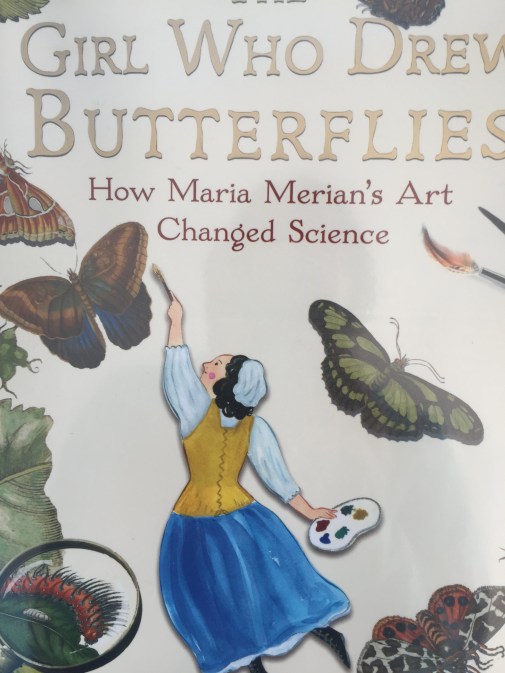
Later that week, the crouch with the caterpillar made me reach longingly for the book, The Girl Who Drew Butterflies: How Maria Merian’s Art Changed Science – Joyce Sidman

IMG_8198.jpg

Maria Merian was a naturalist and illustrator in the seventeenth century.  Written by the children’s author and poet, Joyce Sidman, she says:

In many ways, Maria was an enigma. She rarely wrote about anything other than caterpillars…What we do know is that she had boundless energy, insatiable curiosity, and superhuman focus – traits that would have been difficult to live with, but ones that marked her as a true scientist at a time when the odds were stacked against her.

How does one find the passion and perseverance to stick to a field of study in spite of societal disapproval, familial duties and demanding businesses?  The book gives us a glimpse into seventeenth century life: The impossible clamps on Women, the dangerous possibility of any curiosity being mistaken for witchcraft, the difficult life of artists in general and so much more.

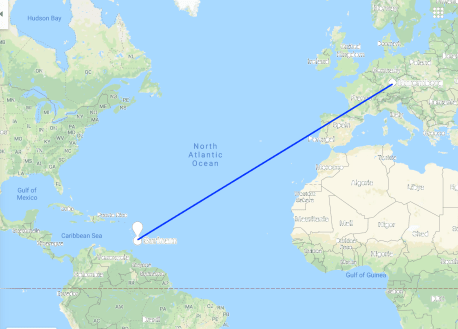
I have always admired those who have high energy levels and put it to good use. Maria Merian was one of those people. She was a brilliant artist, had business acumen and her curiosity about insects made her a pioneer in the field of etymology (A field that did not even have a name until several decades after her death). Her contributions to etymology were remarkable because she also managed to travel to Surinam near Barbados in those days with the sole purpose of studying animal life. Her paintings on Surinam and her books on caterpillars had great appeal in Europe, and Maria Merian went on to transform Art and Science forever.

Screen Shot 2018-03-29 at 5.12.14 PM.png

The book is full of beautiful diagrams, paintings, flowers and plants with little insects on them. It is a joy to thumb through even if it is just to look at the pictures.


Here is to more butterflies, rainbows and magic.

How My Mother Saw Her Father

My mother saw her father for the first time last week. She is 73 years old.

Her older siblings are in their eighties and nineties. Yet, their reactions on unexpectedly seeing their father made one think the last seven decades never happened. Will miracles never cease? Geriatric Joy is a lovely thing to behold.

My mother was the last born in a family of seven. When she was 3 years old, her father passed away. A shock that left the family bereft, and sent their mother into a decline from which she never recovered. Kind relatives helped, but there was no denying that the household was headed for turbulent times. Her older brothers, then teenagers, made for the nearby towns in search of work. They were hard-working boys, and slowly, the boys managed to bring the rest of the family to the town. Despite all the hardships and the lack of money and resources, they sent my mother and her sister (still young children) to school.

The girls did not disappoint them. Their intelligence, hard work and perseverance was easily recognized by their schools, and soon, they were encouraged to get a college degree. When all the world around them judged the brothers for spending their hard earned money on educating the girls (That too sisters, not even daughters wagged the tongues in the village), they did it anyway. The sisters became the first graduates from their village and went on to become Physics and Chemistry teachers.

Life’s tempests may have denied my uncles the opportunity to study, but they did not hesitate when it came to educating their little sisters. They, in my mind, are the true heroes of the #HeForShe movement.

“O, brave new world

that has such people in’t!” 

William Shakespeare, The Tempest

I remember reading the children’s book, Are You My Mother, By P.D.Eastman . In the book, an egg hatches when the mother bird is out. The chick goes out into the world searching for its mother. The little chick asks all types of creatures: dogs, cows, and even cars and planes, “Are You My Mother?”. 


I remember thinking that my mother must have felt the same way about her father. She had no recollection of how he looked, and this was something that always wrung my heart given how much I adore my own father. She, however, was stoic and practical about it, just as she is about life. She always considered herself lucky to have been a sibling to such a loving set of brothers and sisters, all of whom dote on her to this day.

Her brothers, our dear maamas, told us that they looked and searched for any photographs of their dear father, the good-looking, duty bound man.  They had combed through the scant wedding albums, peered into old archives since he had worked as a chef in the Kanchipuram Sankaracharya’s Mutt,  but they were disappointed. Though many people had good things to say about him, and even went on to say my mother looked a lot like him, there were no photographs anywhere. He lived on in the memories people had of him, but my mother did not even have any of those to hang on to.

Then, one spring morning in 2018, on a new moon day,  her 90 year old brother sat down with his morning coffee in hand and opened Dinamalar, the Tamil newspaper. That day the newspaper had printed some pictures from the Kanchipuram mutt’s archives. And there he was. In the frame beside Sankaracharya stood their father. Maama recognized him, and immediately hollered to his son, to send the picture to my mother. “She is the only one who has no memory of how he looked.”, he said smiling like a child again.


So, at 73, my mother finally saw her father. R Iyer had 7 children, two of whom have already passed away. The youngest is a septuagenarian. What were the chances of a 90 year old man still retaining the habit of reading the newspaper every morning? Why he had been reading that particular newspaper that day? The fact that he retained the mental acuity to recognize his father who passed away 70 years ago is nothing short of a miracle.

I sat with my mother while she massaged her arthritic knees, and asked her how she felt at seeing her father’s face finally. Her face broke into a slow, wide smile, and she said, “I felt very happy to see him of course! You should have heard anna and akka (elder brother and sister) though. They were so excited and happy to finally show me my father!”

amma_thaatha.jpg

I love the word, Serendipity.  If this isn’t Serendipity, what is? Though a tiny analytical piece of me nudges me about probability and coincidence, I think R Iyer wanted his youngest daughter to have a glimpse of him in her lifetime, and he revealed himself to her.


How Squids Shaped Our Myths

We are familiar with the Pangea theory (large hulk of a landmass floating together, and breaking apart into the continents of today, current day India going and joining up with the Eurasian chunk and creating the Himalayas in the process etc). Supporting evidence for this theory has been largely in the form of marine fossils found in the Himalayas, a region that is landlocked today.

Pangea_animation_03
Pangea animation from Wikipedia

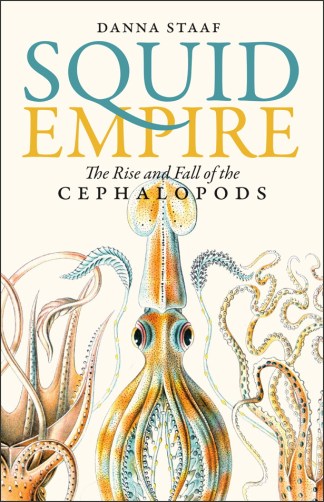
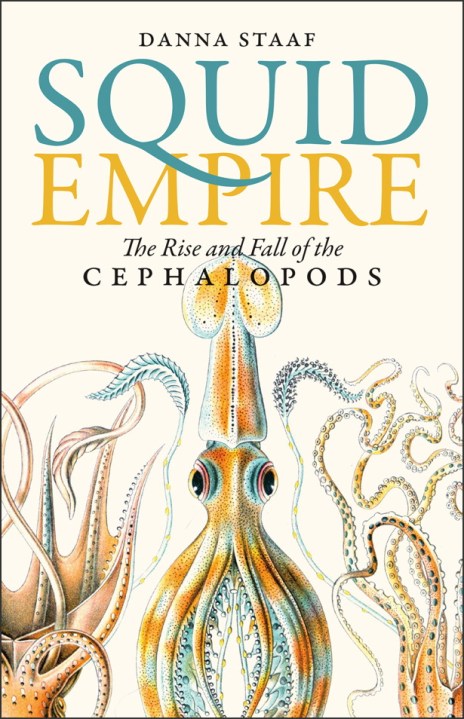
It was while reading Squid Empire by Danna Staaf that I realized how intertwined the evolution of the world, our myths, theories and culture are.

SquidEmpireCover

Culture is a funny word. It is supposed to capture the intellectual and sociological elements of a group of people living at a certain point in time in a certain place. The clothes, the food, the music and drama, the myths, the beliefs, the societal graces etc are what loosely constitute culture. It always amazes me how a word that is essentially an observation of life can be taken by the self righteous and used to noisily monger about the manger (but that is another post for another day.)

It is not surprising that our myths reflect our surroundings. Some cultures where myths have intertwined with religion are also reflective of the evolution of mankind over time in these places.

Indian myths, for instance, say that the Himalayas are home to the Gods. At the time when the myths originated, the Himalayas were probably looked on with awe (they still are, but probably more so 5000 years ago), and the only beings capable of living and scaling the mountains were attributed to having god-like capabilities. (Lord Shiva, the destroyer of the universe, apparently could be reached at Mt Kailas, Himadri Range, Himalayas. )

Lord Vishnu (The preserver), was always depicted with a conch and a shell. I have often wondered why Vishnu had a conch and a shell. Why not a sword and scythe?

Vishnu_shiva
Shiva-Vishnu: Image from Google Search

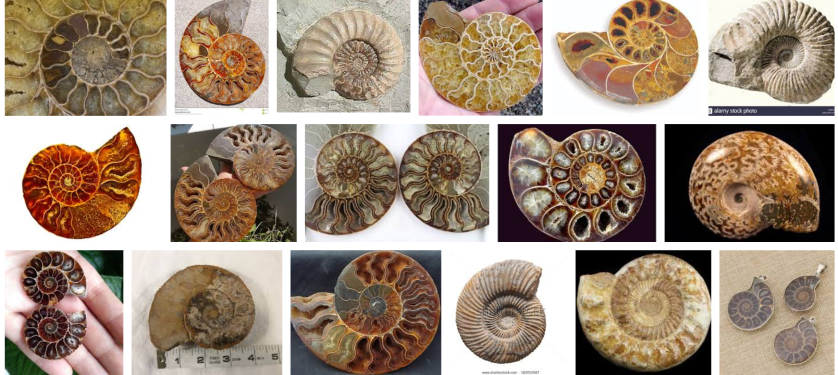
But like a minute puzzle piece waiting to chink into place, I realize that these were the fossils found in the Himalayas at the time. Nautilus shells, and ammonoid shells. They are shaped like conches and shells. Of course, they became the accessories for the popular gods. <Pictures of ammonoid shell fossils below>

Screen Shot 2018-03-22 at 9.10.28 AM

Quote from The Squid Empire by Danna Staaf:
Just on the other side of the Himalayas in India, certain coiled ammonoids fossils are named saligrams, symbols of the god Vishnu, and are believed to offer spiritual rather than physical healing.

Quote from: Adrienne Mayor’s paper on  (Fossil Appropriations Past and Present), (Classics and History of Science, Stanford University)

A current popular exhibit called “Mythic Creatures” at the American Museum of Natural History (May – Dec 2007) demonstrates how some stories of fantastic creatures, such as griffins, unicorns, and water monsters, arose from observations of extinct animal fossils around the world.

There is always a beauty to observing the natural phenomena around us. We are minute in a large throbbing cosmos, occupying a still thriving ecosystem on Earth for minuscule specks in time.

When you think about life that way, it seems beautiful:  a gift meant to be nourished and cherished. Did the squid think they would influence homo-sapiens millennia later, and help shape their culture? Probably not. But they did, just by existing.


Cephalopods

The husband had an amused expression on his face as he walked into the kitchen and saw me reading while making dinner. His eyes were set to roll, and his lips had already started on the journey to upward curvature that results in an indulgent smile. I told him so.

“Your neurons, it seems, are all controlled by one brain – tut tut! Not the case with Cephalopods. Take octopi or octopuses for example. They have neurons tingling all over their many arms, and each arm can function almost independently of another. Severed arms have been known to collect food on their own you know?”

“What are you reading now?”, asked the husband.

“Squid Empire by Danna Staaf. It is a book about squids, octopuses, and some other creatures called nautiluses and ammonoids, coleoids and cuttlefish and god-knows-what-else. Apparently, they are all called Cephalopods.” I said beaming happily, while slowly roasting the dinner. It made me feel like an eight armed goddess myself just reading about these fascinating creatures, and cooking at the same time. Never mind that I was making the most gawd-awful hash at both these tasks.

SquidEmpireCover

“Did you know? The humble garden snail is descended from the ammonoids and squids?” I said.

“Well….I will leave you to it then.” said he squiggling out of the kitchen like an octopus out of a tank.

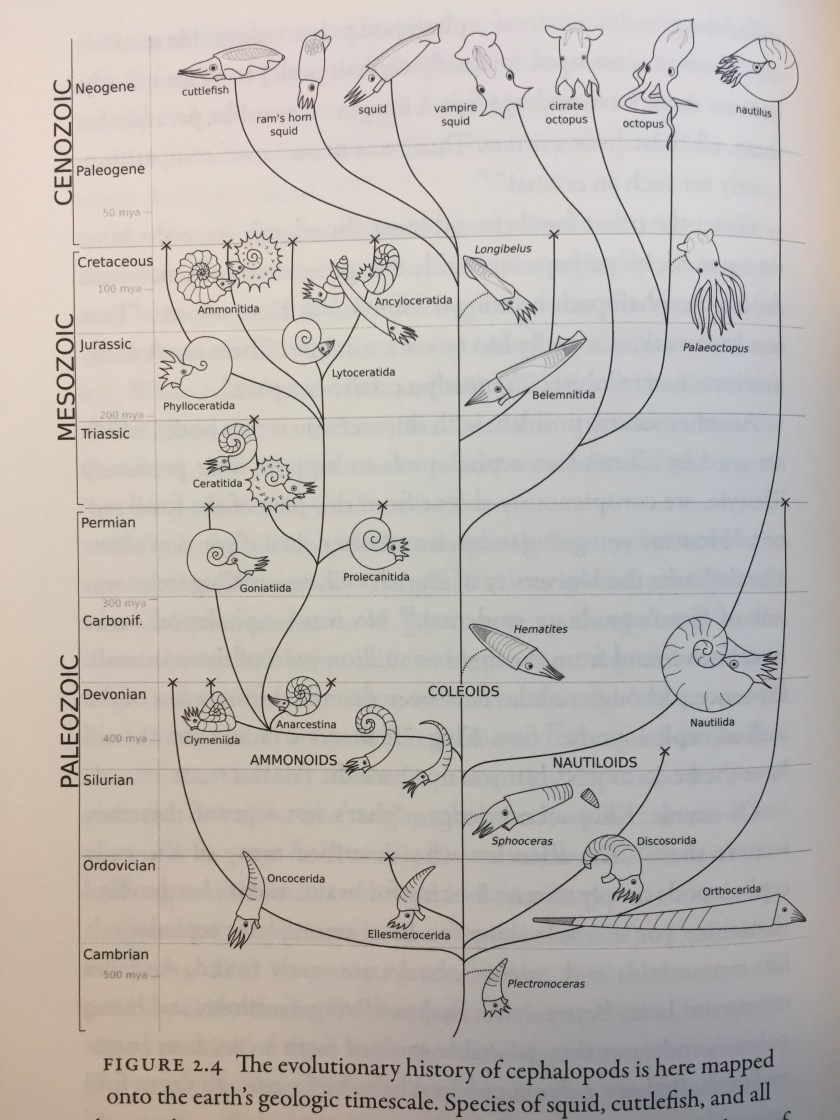
I went back to the book and though I was at times confused by the various scientific terms, I enjoyed the read. It yanked me through the ages, and took me to a time in Earth’s history well before dinosaurs or life on land had started. It was intriguing to see how they formed shells, and how those very shells helped them move from the ocean floor to the central zones of the ocean where they could swim and live with no apparent threat till the whales and larger fish evolved to eat them. The shells secreted a liquid less salty than the surrounding sea water, and this helped them float and remain buoyant instead of being brought down by the heavy shells.

IMG_8046.jpg
The Evolutionary History of Cephalopods from the book, Squid Empire

Why did I pick up a book on Squids?

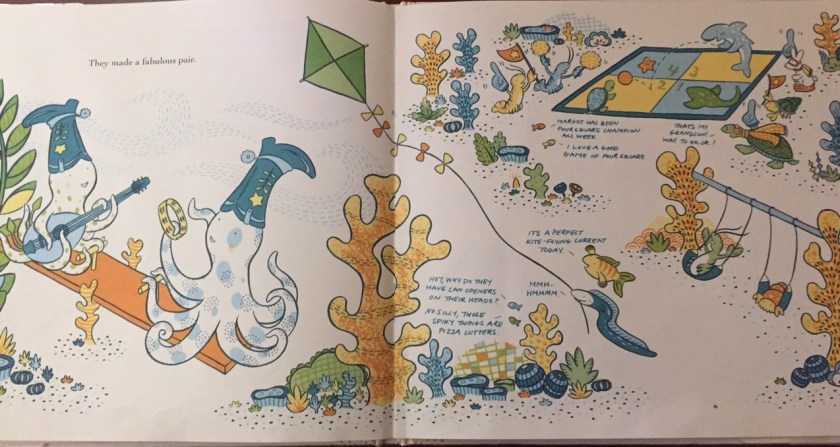
I don’t really know, except that I loved the children’s book, Octopus and Squid by Tao Nyeu. A book that the son and I read every now and then for its beautiful friendship between two seemingly different creatures.

Imagining
Squid and Octopus by Tao Nyeu

Then, a few months ago, I read The Soul of an Octopus by Sy Montgomery

Cosmic Nature of Living:

Quoted from The Soul of an Octopus by Sy Montgomery:

Cambridge Declaration on Consciousness asserts that “humans are not unique in possessing the neurological substrates that generate consciousness”, and that “nonhuman animals, including all birds and mammals and many other creatures, including octopuses also possess these neurological substrates.”

Now, I felt it was time to get acquainted with Squids. I don’t distinctly remember a squid – I must have seen them at the Monterey Bay Aquarium.  Their evolution is fascinating. The book is written by a genuine marine lover (Danna Staaf’s site is here: cephalopodiatrist), and her love for these creatures shines through in the book. I only wish the book had more pictures. I had to keep looking up pictures on the internet. Pictures of nautilus, cuttlefish, squid and octopus obtained from Google search below:

I had never used the word, Cephalopod, before, and I was glad to learn so much about another way of life, even if I may never fully comprehend what it means to have consciousness so permeable, so distributed, and yet co-ordinated.

If there is magic on this planet, it is contained in water. Loren Eiseley

jelly