🌍🌠 The Happiest Planet 🌍 in the Universe 🌠🌍

Disney Land

Talking of bold visions, I think Walt Disney nailed it with his: The Happiest Place on Earth.

How do you take up a vision like that, and work relentlessly towards making it a marvelous destination for all involved? After all, humanity comprises of pesky pixies, grateful gnomes, angry birds, peaceful piranhas, dutiful doxies, irritated iguanas, snappy turtles, hungry caterpillars, buzzing bees, flighty feathered friends, and the list really goes on. No two humans are exactly alike in temperament or ability after all.

Standing around in queue surrounded by children, I was in awe of Disney again. There we all were, waiting to enter the happiest place on earth, some still sleepy, others smiling and bright. 

Throughout the day, whenever I could, I stopped to pay attention to the people around me. The eager children, cranky children, enthusiastic children, meek children, energetic children, dull children, frail children, hesitant children, entitled children, rich children, not-so-rich children, able children, disabled children, they all had a place at Disneyland. I noticed the adults accompanying the younger children too – parents, aunts, uncles, grandparents, guardians, teachers, and tried picking up a tip or two from their interactions. For instance, one obviously famished grandfather sat himself down and created a tower of French fries for his 5 year old grand-daughter, and caught himself a break.

Weeks, days prior to our week-end visit, I prepared the children for it. Remember, we need to sleep on time the previous night and remember, we need to get up before the lark thinks of singing in the morning, and on and on. 

I must admit, Disney Land as chaperones for tween boys who consider it a ride’s worth only if they have had their intestines taken out, shaken vigorously inside out, and then stuffed back inside, is a bit much. As I looked at the grandfather with his tower of fries, I sighed, and the son caught my eye, “What is it?”, he said. His adrenaline was still pumping from the last roller-coaster in the dark, speeding through the cosmos, while I yearned for a nicer ride. Something calm, and soothing: give my innards a chance to settle.

“Well – as much fun as it was to knot my large intestine with the small intestine, using the gall bladder to bind it together and all, I want a lovely ride down a tame stream – I want to get that smile that lingers with a ride like ‘Its a Small World’!” I said.

Disney’s It’s a Small World After All ride.

Magic is a beautiful thing even when you are prepared for it. DisneyLand’s It’s A Small World worked its magic as it usually does – I couldn’t help smiling as we stood in line. The son caught my face, and said, “Hmm…now that you know the show was designed by a woman, it makes it that much more special huh?!”

small_world

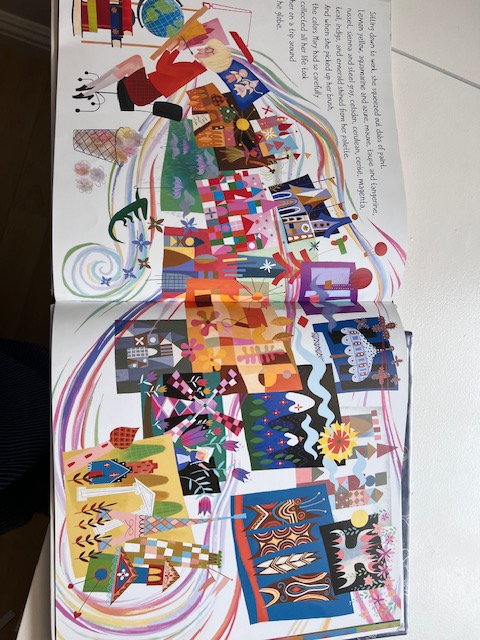
Pocket full of colors : the magical world of Mary Blair, by Amy Guglielmo & Jacqueline Tourville, Illustrated by Brigette Barrager

I laughed, and said, “Well – reading the book makes you think of so many things: things other than the lovely ride. I mean : The color schemes, the preferred movements of the characters, and the theme, the conception, the unity.” 

I could feel myself grow happier, cheerier, and a tad smug as our line snaked towards the empty boats up ahead, Really, catching any of these rides well before they all getting to hour long waits is a form of magic. 

I whipped out my phone, but the son caught my hand, and said, “Remember, you want to enjoy the actual ride, and that means … ? ….” He gave me that look that I give him when his homework isn’t quite done yet. I meekly put it away though I could not resist taking a photo or two along the way.

The special ride around the world felt just as special as always – the music, the lights, the cultures, the joy. How can one not enjoy it when for those 5 minutes, adulting is forgotten and childrening is embraced?

Mary Blair & Walt Disney

This time, we also knew who exactly to thank for the ride: the chief artist and designer, Mary Blair, whose vision translated into one of the most beautiful rides of all time, and Walt Disney who believed in her, and supported her through it. Obviously, it has since been improved upon by the teams, and continues to charm magic-seekers through the ages.
8D484D23-5322-457F-B886-DBBA77D00FDB

Mary Blair’s travel through the world, and the distinct ways in which we perceived the colors of the Earth is so evident in the artwork. Not all of us are lucky enough to catch the ethereal colors of sunset in a desert, or the tropical colors of an island, or see the cultures of different countries. This little ride shows it all in a vibrant display of artwork bursting at its seams with colors, themes and music. Subtle variations in music as the boat moves from American Wild West to Asia, and from there to Russia. Continue reading “🌍🌠 The Happiest Planet 🌍 in the Universe 🌠🌍”

🐘🐘🐘🐘🐘 The Tusks of Extinction 🐘🐘🐘🐘🐘

The Mammoth Tale

Few passages capture the bane of consumerism like this one does. It is from the novella, The Tusks of Extinction by Ray Nayler.

The premise of the book is an intriguing one. 

  • It is set in a future when mankind has figured out how to upload one’s consciousness into the cloud. A manner of immortality. This is very much in the realm of possibility.
  • It is also set in a time where the Siberian mammoths have been resurrected. This has already transcended realms of possibility into reality

The wooly mammoth is being resurrected – being cross bred from the genetic remains frozen in the Siberian Tundra with  the Asian elephants (because they are gentler than African elephants). 

Thus, begins the tale of a doctor whose life was hacked from him moments after he uploaded his thoughts and knowledge to the web. This man, Dr Damira, was a passionate naturalist, a man who studied the African elephants and their ways. He fought for their conservation but failed. This is set in a future where the last of the elephants no longer roam the Earth. 

tusks_extinction

The resurrected mammoths in Siberia are facing difficulty thriving in the wild. They have all been bred in captivity, and do not understand how to survive the demands of living by themselves, caring for each other, and forging paths so they can forage and live through the cruel winters. They are thus being killed by poachers in a cry that reminds scientists of how the elephants were all killed off one by one. 

In an attempt to give them a chance at life, the doctor’s consciousness is uploaded to a mammoth – a matriarch by the name of Damira. 

Bane of Consumerism

There are several aspects of this novella that can appeal to us, but one in particular stood out to me, and that was how our consumerist culture alienates us from the natural world. For we buy things, we want things, we accumulate, we hoard – who is it hurting? I am earning and I am buying. It is all helping the economy is it not?

Extract:

In offices-a tusk in a case, beautifully carved, transformed into a world of its own, worked by human hands into a chain of elephants walking trunk to tail. Beautiful, lifeless elephants carved from the destruction of an elephant, hacked into what had once been a part of a body, a tooth, a tool. A part of a life.

“Among the skyscrapers, there were also older places-little streets of cramped shops, survivors from another Hong Kong. Marginalia that had been missed by the eraser of progress. And there, in the shop windows, so crammed with clever things, there it was. My eyes found it over and over again. Ivory. Ivory jewelry, ivory stamps used to sign decrees that were meaningless now, ivory game pieces of every kind. Ivory turned into useless gewgaws, dripping with the blood in my home. It could be carved into any lovely shape they wished, but all of it began in killing. No-more than that all of it began in killing that took place far away. That took place somewhere the people who thought of ivory as a material could not see. Killing that took place in an extraction zone.

I remember the horror I felt when I first learnt that certain types of leather were obtained from the skin of crocodiles and were thus priced higher. 

Cities like Hong Kong and New York and London at the center, vortexes into which the currents of trade accelerated, into which goods from all over the world were pulled. Places where things became materials. Where things became commodities.

Many of us rarely stop to think of the source of all the things we use as part of our daily lives. In all honesty it is overwhelming to do so. How does the kidney bean come to be in its packet in the grocery store? Once we start down that road though, what about the almond flour, the diamond ring, the leather handbag, the silk scarf, the perfume, the spice, the watch, the gold ring, the ceramic jug? Everything has its tale, its journey, its place in the human chain of wants and needs. 

What Can We Do?

In reality, we cannot give in to an almost paralyzing analysis of source-to-table for everything we consume. Is there economic exploitation along the way, unscrupulous practices, inhumane treatments? Would we be happy to know it all and make informed decisions – yes, (I am hoping that humans have enough humanity to make the right choices if we do), but can we do so? Not always. 

I spent a pleasurable few hours at the mall the other day, and found my fellow human beings doing the same. Glancing around at the happy faces of those of my fellow humans that morning, I did not see malice or greed – I simply saw folks at a mall on a rainy week-end. 

I like that mass production has made life easier, the jobs it has created, alleviating entire nations from poverty. I like that poor children can have new clothes, and that horizons have expanded thanks to the general prosperity of nations. I do not, however, like the ever-increasing pressure to produce and consume more. 

Is the economy to be weighed against the Earth’s resources at every step in the mall? Or just more more meaningful consumption? I do not know.

The Fascinating Behavior of Songbirds: A Morning’s Musings

It was one of those mornings in May – clear skies, the sun’s rays dancing through windows, and replacing moans quickly with sharpness and dedication.

I stood there wondering how it was so thoroughly that we transition from a supine, sleepy form to an alert, going-about-the-day form. The demands of the clock are relentless indeed. 

For an instant, I stopped to hear the beautiful voice of the songbird on our garden fence. It was trilling and beautiful, and I could have sworn just a little inspired – that last note a little higher than a human would have envisioned for that piece. 

It was as I was musing thus, that I noticed the son charging down the driveway to get to school on time – a sock hanging in one hand, a school project in another, and off we went. The songbird flew from my mind as we navigated the traffic, spoke of this-and-that, and chose music for the ride there. 

When I came back, the songbird was still flitting about here and there. I stood mesmerized by the little flashes of movements that my phone camera would not be able to capture anyway, and listened as it chirped, and went about gathering its breakfast.

I remembered a book that I had from the library – patiently waiting its turn.

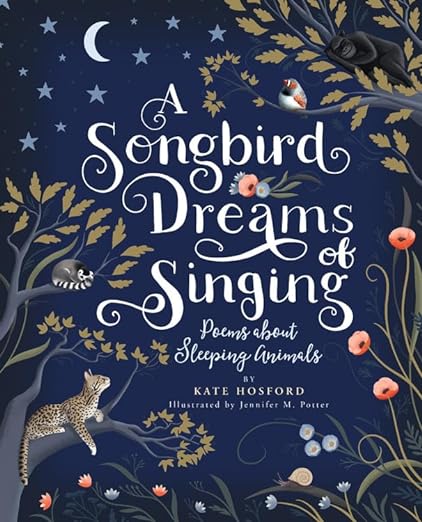
A Songbird Dreams of Singing – By Kate Hosford, Illustrated by Jennifer M Pottersongbird

I flicked open the book. The poem about the songbird was there:

Other birds may dream of worms 

Or flower beds or thunderstorms 

But every night this bird performs 

A concert in his mind.

How marvelous to imagine a songbird rehearsing and getting better at its craft subconsciously – every night.

The book goes on to talk about research made about sngbirds:

In the case of songbirds, scientists at the University of Chicago have done studies on zebra finches demonstrating that the males practice and refine their songs while dreaming, adding little flourishes to make their version of the song unique. Zebra finches are diurnal birds who rest in the afternoon and sleep for about ten hours a night. Like many other songbirds, when they awake in the morning, they sing with particular enthusiasm in what is known as the dawn chorus.

Children’s book illustrators are so wonderful at their craft. This book too has beautiful illustrations, color schemes, and an overall look and feel of a book that is all set to send us to our worlds of dreams too.

So, what should we dream about, and subconsciously try to get better at?

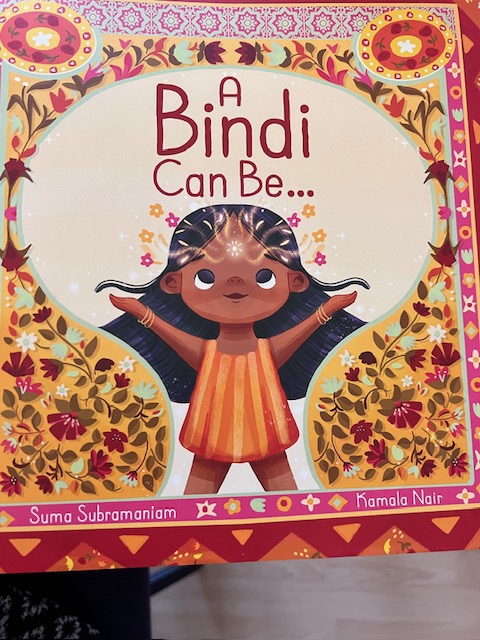
Suma’s A Bindi Can Be

Suma Subramanian

I have been waiting for Asian Heritage Month to review the brilliant books of Suma Subramaniam. I yearn for books that hold a nod for us. I know what it is like to be the only child wearing a bindi in a classroom full of non-bindi wearing children – and so does my daughter I am afraid. 

Despite this, whenever I could, I looked for bindi patterns. Beautiful patterns – so elegantly thought out and shaped. Tiny little spots of art that you could stick on, to transform a face. I have a special kinship to bindis that probably deserve a separate post. I didn’t realize how much bindi related material there is in my head till I started writing this post. I have at least 3 posts worth just with reading one book!

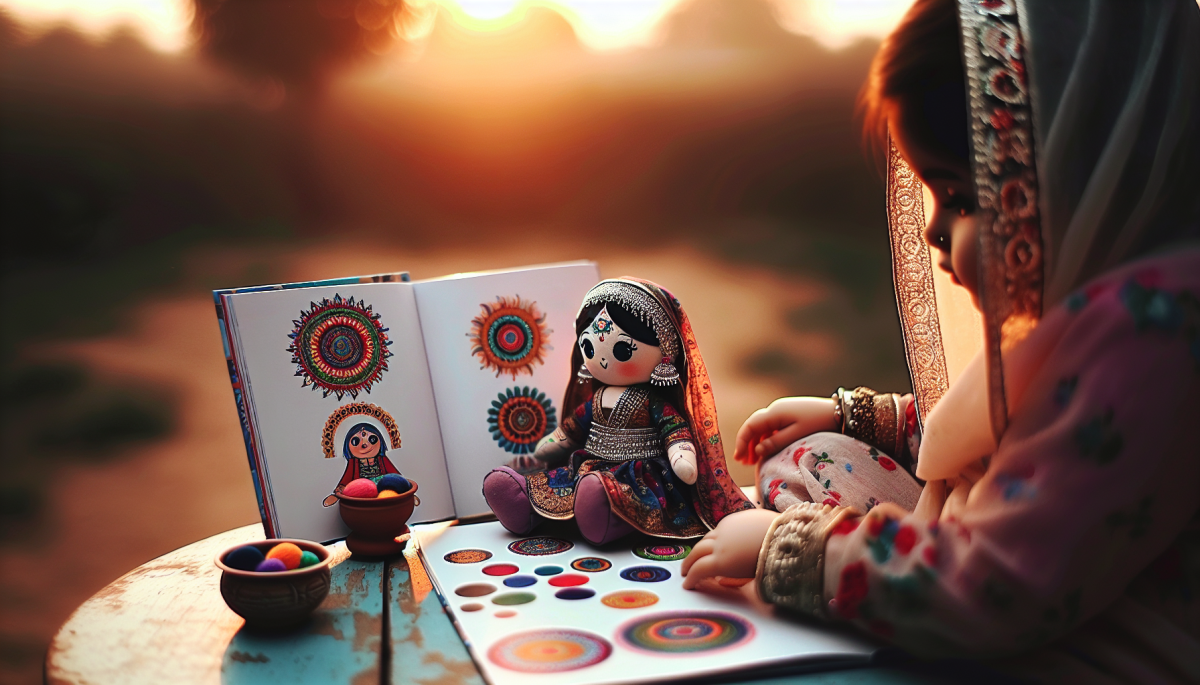
Pottu, my doll

For instance, I had a marvelous doll named ‘Pottu’ – actually the doll was marvelous, it was made to look quite horrendous with all the bindis I gave her. I drew magnificent bindis on her everyday – one day, the sun, another day a palm tree, one day – I’d fill her forehead, face and forearms with bindis. But Pottu was my doll, and there she resides in my long-term childhood memory – a small part of our identity that only those who knew about bindis could understand. 

pixar elephant

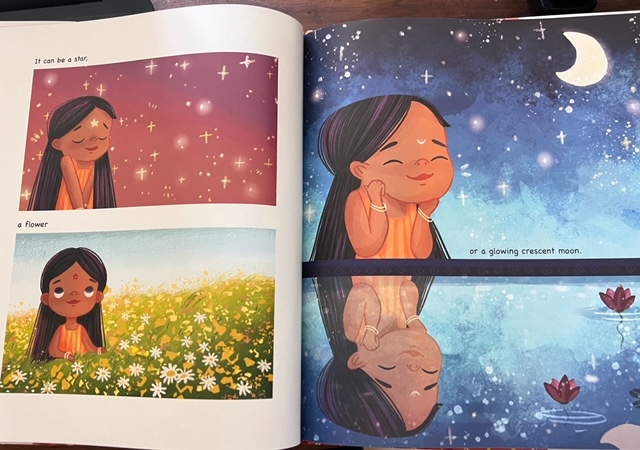
Here was an aspect of ourself that I finally saw in a book. When my daughter showed her baby pictures to her friends, they’d ask about the drishti pottu, or the pottu on her forehead. Finally, children can show their friends what a bindi is – in a book, in an American library. I am proud of that. Like the book coming out gave us bindi-lovers a tiny nod of belonging. You can wear a sari, and a bindi, and you can just Be. 

IMG_1254

Picture from: A Bindi Can Be – By Suma Subramaniam, Illustrated by Kamala Nair

Thank you Suma! 

A Bindi Can Be – Written by Suma Subramaniam, Illustrated by Kamala Nair i

Now on to the book itself, A Bindi Can Be – Written by Suma Subramaniam, Illustrated by Kamala Nair it is a marvelous read. The pictures are vibrant. The joy of bindis is evident. The essence of the small dot transforming you is brilliantly done. 

67273848-1671-40B0-992C-E3C82AFDF5D4

Thank you Suma – for all those children who have had the joy of drawing their beautiful bindis, or having a marvelous bindi collection, or felt curious about a friend’s bindi, this book satisfies them all.

Sarees for Mothers

A Sari for Ammi

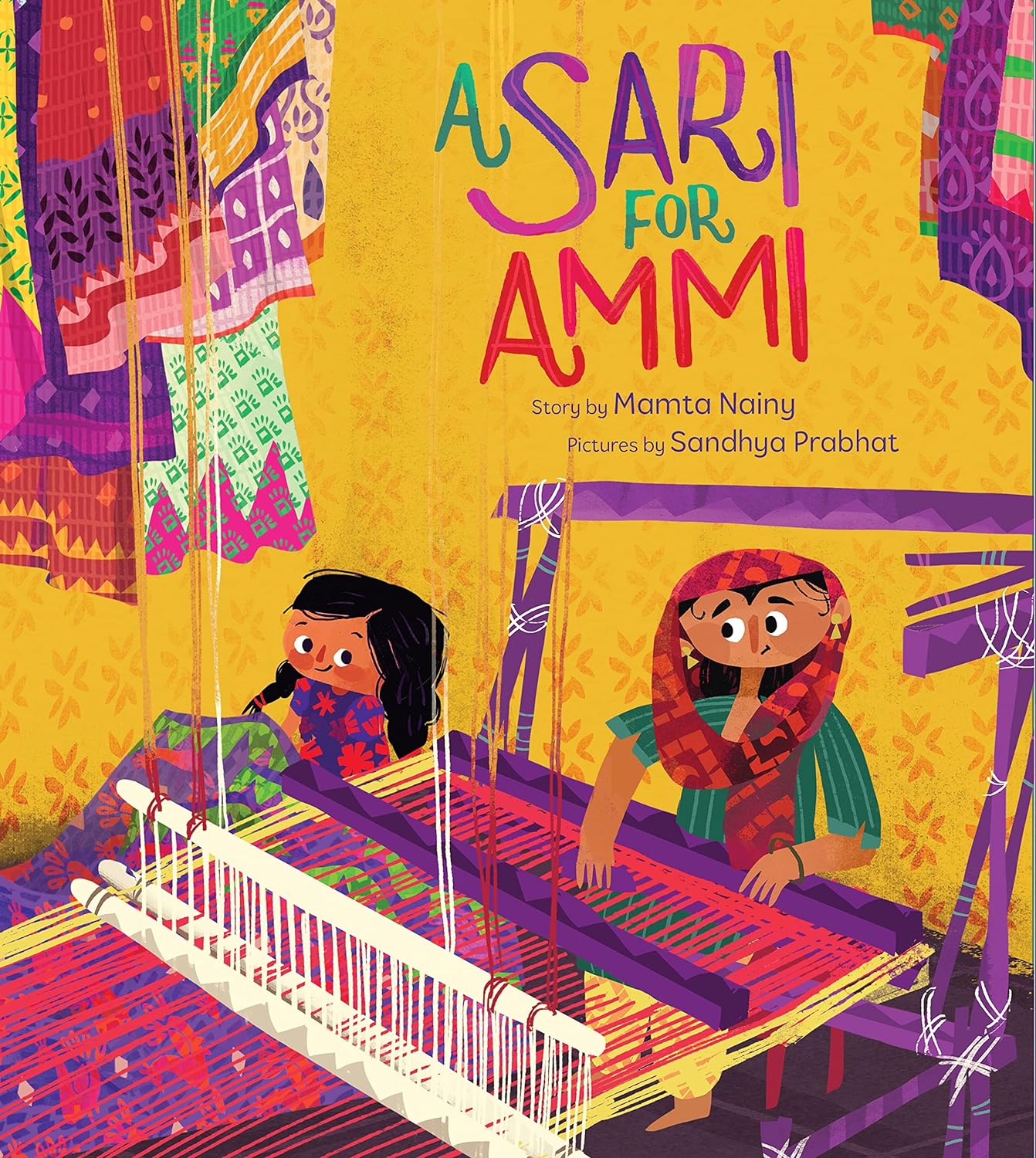
It is Asian Heritage Month, and the library is vibrant. I saw this book, A Sari for Ammi – Story by Mamta Nainy illustrated by Sandhya Prabhat. 

I thought I’d write about this for Mother’s Day, for it is a heartwarming tale. 

The young children of sari weavers watch in awe as their parents work on their arts of creation every day. Dyeing the threads, working the looms, selling their brilliant creations at the local market. Their beautiful mother, who creates magical saris can seldom wear a sari -she usually wears the practical and old salwar kameezes she owns – for she can neither afford the sairs she weaves, nor can anyone buy these for her. They are Kota Doria fabric weavers, and many generations ago moved to the Rajasthan area from Mysuru in South India at Rao Kishore Singh – the then ruler in Rajasthan.

Sari_ammi

The children decide to buy a sari for their mother: One she particularly liked, and one of her own creations. Of course, they realize that they do not have enough to buy a sari, and the heartwarming tale pushes on. 

Buying a sari for a mother is a special joy – one that Indians know and appreciate. For many years, I felt sorry that I could not indulge in this simple pleasure when my mother or mother-in-law came to stay with us in the USA. Luckily, now we have a few stores, and online options, but that was not always the case. 

A simple book that taps into the simple joys of buying your mother figures a saree.

Happy Mothers’ Day to all the wonderful mothers and mother-figures in your life.

We Belong: A Heartwarming Experience at the San Jose Public Library

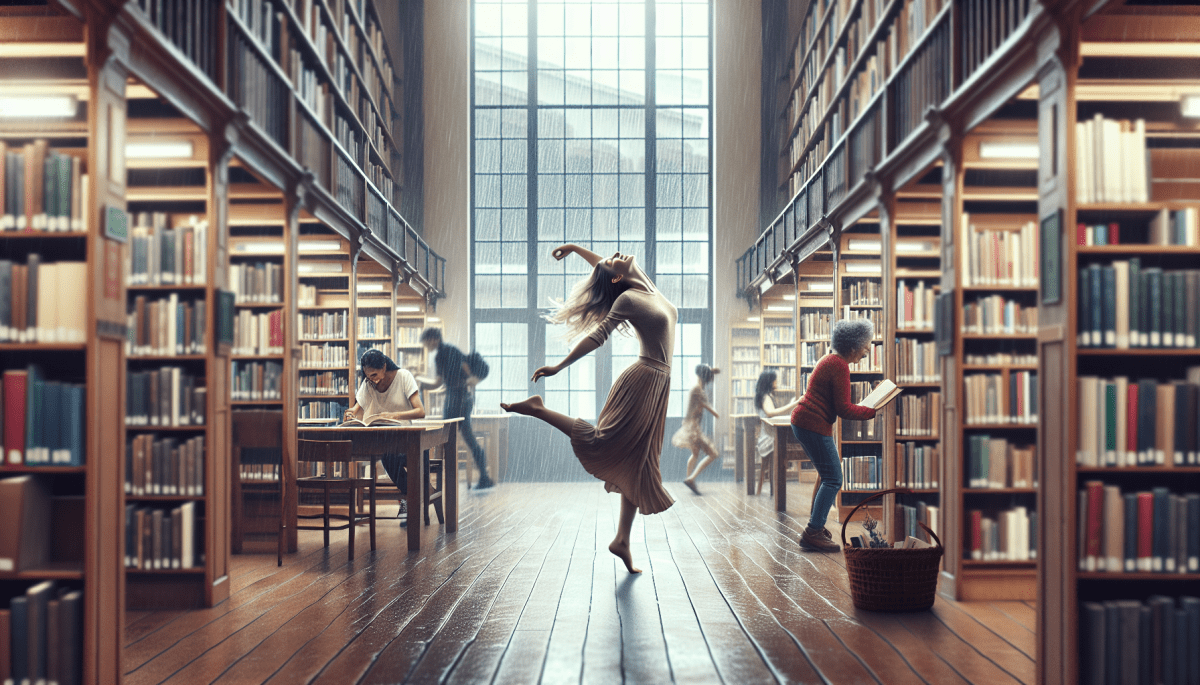
As we stepped into the San Jose Public Library with the brood, I could feel a sense of contentment. It was pouring rain outside, and typically one of those days that the world, including Yours Truly, would have preferred to stay indoors, reading a book, drinking cups of tea and maybe dancing in the rain for a bit. However, we decided to hit the library and then the Art Fair afterwards instead. 

It was a good decision. It was also supposed to be a surprise – my portrait had been put up in the library as part of a We Belong series run by The India Currents magazine, and I felt doubly blessed. To have a picture of my dancing in a library – what more could the Universe give – both my loves of reading and dancing together! 

The husband, children and parents were all suitably impressed, and we took turns looking at all the portraits put up by the talented artist and photographer, Sree Sripathy from the India Currents Magazine. 

Seeing that the pouring rains would not be conducive to an outdoor Art Fair, we lounged around in the library instead. It was perfect Gluggavedur weather. (Gluggavedur is a delightful Icelandic word that signifies, ‘Window weather’ – beautiful from the inside, but too cold to go outside.)

BookWhat a Wonderful Word – By Nicola Edwards & Luisa Uribe

All young, old and those in between were in their respective sections, while Yours Truly flitted about everywhere, dancing my way into everything from Seaweeds to Chinese Poetry and blurbs off novels. I didn’t link the fact that there was maybe an extra splattering of Star Wars content about till I realized it was May 4th – May the Force Be With You day. 

The rest of the afternoon was spent in a glorious haze of the sun peeking through the clouds, and raucous laughter with friends. It was after all World Laughter Day the next day.

World Laughter Day

May the Force Be With You!

The Powerful Epiphanies

The Power of Spring

As epiphanies often go, it was unexpected, and oh so satisfying. This spring season has been particularly fantastic – there are bumblebees, butterflies, dandelions, ducklings – all tripping over themselves to give you epiphanies of life, miracles, hope and so on.

One such day, we sat watching lazy waves rippling through a large pine tree. The previous day had been a cold, and windy day, we had scuttled inside for warmth. The next day was warm, pleasant and entirely suited to lounging around watching wind waving through pines, firs, and gingkos. 

The house was filled with noises of spring – young children exclaiming at blueberries, standing on tiptoes and peering up at the oranges on the tree, running through the house in a mad scramble looking for juice packets and snacks while playing freeze tag or mock-cricket. 

When the next stampede grew closer, I wondered whether to move aside from the herd of stampeding rhinos, or sit my ground and continue gazing at the roses in bud, and the pine in the wind. I continued to sit, and luckily, the fellows stopped, and one-by-one they all flapped around, and flopped on the grasses. 

“What are you thinking about?”

The Ginkgo’s Wisdom

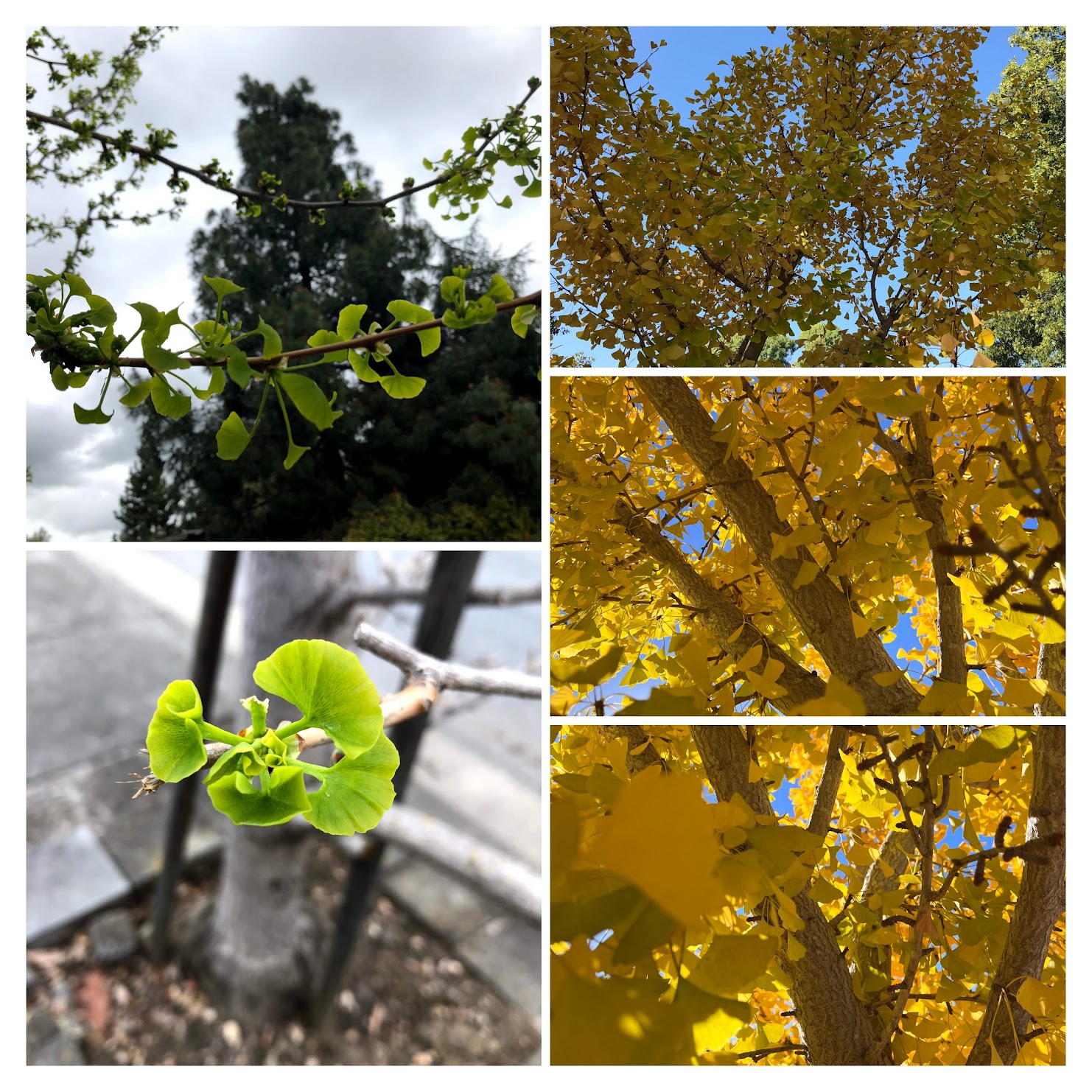
I told them, and they sat pondering for a moment, sipping their juice. I couldn’t resist the pull of a quiet moment, and an uncharacteristically pliant audience. “Did you know about the ginkgo trees?” I asked my young fellow admirers of wind and trees.

ginkgo-COLLAGE

Thrilled that they didn’t all know, I launched on the ginkgo train – telling them about how they were around from the days of the dinosaur, and how they all communicated to each other, and decided when to shed their leaves. The son said that one of the trees will slow down if it is going too fast in the color changing race, waiting for its fellow ginkgos to catch up.

“Like friends are supposed to be!” piped up another. 

I beamed appreciatively. “Yes – exactly like friends – all helping each other get there. Together.”

Read also: The night of the Gingko : By Oliver Sacks in the New Yorker magazine.

The day’s epiphany done, the playgrounds beckoned, and I let them all run off their sugar highs before expecting them to quieten down for the night. I wonder how the birds manage to quiet their brood when they’ve had a little too much nectar. That epiphany can’t wait for another day.

“A real artist is the one who has learned to recognize and to render the ‘radiance’ of all things as an epiphany or showing forth of the truth.” ~ Joseph Campbell