Emotion in Art: Unveiling the Power of Creativity

Art is about capturing a feeling 

T’was a few days before the Inside Out 2 movie was released. The husband was making me watch a thought-provoking interview. (He knew the distractions at hand on a beautiful summer evening. I needed to watch bees flit, deer graze, geese squawk, herons fish, dogs bark. As I cradled my evening cup of tea wondering when to get out on my evening walk, he swooped in. “Won’t take longer than the time it takes to gulp your tea” he said cheerfully and I gave him a skeptical look. I do not take ½ an hour to drink tea.)  

image-2

Anyway, in the interview, they spoke of suffering and how one needed that pain in order to emote well as an artist. It is not a new sentiment. I remember listening to an interview by J K Rowling or Stephen King (I don’t remember which) that one needs to have had a sufficiently terrible time as a teenager if they were to write anything worth writing at all. 

Problems Are Steady

I am not sure I agree with that. Suffering can be acute, agonizing and astonishing in its effects even as adults. In fact, much like our boggarts tend to change through life, so too does our ability to imagine and empathize, don’t they? Also, for many of us, problems tend to be a steady stream in life – we get jittery and nervous if there aren’t any. Can it really be that we are having a perfectly peaceful time – do you think something awful is going to happen? This can’t be true. Maybe I should call the children, see if they are okay.  Oh – what about the old parents, the siblings, the nieces, the nephews, our friends, colleagues, neighbors? Work? No? All well – is this really so?

Then, you tend to the heart like an overwrought bee in summer and soothe it down. “Yes my dear – there really are flowers everywhere! Believe it or not, managing plenty is as much work as managing long distances for some nectar. Just relax, will you?!” Problems like to steadily hum along like background music. We all need problems at some level, do we not? At least that’s what I tell myself when things get a bit clammy. 

Does Art Capture Emotion?

So, does art need to be about capturing emotion – whether through direct suffering or empathetic suffering? I thought Starry Night by Vincent Van Gogh was brilliant because it captured the frenzied anxiety of the artist’s mind. But, was that what everyone thought? How about those moments of bliss, joy, anger, disgust, repulsion, serenity, contentment, love, and all the ones that Pandora so generously released from her little box of troubles. Hope?

Screenshot 2024-06-29 at 3.32.19 PM

A couple of days later when we went to watch Inside Out 2, we sat spellbound as the movie captured Anxiety’s frenzy so perfectly in this animated movie. How Riley’s imagination spewed up every little thing that could go wrong and let her sense of self develop into a skewed sense echoing, “I am not good enough!” was tragic and Oh! So Well Done!

Screenshot 2024-06-29 at 3.28.31 PM

When you observe a piece of art, do you concentrate on how it makes you feel? Or do you appreciate it for the skill of the artist? 

P G Wodehouse on Art

What’s a post on Art without one of my favorite quotes by P G Wodehouse – only I feel a little like Bertie Wooster himself writing this – it has something to do with a painting looking like ‘summer blew up in your face’ – but I cannot remember it. Gemini threw up its hands and said: P G Wodehouse is not an art critic, but an humorous writer, without a trace of irony. I did spend an enjoyable few hours since then

(a) looking for the quote and reading several good ones on the internet,

(b) perusing my own PG Wodehouse collection opening books at random looking for the quote

Which is to say that I had a marvelous time, but still not find the quote. If anyone remembers it, please let me know. But the art of remembering the quote and imagining the painting itself made me laugh, made me feel joyous, so by that standard, it is already a piece of art. What do you think?

I would love to hear all the different ways in which you appreciate Art.

The Storms of Vincent

Regular readers know that I am a pluviophile (one who loves the rain). On my recent visit to India, I was out walking around the apartment complex our family lived in one night, and found myself caught in the most brilliant and relentless rain they’d had in months apparently. 

I was delighted. 

rain

I was on a late night phone call to the family back in the US, and I rushed to the building in the center taking refuge there and looking stupendously happy for someone who had no idea how to get back home in the rain, or if the door would be open for me when I did get back. None of that mattered just then. Living in the present and all that. I poked my tongue out to catch a few raindrops.

“Hello!” said a neighbor, and I gulped feeling foolish. She smiled and I smiled back sheepishly, hoping she hadn’t seen. 

“I don’t think this is going to stop just yet. I am just going to run for it. “ she said and gave me one of her dazzling smiles, and plopped off through the rain. 

I stood transfixed by the pouring sheets of rain. It would have definitely been classified as ‘a storm’ in California.  Lightning lit up the skies, and thunder rumbled. It was beautiful.

I don’t know how long I stood there gawking like that, but soon I realized that the downpour was not stopping any time soon, And it was close to midnight. Unless I wanted to spend the whole night outside, I would have to run through the rain. So I did. I splashed into the house – luckily the daughter was still awake, chatting with her friends on the phone and she opened the door. She gave me a disapproving cluck and said “Oh my gosh – let me get you a towel.”

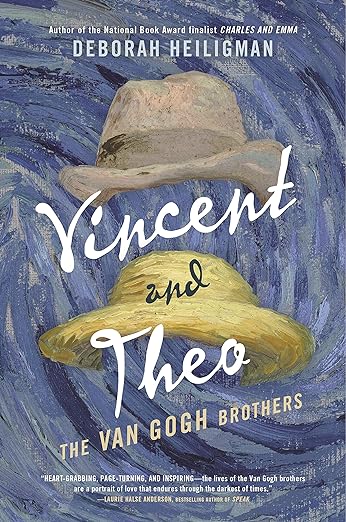
As I watched the rain pour itself out, the little rivulets of water sliding down the building walls, and the flashes of lightning illuminating the cityscape every now and then, I found I could not sleep and picked up the Vincent and Theo book by my bedside, and flipped to the part where Vincent likes painting storms.

vincent_theo

Excerpt:

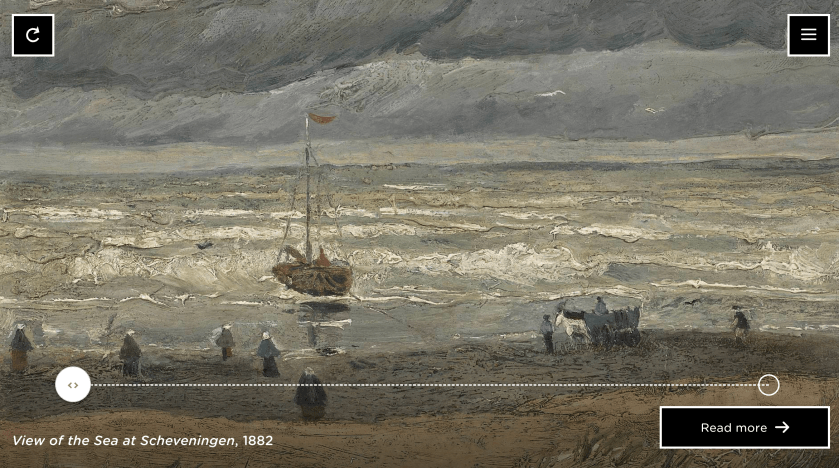
It’s been stormy and stormily beautiful to Vincent in Scheveningen lately, and into the squalls he goes. He is just starting to paint with oil and is not used to them yet, but he takes oil paints into the storm to paint the beach, the waves crashing one after the other, the wind blowing, the sea the color of dirty dishwater. He makes one of his first oil paintings, View of the Sea at Scheveningen, with a fishing boat and several figures on the beach. The wind is fierce, kicking up the sand. Sand sticks to the thick, wet paint.

Vincent loves capturing the turbulence of a storm. “There’s something infinite about painting”, he tells his brother. “I can’t quite explain – but especially for expressing a mood, it’s a joy.”

A few days later, on a quieter day, he sketches the beach. Sending the sketch to Theo, he describes a “Blond, soft effect and in the woods a more somber, serious mood. I’m glad that both of these exist in life.”

Wild and somber. Room for both. Room for all.

https://ontrafel.vangogh.nl/en/story/167/traces-of-a-nasty-little-storm

Please check out the View of the Sea painting and further details here

Screenshot 2023-09-25 at 2.35.11 PM

Vincent’s life was a stormy one too. He was not an easy person to live with and this caused many rows with his family, though he was intensely dedicated to all of them: his parents, siblings (especially Theo), uncles etc.

I looked out of the window again. We all live through the storms in our lives. But, the good thing is that no storm lasts forever. Not all living beings would have the luxury of drifting off to sleep like that, and that made me very grateful for a warm bed and dry clothes.

“There is peace even in the storm”

― Vincent van Gogh, The Letters of Vincent van Gogh

raindrops

The Joy of Effort – A Sense of the Infinite?

I was reading the book, Vincent and Theo – the Van Gogh Brothers by Deborah Heiligman. There are many aspects of the book that appeal to me. The narrative style, short chapters, clear language, not withstanding, it also touches upon difficult temperaments and the strain on relationships, Vincent van Gogh’s mental health, and his subsequent descent that led to the accident of cutting his ear off. 

vincent_theo

To Vincent van Gogh, portrait painting became an almost urgent need to master – just before his spiral towards insanity started. Uncle Cent, after whom he was named, was the closest uncle to him, though he was disappointed in Vincent, and left him with no legacy or inheritance. He left it all to his brother, Theo, instead. Still it moved Vincent at the time. He was in the process of prolific creation, and thoughts of mortality made him think of portrait painting with a sense of urgency.

This is a self portrait of Vincent van Gogh made in 1887. This portrait is on display in the Rijksmuseum in Amsterdam.

Screenshot 2023-09-18 at 10.43.48 PM

“Uncle Cents death makes him think more than ever about mortality – and immortality. Maybe there is an afterlife, maybe not. But if he paints someone well, that person is alive forever.

In the time he will spend in Arles – 444 days- he’ll make two hundred paintings and one hundred drawings, a huge number for an artist. He’ll paint landscapes, still lifes, scenes of cafes at night, furniture, rooms, flowering trees, flowers-he is about to begin painting his favorite again, sunflowers. But painting portraits is the thing that moves him most deeply, that gives him “a sense of the infinite”.”

I put the book down and thought about the meaning of effort in our existence. For many artists art gives a sense of meaning. To capture the infinite as Vincent van Gogh says. 

What has happened to portrait painting as a venue since photography came in? Maybe, photographers tend to capture the infinite. 

I thought of all the different mediums slowly replaced by a quicker technology. 

  • Writing  & Editing – ChatGPT, Grammarly and ProWritingaid are all quickly gaining traction for this hobby. 
  • Painting – there are tools available to take any picture and make it look like a painting. You can even choose the style you’d like your photograph transformed into
  • Knitting & Embroidery – almost lost to mechanization and mass production 

While newer and quicker mediums are welcome, I wonder about the appeal of the slow and steady. After all, half the joy is in the effort. I know I enjoy mulling and aching over my words – whether it is a short article, a children’s book, a novella, short story, or larger book. But I do also enjoy using my laptop – the ease and speed far enhanced from the days of penning my thoughts in notebooks as I used to do. 

I am sure all of our tools will lead to different hobbies and pursuits – after all, human imagination can rarely remain idle. I only hope the newer ones provide as much satisfaction in the effort.

Almond Blossoms to Cake

“Hmm….is that badam cake?”. (Badam is the Tamil name for Almond) The son’s nose whiffed and sniffed rapturously as he came home from school. I laughed at his reaction. The heavenly scents of ghee, almonds, milk, cardamom, and sugar have felled many a strong heart. No wonder celestial offerings have this combination of aromas the world over. I nodded and the little fellow ran inside. His grandmother handed him a warm piece of badam cake, and his eyes shone. His mouth watering, he gave her a hug, and knowing how his grandfather must’ve been the one who stirred the mixture for hours to get it to this consistency gave him a hug too.

Then he bit into it slowly: relishing, licking, savoring the cake in his hands, he danced a little jig. 

Relishing badam cakes is a family tradition I think. Across the length and breadth of the family tree, you will find people who melt in anticipation of badam cake. The nephews, nieces, son, daughter, their parents and grandparents all smack their lips when the very name is mentioned. The grandmothers treasure the almonds more than diamonds.

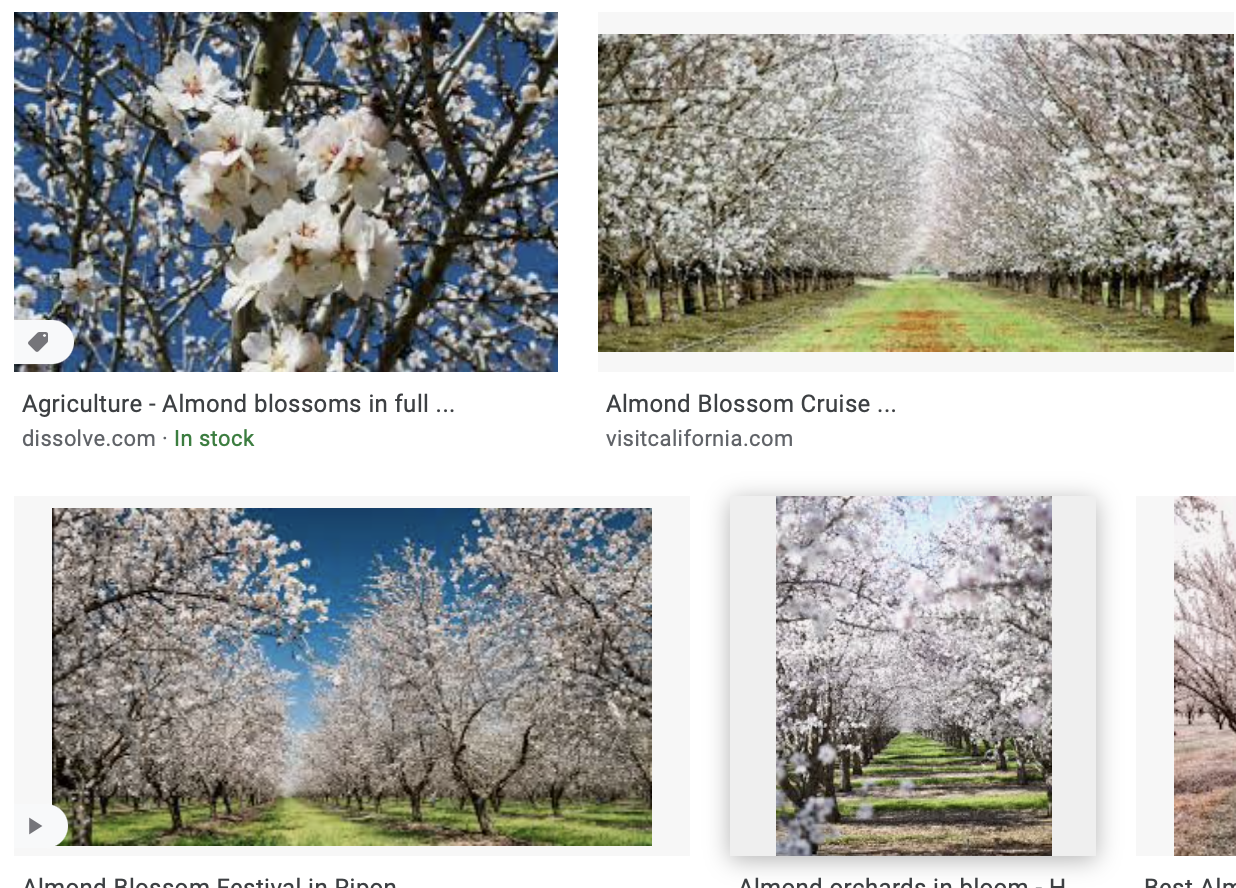
A couple of days later we went on a short drive. The drive through the green hills of California was enough to raise the spirits of everyone in the car. The view of the rolling hills of the Bay Area is best in late winter and early spring. All around us is resplendent green tugging at the heart strings of poets to take up that muse of the alluring verdure. But, there are bounties waiting the moment you reach the plains too: fields of almond trees in rows and rows spread over acres like one of those 3-d models that mesmerize you in their symmetry and movement. In early spring, the almond trees are in full bloom. Watching the brilliance of their white snowy blossoms even non-poets feel their heart strings tug.

It is no wonder that Van Gogh and thousands of artists on this beautiful planet looked to almond blossoms as inspirations in their work. It is stunning. Vincent Van Gogh wrote in a letter to his brother as he worked on his famous Almond Blossoms painting:

I am up to my ears in work for the trees are in blossom, and I want to paint a Provençal orchard of astonishing gaiety.

Van Gogh
Almond Blossoms by Vincent van Gogh – Image from Wikipedia – using Wikimedia Commons

Grown in France, Spain, Iran and California, almonds occupied prime real estate in the nourish-n-cherish childhood home. We had sturdy Godrej cupboards of yore for valuables. Other families stashed gold, silver, diamonds etc: ours had almonds and cashews.

Soaked, peeled with glee ( you could pop the almonds out of their skin after soaking, and several of them would escape and flee across the tables), ground, and then stirred with ghee, sugar and cardamom, this is a delicacy alright.

The son and I watched the trees in quiet symmetry zoom past our windows. Beautiful fields full of trees, quietly standing in the Californian soil doing all the hard work of blooming, sprouting and growing. How I wish we could learn from trees. How they go about the business of living and enabling living for creatures such as we: sans fanfare, yet with complete grace and majesty. A stoic patience underlying their vibrance; their steady creation the backbone of life on this planet. 

almond fields California

I thought of the happy faces of the nourish-n-cherish household when we see the badam cakes each time. That godly moment of sliding the cake into the mouth – all starting with the astounding wondrous work of the almond flowers in bloom outside the window. It makes us pause and appreciate all that is takes to satisfy the human palette, doesn’t it?