
Ephemeral Fashion: The Humor in Childhood Wardrobes

We were sitting around waiting for an event to start, huddled under a shamiyana-like structure. The rain was pouring – the way it pours in the Nilgiris. All the metaphors and mythos of Great Rains seem very likely, and just like that the skies clear up, and one wonders what happened. Where the rains went and how life goes on as though nothing happened. Dramatic skies are truly nature’s mystics. 

Anyway, there we were, sitting around under a canopy waiting for the event to begin, when a young fellow walked past us in his too-big uniform. The seams of his pants were getting wet from the puddles from the recent rains, his shoes a size bigger, his blazer two sizes bigger, and I couldn’t help smiling. 

I caught the smile on my friends faces too, and we exchanged a quiet moment of reflection. How as children, we were really never properly dressed. All our new clothes were slightly big. Prudence, economic necessity, environmental concerns – whatever the name given, ‘too big’ was the style. 

Goldilocks Style

There was a phase in life when we were dressed in either too-big-new-clothes or too-small-old-clothes. Goldilocks could’ve had a philosophical lesson or two if she’d stopped by and seen us. Life truly taught us the beauty of ephemeral pleasures with clothes – that brief, all-too-quick time when your clothes fit perfectly is never long enough to feel well-dressed. Sigh. 

“Those dreaded hand-me-downs!” I said and shuddered, exchanging a look with the sister, and she gave me one of her joyous cackles. You see? The sister and I have very different bone structures. Hers was what my mother approved of and called Healthy. Mine, on the other hand, made my mother scrunch up her nose, and wonder about what she could be doing better to help things along. But such is fate. The sister’s hand-me-downs, therefore, swamped my scrawny frame (Oh! How I miss those days of being nonchalantly petite and being able to tuck into stacks of buttered toasts without a second thought?!). I perennially looked like I was dressed in pillow covers. Very house-elfish fashions for Yours Truly. 

Nostalgia

That’s how we found ourselves going down the path of “Oh gosh – do you remember?”

And “It should’ve been outlawed. Remember when …” 

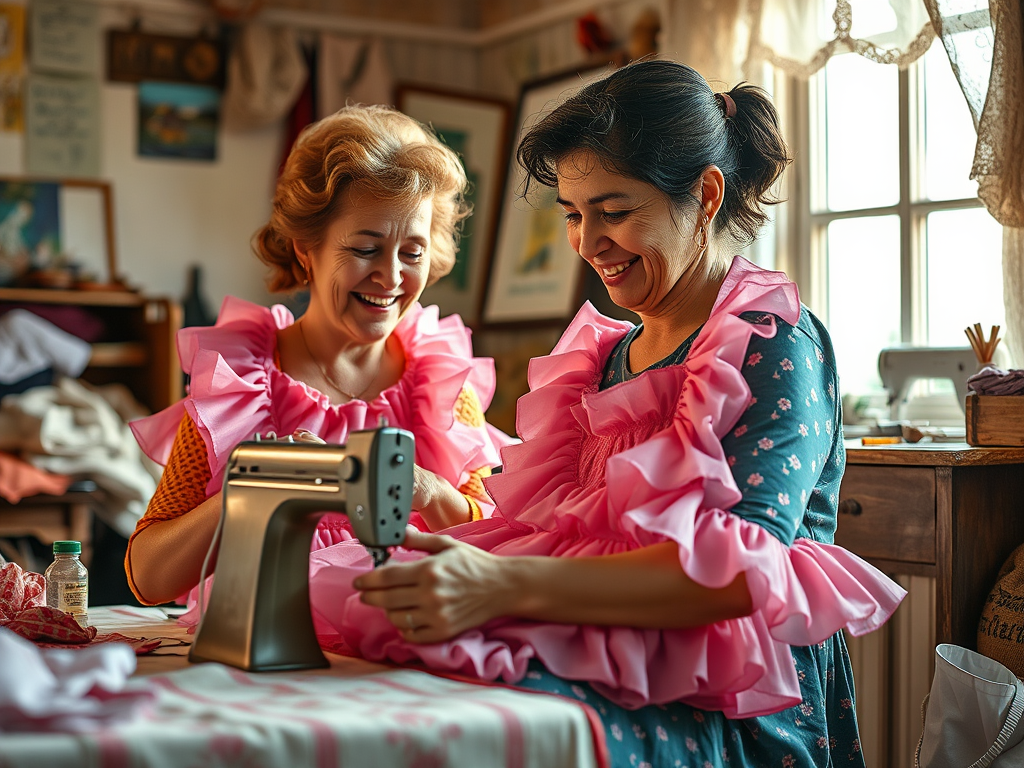
The mother was a self taught seamstress and she spent her evenings after school (she was also a high school Physics and Maths teacher) sitting and stitching all manner of clothes for her children and herself. The father escaped. Men’s fashions were where she drew the line. The lucky man! 

https://nourishncherish.org/2012/06/12/what-the-well-dressed-man-is-wearing/

It was a matter of great pride for my mother who learnt tailoring so she could stitch our clothes, alter them when necessary etc.

Frilly Fashions

The mother had no access to fashion magazines, and in those days of Doordarshan, one could not get many inspirations from television either. So there we were. There was a phase when she learned how to stitch Frills. Victorian tailors couldn’t compete when she was in this phase. All our clothes had frills all over.  Years later, I pointed to one monstrous pink dress in a photograph, and asked her what she was thinking of, and she looked confused. 

“Frills made you look bigger and better. “ she said.

Obviously. No irony, no sarcasm. I didn’t have the heart to tease her then. She was still so proud of her frills. Never mind that it made me look like a strawberry in pineapple clothing.

When finally I put my foot down and refused any more of her creations, she conceded to have the school tailor, Paada, stitch our clothes. A distinct improvement but still not exactly fashionable. Where would he get ideas in a village nestled in the Nilgiris with a population of less than a 1000 people?

I can’t tell you how grateful I was for uniforms. As we sat there looking at growing children dressed in slightly loose and big clothes, I felt like the universe really does have a sense of humor.

I truly understand now Bertie Wooster’s pride in his article he submitted to Aunt Dahlia’s newspapers on ‘What the Well-Dressed Man is Wearing’. Trying to capture the ephemeral is what Art is all about, isn’t it?
Paada The Fashion Tycoon

Recently, I found myself reading a travel magazine that highlighted the delights of San Francisco. San Francisco is one of those delightful cities that has so much to offer the free soul. I pored over the food options like a snooty gourmet, and realized that the thing to do was to catalog all the ingredients in the menu option. I realized my folly. I should not be saying idli & sambhar for dinner. I should be saying rice cakes made from fermented rice and lentils ground to a perfect consistency & lentils (not the same lentils used for the idlis, another type) with tamarind from local farms with just a touch of coriander and grape tomatoes from the Napa valley.

I should pitch in the local motif strongly, till people stop me to ask, local to where? Eh. The sturdy plains of the Cauvery delta maybe or the African plains? I mean, does tamarind grow elsewhere?

Then, I went on to the shopping pages to find that local boutiques were marketing their wares. Locally designed and tailored by seamstresses in San Francisco, it screamed.

I can see things shrewdly sometimes. It seems to me that local is good, not-local not-good. I wonder when things changed.

Human-beings have many faults. One of them is yearning for something that is not currently available to one and all. Exclusivity. That’s the thing we go for. Take the whole local vs foreign thing. I remember when I was growing up in a small mountain village in South India, people distinctly preferred the Made in <Country other than India>. Shiny material from Singapore was higher rated than polyesters made in Calico mills, India. Soaps from Dubai better than plain-raj Hamam. You get the gist. Foreign better than local.

It was a different matter altogether that no matter the source of the material, the actual stitching was done by the local tailoring talent. In our case, Paada or Gobi: Stalwart tailors, both of whom deserve a separate series of blogs to themselves. Paada was the  tailor who stitched our clothes. Gobi did the honors for the father’s baggy coats and pants. Paada was the one who would stop at our home on the way back from work in the school, take measurements and give us fashion design suggestions as to what would work best with the cloth at hand.

fashions

Paada knew the kind of fashions that was approved of by the parents, and those that would appeal to the young at heart. The parents  seemed to think that if the clothes we wore belonged to the time and age of their youth, our outlook would too, and they would not have to worry about the common disease that afflicted young women about being the Modern-Girl and all that. It seemed to us that the kind of fashions that appealed to the parents belonged best in a Jane Austen book, and so an impasse was reached.

Paada stepped in gallantly at times like these. He was a soft-spoken, medium sized, middle-aged man with a gentle smile. I sometimes doubt whether Paada might have done well for himself in the Diplomatic Services.  His suggestions were smack in between the parents’ and ours. For example, if my parents wanted a maxi (full-length dress) with a full-hand sleeve, and we wanted a knee-length skirt with a top having a puffed sleeve stopping thirteen inches above the elbow, he thought hard and wielded his magic wand i.e. tape measure, and suggested something that pleased both parties. Something like a skirt that was mid-way between ankle and knee, with an elbow length sleeve top. Then he’d suggest using the remaining cloth to bung in a hideous looking shirt for the little sibling.

As you can imagine, that was not always the most pleasing to the eye, and made us look like Thing 1, Thing 2 and Thing 3. But it half pleased the affected parties, and he got his pay, life was good. Fashion has left many scars on the Bala household.

thing123

The point is that we had local tailors, seamstresses and custom made local fashions, and much as we liked dear old Paada and Gobi, we did not care for it, since the in-thing at the time was ready-made fashions preferably made abroad and imported. If Paada & Gobi were to set up shop in San Francisco now, however, they would be the hot fellows in demand. Interesting.