
“What are you reading?”, asked the daughter.
The pair of us found ourselves enjoying a quiet Saturday morning and we were determined to make the best of it. I had been reading the Manga’s Guide to Biochemistry with little luck. Try as I might the fascinating area remains a mystery. Cellular structures and how they interact, how they power our bodies. The concepts are explained well enough. But it still did not seem to answer the fundamental questions of energy disparities among people. How is it some of us are bursting with energy and others not? How do healthy doses of sleep and diet help with these biochemical processes and our own system?
I am sure many eighth graders know it all well enough, and they’d roll their eyes at my interest in these matters.
The Manga Guide to Biochemistry by Masaharu Takemura , Kikuyaro, et al.
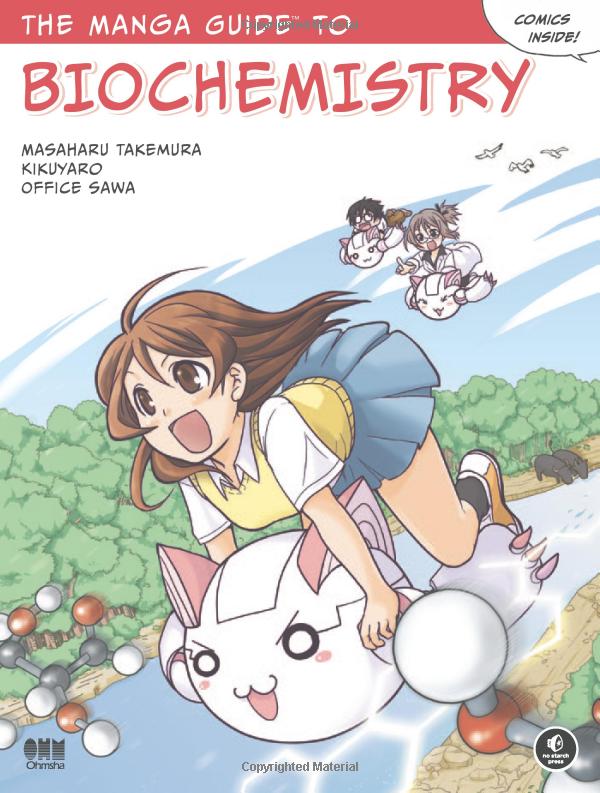
‘The Manga Guide to Biochemistry’ , I said lifting the book helpfully to show her.
She swirled her eyes – not just rolled them.
“Who spends their Saturday mornings reading about Biochemistry?”, she said.
“Those who didn’t spend enough time in school reading about Biochemistry!”
“Ah ha! So you accept you weren’t a saint in school!” I laughed. I admit I may have written myself out to be a Mary Sue when I wanted to talk myself up to the children. A Mary Sue, I learned recently, is a form of wish fulfillment by authors when they write idealized versions of themselves as characters in the story.
Quote from wikipedia:
A Mary Sue is a character archetype in fiction, usually a young woman, who is often portrayed as inexplicably competent across all domains, gifted with unique talents or powers,…, unrealistically free of weaknesses, …, innately virtuous, and/or generally lacking meaningful character flaws.
“Guilty as charged. But really though: I like this book. I am not even sure I understand half of it, but it is still nice to try!” I said.
She gave me an indulgent look and said, “Fine! But no doing that thing you do and reading out interesting bits of it out to me, understand?” I nodded.
“And may I ask the same of you my dear? I am not sure I want to know how the count’s first kiss felt on her cold cheeks or whatever it is you are reading now.”
She snorted, but had the decency to look abashed at the evident enjoyment of her little rom-com : It’s in His Kiss by Julia Quinn. “It is now a TV series – Bridgerton. Actually, you may like it. “ she said, and I perked up. I had heard the series was very good.
“Oh amma! How quickly you go from disdain to curiosity?!”
“Maybe I will understand the biochemical processes associated with attraction first huh?” I said laughing.
Love, Actually: The science behind lust, attraction, and companionship

 Nourish-n-Cherish