⌘ The Essence of Life ⌘

The Fabric of the Indian household

One of my half written posts from one of my earlier trips to India touches upon the heroines of the Indian upper middle-class  household – the cooks and maids. The fabric of the Indian household is maintained through a network of maids – 3 or 4 of them, who swish through the house at various points in time, professionally taking care of the household chores, and keeping a human touch to those who crave for it. I know the aged parents looked forward to a few words with them: a smile, a question, or a comment.

As much as I savored the solitude, and quiet of nature back home in the United States, I understood the tug and pull of humanity in the fast-paced life of the Indian subcontinent, as well. You were never truly alone, even for a few hours, in India. There were maids, delivery men, sweepers, cleaners, neighbors in close proximity, cooks, who were all as much part of one’s routine as the immediate family themselves. 

“Did Appa like the avial?” the cook would ask as she entered the house, to which the father-in-law would reply cheekily that it was nothing compared to his sister’s avial. We all know, there is no point talking when his sister’s avial is raised, and she does too. “Ask your sister to make it then – look at him!” she’ll say looking to the mother-in-law for support and she would jump in with glee.

Read also: The Simple Grocery List
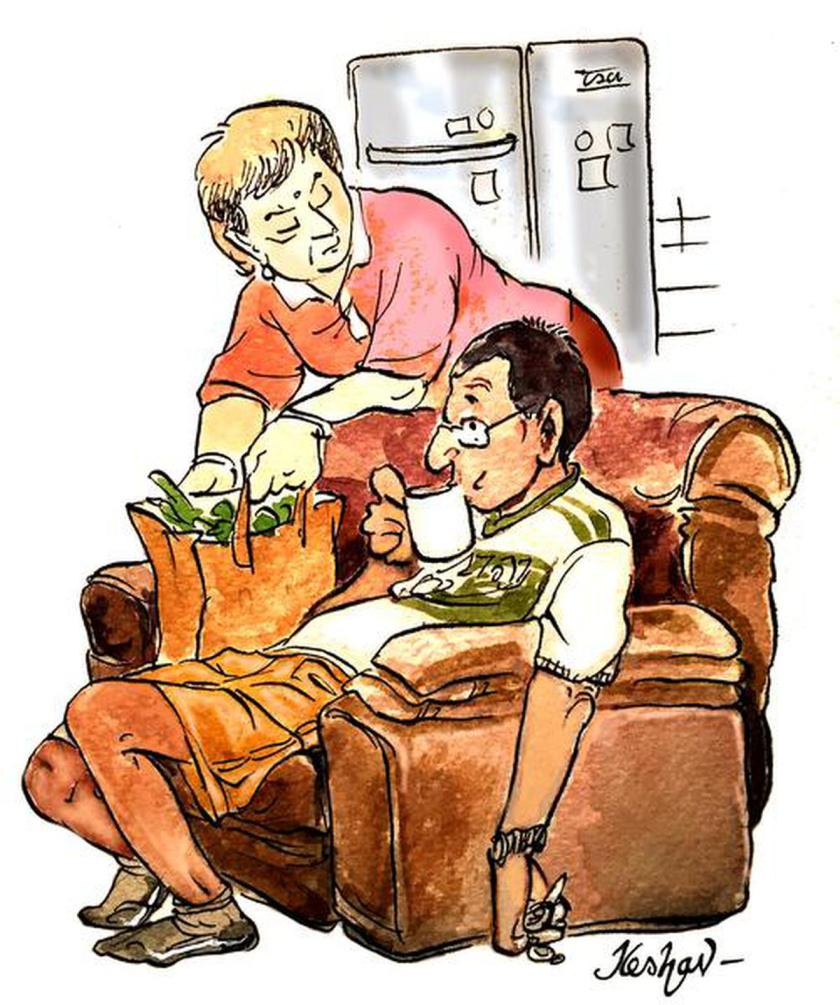
MrKeshav- Open Page - Groceries

Picture Credit: Mr Keshav, The Hindu, Open Page, on the article, A Simple grocery list

The whole thing would last maybe a few minutes from start to finish but this sort of camaraderie punctuated the day at regular intervals, and it provided them with much needed human contact. 

A few days before he began losing consciousness, he pestered his wife to buy their maid (their maid from a few years ago)a cell-phone, as she had told him hers was broken, when she’d called to see how he was doing.  

The Essence of Life

He was not a perfect man, and yet he managed to get people to only remember his loving side, his gentle humor, and his willingness to help. I cannot find the exact quote now, but when asked how he produced such marvelous tales of Malgudi, the eminent writer, R K Narayan, said that he only needed to look out the window, or sit in his front-porch observing life, and they gave him all the material and inspiration he needed. 

As the cooks and maids cried uncontrollably at his funeral, and told us how much they would miss him I was reminded of that interview by R K Narayan on the nature of humanity, and their human foibles being the gentle essence of life itself.

After all, we are who we are, and never is that more apparent than in the small, everyday interactions.

The Magic of Malgudi

Maybe it was the fact that we visited the home of R K Narayan after the opulence of the Mysore Palace, or the fact that while all of rural Karnataka seemed to have decided on Mysore Palace, nobody had thought of R K Narayan’s abode, but the author’s bungalow on a quiet residential street was like a little cocoon of quiet and peace. A lovely setting in which to imagine the most magical tales of small-town Malgudi.

It isn’t a humble abode – it is a beautiful house set in an upper middle class neighborhood. White and two-storeyed, it is a lovely home and while inside, I couldn’t help remembering his own notes on how he had acquired the piece of land on which it was built. 

rknarayan

Book: The Grandmother’s Tale – By R K Narayan.

Far away from the town center as it was then, the realtor had promised him that it would be the bustling center of town one day. He left his noisy abode in Vinayak Street, and moved to this one – with the railway tracks to one side, the lilting hills and the then empty lands stretching between the home and the Mysore Palace.

img_7457

With his characteristic wit, he wrote of his gardener, Annamalai, who helped maintain the land around his house. Annamalai, like most men of the soil, intuitively knew how to clean and maintain lands.

I stooped to look at the plants for a brief moment before entering the home and remembered Annamalai’s classification: “This is a poon-chedi” (flowering plant) and chuckled to myself. 

“If he liked a plant, he called it poon-chedi and allowed it to flourish. The ones he did not like, he called “poondu” (weed), and threw over the fence.”

  • R K Narayan –  The Grandmother’s Tale (Story: Annamalai)

Annamalai was no horticulturist but seems to have taken care of the great man’s lands well enough.

Inside the house, it was largely quiet and the lady who stood at the entrance was happy enough to receive us. She was diminutive, and oddly neither welcoming nor dismissive. She surveyed us as if mildly annoyed with herself for being interested in us. She sometimes followed us as we entered the household and read the quotes off the walls. When it was obvious that we were in awe, and really happy to be in the place where R K Narayan wrote his gentle tales of Malgudi, she turned into a hesitant hostess and urged us to explore the rest of the house too. “Go upstairs and see the bedrooms. That’s where he slept.” she said, and I had to resist chuckling. 

I wondered what the master literary giant would have to say about her. It would be an insightful description no doubt and one tinged with the gentility and charm that he saw humanity with. That much was certain. 

The thing is: going to this quiet house tucked away in a residential locality in Mysore was comforting, and I thanked the brother profusely for showing me this gentle giant’s house. 

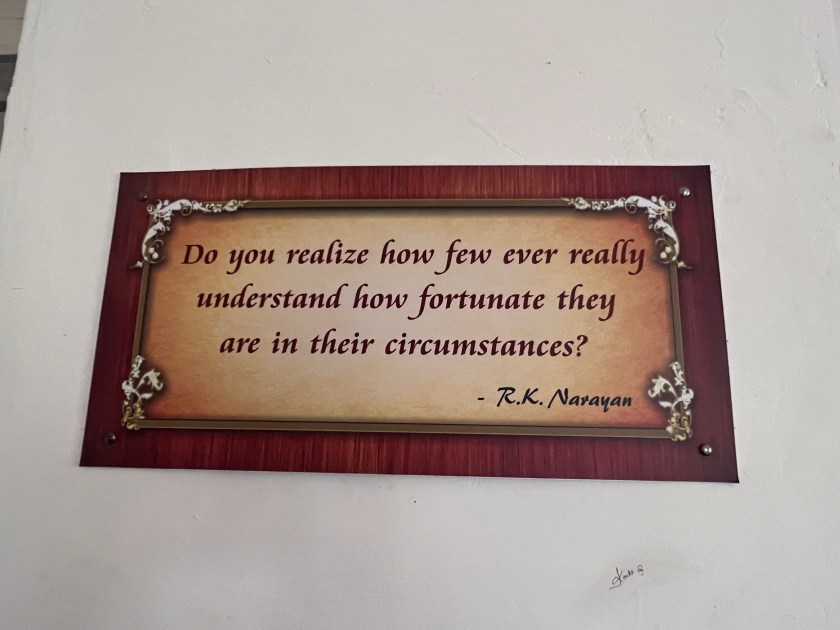
“Do you realise how few ever really understand how fortunate they are in their circumstances?”

– R K Narayan

img_7473

Rasipuram Krishnaswami Iyer Narayanaswami, the author and Rasipuram Krishnaswami Iyer Laxman, the cartoonist together enthralled the world with the spontaneity, humor and joy of Indian life. 

img_7468

Also read: