On reading about a teenage girl who committed suicide after being at the receiving end of abuse, Trisha Prabhu, was shocked. That a girl who could have had a productive, love filled life chose to deprive herself and her family and friends of the opportunity was nothing short of devastating for her.
She spent hours researching the topic. She found out teenagers tended to be way more impulsive than adults. The efforts led her to Rethink. The problem is we are in such a rush, the heady feeling of sending that email response, that comment out the door, so we can get started on the next stimulus is draining. Something has to give and that something is the ability to stop & think. So, her solution is simple: Her algorithm detects abusive language and pops up a message that says, “You are about to say something that may hurt the other person. Are you sure you want to post this?”
The rate of abuse with this simple action was down by 93%. A whopping 93% of the time, all the brain needed was a second’s introspection.
We are rewarding behaviors requiring instant reactions.
For instance, I do not like it when somebody is notified that I have read a message, because the clock is then ticking. I am fairly certain some team danced their way to the bank after that feature was rolled out, but I cried. Now our brains go: They know I have read it, they are wondering why I have not responded. They now know I am thinking about it. How long can I think about it? Will they think I am thinking about it?
thinking and writing
I read another article on the gentle art of letter writing and thought to myself that what I miss most in these days of frenzied communication is the space to ruminate and practice the Art of the Considered Response.
There are certain gems that Lewis Carroll says that are as relevant to the letter writing era as the social media era:
Don’t try to have the last word!
Don’t repeat yourself.
When you have written a letter that you feel may possibly irritate your friend, however necessary you may have felt it to so express yourself, put it aside till the next day.
This post could go a hundred different ways and indeed has been written and rewritten multiple times over the years and has not made it to the blog on each of these occasions because I was not satisfied with it. I still am not satisfied with this post, but I am rewarding my sense of instant sharing by publishing it now.
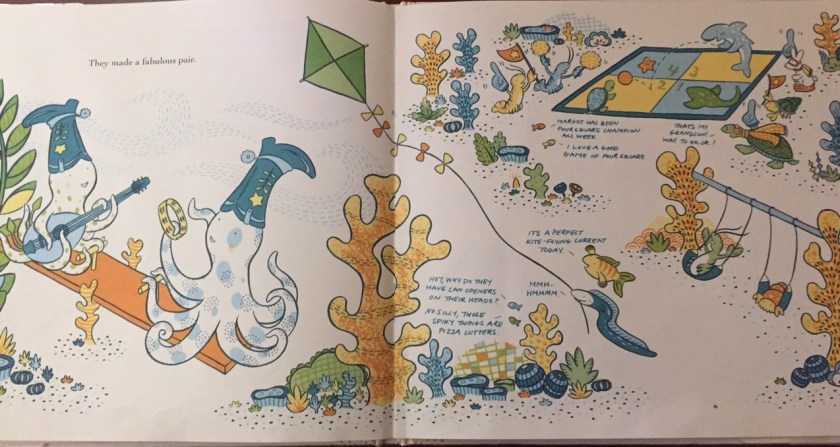
I like reading children’s literature. I have always liked reading children’s books. They tap into beautiful aspects of our mind that is dormant in our adult lives. It is almost like unicorns and fairies are only there for minds great enough like a child’s mind. The son seems to like tales of friendship between frogs and toads, race cars and tow trucks, octopus and squid etc.
Squid and Octopus : By Tao Nyeu
The ability to imagine a whole different world when we have a perfectly good one around us requires an imagination greater than our conditioned minds can take.
Imagining
Of late, I have been thinking often of the post of mine a few years ago:
I love the books by Dr Seuss addressing important questions such as:
Want kind of feet do you want?
Would you rather be up or down?
A question our children often get asked is: What do you want to be when you grow up?
I know it weighs on some children a rather lot more than on others. When they ask me what they should be when they grow up, I reverse the question and send it back to them to think. What do you like to do, and from there we can see what you would like to be.
The son’s answer is an interesting one. He wants to be an eye doctor and a fire fighter ‘this month’. (He was fascinated that his sister went for an eye exam and got to come home and test her brother’s eyesight, and he is in awe of fire-trucks and Disney’s Planes 2 movie about a plane training to be a firefighter ).
The daughter picks a different profession every few months, and one day when they asked me what I wanted to be when I grew up, I thought a little harder instead of shooting something out to appease them: This is what I want to do. I want to do several things that stretch myimagination in several directions for several weeks at a time. I want to be a writer,a dancer, a teacher, an entertainer, a researcher, an economist, a firefighter, a nurse, a counsellor, a tree planter, a software engineer, a banker, a naturalist, a biologist, a librarian (one of my earliest dreams), a doctor, a teacher, a painter, a sculptor, a physicist, a chef, a scented candle maker, a perfume maker, a florist, a gardener, a textile engineer, a physicist, an anthropologist, a historian.
How about a reader, a dreamer, a traveler, an adventurer, an imagineer?
Dr Seuss: Would you rather be?
Some weeks, I want to be as introverted as it is possible to be, some weeks, I want to work a party into everything I do. I would like to be the animated one day and an animator the next. I would like to be a thinker one day and a do-er the next.
I would like to be curious-er everyday.
There are several things that removal of poverty can bring about. One, I hope is the ability to try different things to see the most appealing work for each person. That, in itself, could obviate the need for self renewal:
The past week-end made me think of our Seattle-Vancouver vacation again. We trooped into the house after making a hash of things at the Annual Arts Fair in the sun. We looked like the grass in California with the signs on them saying “Brown is the new Green!” Parched, in other words. The son, approaching the color of a roasted salmon, put his hat down and said, “There is a half moon. There is a full moon. Why is there no half sun? Always full sun!”
Half Moon and Half Sun
I could not have expressed it myself better, and thought about our sentiments during the vacation.
The sun rose like it was being called to bake cookies in the open grass at 5:30 a.m., and long after the cookies were baked, the fish dried to make karivaadu (dried fish fries) and the vattals (some sun-dried lentils) dried, it blazed on. Around 10:00 p.m. it would reluctantly start to set, assuring us that it will be available at 5 a.m. the next day.
All this wonderful Sun meant that we were harder-put-than-ever to pass up any part of the day for resting or otherwise missing out on the fun. We went traipsing from waterfalls to rivers and bays with gusto. At 10 p.m. we took a short breather before heading out to night-time activities such as fireworks and taking in the lovely images of the Seattle skyline by night.
I have to also make a honorary mention of the fact that we were almost thrown out of a coffee shop. The Son has a loud-ish sort of voice. The kind of voice that make apples leap out of their skin. When excited, bananas peel themselves too. He was excited when we stopped at one of Seattle’s famous coffee shops for a refresher.
He had been spending time with my friends’ sons: two adventurous lads of 7 who looked like demi-Gods to his 4-year old self. When they leapt, he tried to leap too even if it it looked like a dull thump of a jump to retrieve his pride. The boys were having a blast in the car. They laughed at their own wit and the son was beaming trying to join in on everything. We were trying to keep things classy.
“Guys! No Fart jokes please.”
“Let’s try some other things to talk about. Poop is not cool.”
“Yuck! Guys! You know – let’s move it back to the classy Fart jokes again.”
When we tumbled into the Coffee shop, the boys were singing songs.
The son had learned a line or two from these wonderful boys-of-7 (He had to keep saying their age, like you call someone Dr Doofenshmirtz). They had taken him in to their circle without asking a question. He beamed at being included and used that wonderful voice of his to belt out the Lego movie song, “Everything is awesome. Like over-priced coffee.” The daughter can show a remarkable sense of propriety when she can boss over the little fellow and she clamped her hand around his bass tones chiding him for singing about coffee. “They won’t give us coffee then!” she said to him, and he replied quite logically, that he wanted ice-cream and not coffee.
All in all, it was a wonderful treat to hang out with friends, even if it got us nearly thrown out of a coffee shop, in Seattle.
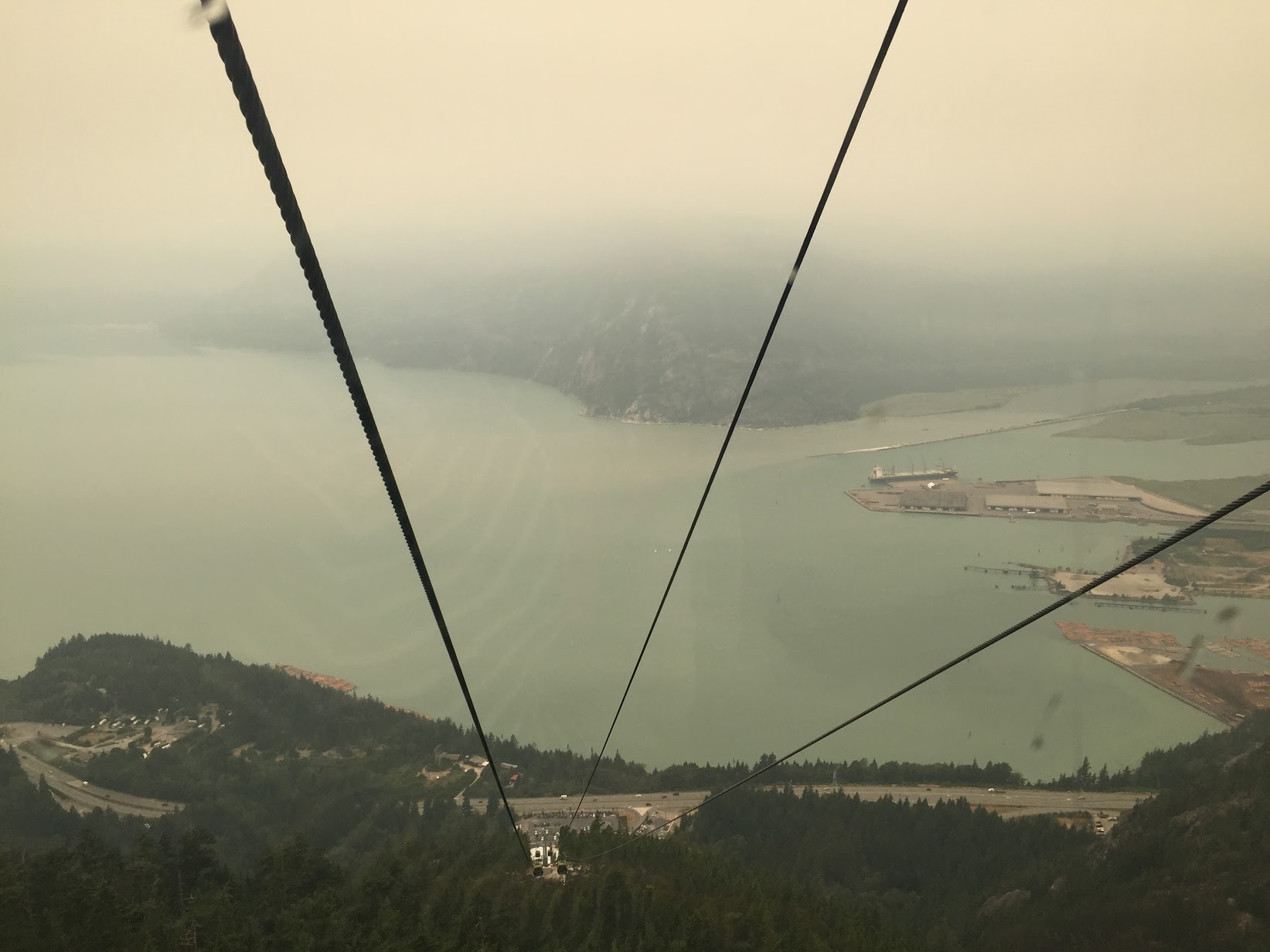
We then popped into Vancouver and finished up with bicycle rides along Stanley Park, rope bridges, gondola rides and what not.
gondola
I must say the long days were lovely and though the husband and I on occasion looked like drooping dogs who could be mistaken for carpets, there were no such problems for the children. They were truly indefatigable. At the end of a long day, they would perk up again at the mention of ice-cream or a swim.
It is wonderful how Vancouver made a thing about rope bridges and we swerved and swayed with the best of them. The children were thrilled when shown nature’s model and we spent a few minutes crouching to see this marvel at 96 F before heading back indoors.
nature’s inspiration
In 5 days, we had thoroughly exhausted and enjoyed ourselves. We headed back hot and happy. The half-sun would have been good, but the half-sun is what those poor folks get in the Winter I suppose.
Vancouver is right across the U.S. border on the Canadian side, but rum, how it gave us a unique experience, just by not having access to our cell phones while out and about there. I’ve written about how our generation’s boon and bane is the smart-phone.
The simplest of things can bring on a pang on nostalgia. For instance, free Wi-Fi was not as easy to come by, and the first thing the husband did was pop into a store to buy a good old fashioned paper map of Vancouver and its surrounding areas. He was thrilled with this map and reveled in the joy of looking up routes, and roads. I was thrilled that he could not badger me to see if the traffic up ahead is red, or yellow, (2nd paragraph here) and could peacefully drink in the beautiful scenery.
Paper map of Vancouver
While there, the daughter sat up front while her father drove and gibbered away at his ear.
It was time to figure out the best way to go from Point A to Point B and the task fell on the daughter. “I am no good at directions!” she moaned, but it held no water. With Privilege Comes Responsibility, we said and shoved the map in her hands. Her reaction was one her 16 year old self would have approved of.
We are all creatures of habit in some ways. I remember one time sitting for a Mathematics paper in school, only to find that the question paper drew a right angled triangle upside down. We are all used to seeing the right-angle in the ‘L’ position, so when drawn in the ‘7’ position, it required re-orientation and I chuckled at how our brain gets befuddled for a moment before acquainting itself to recognize a familiar Pythagorus problem.
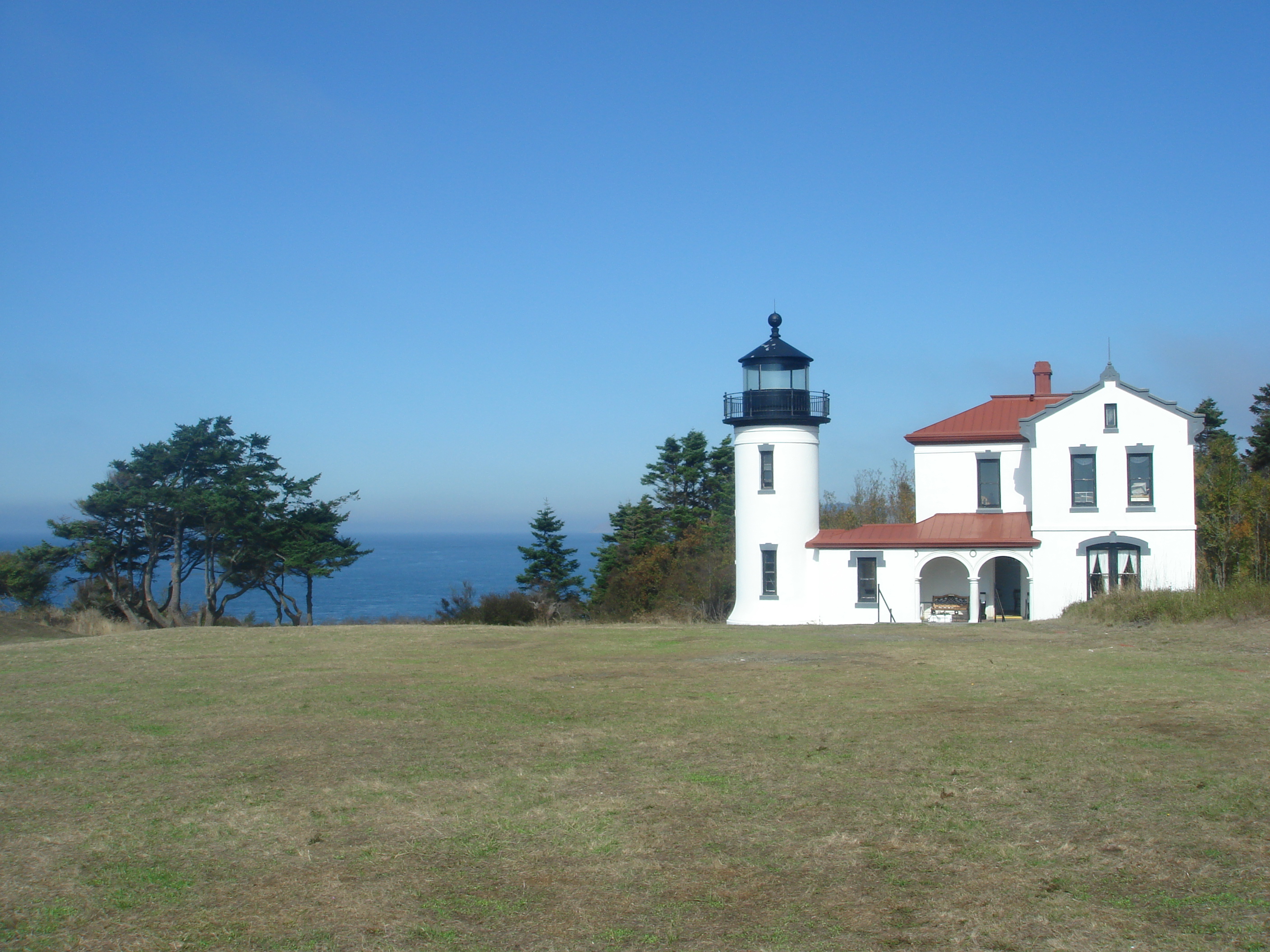
Why drag poor Pythagorus into a post on Vancouver musings? I’ll tell you. Whilst on our vacation, we went to a lighthouse. Just a whim. Lighthouses have a way of looking welcoming to folks a-visiting and we made a beeline for it. This one let us climb a rickety staircase to the top and see a non-functioning light. Obviously, this excited the children to no-end and they took us on guided tours up the rickety stairs exhorting us like we were 82 year olds with a wobbly sense of balance.
* Step sideways! *
* Hold on to the railing! *
* Careful, you can fall down all the way down from here. *
I must say my 82 year old self would have been happy at the care and consideration.
Lighthouse : image Source: commons.wikimedia.org through Google Search
Inside the lighthouse, there was a museum of sorts downstairs and the caretaker inside was itching to talk to somebody. It was a glorious summer day outside and no one had bothered to come inside the lighthouse. He must have had a morose sort of day being couped up inside when folks outside were flying kites, running, jumping, climbing up slopes while letting the sea breeze rustle their hair. So, when we went in, he let loose a torrent that would have had his lighthouse forbearers proud. He told us about the different frequency lights, and the size of the lanterns, how far away they could be seen and on and on he went. My friends and I were reduced to “Hmm”-ing and “Aah”-ing. When he drew breath, we could say, “That sounds marvelous.” but nothing else.. He spoke to us about the different types of lights used in the days of yore and how the current lighthouse is not functional. A small voice in my head went off: If it is not currently functional, why have this poor man sit here and do nothing? I was not left to ponder on these thoughts for very long, for the sail winds had deposited me in front of a wall. The wall had a large map and on this map, the poor man pointed out three spots that formed a sort of triangle among lighthouses.
Thus far in the proceedings, I could not be classified as anything but blasé. I had been a polite head nodder and took in little of substance. I could not, for instance, hold fort at a lighthouse if the demand arose, in spite of the extensive information I had been given by the kind man. Yet, the map shook me. You see, the lighthouses seemed to be in a triangle, and what was worse, it seemed to be overlooking land. But that could not be right, since we were on an island.
“So, anyone trying to attack the Puget sound…” he went on, but I was not listening.
I stopped him, ”So, were there any land-based attacks?” I asked still fogged. I had to get to the bottom of this mystery.
“No…no. This was a Naval Base, and as such designed to protect us from attacks from the Waters.”
“So, when you say this was a Naval base and there could be attacks from the bay, how could these lighthouses have detected them?” I asked him totally unable to understand the whole thing.
The poor man. If he had had a day where people were agog at his work, he would have swept me out to sea then and there. But as it was, I was the only person who had shown the remotest interest and he sighed a bit and then adopted a kindly tone that was at once slower and louder. “You see this? “ he said waving his hand at the map. “This is one point in the triangle, and this is the second and this is the third. Only three points in a triangle.”
“Yes. I see the triangle.” I said stung.
“Good! Yes, so you see the Russians could not get to us.”
“But this is an island, right? How would the Russians coming on land be detected by the lighthouse?”
I could feel my friends inch away from me a bit. But I was intrigued now and nothing, not even looking like a fool, could stop me now. The man at the lighthouse mopped his brow. (It was a hot day), and tried explaining yet again. He had learnt his script by heart and had, apparently, not yet taken the Daft Questions Training. He simply repeated the whole thing. It was when he reached the great part this erstwhile lighthouse had done to protect the shores of this great land that I figured out something.
“Wait a minute! What is that brown patch? Is that the Puget Sound?”
“Yes it is. You see there is point #1 of the triangle, and there is point #2…”
I stopped the man mid-sentence and beamed at him. “No need to explain anymore my dear man! I have understood all! “ I told him. He beamed at me, thinking to himself that that script must be marvelous and that he only needs to repeat it multiple times everyday and all his problems and of those visiting his lighthouse would be solved.
Reading a map
We all know Land is depicted in Brown color, who depicts Water in Brown? I flashed back to this and narrated it to general hilarity in the car, and assured the daughter that she could not fail, and that if she tried hard enough, she could ensure we stayed on land and not plunge into the ocean near Vancouver.
There is something about humor that acts as a stimulant. She sat there figuring out which street we were on and by that finding out which road we needed to get onto and got us there without dragging us through the city unnecessarily. Which is more than can be said for some people who cannot bear to see the traffic back up for more than 2 minutes.
I had left folks off on a cliff hanger in the last post(The Lure of Fernweh & Veg..) We had arrived, with ample time left to eat a hearty evening snack, at the airport from which to fly towards Seattle. We were told by the crew, that forgot how to smile, that we had come to the wrong airport. Our flight, was to leave not from Oakland airport, but from San Jose at the same time, said one of the crew and the pair of them at the desk scowled.
I never knew what people meant when they said they were struck dumb. I now know.
On hot days, inside the brain, it feels like ice cream is melting and spilling over into the Broca’s area commonly known as the left frontal lobe. Weather Forecast in Brain: Snow avalanche
The Broca’s area is the part of the brain that controls speech and having melted ice-cream over it renders cohesive speech delivery impossible. All that is manifest on the face is an advanced level of ogling, noisy gulping and impressive eyes opened in wide disbelief. Some people can then say, “Eh?”, but most like me, just continue with the ogling, g-ping and eye-strengthening exercises.
About a minute later, I found my voice. “What? I mean how? How could Alaskan Air send the flight notifications for Oakland then?”
The husband, was having a pretty tough time reigning in his Broca’s area too, but he coerced his left frontal lobe into speech. “I set up the alerting. I mean, we are flying back from Seattle to Oakland, so I must’ve gotten confused. The flights from San Jose and Oakland are at the same time remember?” he said.
“Well, the airport is pretty empty, so the flights must be quite empty too, who not ask them if they can put us on the flight from here?” I asked simply. It was a reasonable request I thought, but the flight crew taking in our plight did not seem to think so.
“We cannot do that. Call the reservations number. There is a 1-800 number on the website.” she said petulantly, like we were badly behaved, very naughty children, making mischief for her by arriving at the wrong airport. I could have told her that playing games with her apparently absent sense of humor was not exactly my idea of a vacation. But something about her face and mine, made the husband step in. Using his omniscient diplomacy, he held my hand. He had sensed the loosening of my left frontal lobe and he knew, it would be quick in making up lost time. His hand held back that sharp rebuke hovering near the tongue. He then asked her, politely, if there was anything at all that could be done, and she said “No.” (I mean there wasn’t even the perfunctory ‘sorry’ that most crew members throw in without meaning it.)
The husband tried yet again, “If there is a change fee or something, I can pay it here. “
“No. Please call 1-800 line Sir.”
“You cannot do anything?”
“No.”
There was no denying it. Alaskan Air had missed a golden customer service opportunity. For, we are easily appeasable folks and would have gladly taken any help they could have given us.
We had flown Southwest Airlines before and though, this was a first when it came to airport bloomers, there have been many occasions when we have arrived early and had been delighted to find that Southwest could accommodate us on an earlier flight, or on a later flight if the security lines were horrendous, and we would have a mad rush getting to the gate on time. Every time, their proactive customer service was exemplary and better yet, unceremonious: It was handled by the crew checking or printing out your boarding pass.
Why then was this so difficult? Maybe, that is why Southwest was exemplary, because it was out of the ordinary.
But, of course, life is in the uncertainties and given that there was no help forthcoming from the airline staff, the husband called the 1-800 line and was listening to some music on their hold line. A thought struck me as I checked my watch: there were another 35 minutes in which to make it to San Jose if we caught a cab quick enough from here. The drive time at current traffic rates showed 40 minutes.
Time for a climax nourishncherish household! Time for a climax.
Say what you will, during moments like this, some people, like the flight crew above make you want to throw your hands up in despair; while some others make you want to congratulate their attitude and spirit. It just goes to prove that attitude is everything. Intelligence, rank, position and everything else seems secondary. The taxi driver arrived and within moments had the situ. surmised.
Here was a man who was determined, and sorry for us. He caught the high occupancy lane and concentrated rigorously enough to get us to the San Jose gate at 6:10 p.m. The flight was at 6:55 p.m. San Jose airport was empty too. We tumbled through security, raced past the terminals and ran into the aircraft. Then, we stood around choosing convenient spots in a half filled aircraft, and taking deep breaths, before giving ourselves congratulatory high-fives. The children were marvelous throughout the adventure and we made it. Just about.
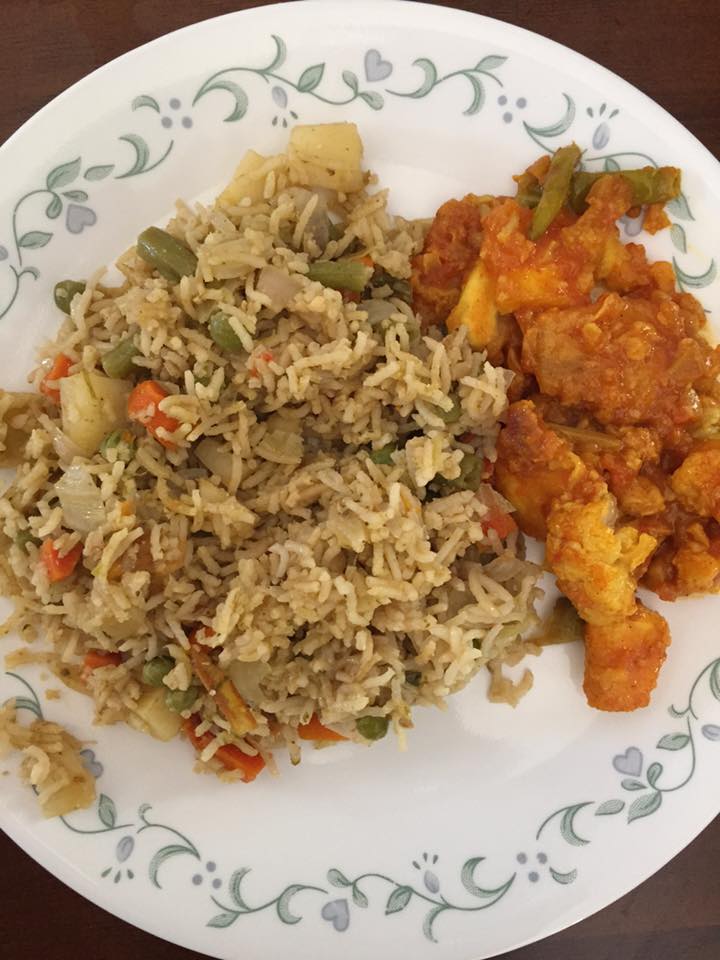
Before switching off my phone for take-off, I checked Facebook. The results of the Vegetable Quiz were out. It turned out to be Cauliflower Paneer and Vegetable Biriyani with this helpful photograph to tide us over.
We are not angels. Neither are we yogis. I found myself irascible. We had not had time to buy food, we had barely time to catch the flight. This photograph was too much.
Weather Bulletin in Tummy: Strong thunder storm.
I weakly waited for water, while my stomach rumbled loudly and frequently. The flight crew handed me 36 ml to sprinkle into the thunderstorm.
“If we had stopped at their house on the way, we could have had that excellent biriyani and paneer!”, said the husband and I moaned.
Weather Bulletin in Tummy: Hailstones & mild rain
The tiny packets of airline honey roasted peanuts landed like hailstones and more water rained down.
We bought a cheese platter from the crew, and waited. In our hungry minds, the fruit & cheese platter grew in dimensions. There were water melons jostling with grapes, and blueberries were complaining about the lack of space. The oranges tried to mediate the fracas, but got hit by the cantaloupes. The cheese just tried to get in wherever it could. The platter came, and well….see for yourselves:
cheese_platter
By the time we landed in Seattle, the hunger pangs had quietened down somewhat, apparently given up on the idea of anything substantial.
That is why our hosts at Seattle saw us demolish the food laid out on the table like that. I always enjoy my friends’ hospitality, and the meal was doubly enjoyable given the circumstances. There was only munching for the first 10 minutes. Then, we sighed contentedly and gave them the lowdown of our journey there and they were suitably impressed.
The after dinner fruit platter showed us what fruit platters should look like and we retired happily to start our short vacation in Seattle & Vancouver.
I participate in the enjoyable task of selecting a vacationing spot, and then graciously withdraw from the actual booking. The days leading up to the vacation, I spend drooling on the side trying to determine spots of interest, planning our days there and so on. As the vacation nears, I am all in, plunging my oars into the waters, packing, repacking and running around till the last minute. In short, like this: Tea please!
The husband, in the meanwhile, after my gracious bowing out, makes a pleasurable study of options available for our vacation. I am grateful that all the research is now online. I cannot imagine how a paper trail of booking a vacation would grate at my nerves. Starting with the ticket booking, he will find everything that is in the databases of all travel sites and airlines. He will have, at the tip of his hands, enough irrelevant information to fill a miniature book.
He knows better than to regale his process with me, for I have picked up a tip or two from my mother’s technique of shrieking with agony. When he started the last trip, the filtered down version of 62 pages worth of travel information was:
Flight Departures:
Oakland to Seattle at 6:55 p.m.
Available Airlines: Alaskan, South West
San Jose to Seattle at 6:55 p.m.
Available Airlines: Alaskan, South West
San Francisco to Seattle at 6:25 p.m.
Available Airlines: Alaskan, South West
Home to San Jose: 25 minutes
Home to Oakland: 30 minutes in the opposite direction
Home to San Francisco: 50 minutes
San Jose to Oakland : 45 minutes (You need some apparently useless information given too!)
Oakland to San Francisco (this is where you use S-with-A)
Return tickets:
Seattle to San Jose at 5:05 p.m.
Available Airlines: Alaskan, South West
Seattle to Oakland at 3:05 p.m.
Available Airlines: Alaskan, South West
He did try to add another destination & airline to the mix, but I employed S-with-A and vetoed the idea.
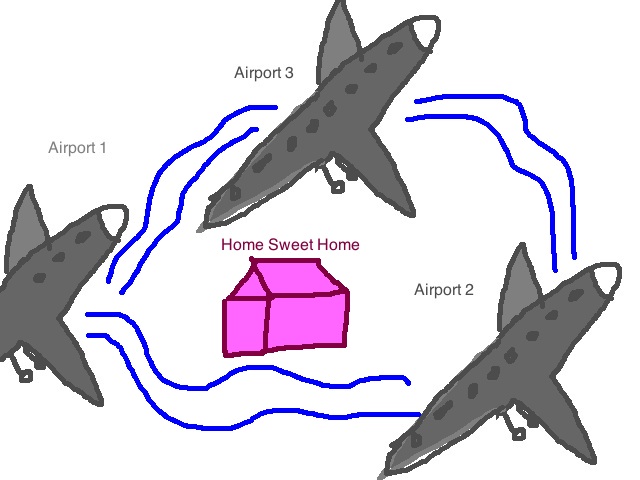
Airports
With me so far? The day of the trip dawned, and all day long, flight notifications buzzed reminding us of our upcoming trip with Alaskan Airlines from Oakland to Seattle at 6:55 p.m. (I set up notifications so we will be absolutely sure we will get there on time, said the husband looking very proud of himself.)
Flight notification: Flight is on time.
In between all this, there was Facebook to check during the day and any intervening minutes we may have had at our disposal, we dithered at this spot on the web. One friend of ours, having done his share of vegetable cutting for the day’s meal, took it upon himself to post pictures of his labors on Facebook.
vegetables
Flight notification: You may now check in.
On the carnival grounds of Facebook, however, the picture of the vegetables was garnering interest. People poured in with their compliments on a job well done, and wondered what his wife must have done to deserve as able a helper as him. With vegetables like that, it was expressed, that any dish could be a success. His innocuous picture had turned into a sort of an online quiz as to what the dish was. I did wonder how a person so intent on cutting to specifications, did so without finding out so much as the dish name, towards which his labors were contributing. Maybe, that is the bane of all of us who contribute to projects without fully comprehending the greatness it can help unleash, I thought to myself philosophically. (There were no doubts, this was heading towards a great dish)
Flight notification: It maybe a good idea to leave.
We piled into the taxi and left in what was termed a comfortable span of time. The taxi ride inched us closer to the airport and the online quiz inched closer too. The latest hint was that paneer was involved. The answers made the stomach rumble when people, somewhat insensitively, bunged in Chinese Noodles and Vegetable Biriyani. Our own fare that afternoon had been slim pickings for I had gone in for the left-over technique, so as to leave an empty fridge while we were away.
We reached with the bags, ruts and tots at Oakland airport. After bidding our taxi good-bye we entered an almost empty airport and washed up in front of the grumpiest crew on duty. Maybe, they too were hungry, I thought to myself charitably. It was after all, inching towards the evening coffee time.
Flight Notification: You should now pack up and leave, or things could get sticky.
Ha! We are already at the airport – take that Flight Notification! I thought grimly. It is rare that we are in positions of ample time to kill, and I was thinking of hitting a good eatery once past the security check gates. All that face booking and quizzing and vegetable-guessing had me jotted down firmly in the ‘hungry’ category.
Imagine our shock then, when the crew that did not know how to smile, said our flight left, not from Oakland, but from San Jose at 6:55 p.m.
I never knew what people meant when they said they were struck dumb. I now know.
Update: This article was published in The Hindu Open Page dated 20th May 2018.
Watch me while I tilt my head to a 45 degree angle, glaze my eyes and yank you through a storm. We will have to rekindle some childhood memories. Let’s give it a good two or three decades shall we? Good.
Event: To buy a television.
Life has always had its share of amusement and drama, primarily because of the characters in it. When I look around in my life, there are very few placid characters. I have the boisterous ones, the catch-life-by-horns-and-dance-till-dizzy ones, the energetic ones, the sort of people who make observations that make you laugh or admire the speed of the repartee, but seldom dull.
Most households, for example, after deciding to buy a television would take the money available, go to a store and buy one. Mine, on the other hand, well read on.
After making the easy decision of wanting to buy a television, the drama would begin to unfold like a small storm whose eye is coming slowly and surely towards your home. Gaining in strength and fury.
It would all start disarmingly simply. The father would aimlessly drop into an Electronics store to see the different models available. Then, slowly, he would inundate the house with pamphlets from different stores, price comparisons, model evaluations, and cut-outs of advertisements from newspapers and magazines. Anything that had anything about a television: Philips and Samsung would jostle with Dyanora and Whatever-else.
The glossy pamphlets would pile themselves on the tables, couches and side-tables for weeks. All visitors to the home could not miss the mess, and within days the whole community knew that a television purchase was imminent in the home. We lived in a small hillside community where everyone knew everybody else. So, of course, every body weighed in with their advice. There is a certain joy in knowing that people are concerned about you and your doings, and we enjoyed it for the most part.
Storm Status: Brewing and gaining in force. Now visible over horizon.
Of course, every time somebody walked in, we would be embarrassed and apologize for the mess, but it did not bother the father. He was rather pleased with his research and freely boasted about the pains he took in stewing the house with this garbage. “Everybody’s house is like that!” he would say airily when accosted and things would go on.
Storm Status: Momentum building up. Eye of the Storm approaching.
People (read my mother) wanting to sit on the couch at the end of a long day would first have to bite down the sharp words that rise at having no seat available, and then shove all the pamphlets onto the floor before sitting. This was the physical aspect of it. The emotional aspect of it was worse: you see the father was so carried away by his own researches that he would regale all features with gusto at the dinner table or over coffee. CRT tubes, antennae size, screen size and voltage stabilizers, was served with cake and coffee to visitors and family alike.
Storms, Televisions & Other Things
After a few weeks of this agony, the roof would lift off with the mother’s shrieking, because she can’t bear the mess and the talk surrounding televisions any more.
Storm Status: In the Eye.
To this hair-shrieking response, the father would calmly ask his beloved why she was getting tense, and that she must learn to relax and enjoy the process. Asking somebody to relax while not making any change to the circumstances can be a tricky thing to do. It is an interesting social experiment well worth observing from a distance. I would strongly advocate it.
Storm Status: Spent.
Then, as if nothing had happened, he would head out one day to buy onions and come back with a color television. To quizzical looks from family and friends, he would unveil with a flourish, a brand he has never researched or heard reviews about before. He would have just fallen for the salesperson’s glibbity. Even though, the television matched none of his carefully researched specifications over the past weeks, we were all glad to have the thing done with, and settled in to have a good time with it.
Storm status: Passed.
Take a deep breath and come back to the present.
That’s approximately how the husband books a vacation.
There are a few trees by our walking path. Great firs, pines, eucalytpus with their mild scents and some bottlebrush trees (Apparently their biological name is Callistemon Melaleuca Myrtaceaehttps://en.wikipedia.org/wiki/Callistemon. I mean if you can call Anantha Padmanabha Venkateswaran as Nandu, would you rather call him Anantha Padmanabha Venkateswaran?I think I will continue calling them bottlebrush trees.)
Often when I walk past these trees, I think that to be a tree must be a great thing. To foster life by just living, to be the cornerstone of life as it unfolds around you must be wonderful if you have the right mindset of course. I mean, I don’t know whether trees are contented beings or go through the same tumultuousness that humankind does. But they are the steadiers for scores of nature lovers, so we assume they are content.
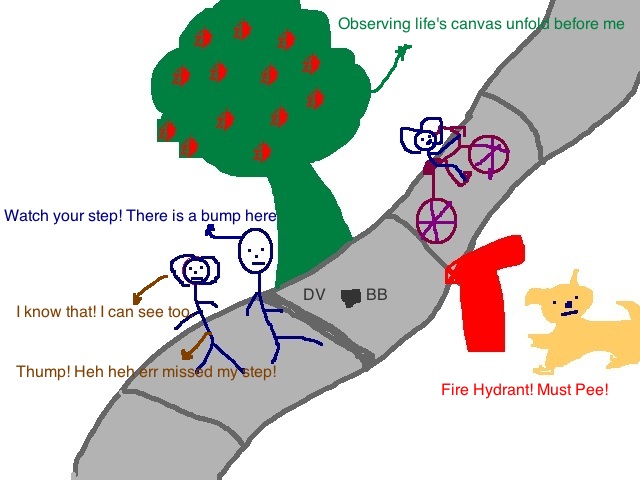
Anyway, what I wanted to talk about was not the trees, but the drama these trees witness every now and again. There is a spot of pavement near these trees that is uneven. One large slab of concrete is about 2 inches above the adjacent one. This makes for bumpy rides, trippy walks, parents telling children to be careful, husbands telling their wives to be careful and being met with retorts as to how they too can see the pavement is uneven, walkers yelling to cyclists to be careful, kids yelling to one another to watch the bump and a few scrapes and bruises as people busy squabbling about having eyes of their own neglect to watch for the step and go hurtling down.
Life is a Canvas
Yes if that does not constitute Drama, I don’t know what does. Many attempts have been made to smooth the mini step over: logs were placed, stones were provided. One try was pretty smart, for they tried to make it a slope instead, but somehow, all attempts been half hearted. One time, there were a great many cones and much hullaballoo. A tar laying machine managed to get one half of itself on the pavement like a dog raising a foot to pee against the fire hydrant, and was making a great noise filling up the hole. It was definitely a wonderful scene to stand and watch. It proved to be a fascinating evening as we watched the gravel held together by some tar. The loose gravel was there, tar was poured half-heartedly as if wondering whether the sidewalk really needs tar, and anyway the huge thing that rolls on it to pack the gravel together couldn’t make it to the narrow pavement, so the repair-folks just left it there. The next day, the gravel started disintegrating and within a week, there was nothing left except the trees waiting to see what the next endeavor to tackle this spot would be.
Things went on and every now and then there would be an attempt to level the flagstones and nothing would happen thereafter. All that changed last week when the city decided to pour cement and make it all even instead. This looked like the thing.
Once the cement dried, I was appalled to see that some couple had used the drying concrete as a canvas on which to declare their undying love and had carved their initials in while it was still drying. Looking at that graffiti annoys me much more than the inconvenience of tripping up every now and then. I have the same feeling of bubbling annoyance when I visit any of the heritage sites in India. Beautiful structures all telling us how much DV loves BB. If you are DV, and truly love BB, please use that marvelous force to forge a meaningful life not just for DV and BB, but DV&BB’s friends, colleagues and community too.
When I saw this news article, it looked to me like nature slapped us all in the face with her sarcasm.
The article states that the rate of extinction brought about by mankind is 114 times the normal rate for species to die out and regenerate themselves.
At this rate, the human rock face maybe the one to tell future lifeforms about our race, and if they look elsewhere, they may also know that DV loved BB, if those lifeforms also have hearts and use that to symbolize love.
I wonder whether you have asked folks for directions in the rural areas – you know, the kind of places where you wait to take the mid afternoon bus to get to the village market for groceries. Nestled deep in nature as they are, the directions will almost always contain some landmark of man-made proportions. There is a large statue by the village square: opposite that is a post office and from there, you can wait for an hour for the local bus to take to you to the nearest town. Like that. Most times, of course, the man-made landmark is also hideous to see, but that is not said out aloud, for folks are usually proud of their landmarks for one; and for another, they are probably the work of some artist who is the relative of the local postman’s nephew.
Urban folk that we are, in our local little suburb, our landmarks tend to embrace nature I find. We refer to the single patch of nature in our midst as our crowning glory. That is our landmark. The field where ravens caw, chats chitter and frolic among the resplendent sunflowers and the corn. It is simply known as The Corn Field, though the resourceful farmer there also grows squashes, pumpkins, tomatoes and bright, neat rows of flowers.
Many a time, we tell one another, ‘I am going to walk down to The Corn Field.’ Yes, we are proud of it, and I have expressed gratitude for having this son of the soil tend it so marvelously for us. How else would our children know about the beauty of growing and consuming healthy food? Many have been the evenings when the son and I have stood mesmerized by the work on the field. The farmer there has offered the little fellow a ride on his tractor as he bumps along sowing seeds and getting it ready for the next harvest. This field, is one of the most fascinating things in our semi-city/suburban life. We get to relive the magic of life through the kind farmer’s efforts, and he knows it.
As I set off one evening to The Corn Field, my heart was filled with longing. I’d had a rather long day and I was waiting to see the bright sunflowers in bloom.
Sunflowers in Bloom
I wanted to just watch the sun go down over the field and sigh at the beauty in that small patch of land. As I approached, there was something off and I was filled with a deep sense of foreboding. For one, the farmer had left the patch without re-cultivating corn for a bit longer than is usual. For another, I saw a signboard there. I knew that little thing. It means another spot of nature has been sacrificed on our relentless march to civilize and inhabit the world. “No no please not this one too!”, I cried as I half ran to the signboard. Right enough, there was a sign board indicating that the land was going to be used for building another 800 flats and I gasped.
So many times, I had enjoyed explaining to our children about the farm, sharing with them my half baked knowledge about crop rotation, tilling and watering. What would happen to the ravens, sparrows and numerous birds who visited the place? Would we lose the sweet sound of birds twittering too? There would be no need for the hideous scarecrow that does a pretty poor job of scaring away the birds anyway.
Beauty of Life
Everything would be gone for another set of buildings closely clustered together. Could we not leave this one patch as an Ode to Nature?
International Yoga Day is approaching and consequently there was an intense discussion amongst our diverse group, that involved yours truly foraging in the murky forests of my Indian-not-at-all-devout-Hindu upbringing and serving up dubious explanations. As we leaped and scoured the real and mythical worlds alike, the venerated Vanars would have been proud to see us. We started with lofty enough topics, but ended up – well, see for yourself where we ended up.
International Yoga Day
The discussion started with Yoga-in-the-park for International Yoga Day. Why must it be so early? said a colleague and I sympathized. Regular readers of this blog know that I am not at my brightest in the mornings. I am best left alone to peek out from behind my coffee and quickly pull myself back into the cup, peek from the c., pull back in, and then slowly, like a snail, venture out into the world.
I deplored the state of affairs in India and how we deify the early-riser and leave the poor late-risers feeling somewhat inferior and catching up with the early-risers for the rest of the day. We traipsed around early morning rituals and temples and why meditation in the first place.
Just as I was patting my back on the spiritual plane the discussion could reach from the lofty stepping stone of Yoga,it slid straight down the slide to idlis, dosas & sambhar. It was like playing Snakes & Ladders in the thick Madhuban forests, I tell you. From the spices of the foods, it was but a natural stop at yogurt.
After moving to the USA, I like flavored yogurts such as strawberry or apricot yogurt, but I also told them about the slurpilicious plain-yogurt and rice. There was a sticky moment when folks could not see the appeal of plain yogurt against the Apricot yogurt, but I scored a goal by bringing up mango pickles.
When you bring yogurt and rice up to a South Indian at lunch-time, she can’t but help talking of mango pickles. Other colleagues of Asian origin chimed in with durian and jackfruits, and we all sighed collectively at the exotic fruits and tropical vegetables of the East. Some bright person then said something about lotus roots and another said that Buddha sits in a lotus.
Spiritual-plane-wise, we were getting back up from the hard fall into dosa, sambhar and curd rice territory, so I felt I had to wade in.
“For some reason, the lotus holds a special place in Indian Mythology”, I said.
I turned and looked at the awed expressions on my co-conversationalists, and this gave me the confidence to plunge on. It is a knack. When people expect something profound from me, as if they are making up their mind to see whether or not I am intelligent, I say something like this and dash all hopes.
“Most goddesses I know like to sit in one. Although the lotuses I have seen are pretty small – I don’t know how goddesses sit comfortably in them. “
“Really? Goddesses sit in lotus too? I don’t know much – I have seen some pictures of Indian Goddesses, but never saw that – maybe hard to make out from the saree and all, but Buddha I know.” said a colleague who has taken the Myth of the Mystical East to heart.
I summoned up the picture of Saraswathi and Lakshmi in my visual eye. I don’t remember seeing their saree flowing over their lotus seat. I mean, they were caparisoned in beautiful garments and jewelry, but the lotus was apparent too. I have never seen the saree flowing all over the lotus hiding it from view. Have you?
Somewhat befuddled, I prodded on. “No, I am pretty sure the Goddesses sit in lotuses. I do remember seeing some stylistics paintings of Buddha in a lotus, but mostly he is under a Bodhi tree, looking happy, right?”
This must have been interesting to watch, if it wasn’t me, sinking deeper and deeper into the mire. Anyway, neither of us backed down, and both of us were equally sure of our lotus occupants. The birds stopped twittering to watch the great philosophical debate. Apricot yogurt or plain yogurt with rice: Which one would emerge the victor?
Buddha in Lotus?
“Really? I don’t know. I have always seen Buddha in Lotus Asana – except for some statues in Pier 1 Imports, of him lying down.” said she.
Wait a minute. I knew what was going on. I observed, deduced and felt that faint feeling of relief and comprehension dawn on me and the birds twittered again. I asked, “You mean the yoga posture Buddha sits in? Lotus Asana?”
“Yes! Isn’t that what you have been talking about? “
“Oh when you said you couldn’t make out the lotus in the Goddesses, you meant, you couldn’t make out whether their legs were truly crossed in Lotus Asana with the saree and all that?”
“Yeah.”
And then, I laughed as I told her that I was talking about the seat in which the goddesses sat, although, I conceded they may have been sitting in lotus asana too.
So, both of us were right. You can have apricot yogurt or plain-old-curd-rice-with-mango-pickle. Yes, in the Lotus Asana, if you like.
Maybe that will remind us to be truly humble while talking of Lotuses or anything else. We are, after all, a fraction of the small blue dot in the Cosmos, like Carl Sagan said.














 Nourish-n-Cherish