
Suma’s A Bindi Can Be

Suma Subramanian

I have been waiting for Asian Heritage Month to review the brilliant books of Suma Subramaniam. I yearn for books that hold a nod for us. I know what it is like to be the only child wearing a bindi in a classroom full of non-bindi wearing children – and so does my daughter I am afraid. 

Despite this, whenever I could, I looked for bindi patterns. Beautiful patterns – so elegantly thought out and shaped. Tiny little spots of art that you could stick on, to transform a face. I have a special kinship to bindis that probably deserve a separate post. I didn’t realize how much bindi related material there is in my head till I started writing this post. I have at least 3 posts worth just with reading one book!

Pottu, my doll

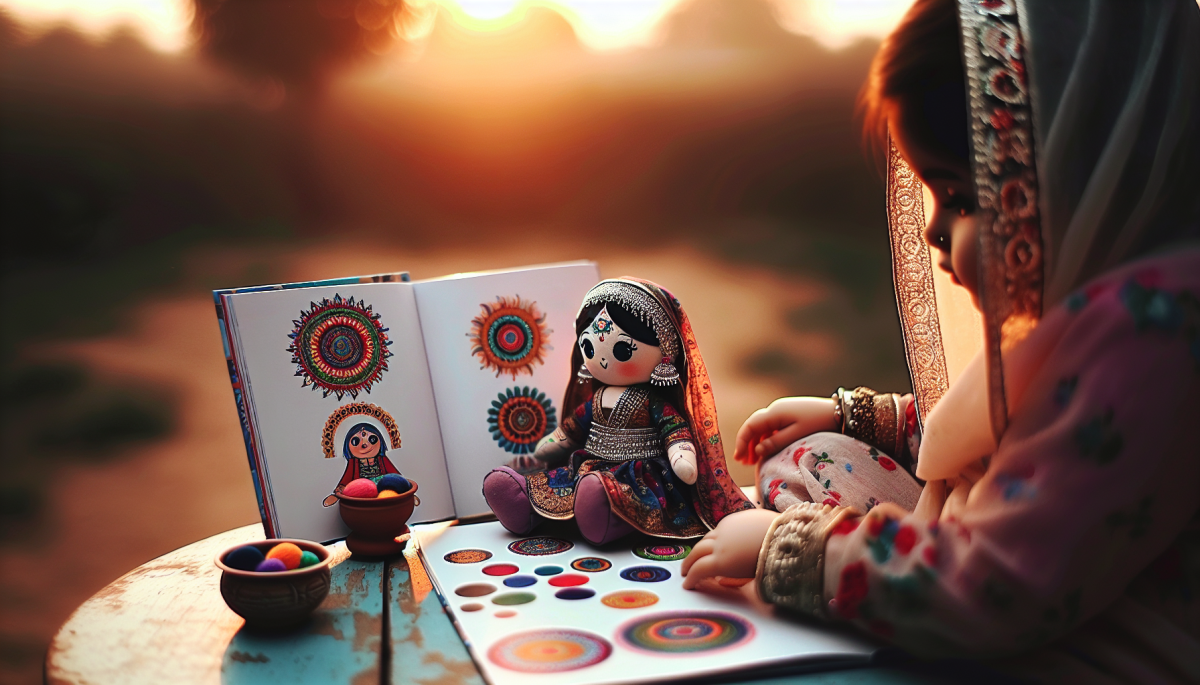
For instance, I had a marvelous doll named ‘Pottu’ – actually the doll was marvelous, it was made to look quite horrendous with all the bindis I gave her. I drew magnificent bindis on her everyday – one day, the sun, another day a palm tree, one day – I’d fill her forehead, face and forearms with bindis. But Pottu was my doll, and there she resides in my long-term childhood memory – a small part of our identity that only those who knew about bindis could understand. 
pixar elephant

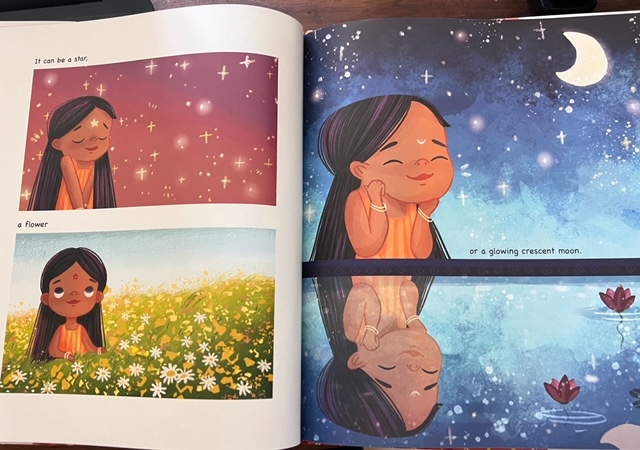
Here was an aspect of ourself that I finally saw in a book. When my daughter showed her baby pictures to her friends, they’d ask about the drishti pottu, or the pottu on her forehead. Finally, children can show their friends what a bindi is – in a book, in an American library. I am proud of that. Like the book coming out gave us bindi-lovers a tiny nod of belonging. You can wear a sari, and a bindi, and you can just Be. 
IMG_1254

Picture from: A Bindi Can Be – By Suma Subramaniam, Illustrated by Kamala Nair

Thank you Suma! 

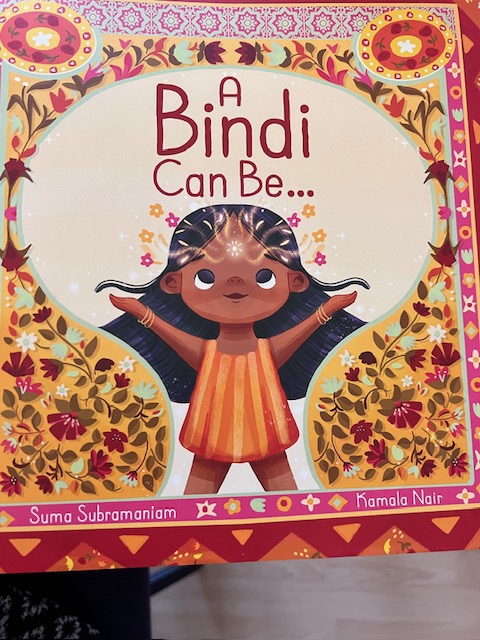
A Bindi Can Be – Written by Suma Subramaniam, Illustrated by Kamala Nair i

Now on to the book itself, A Bindi Can Be – Written by Suma Subramaniam, Illustrated by Kamala Nair it is a marvelous read. The pictures are vibrant. The joy of bindis is evident. The essence of the small dot transforming you is brilliantly done. 
67273848-1671-40B0-992C-E3C82AFDF5D4

Thank you Suma – for all those children who have had the joy of drawing their beautiful bindis, or having a marvelous bindi collection, or felt curious about a friend’s bindi, this book satisfies them all.

The Indian Twist to the Schadenfreudian Principle

I recently read a book that had Amazon’s review pages creaking and groaning. It just could not deal with all the heaps of praise and drudged along a bit moodily when you called upon the page to load. Naturally, when I started, I expected it to pull my attention given the huge fan base it had garnered. I was in for a shock. Not only did it not retain my attention, I found myself making excuses for not picking up the book. The book was dank, depressing and catered to the author’s almost pathological need to describe everything.

He looked at his shoes. The brown leather had been cut a bit brashly along the edges, while the leather leading up to the laces were done alright; almost like the cobbler preferred the laces portion to the edges. The brown was a little too brown and on the dusty trails should have blended in, but the gathering dust on the shoes made his feet stand out. Shoes that large gathered a lot of dust.”
And on and on, he went about the dust and colours of the dust, and the patterns it made on the shoes(iff he decided not to take off on the cobbler somewhere near the lace section.) If this was his attitude toward brown shoes, he seemed to get even more excited with tragedies and dripped and dried our hearts out to dry.

Definitely not what the doctors prescribe for already depressing Januaries. I found myself moping about the house, after donating all the brown shoes I could lay my hands on, because that is what a depressing book does to me. It etches my senses down a couple of notches. It just goes to prove that one never knows what is it that people like and why. It is a known fact that humans love to watch suffering in their entertainment choices.

There is a name for it. It is called SCHADENFREUDE: enjoyment obtained from the troubles of others.

It is this that Indian soap opera producers tap into to get their daily bread. Watch any Tamil (or Indian) TV serial in the evening for a healthy dose of morbid fear and tears.
Which brings me to a fundamental question. One can hardly assume that a human being can put up with this much stress, mental agony and physical pain and still take the care to line their lips perfectly with lipstick, and pin their neatly ironed sarees while waiting for the next blow to strike them. I mean when I was reading Book One, I couldn’t even bothered to get out of my pajamas. It seemed too much of an effort.

The Schadenfreudian Principle may indicate that humans enjoy looking at troubled folks, but basic human research suggests that people subconsciously like beautiful people. The result is Indian evening entertainment. These women brave the most severe emotions – raging jealousy, copious tears, vicious misdemeanours and heavy physical and emotional abuse – all the while looking like this. Never a disheveled girl would you find in all the serials of Tamilore.

Thank you Ladies!