The Contentment Unit of Measurement

This Spring, we are with Bala, that gullible grandfather with a booming voice, hearty antics, a retired man with a ros-ie outlook on the working life, and genuinely enjoying the company of his grandchildren: young blood and all that.

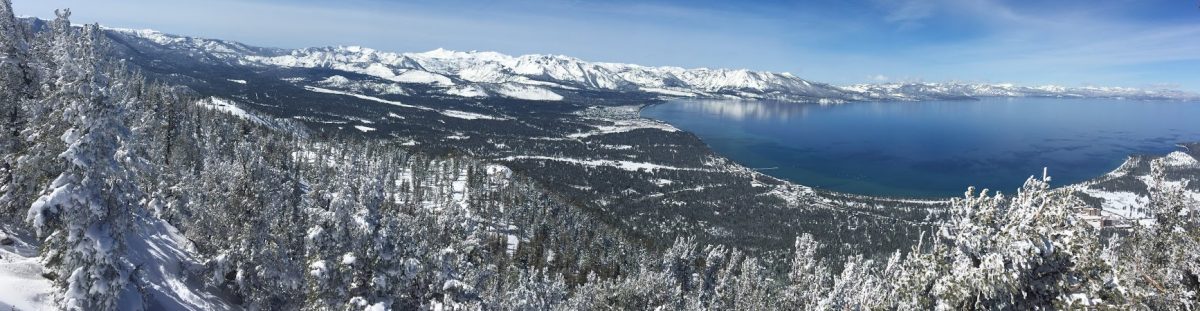
As I have written before, what with the pace of life and so on, we decided to take a short trip up the hills to Lake Tahoe. It was a marvelous time to visit. The mountains had had a fresh sprinkling of snow less than two days before our visit, but you’d never know it, the way the sun beamed down upon us as we ascended the mountains. Pure bliss. Lake Tahoe is one of those places that can soothe as well as it can pump adrenaline for the adventurous. And why not? There is a pursuit there for every one. From the quiet walks, to the serene views, to the snow, there is Paradise right here.

IMG_2215

We stayed at a house with a kitchen in it, so the mother was content. Finding a good kitchen in which to make a warm meal to feed her family at the end of the day is what makes the mother happy. So be it.

After a hot dinner, I sat with my legs-up on one of the fuzzy armchairs for a spot of reading. A reading light provided just the right amount of light, the son played with his cars on the floor, the daughter arranged the setting for a board game, the fire crackled merrily in the fireplace, and it was a cozy scene. I had picked out a magazine on mountain living or some such thing, from the conveniently placed magazine trove nearby. It turned out to have rather a lot of material and pictures on houses in the area. Lovely pictures of clean houses with vases, throws and plumped up cushions. I mused on the cleaning effort that goes into an everyday home.

One time I remember dropping into a friend’s house without calling in advance and was struck by how neat the whole place was. Not even a key was out of place. My own key was missing from the center table where I had placed it. I looked for it while leaving, only to find that my friend’s then 3 year old son, had taken the keys and put them away in the Keys Drawer. I was so impressed.

Things are different on our side of the spectrum. Oh so different! When I walk into a hotel room for instance, I can slice and dice the room in a jiffy and tell you how it will be after a day or two of us in there. I can tell you where exactly the rental papers will be strewn, where the keys will be plopped, where the chargers would be hanging and tangling themselves, where the socks will be bubbling out of the shoes and where the wet towels would be laid out.

I thumbed through the pages, all the while admiring the neat photographs, and wondering how people lived like that. The husband belongs to the jolly category of people who will tell you that a squeaky clean place like that must

(a) belong in a magazine for photographic purposes or

(b) be a hotel,

and then proceed to flop his coat on the recently cleaned couch.

Of course, this is a source of trouble in the dear home. For me, not him. For the misplaced coat never seems to bother him. He is convinced about the too-neat-to-be-a-home theory. A theory in which he is ardently supported and praised by his loving father-in-law, who thinks nothing of stewing brochures and magazines in every available spot in the house.

Storms, Televisions & Other Things

The father was sitting across the hall with an equally attractive home living magazine in his hand. He wobbled up in few minutes  to show me a stately mansion with an impressive number of bedrooms and large garden. The grin on his face was set to ‘Tease Thy Daughter’ and he said “So, how about buying something like this for a vacation home?”

IMG_2328

I looked at him and said with a quake in my voice, “Can you imagine cleaning a place like this?”

Contentment comes in various forms – mine is in the size and shape of a three bedroom house.

The Empress of Palates Examines The Upma Conundrum

This post is heavy on Indian foods: Upma, Chapathi, Koottu. Here is an image that will help: (Just a snapshot from Google Images when you look up South Indian Tiffins – idli, dosa, pongal, upma, sambhar, chutney, koottu.)

I am glad to say that this post was featured in the Open Page in the Hindu dated 19th July 2016. http://www.thehindu.com/opinion/open-page/not-cool-enough-yet-the-upma-conundrum/article8866694.ece – illustrated in the article by cartoonist Keshav, whose work I have admired ever since I knew how to appreciate humor in the written form.

Screen Shot 2016-02-03 at 3.46.10 PM

“Folks are coming home for dinner tonight, what do you say we finish up all the leftovers in the fridge, so we can start afresh tonight? ” I said peering into the fridge. One box of chinese take-out (kung pao vegetables) was stacked atop a glass container with homemade vegetable biriyani. Beside it lay some south indian koottu and a few chappathis. One sweep to conquer Genghis Khan, Akbar and Raja Raja Cholan.

“Sure!” said the husband. I must tell you that of the many virtues I love about the husband, one is the fact that he is not a snooty gourmet. He is one of those lovable fellows who will have an omelet with dosa and soup, and gush on to say that it was a good meal. So much so that, I have gotten used to being quite the Empress of Palates around the house. If I think we could have masala vadas and I am in the mood to make them, I set to it with gusto.

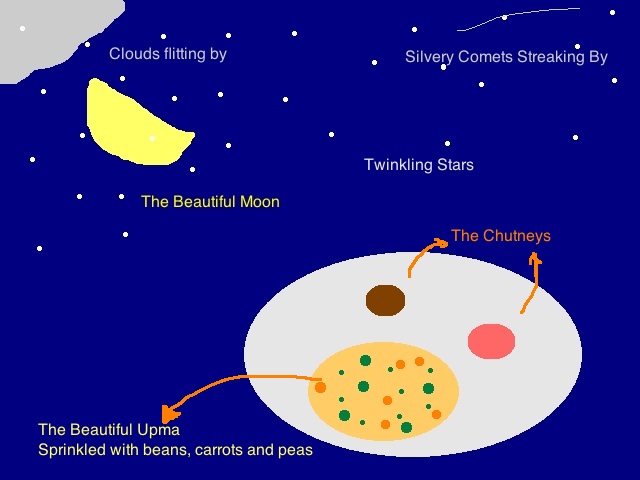
“I told the guys we shall make it a South Indian dinner potluck.” said the h. as I peeked into the phone telling me about one friend’s contribution. I nodded. One friend said she would make a side dish that would go well with upma. So,  I said I will make ‘Upma’. (https://en.wikipedia.org/wiki/Upma) It is that beautiful dish that is garnished with beans, carrot, peas all cut up into tiny pieces like stars, planets and comets speckling a clear night sky, and to complete the panorama of the flitting clouds added,”I’ll also make a mean groundnut chutney. ” Van Gogh’s Painting would beg if I made this beautiful one swirl.

upma

I had that smile that tints my face when I look up at the night sky, while the husband looked mortified. . “How could you? Why would you make upma when you can make so many other things? Upma is not the right dish for .. it just isn’t the right dish pairing for dinner alright?” said the man hovering his chappathi between the kung pao vegetable and the koottu, on his plate, as though deciding which was the worse choice to make.

“But you don’t mind eating upma. Even though you say you don’t particularly like it, you do justice to the dish don’t you?”

“Well yes. But upma is not a dinner worthy dish.”

The brain was fumbling with the light switch somewhere. “We had it for dinner last week with tomato chutney remember?”

“Yes! For us it is okay, but it isn’t exactly a dinner dish for Guests.” he said with a flourish. Like one who has just scored a particularly tricky point at the Local Debating Competition. The way he said ‘Guests’, one would think President Obama was stopping by with Elon Musk to discuss the Space Program over a plate of upma that evening.

“I thought you said that the only folks who visit our home are those you can open the kitchen to.” (This, he said in another discussion surrounding the use of a formal dining table in the home, but I am entitled to use the argument here: I checked with the daughter.)

“Yes but upma is easy to make. “

“Really? Last month do you remember me peeling some pasty stuff off the pan when you attempted to make it? You said that I made it look easy to make upma, but it actually is an art by itself.”

“Yes…I did. But that was to appease you.” I drew myself up. The husband raced on before I tacked on to the subject of appeasing and said, “NO. Not upma. Anything else.”

“I don’t understand this – what is wrong with upma?”

“I don’t know. It is considered a poor man’s dish.” said the husband, his arguments thinning. The cashews and ghee swam before my eyes and wondered which poor man would cook like that.

I gazed at the poor fish, and let it go. A few minutes later, the phone piped up with friends telling one another what they proposed to bring. One of them said she would bring Upma and then went on to add: My husband thinks I should not say Upma though, so I shall bring Vermicelli – Sooji Khichadi. A few minutes later, the phone buzzed again with her husband chiming into the conversation saying he had convinced his wife to switch their entry to Pongal instead of upma.

What is the mystery that plagues Upma’s status in South Indian Society? The Empress of Palates demands an examination. An Upma Festival maybe?

A bad rinse is good?

It had been a rather long journey for us.  We had already spent 13 hours on the bus. We had gone from (hot and sweaty) to (cold and hungry) overnight. The journey had been rocky and not, altogether pleasant. The bus had droned over endless hot, dry plains, before beginning its 3 hour ascent to the cool, refreshing hills in South India. It was 6 a.m. when the driver stopped for a break at a riverside village. “Vandi patthu nimisam nikkum” he shouted (The bus will stop for 10 minutes. )

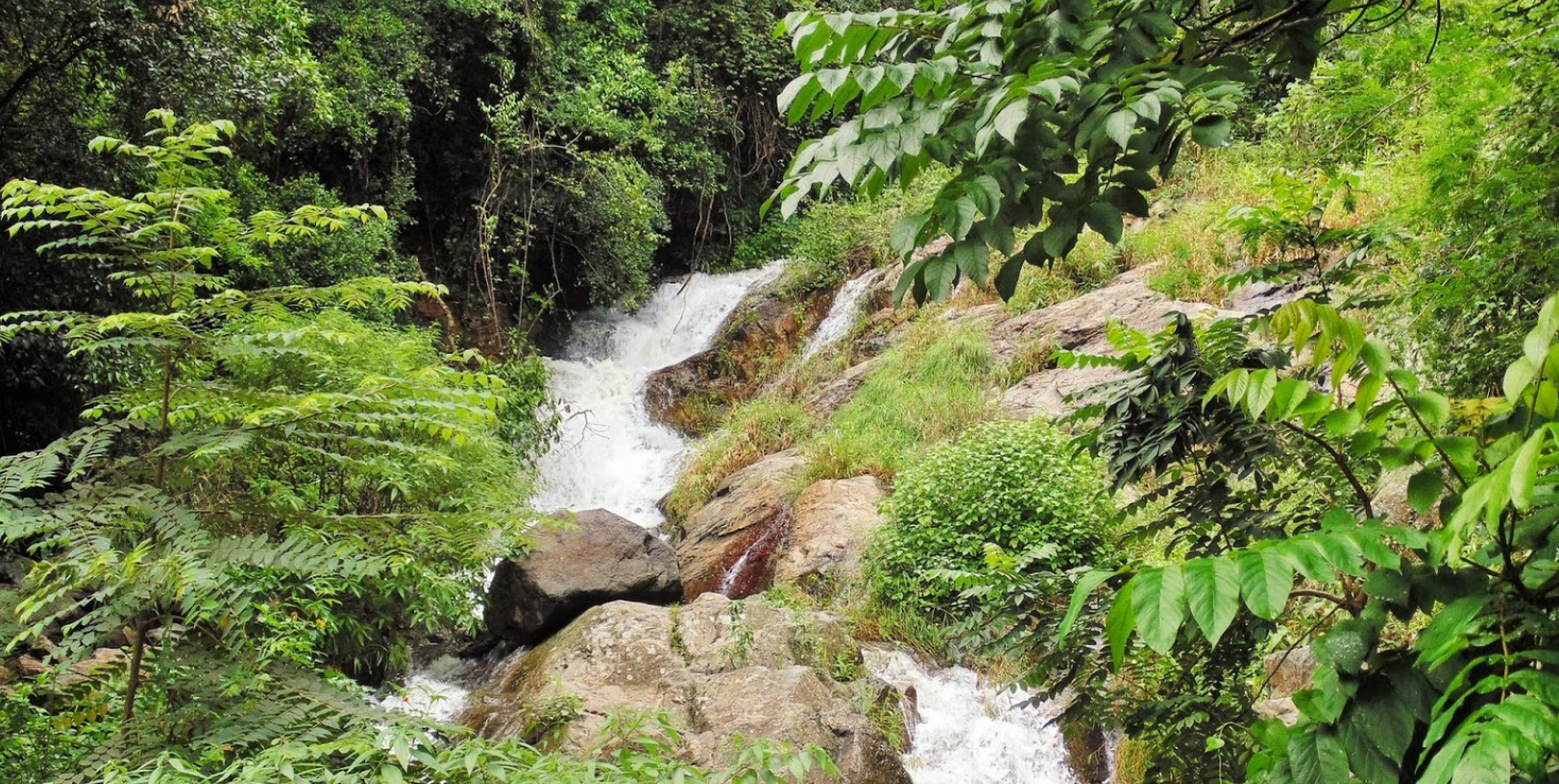
Our knees looked like gnarled trees as we stepped out gingerly to stretch ourselves. I was happy to breathe in the fresh mountain air. We could hear a swift river flowing nearby and this small village was named after the river.

Burliyar
Burliyar

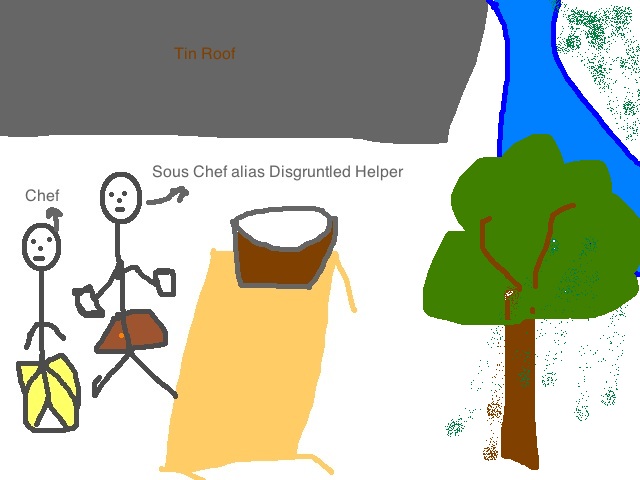
To add to the appeal, the fresh smells of Nilgiri tea wafted around us. The father and I made our way quickly toward it. The tea-shop was a shanty like any other on the route: A tin-roof, a couple of kerosene stoves and glass tumblers that were narrow at the bottom.  

The point is, there we were, sleep-walking towards the spot where our noses were leading us and our bodies shivering with the early morning cold. The father ordered two teas in his booming voice.  It was then that I stirred and noticed the men in the tea shop were clad in dhotis. The guy making tea was obviously a bossy sort, for he clicked his tongue at his helper. Distinctions were evident between employer and employee. The employee was a man, clad in a much-dirtier dhoti than his employer. I mean, if you are going to become this filthy, is there any point in wearing a white or cream colored dhoti? Why not just wear a brown towel or a tree bark and be done with it? Maybe it was their corporate dress policy, I thought to myself and settled into a sort of stupor again, my mind wandering. What if he wiped his hand on his dhoti and then put his fingers into our tea-cups? It happens all the time. Should I say something or risk it and down the life-saving and hope it would not become the life-taking in this case?

The teashop near the hills and river

I peered into a vast vat with what seemed like steaming hot, very watery tea and said, ‘This isn’t the tea is it?” The father peered in looking worried. You don’t drink 100’s of cups of tea for nothing. When you peer into pots of murky liquid that you suspect is tea, it doesn’t make very good tea. I hesitated before asking the man – you see these chefs can be picky blighters. You look dubiously at their tea, and the next thing you know, they behave like recalcitrant mules on a mountain path and refuse to part with a biscuit packet, marketed by Parle-G.

I was trying to see how to put things tactfully (I can’t say I have progressed much over the years), when the bossy bloke bellowed to his helper, possibly the sous chef in the establishment.  The disgruntled helper, or sous chef, wiped his hands on his dhoti and then plunged his hand into the vat I suspected to be tea and extracted a few glass cups. I mean! What? Had I not caught myself, I might have fallen over backwards in a neat scoop. The s. chef, however, noticed nothing and bustled about with his work. Having extracted the glasses from the muddy waters, he wiped it dry with a piece of cloth that would have given food inspectors in the western world a heart attack and deposited the cups on the counter for the tea.

The father and I exchanged deep looks packed with meaning and I saw the light of resolve and understanding dawn in the father’s eyes. His eyes had the it-is-a-simple-matter-of-education gleam in them. Once a teacher, always a teacher. He said to the pair of them, quite politely in my opinion, something to the effect of washing the cups in flowing water before offering us tea in it. Washing, he said, does not happen in stagnant water that looks like tea.

The disgruntled helper or sous c. growled. “Saar! It is washed!” he said

My father appealed to his inner teacher once again and explained that washing dirty cups in dirty water still leaves the cup dirty.

It did not go down well. The sous chef now looked like a sulky sous chef.

Saar! All washed Saar. I wash again.”  He smartly picked up the cups and dipped them into the same water again. I moaned. The father moaned and the chef groaned. Maybe the code of conduct with respect to washing cups had been gone over several times in his training, but had not registered much like the corporate dress policy.

“Flowing water pa! You must pour water over the cups and wash them. Otherwise, all the dirt will be in the cups too. What you want is to go for the clean effect of flowing water. Remember your town was named after flowing clean water from the river.“

What happened next could try the soul of the most optimistic teacher, for the man, simply plunged his hand into the water, took a cup and filled it with dirty water and poured it over another cup and washed it. He beamed freely at this bit of going-the-extra-mile-for-the-customer while we cried in our hearts.

“Clean water my good fellow. Clean water!” cried the father, while the helper stood there looking confused.

I noticed with a sort of sinking feeling that the father’s voice being a stentorian one, all tea-makers in the little river town on the mountainside heard this little altercation, thereby dishing our chances of picking up tea elsewhere.  I tugged the father’s sleeve to let things be and asked to buy a bottled water. I then smartly poured a little bit of water on the cups and then asked for the tea in them.

I had, of course, affronted everybody by doing this. The father, for he felt that he now had to explain Economics to his daughter (Who spends Rs 20 on bottled water to wash teacups  when the tea costs Rs 5 each?)  The chef and sous chef cried too, for they never understood why folks bought water in a bottle in the first place, when it could be had for free in the river. To use good money to wash already washed cups was just excessive. They probably went home that night and lectured their children about not becoming obsessive and how a little bit of grime and dirt never hurt anybody.

As it turns out, they may have been right.

http://www.npr.org/blogs/health/2015/02/23/387553285/kids-allergies-and-a-possible-downside-to-squeaky-clean-dishes

I quote from the article:

The findings are the latest to support the “hygiene hypothesis,” a still-evolving proposition that’s been gaining momentum in recent years. The hypothesis basically suggests that people in developed countries are growing up way too clean because of a variety of trends, including the use of hand sanitizers and detergents, and spending too little time around animals.

Squeaky clean dishes contribute to lower immune systems and therefore higher allergies.

P.S: The episode above happened about 20 years ago, but the mind has a way of resurfacing old snippets when it reads something new.

The Circle of Research

I am speaking of research almost as if it were a breathing force like Life itself, and bear with me while I lay out my thinking for you. We have all heard many times before the great Circle of Life and whenever we see our progeny show traits from long forgotten ancestors, we smile indulgently and invoke the sacred chant of the Circle of Life. Why then, do I attempt to use the same term for the circle of research?

It is because I have seen this a hundred times before. One day, I get up fresh to the breaking research that fats are bad for me and that anything other than fat is good. So, I toughen my resolve and gorge on potatoes and rice to keep me alive. It is a sacrifice staying away from the butter and the ghee, but I do so, because my well-being in very important, and I must do all I can to help the old engine chug along and all that. Sound logic, so far?

Then, along comes the next piece of research that tells me that carbohydrates are bad and gasp! The potatoes and rice that I have been eating with a sense of sacrifice, have been doing nothing but harm to me. There is a state of great panic and the research articles tell me that whatever I do, I must lay off the carbohydrates (long association has formed a close bond with these fellows, but I have to sever ties) and I look away from the fried potatoes to the fried vadas. Apparently, since the vadas don’t have carbohydrates, and are fried in excellent oil, they are nothing but fat and proteins and therefore, very good for my soul.

Life goes on and so does research. I have always been an avid reader of research that helps me quantify whatever I am doing. By these standards, I have been embracing the articles on moderate exercising, fresh air and all the wonderful things that it does to your body. My Google news feed has learnt the kind of things that interest me and only show me things that I like to see.

So, imagine my chagrin that when I used a new laptop, I saw a news item telling me that too much exercise reduces one’s life expectancy. I assure you I am not guilty of too much exercise or excellent eating practices, but what if I was? What if I had embraced exercise and diets according to all those excellent research articles?

http://www.webmd.com/fitness-exercise/news/20140401/too-much-running-tied-to-shorter-lifespan-studies-find

Now, if you will excuse me, I would like to calm my frenzied nerves with a pound of dark chocolate.

The Dosa God’s Warning

It was a lovely afternoon as we sniffed the fresh rain-scented air mingling with the Eucalyptus tree’s heady smells. We were headed to a regional park about an hour’s drive away from where we lived for a birthday party. Our friends, had wisely selected a Regional Park Reserve for the party, so there would be plenty of fresh air and nature while enjoying each other’s company. I could only admire their choice, for the day was beautiful and this park was one we had never been to. Lush green forests rose on all sides, and every time we peeked out a curve, we could see the glistening blue waters of the bay in the distance.

Now, every year, when January rolls in with the fog, rain and murky resolutions, we tell ourselves that we must spend more time outdoors on hikes and trips. The reason we don’t keep that up diligently all year-long is so that we can use that as a resolution when January rolls along again. I am sure it will be a tad tiring to have to look for new resolutions every year, wouldn’t you agree?

As the car climbed the hills, I stuck my head out wistfully and sighed, saying the things that nature taps me into saying each time: How I love fresh air, lucky that we live so close to mountains and forests, blessed with the ability to enjoy these things in cheer and spirit etc. I went a step further this time and said a bit critically, maybe, that we really should stop sitting home and eating dosas and get out more often. I should have known that one does not insult a perfect dosa without having one’s nose broken. The Dosa Gods are benevolent, but they will not let you go scot-free would they?

The daughter, meanwhile, was bristling with the injustice of it all. “We didn’t have dosa! You made me eat carrots.”

“Which I see you did not.” I added smartly, and she chuckled to herself.

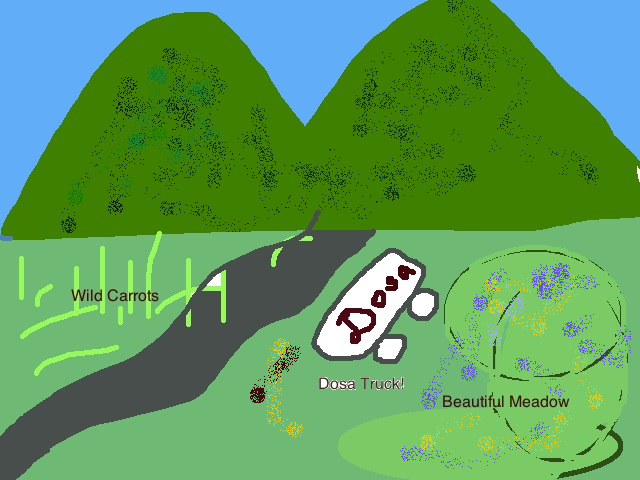
We spent some time looking for the right area, because the park was large, and cellphone reception was spotty. It was the daughter who spotted it first. On the side of the road, by some yellow fox flowers, and dark green ferns, was a gleaming van. “Amma look! You need not stay home and eat dosa. There is a dosa van right here!”

I felt my broken nose where it was snubbed and it felt raw. You could have knocked me out with a feather. There was a dosa van indeed. What’s more? It was for my friend’s party. If that was not a Dosa God’s warning, I don’t know what is. But the Dosa Gods are good: we were in time to enjoy some excellent varieties of Dosa with good people. The simple dosa rose in reverence in my eyes.

The Dosa God's Warning

The Dosa God’s Warning

As we took a walk back to our car, what do you think I saw? Wild carrots growing on the path. I stopped to show them to the daughter. She was as excited as I was. I had never shown her carrot plants before and I glowed with her as we admired the beautiful carrot leaves. We saw loads of ants attacking the wild carrots. Never one to waste an opp. when I see one, I told her about all the excellent properties of carrots. A mellow cheese dosa in her stomach made her receptive to the unsung carrot I guess, for she was an attentive audience.

I thought sagely said that the day was indeed one of sobering food thoughts. Dosas for me and carrots for her.

On Healthcare

When it comes to Healthcare, I’ve a little experiment to suggest. You can take the combined brain mass of the intellectuals around the world, and defy them to come up with a mess. I’ll bet the feather on my hat that they could not come up with a solution that matches the large scale bungling that capitalism has produced.

There are certain things that Doctors have to do to survive, and there are certain things that Insurance companies have to do to survive. What’s the wrong with that? Nothing *shrugs shoulders* Everyone could sing and admire sunrises, but for the minor blemish on the horizon: The things that Insurance companies and Doctors have to do to be healthy financially don’t always intersect with the fact that the patient has to healthy.

Let’s consider a chest congestion. If the same ailment were to befall me in my hometown in India a few years ago, I would walk up to the clinic across the street. Not in the mood for a clinic? No problem, I’ll settle for the pharmacy and refer lovingly to the “brother” who runs the store as “Anna”, and say I have a cough. If I could cough for him grossly, with the ringing sound of phlegm, he would prescribe me an anti-biotic in a jiffy. Two days later, I can breeze along the streets of Broadway and perform as the lead singer at the Italian Opera without anybody being any the wiser.

Not so here – uh uh! Nope! I have to get a minimum for 3 appointments before the anti-biotic, charging my insurance company I know not how much, and charging me my “co-pay” each time. Let’s say, the co-pay is $20. $60 and 10 days later, I am still no closer to getting a cure than a baboon coughing up phelgm without any access to health care in the Congo basin.(I don’t know whether baboons cough, but let’s assume they do) Then, it is prudent to have a meltdown in the Doctor office, at which point a nurse would stir in your direction, and touch you with her sympathy. By the time, the anti-biotics come along, the lung that’s been wheezing along fine thus far looks pneumonic, and a chest x-ray is in order, the bronchial tract that was hitherto clear has constricted making you whistle everytime you breathe. In short, you can forget the opera, and the coughing baboon in Congo is better off, because it did not lose $60.

I am not saying that walking to a pharmacy and having an anti-biotic prescribed has merits. But you must accept, it has ease and works for 80% of the minor ailments that befall a middle aged person.

Now, we come to Pricing. You can get the medications from an approved pharmacy for $160, whereas the same thing in Walmart costs something the common man can afford(like $10). It has happened to me, I got something for $4 in Walmart, while the same medication cost $100 in Walgreens after the co-pay of $20!

What is frightening is, where does this rip off stop?

Does it make older people feign health as long as they can possibly help it rather than get entangled in the quagmire of health care?

As if, the medical healthcare industry has not caused enough heart-ache, they are now becoming creative. Case in point: this lady’s depression treatment was denied because she put up photographs of herself in a bar on her birthday on Facebook!

http://tech.yahoo.com/news/ap/20091123/ap_on_hi_te/cn_canada_facebook_insurance

(which incidentally lends credence to my previous post on Facebook)

Where does this long road lead?