
Suma’s A Bindi Can Be

Suma Subramanian

I have been waiting for Asian Heritage Month to review the brilliant books of Suma Subramaniam. I yearn for books that hold a nod for us. I know what it is like to be the only child wearing a bindi in a classroom full of non-bindi wearing children – and so does my daughter I am afraid. 

Despite this, whenever I could, I looked for bindi patterns. Beautiful patterns – so elegantly thought out and shaped. Tiny little spots of art that you could stick on, to transform a face. I have a special kinship to bindis that probably deserve a separate post. I didn’t realize how much bindi related material there is in my head till I started writing this post. I have at least 3 posts worth just with reading one book!

Pottu, my doll

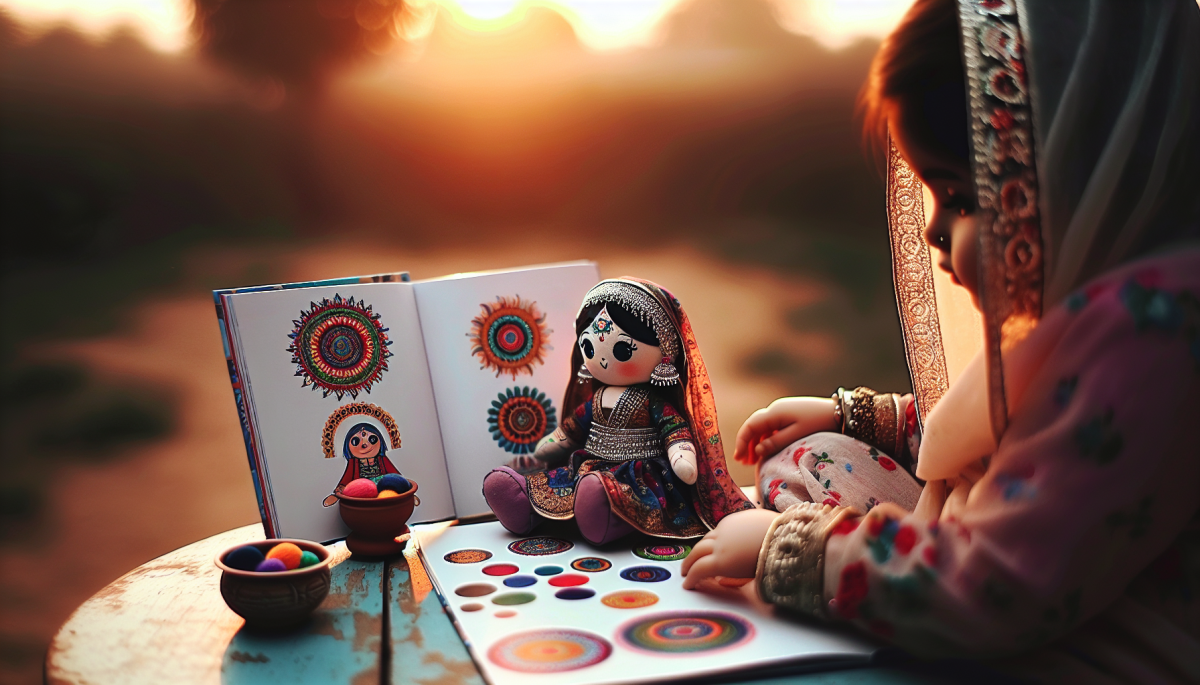
For instance, I had a marvelous doll named ‘Pottu’ – actually the doll was marvelous, it was made to look quite horrendous with all the bindis I gave her. I drew magnificent bindis on her everyday – one day, the sun, another day a palm tree, one day – I’d fill her forehead, face and forearms with bindis. But Pottu was my doll, and there she resides in my long-term childhood memory – a small part of our identity that only those who knew about bindis could understand. 

pixar elephant

Here was an aspect of ourself that I finally saw in a book. When my daughter showed her baby pictures to her friends, they’d ask about the drishti pottu, or the pottu on her forehead. Finally, children can show their friends what a bindi is – in a book, in an American library. I am proud of that. Like the book coming out gave us bindi-lovers a tiny nod of belonging. You can wear a sari, and a bindi, and you can just Be. 
IMG_1254

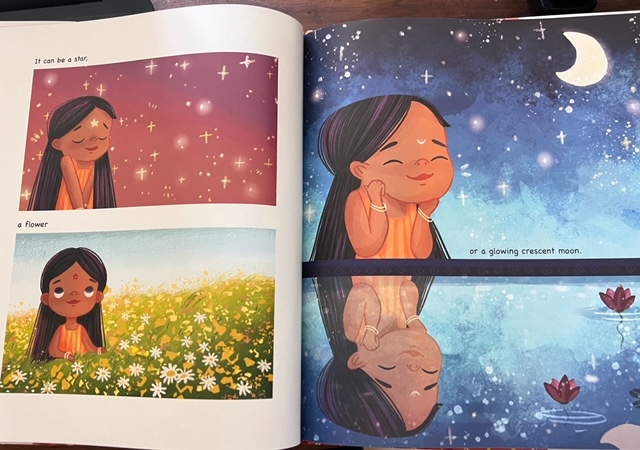
Picture from: A Bindi Can Be – By Suma Subramaniam, Illustrated by Kamala Nair

Thank you Suma! 

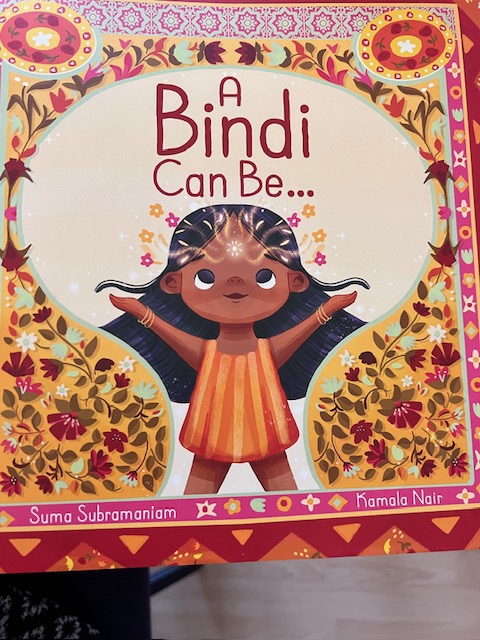
A Bindi Can Be – Written by Suma Subramaniam, Illustrated by Kamala Nair i

Now on to the book itself, A Bindi Can Be – Written by Suma Subramaniam, Illustrated by Kamala Nair it is a marvelous read. The pictures are vibrant. The joy of bindis is evident. The essence of the small dot transforming you is brilliantly done. 
67273848-1671-40B0-992C-E3C82AFDF5D4

Thank you Suma – for all those children who have had the joy of drawing their beautiful bindis, or having a marvelous bindi collection, or felt curious about a friend’s bindi, this book satisfies them all.
The Whole 9 Yards

The whole 9 yards

We lost my father-in-law (henceforth referred to as Appa) earlier this month. He had a wonderful life, was loving and was loved by almost everyone who knew him.

When we reached home and awaited the body from the mortuary, bizarre things began happening. We were supposed to be sending the father-in-law’s soul to a different realm, but I found myself transported to a different realm instead.

Suddenly, one is surrounded by a society that morphs into layers of irrational. I was overpowered by a mob of conservatives who draped me in a 9 yards saree before I could breathe.

For reasons beyond me, the society of people I was born into, sets great store by a garment that is wholly undeserving of the praise bestowed on it. It is the 9 yards saree. I abhor the garment for several reasons: apart from the casteism it symbolizes, it is also an extremely uncomfortable garment.

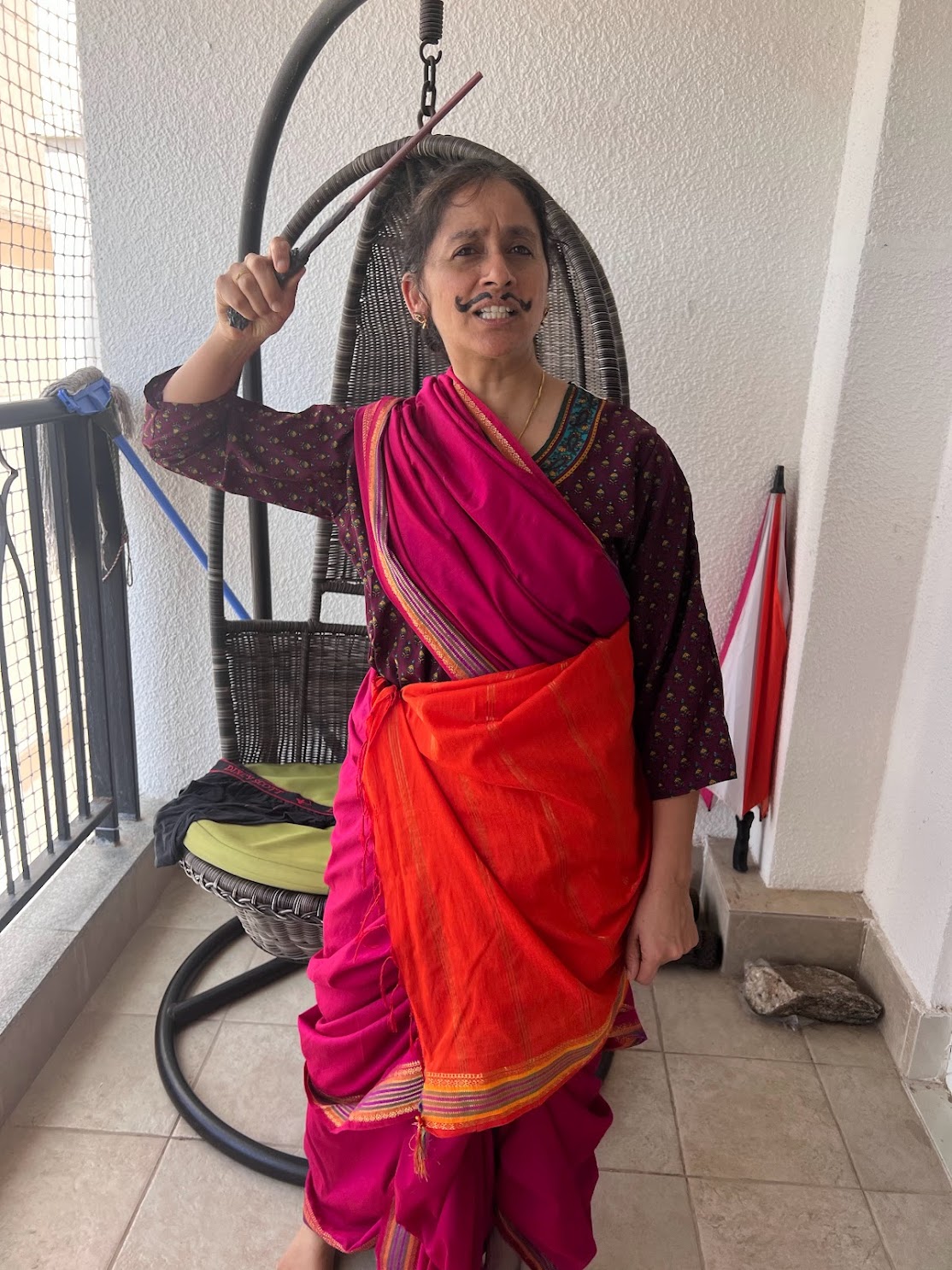
The 9 yards saree makes one look like a roadroller, impedes motion, and rouses an instinct in all females who see you to ‘fix’ the saree. One thinks, the folding pleat behind the legs is too long, another thinks the tugging back is too long. So, they all attempt to fix it — all completely well-intentioned of course. Only this gives you a strange sense of being disrobed – for like one of these sailors knots, if you pull one place, the whole thing can unravel. One time, an aunt, tugged something while I was descending the stairs and I almost fell headlong down the stairs. After the initial flare of annoyance, I started to laugh trying to envision myself like a rolled up carpet at the bottom of the stairs, and all good hands trying to extricate me from a 9 yard mess.

I have never liked it – but as luck would have it, society is enamored by it.

As I moved numbly to see the mortal remains of my dear father-in-law, about 50 different women and 10 men told me that the important thing to remember is that I wear this particular 9 yards saree everyday – to be washed, dried and worn again for the next 13 days. “Remember – the same saree only.”

I stared at them too speechless to say anything. Could they not see I was grieving – why was this same-9-yard-everyday thing so important?

It made no sense – until you realized that religion loves giving dictums for everything starting from how a woman should dress to how she should grieve. This one was apparently to ensure that we did not accidentally attempt to feel good by dressing well.

I’ll let you all roll your eyes at that one.

Dear Appa

A few years ago, when we had moved into our new home, everyone was pressurizing me to wear a 9 yards saree for the house warming ceremony. I was sipping my tea looking glum one evening after another aunt insisted that it was a critical garment for the success of the ceremony. Appa asked me “Yenna ma?” (What is it, ma?) in his typical calm voice sensing my disquiet.

I told him that I didn’t like the 9 yards saree but everyone wanted me to wear it.

He looked at me and said, “Don’t wear it!”

I looked up, and saw him looking at me sincerely. He continued, “This ceremony is supposed to ensure that you are happy in your new home – wear something that you will be happy in!”

I didn’t wear a 9 yards saree that day. I wore something I was comfortable in.  When I came down the stairs, he saw me and gave me a glorious smile.

Dear Society, Can you change?

I thought of this little interaction every day that I was miserable in the 9 yards saree during his long drawn out death ceremonies that everyone insisted had to be done in 9 yards (for the departed soul you know?)

saree_potter

(Saree Potter – caption by the brother)

Actually, this seemed to be a theme through many of the ceremonies. There were a lot of things that I am sure Appa would not even have considered – but religion seemed to dictate it all necessary to his soul. There were hours of mantrams and ceremonies everyday that we little understood.

What I would have liked is for people to let us know the little and big ways in which he impacted them. For it was apparent, that he was loved by everyone who had the fortune of interacting with him. He was a dedicated brother, brother-in-law, husband, father, father-in-law, uncle, grandfather, and friend. As it was, there was precious time left for personal anecdotes and reflections after the long-drawn out ceremonies that Appa, when alive, had little patience for.

“Man is kind enough when he is not excited by religion.”

– Mark Twain