We Are The World, We Need Kindergarten

There was great excitement as the children in the toddler son’s classroom got ready for their Spring program. Girls in pink dresses tumbled with boys in white shirts. The hustle and bustle: bazaars and marketplaces paled in comparison. I was wondering how these children could be made to calm down enough to start the program, when their teacher turned as if on cue, looked at them and said, “Now children, don’t tire yourselves out before the program, come let’s all sit and play nicely here.” and the frolicking lambs all smiled at their teacher and sat together and played.

Just like that.

I am always awestruck when I see young children behave in classroom atmospheres with their teachers.

Within minutes the children were lined up, and eagerly awaited their recital.

The heart warming program was put up by the children to the accompaniment of the Piano by a brave piano teacher. Brave, not just because he walked into a classroom full of children who can comfortably seat themselves in a doll house, but also because he did his duty marvelously. The singing that should have been in D-Major could be in C-Tenor or Z-Furore, but did that distract him? No Sir. He played like Ludwig Beethoven with that piano, and the tots shouted along as best as they could.

The children seemed energized and took us all along on a wonderful ride together with their singing and dancing, song after song.  My eyes misted up as the little ones sang at the top of their voice, carried little LED lights and sang a beautiful song. The lights dimmed and the children picked their way gingerly around one another, careful to not step on each other’s toes.

IMG_2450

There comes a time when we hear a certain call
When the world must come together as one
There are people crying 
And its time to lend a hand to life
The greatest gift of all

We are the world, we are the children
We are the ones who make a brighter day
So lets start giving

In other news, I recently finished reading the book by Dilbert creator, Scott Adams: How To Fail At Almost Everything And Still Make It Big

The book itself was a good one and Scott Adams peppered his book with anecdotes and humorous writing. He took up the saga of his diagnosis of spasmodic dysphonia and along the way explored topics related to general happiness, optimism, good diet and so on.

He mentions multiple times that it is prudent not to take medical advice from cartoonists. But cartoonists and humorists have a way of packaging material in a manner palatable to the human brain, and I thoroughly enjoyed the book.

What annoyed me was that I had borrowed the copy from our local library and the whole book was underlined in pencil by a previous reader who had no idea how to extract the main idea from a paragraph. Probably someone who did not pay attention in Elementary School, or one of those people who forgot what summaries were as time progressed. If the cartoonist had written a one-page paragraph that said something like : ‘Be active daily’, the bubbling baboon brandishing a blunt pencil had taken the pencil across the whole paragraph.

FullSizeRender (2).jpg

I have had cause to remark on this before and I shall do so again: What kindergarten children know, adults don’t. It may not be a bad idea for every adult to attend kindergarten classrooms once every decade. Yes. Every decade. All adults need to spend a school year, coloring within the lines, standing in line, learning to say ‘Thank you’ and ‘Please’, reading marvelous children’s literature to open our minds out again, singing hopeful and uplifting songs, playing whole-heartedly in the playground and getting a time-out for scribbling on books.

All recent kinder-graduates will do their part in keeping the so-called adults from slipping again, and just when it looks like they won’t listen, off they get sent to kindergarten class again.

Instead of spending all this money on law enforcement, I am sure a simple time-out like that will do marvels.

Cybotic Leaders or Alien Invasions?

I am reading a book called Mind, Life and The Universe: Conversations With Great Scientists Of Our Time. It is a compilation of interviews with scientists. It is fascinating reading. Holding one book letting one know so many areas in which one knows nothing is nothing but humbling.

One interview is with Jane Goodall. She says that what struck her as horrifying while studying chimpanzees was the fact that they could identify with a clan and go on to attack, maim or kill fellow chimpanzees belonging to a different clan. Similar to what human beings do to each other. Somewhere along the evolutionary cycle, our genes seem to have mutated thus – to identify race and religion and any number of extra associations and look down upon others.

Carl Sagan, in his book, The Cosmic Connection, writes about how if an alien civilization were observing us now, they would think that what we value most is violence. For that is what is available as entertainment and that is what being streamed into our homes everyday, and what our children engage in, in the form of video games.

(https://nourishncherish.wordpress.com/2015/10/09/the-wind-in-the-reefs/)

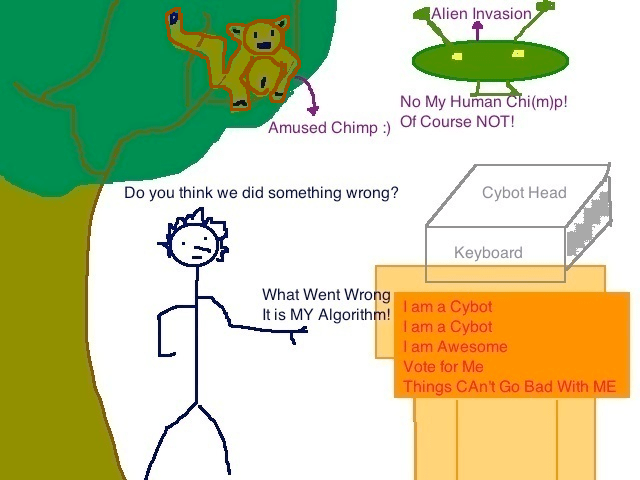
Last week, we did not need aliens to observe and see what is taught to us. A twitter bot, Tay, written by humans was let loose in the internet to learn and respond like a real user (The future is not far when a good cybot becomes the President of a country). Within 24 hours, we had turned Tay into a racist, misogynist, abuse-spewing user. Who can blame Tay for learning to be a racist jerk in one day? If that is what we are teaching twitter bots, could it be what we are teaching our children in a slower, sturdier manner?

I quote from article below:
http://www.cnbc.com/2016/03/30/tay-microsofts-ai-program-is-back-online.html

“Unfortunately, in the first 24 hours of coming online, a coordinated attack by a subset of people exploited a vulnerability in Tay,” Lee explained. “As a result, Tay tweeted wildly inappropriate and reprehensible words and images.”

How do we teach an algorithm empathy? As Jane Goodall said, “Only when our clever brain and our human heart work together in harmony can we achieve our true potential.”

https://www.brainpickings.org/2014/09/30/jane-goodall-empathy/

I remember a P.G. Wodehouse book, Right Ho Jeeves, in which Jeeves (that all-knowing butler who saves his young, idiotic, but thoroughly good-natured master, Bertie Wooster many times over) says, that the best way to unite warring factions is to introduce a common enemy.

chimp

It looks like an alien invasion might save us from ourselves. If those aliens are only 0.1% percent more evolved than us, we can be their chimps.

The Happiness Machine

In one story track of the Dandelion Wine, one of the characters, Leo Auffman, sets out to create a Happiness Machine after listening to low-spirited conversations among the old. Grandpa Spaulding, does let us know early in the process not to wait for the thing with bated breath, but we do.

Leo sets out to make his happiness machine imagining all the things that will make us happy. One quiet evening when he asks his wife what she thinks of it, she is stiff in her response, but Leo is too excited to notice that she doesn’t approve of the project. He spends more and more time creating the machine much against the wishes of his wife. He grows increasingly fond of what he is creating and neglects his family, too busy to notice the discordant strings starting to play out among the children. His wife tries to get him to see reason, and tells him that he is better off with his children, and spending time with them, but the excited Leo can barely wait to unveil the beautiful Happiness Machine to the world so there will never be discontent among the populace again.

It is only when he discovers his son weeping uncontrollably after taking a spin in the Happiness Machine that he fumbles. He is confused and cannot see where he went wrong. He pleads with his wife, Lena, and she too tries it out. At first, he hears her laughing, but slowly a deep wracking crying emerges from within the machine. Poor Leo – all he wanted to do was make people happy.

Lena comes out, and tells Leo that at first it was beautiful and she thoroughly enjoyed it. There was Paris, and all the wonderful places to see, right there in her backyard, but slowly a discontent set in. Hitherto, Paris and Greece were wondrous places, but not ones she ever dreamed of going to, and she was happy with her chores and the family. But now, the happiness machine had shown her everything that was possible.

Happiness_Machine

What’s more, she goes on to say that she truly started crying only when the Happiness Machine took her dancing with Leo again. They hadn’t been to a dance in twenty years. Leo says he could take her dancing that very evening, but she says that is not the point, since all the Happiness Machine did was remind her of those golden times and foolishly wish for it again instead of treasure the memory. The children have to be fed, chores need doing around the house. Who wants a sunset to last forever? The sunset is only beautiful because it does not last forever. The whole time I am thinking I have my real life to get back to. My children to feed, my home to clean, my work that awaits me. Oh Leo, how could you forget that real life can never match up to what a Happiness Machine says my life should be like?

The story finishes with Leo realizing that a Happiness Machine was there with him all along – he was just too absorbed to notice it. One that doesn’t always work, but will do – his family.

A book written in 1957. Brilliant.

Dandelion Wine

I used to eat wild berries. This is the kind of statement that gets folks today squeezy. Were you really okay after eating wild berries? Yes. You sample one and then another if the first felt okay. Leave it at that and then a few days later, if you haven’t spent the preceding few days heaving up your insides, go for it again. Yet, every time I try to eat one, the husband grabs my arm and looks at me accusingly. The daughter twirls her eyes at the rebellious mother and berry eating becomes another adventure that is reflective of my wild youth.

In other news, I read an excellent book, Dandelion Wine, by Ray Bradbury. Dandelion Wine is essentially a book of a boy’s summer in a small sized town. The first time he realizes that he is alive. Alive in a way he can observe the smells of summer, relate to the activities the hot sun brings with it, deduce what relationships mean, deal with the pain of seeing a childhood friend move, and how we need a sense of community. In this short book of related short stories, there emerges a brilliant, simple narrative of a 12 year old boy, Douglas Spaulding.

In one story, Grandpa Spaulding realizes that Bill Forrester, their young gardener, who is training up to be a journalist one day, buys a particular variety of grass that only grows to a certain height and then stops, thereby making a lawn mower redundant. (Luckily, no such grass exists to this day.) It is just a pretty lawn requiring very low maintenance. Grandpa is shocked at Bill for considering buying something that inches out the clovers and dandelions which means there will be no bees or butterflies in the garden. He goes on a tirade saying that this is the problem with the younger generation.

7B35B2B0-F446-4A6C-B797-88D7DA9EEE8F

He tells a stunned Bill that he wants nothing to do with the grass till he dies, for he likes mowing the grass. He likes the joy in small things. The problem with the younger generation, he says, is that they hop from one big thing to another and find methods to get rid of all the small things that fill the day. He tries to explain to him that one day he would go crazy trying to find little things to fill his day.

“Lilacs on a bush are better than orchids. And dandelions and devil grass are better! Why? Because they bend you over and turn you away from all the people and the town for a little while and sweat you and get you down where you remember you got a nose again. And when you’re all to yourself that way, you’re really yourself for a little while; you get to thinking things through, alone. Gardening is the best excuse for being a philosopher. Nobody guesses, nobody accuses, nobody knows, but there you are. Plato in the peonies, Socrates force-growing his own hemlock. A man toting a sack of blood manure across his lawn is akin to Atlas letting the world spin easy on his shoulder. As Samuel Spaulding, Esquire, once said, ‘Dig in the earth, delve in the soul’. Spin those mower blades, Bill, and walk in the spray of the Fountain of Youth. End of lecture. Besides, a mess of dandelion greens is good eating once in a while.”

I haven’t eaten Dandelion stems though – time to try some freshly washed ones from the backyard. I like the way Grandpa Spaulding thinks.

garden

I just need to remind myself of Grandpa Spaulding’s wise words when I am moaning in the kitchen doing the after dinner cleanup.

Published in 1957, this story’s theme resonates on multiple levels. Today, we find other distractions to fill our day. We graze on Facebook, we try the pulse of Twitter, we farm with the flick of a finger on Farmville. Which brings me to the next lovely topic on The Happiness Machine in Dandelion Wine.

For Poignant Reading

I finished reading When Breath Becomes Air by Paul Kalanidhi a few days ago.

Peppered throughout the slim volume are references to literary works that appealed to the author during his life. Dr Paul Kalanidhi was a neurosurgeon and neuroscientist. He  double majored in Biology and Literature from Stanford University. His love for literature and the underlying angst to understand the question of ‘where morality, biology and philosophy intersect’ are evident throughout the book. His experiences with living and dying as a surgeon only deepened his yearning to understand the truth and he eventually seemed to learned to view his illness as a method of finding out what that very question meant in the face of death.

At one point in time, his oncologist, wanted to start keeping tabs on his mental acuity as tumors spread to his brain. His wife started recording him reading something everyday. One evening, he started reading with his infant daughter seated on his lap. A few seconds into the reading, he put down the book and recited the whole passage from memory. His wife and mother exchange smiles that clearly say, “How typical of him!”. Little glimpses like that made the human being who comes through the pages a very like-able person. A good son, friend, husband, brother, friend, father and doctor.

The book finishes abruptly as time accelerated and Dr Paul Kalanidhi died before he could finish the book.

You can easily skip the prologue. It adds little value to the book or to the personality of the author. But the epilogue written by his wife, Dr Lucy Kalanidhi, was incredible and wrapped up Paul’s story. I read it twice back to back. I loved how beautifully she wrote about the place they chose for his final resting place. A serene place in the Santa Cruz mountains overlooking the coast, and where deer eat the flowers, and gentle rains make the grass grow. It is also the place where the natural elements rage. Much like his life.

There is one particularly moving passage where Dr Paul Kalanidhi writes to his baby daughter, Cady, that there will come a time when she lists her accomplishments and weighs her contributions to the world. At that moment, he tells her never to forget that she made a dying man very happy. I teared up every time I read that.

IMG_7533

I felt the same when I read Dr Randy Pausch’s The Last Lecture. Both these people may have written their books when they knew they were dying, but both books are incredible pieces on how to live.

Nose in Books & Feet in Socks

As an immigrant to the United States, there are things I will always cherish. Lovable quirks such as “Water no ice please” or “Aww..”. Things like different reading fare is marvelous. Growing up in the misty mountain valleys of South India, we had access to good children’s books, and I relished every moment spent with my nose in books and my feet in socks.

Enid Blyton lifted all of us children into clouds above The Magic Faraway Tree or whisked us away on the Wishing Chair. Tinkle comics & Champak took us for a spin (I am trying to remember some of the characters without the aid of the Internet – a cheap thrill in the current times – Kalia, Chamataka, Doob-Doob, Tantri the Mantri, Suppandi, Naseeruddin Hodja, Vikram & Betal and of course, that vague huntsman who should be the mascot for gun control laws, Shikari Shambu).

tinkle-collage

Later, Nancy Drew, Bobbsey Twins, R.K.Narayan, and Alexander Pushkin were the in-things to read.

As more serious fare gradually replaced this wonderful array, I never expected to be revisit that wondrous feeling of picking up a children’s book where you know not what magical world opens up to you, and when. But that is exactly what happened when I had children here, and we journeyed into these marvelous worlds together. I had never read the Thomas Train series or the Curious George series or the Beranstein Bear series or any of the books by Dr. Seuss as a child and I got to experience all of this with them for the first time. Oh! The simple pleasures of reading a book like any of these for the first time is gift enough, but to be blessed to be able to read it for the first time as an adult is surreal. It was like growing up all over again. To that, I am eternally grateful.

Walking into the children’s section of books is such a treat. Dr Seuss’s birthday gave rise to a number of excellent articles and I relished them almost as much as the books.

What Pet Should I Get?

Seuss-isms

Just as Dr Seuss promised, the nonsense woke up the brain cells that were sluggish due to lack of use and life became an adventure again.

dr seuss

It even makes me think nothing of making a fool of myself publicly and putting out things like:

Do you want to be a Sailor?
Or do you want to be a Tailor?
Maybe we need to be a Failor
Before we become a Winnor.

Space Racers – Together The Fun Begins!

It gives me great pleasure that this article was published in The Hindu’s Open Page dated 27th September 2016. The illustration is beautifully done by Mr Deepak Harichandran

http://www.thehindu.com/opinion/open-page/open-page-rise-and-shine-on-astronomy-day/article9150779.ece

There is something deeply calming and beautiful about gazing up at the stars at the end of a long day. It feels reassuring to know that we are but a small part of the cosmos, and it helps us puts our worries, anxieties and fears in perspective.

If there is nothing for the children to enjoy in terms of nature,  divert their attention to the ever changing panorama of the skies and let them experience wonder said Reverend James Woodforde in The Diary of a Country Parson when asked about children growing up in urban surroundings, who do not have the luxury of waddling through nature.

Reverend Woodforde (https://en.wikipedia.org/wiki/James_Woodforde) would be pleased indeed if he went on a walk with the toddler son. Once the stars are visible, the son makes it a point to look up, his eyes filling up with wonder and questions bubbling up.  His ardent sister fans him along by pointing to the constellations and asking him to identify some of them. The young astronomer accepts this great responsibility with grace. He then proceeds to point at Ursa Major and calls it Orion, Ursa Minor is christened Sirius, Jupiter is labelled Venus and the Moon remains the Moon. All of this is done with confidence and joy, and the walk takes on a gentle humor of its own.

It is hard to identify constellations for us and even less need to do so now that we have access to excellent apps such as Skymaps and Google Sky. The skies are, however, fascinating and it will be nice to be able to identify the constellations even if we don’t need them to navigate from Spot A to Spot B at the moment.

star_gazing

One night as we stepped out for a stroll after a particularly satisfying meal and dessert, we diverted our gaze skywards as is our wont.

“If I become a space traveler, will you come with me?” he asked me a little line of worry creasing his face.

The background to this question was, of course, another conversation in which we had to let him know that when he grew old enough to become an astronaut, we would be past the age that is currently acceptable for astronauts. Maybe his sister could join him, but we may be past it. He looked forlorn when he heard that, and I made a mental note to remind him about how keen he was to have our company on a space vehicle, when he attempts to learn driving as a teenager.

I looked at his face and said, “You know? A century earlier, nobody could have thought your grandparents could fly across the world to meet you, so we don’t really know how things will change. Maybe if things progress along space travels, we could. Who knows?” I said. He seemed happy with the answer, and said,”Where would you like to go first? Which planet?”

I thought for a moment and said I would like to go to Neptune. “How about you? Where would you like to go?” I asked him.

“I want to go to Jupiter – maybe the great big spot in the storm.” The daughter asked him why, and he said, that he would like to see the moon have some company. On Jupiter, you can see 64 moons right?

“Did they teach you that in School?” I asked pleasantly impressed and surprised.

“No…..on Space Racers, Eagle and Robin get stuck in the storm on Jupiter remember?” said the couch-astronaut. (Space Racers is a TV program created with input from NASA)

“Space Racers – Together the Fun Begins…Rockatocka mission, we’re on our way….Space Racers…..” He then sang the whole title song for my benefit,laughing to fit (https://www.youtube.com/watch?v=HZPOAEGhTl8)

Whether through Television, movies, smart phone apps that map the sky for us or through Science lessons, it is wonderful to glory in the expanse of the Universe and humbly accept our position within it. Like Carl Sagan, the noted physicist, said, “Astronomy is a humble and character building experience.”

Happy Astronomers Day!

A Jane Austen Education

 I like to draw relaxation from the joy in little things. The ability to stop and look at a flower or amble along with friends and family discussing the little matters of life that make up the notes of music as we hum along in our lives.

IMG_7466 (1)

The ability to feel like it is okay to not be driven by this high sense of purpose, but living a useful life all the same.

There is no power on Earth that can neutralize the influence of a high, simple and useful life. - Booker. T. Washington
There is no power on Earth that can neutralize the influence of a high, simple and useful life. – Booker. T. Washington

When people talk about good stories, they are usually pumped up about plot, drama and suspense. I am all for plot, drama, suspense, mystery, hot-cold love and so on. But our lives don’t always turn out that way, nor should it. That is why I recharge myself with writings of Miss Read, Jane Austen and P.G.Wodehouse. When I read these authors, I can assure myself that it is perfectly okay to lead lives that will not get a dramatist to reach for his recording device, but one that is joyful enough in its pursuits and activities to make it an interesting one.

Every time, I unwind with a Jane Austen movie, the nourish-n-cherish family rolls its eyes and flees the television area. Now that I think about it, it seems to be the only way for me to get some air time with the television. Hmmm (Evil laugh with gleam in eyes). But I hope one day to be able to get them to enjoy the movies with me.

I am reading ‘A Jane Austen Education’ by William Deresiewicz, that is essentially all the life lessons that her writings have for us to imbibe. Such a delightful book! There are some things that are clearly just the author’s perspective of applying her writing to his life. Not to mention that this book was written by a man, so it is only natural that his and my perspectives vary. 

The books starts with my favorite book of hers: Emma.

Little nuggets of writing like this spot the whole book and make me want to open it up at random and read again.

Jane Austen was about a year old when another English Author wrote a statement that could serve as a motto for all her books. “Life is a comedy for those who think”, said Horace Walpole,  “and a tragedy for those who feel.”. Everyone thinks and feels, but Jane Austen’s question was, which one you are going to put first? Comedies are stories with happy endings. I could grow up and find happiness, Austen was letting me know, but only if I was willing to give up something very important. Not my feelings, but my belief in my feelings, the conviction that they were always right.

Another one:

Being happy and feeling good about yourself are not the same thing.

A dictum that Mansfield Park reveals, that is as good today or even more apt today than any other day in the past.

Perpetual amusement leads only to the perpetual threat of boredom.

 I can tell you that it was truly a shocking revelation to me, that a recent study said we reach for our phone 221 times a day. (http://www.nybooks.com/articles/2016/02/25/we-are-hopelessly-hooked/)

Imagine that. More than 200 moments in time when we could be observing (anything at all really) spent checking a digital device. Are we not just as guilty as the Crawfords in Mansfield Park for needing that kind of continuous stimulation? It is no wonder that Digital Addiction is a real thing  requiring treatment.

http://www.gq.com/story/video-game-rehab?utm_source=nextdraft&utm_medium=email

It reminds me of this article:

Anyone with any degree of mental toughness,” artist Georgia O’Keeffe wrote in contemplating life and the art of setting priorities, “ought to be able to exist without the things they like most for a few months at least.

A sobering thought indeed.

Love on Mars?

I am reading a book that is futuristic in outlook. Trees on Mars By Hal Niedzviecki. Sitting on our commuter train, I look around to see that there is only one other person in the whole packed compartment reading a book. The book itself is a somewhat distressing outlook on our obsession with the future and futuristic trends. How Artificial Intelligence will and is taking on more and more of how the Internet World functions. How the waves of the future are affecting the educational system. How it could affect our entertainment choices, art and the study of humanities. We all know that is happening and is inevitable and all the rest of it, but I put the bleak thing away to ponder on some things that cannot be done away with.

As I stepped out of the train station that evening, I saw a vendor hawking red roses with a lopsided grin on his face. As though mocking and daring folks to stop and buy his roses. I have seen these vendors every year, during the week leading up to Valentines Day. On Valentine’s Day, you see a bunch of folks you would never have chalked down as the romantic type when observing them on the train, doling the cash out for a few roses for their beloved. The AI systems could take a while figuring out which ones have that streak of romanticism in them, I thought victoriously, but of course I might be wrong.

With Valentines Day approaching, the son’s preschool environs are a-quiver with excitement. Pink and red hearts plaster the walls. The daughter drew a card with a large heart and a bunch of surrounding hearts for our Anniversary. The son asked if he can take the card the daughter made for our anniversary to his school to put it up on the notice-board. “No!” I squealed. Before any egos could be bruised, I assured the children that the card was beautiful but it was meant for Appa and Amma alone. I am not sure I am quite ready for that to be bandied about on a school notice board. Not to mention the questions surrounding marriages, weddings or society’s inevitable curiosity around arranged marriages.

I am also reading The Wild Swan a book by Michael Cunningham, a clever take on fairy tales with a dose of the worldly adult interpretations. Each tale is short with a slightly different view to the tale. But, I cannot deny that I like the children’s versions better. The children’s versions are common tales but manage to spin magic about them.

Pretty much how the children manage to spin magic around Valentines Day.

I miss the years of Elementary school valentine’s day preparations with the daughter. She would arduously draw hearts and flowers on every card for every child and teacher in the class. I knew those cards were to join the recycle pile in their own homes by the end of the day just as the pile she came home with did, but it was a wonderful concept and kept her happily occupied for a few hours.

Love on Mars

I really like how the younger children get to see love in its more wholesome form. They love their parents, grandparents, uncles, aunts, teachers, friends, siblings, caregivers and pets. It all gets a bit wearying when they want to make cards for them all, but I prefer that to the more narrow interpretation leading to conjugal harmony( or not) one day.

As long as we know how to retain this curious ability to love and be loved, the future can march on to the beat of generated bytes and streaming bits.

Happy Valentine’s Day !

The Curious Garden

I have always loved reading Children’s books. There is something charming, and uplifting about them, a shining hope that we sometimes fumble with as we grow older. Even when the books deal with hard topics, even when they deal with hard concepts. Every time I feel jaded, there is nothing like a lovely children’s book to help me uncover the magic again.

One beautiful day in November, I dragged the children along on a walk. The fall season, and the recent rains had given way to unruly gardens, crisp fallen leaves for us to feel the crunch as we walked on, and little birds frequenting the place once more. On the road side, was a hedge trimmed to the shape of an oblong mushroom and the toddler son stopped in front of it and said, “Like the Curious Garden book right? This is how it was in Amma’s garden when she was a little girl.”

The daughter looked dubious. “How do you know it was like that in Amma’s garden when she was a little girl. You weren’t there remember?” The son looked hurt. It is true that he is often confused with time and does not understand why there were periods in our life before he was born, when he always remembered having her with him.

What is Time is a favorite question of his.

“I know! But Amma told me when she read the book, right Amma?”

“That’s right!” I said somewhat taken aback that he remembered what I had said in passing while looking at the pictures in the book a few days ago. It has since become a favorite book for both of us. We love cuddling up with the Curious Garden.

It is a heart warming story about a little boy named Liam who looks after some plants on a forgotten railroad track only to have the curious garden spread its influence all over the forgotten places in the city. The Curious Garden also inspires many amateur gardeners and the last page shows the transformation of a bleak, smog-laden city to a beautiful one with creepers and trees and hidden nooks of gardens by the time the boy grows to a man.

One on gardens in Brain Pickings:

https://www.brainpickings.org/2015/08/10/the-little-gardener-emily-hughes/

During Thanksgiving, the pre-school that the son goes to had an exercise asking the children what they are most thankful for. The notes were shaped like feathers and they were all posted on the notice board together in the shape of a turkey. I stopped to see what the children were thankful about. I must say it was all wonderful. Very few had capitalistic tones, which definitely warmed my heart.

The son’s feather-shaped note said he was thankful for Mom cuddling up with him and reading Curious Garden.

IMG_1115