The Physics of Space & Time

The husband and I have been married for 20 years now.  Plans were great. Let’s go on a trip to the mountains, by the lakeside, near the shores of the Pacific Ocean. Instead what happened was that the phone calls flew over the mountains, past the lakes and through the oceans as we reminisced the 20 years together. I had to come to India to look after the old parents, and the husband was making calls everyday to ensure I had the right masks, the right tests, and the right flights. 

While the day turned out to be a special one anyway with loved ones calling and making it a special one, I found myself reveling in the words of James Baldwin:

James Baldwin on long distance love

“Pretend, for example, that you were born in Chicago and have never had the remotest desire to visit Hong Kong, which is only a name on a map for you; pretend that some convulsion, sometimes called accident, throws you into connection with a man or a woman who lives in Hong Kong; and that you fall in love. Hong Kong will immediately cease to be a name and become the center of your life. And you may never know how many people live in Hong Kong. But you will know that one man or one woman lives there without whom you cannot live. And this is how our lives are changed, and this is how we are redeemed.

What a journey this life is! Dependent, entirely, on things unseen. If your lover lives in Hong Kong and cannot get to Chicago, it will be necessary for you to go to Hong Kong. Perhaps you will spend your life there, and never see Chicago again. And you will, I assure you, as long as space and time divide you from anyone you love, discover a great deal about shipping routes, airlines, earth quake, famine, disease, and war. And you will always know what time it is in Hong Kong, for you love someone who lives there. And love will simply have no choice but to go into battle with space and time and, furthermore, to win.”

James Baldwin

It turned out to be propitious indeed that I was in the very city that our wedding took place in, and the husband was in California  – the place we went on to make our home together. As James Baldwin so eloquently put it, ‘we simply had no choice but to go into battle with space and time’.  I remember my sister asking me before my wedding what my favorite place was, and somehow I answered ‘California’. I’d never been there, I simply knew the person I loved was there. She threw her head back, laughed and teased me well. I deserved it. Hitherto, I had never missed a heartbeat in saying ‘Lovedale’, and here I was, already switching my answer to a place I had never seen.

As we sat down to a meal that evening, in my parents’ home, the stories of our lives spun its enthralling web around the little table. How we welcomed the wrong bridegroom party at the station all those years ago, only to realize after unloading all the luggage that it was a different wedding party with the same name(!) South Indians, especially of the previous generation could all be gifted a baby book of names, for they named their sons and daughters after their favorite gods and goddesses, and the popular ones studded the streets like stars on a clear night.

The wedding photos that for two decades had not been taken out for a viewing suddenly found itself in demand. I looked at the album to find some loving aunts and uncles no more, some whose rich tree cover had thinned out over time, others whose foliage had turned color in the intervening decades, children who had become adults and went on to get married and set up their own families. 
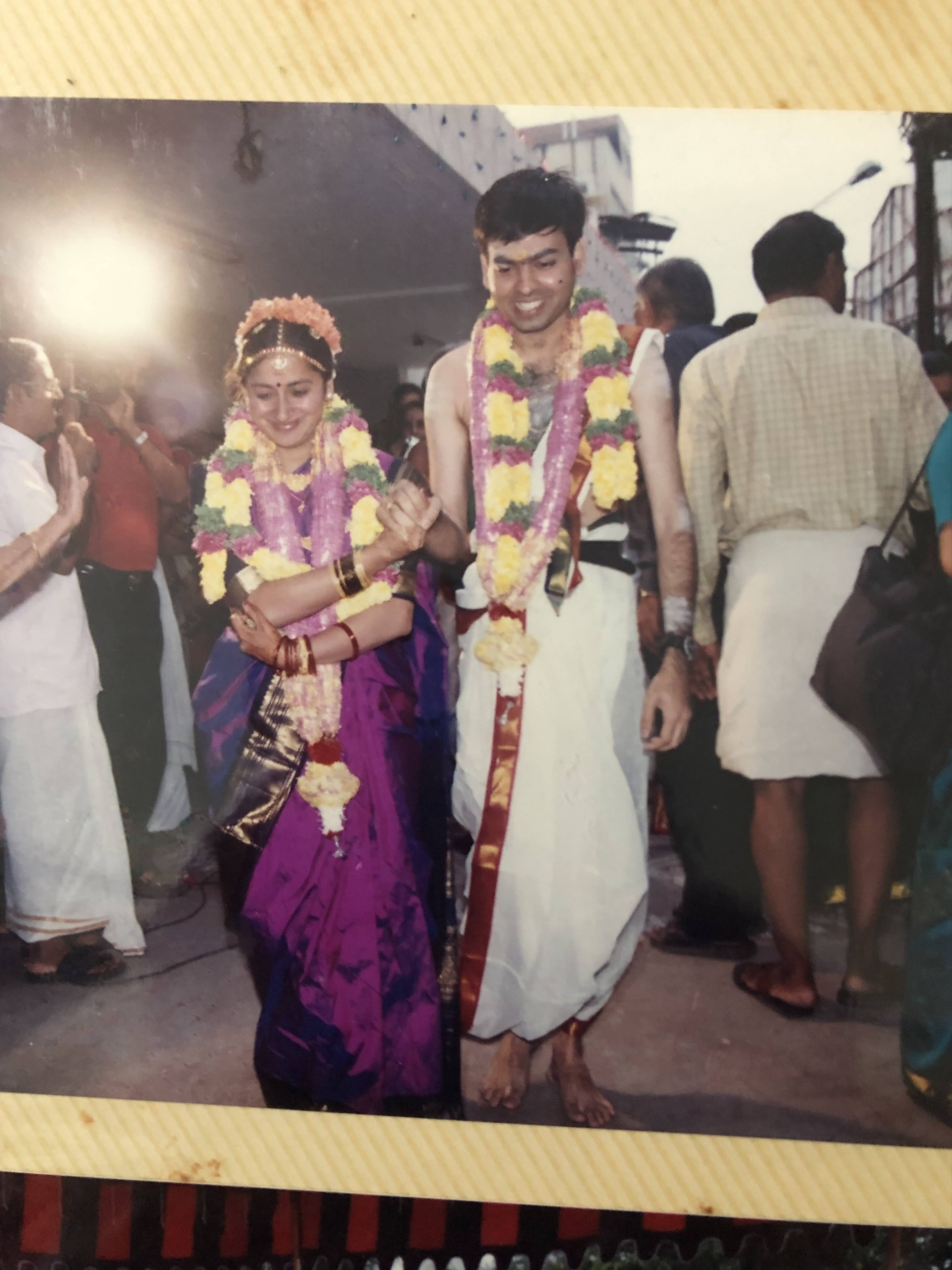
The march of time maybe relentless, but the memories are timeless.
World Peace

The first part of this article was published in The Hindu titled Collective Effort dated 10th April 2022

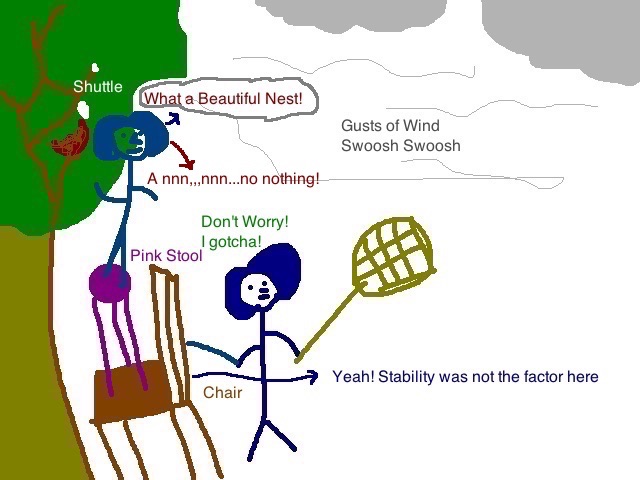
I am in India on a short trip. Most evenings, I take a short walk around the apartment complex the parents live in. The community is a middle class community with children playing outside every evening. Regular readers know how much I enjoy seeing children playing outside everyday. One day as I was walking past the play area, I stopped to see what the commotion was all about. Slippers were being thrown as high as little hands could reach, and all the little children were standing around giving instructions. It was then I noticed the two badminton rackets lodged up in the tree branches above (probably a dare since there were two rackets lodged firmly.)

The little band of racket-throwers were now trying to retrieve them from the trees, It is amusing to be a silent spectator to problem solving such as this. Several suggestions were being given by all gathered (Some enthusiastic, but clearly not grounded in laws of Physics. Others, theoretically brilliant but lacking the practical aspects such as the presence of a long 7 ft stick to dislodge the rackets). When it looked like there were close to dislodging the racket by themselves, I carried on, only to come back a few minutes later on my rounds to see that several attempts had yielded nothing. A general despondency had set in, and some gloomy faces stared at the unyielding tree with its branches so ridiculously high above. 

When it was obvious that the little folk could not dislodge the rackets, a small dip in their collective can-do attitude was apparent. Sensing this, the older children playing a little distance away, gathered to help. On my walk as a spectator, this was such a heart warming scene, for I could see the future of humanity secure in this simple act. When one of us suffers a setback, the others came to help willingly without even being asked. The older children had height on their side, and the tallest one lifted a younger child, who then dislodged the racket with a stick lying around. 

The cheers erupted all around. One might’ve assumed that a World Series match was just finished. But this jubilation was a different one altogether and play resumed.

Retrieving rackets from trees!

I wish children played outside on the streets more especially in the United States. I couldn’t help thinking that that motley bunch of children could have a future CEO reimagining the world, a diplomat helping out in times of humanitarian crises, scientists solving problems as deftly and quickly as humanity creates them, artists and writers who dare to dream and imagine a different world, etc. 

Which brings to this excellent book I was reading earlier, World Peace and Other 4th Grade Achievements. I always think highly of children’s perspectives and potential, so naturally I was attracted to this book. In the book, a fourth grade teacher, John Hunter designed a game to restore World Peace in a mythical world of his creation bearing enormous resemblance to our own. Climate change, wars, humanitarian crises, economic bankruptcies are all problems to be solved in this world.

World Peace and Other 4th-Grade Achievements by [John Hunter]

There are Prime Ministers of countries, nominated by the teacher. There is a World Bank, a weather goddess who controls things like freak climatic disasters, the stock market etc, a United Nations council all ably run by the children in the classroom. There is even a secret saboteur whose main job is to spread lies and sow discord between factions. So they learn to trust but verify, be wary but condone etc. 

He has a 3-D model depicting their world in which the oceans, the lands and the skies above us need governance and international cooperation to achieve World Peace. They are given 50 problems that must all be solved, and the net worth of the countries needs to be higher than when the game started for the game to be won.

He has perfected the game over several years in his classroom, and the results are indeed stunning in some cases as he writes in his book. In most years, the children did manage to solve World Peace in spite of the overwhelming odds stacked against them. Like in the little anecdote above, the children mostly hit upon a solution only after they are that close to giving up altogether. The failure, dejection all slowly yields to a new mode of thinking. One that is difficult to think of before, and this invariably leads the teams to collaborate and help each other better. (As J K Rowling says in her Harvard Commencement Speech – The Fringe Benefits of Failure and the Importance of Imagination)

TED Talk by John Hunter – 4th Grade Teacher

Truly, what we learn in Elementary School is priceless. The camaraderie accompanying solving problems truly makes the heart lighter. When in the right company, no problem is insurmountable. More importantly, there is hope for this world despite what we have done. 

The Potent Combination

2022 started off with a sprig of the fantastical. The first book of the year was The Ickabog by J K Rowling. Regular readers know that I am a fan of her work for children (Harry Potter, Fantastic Beasts, The Ickabog etc, but not as much of her works for adults such as the Robert Galbraith ones or other adult books) .

The Ickabog by [J.K. Rowling]
The Ickabog – By J K Rowling

In any case, I was grateful for the first book of the year being one so classically told, and imagined. Her story is relevant to every dictatorship, and every place where power holds sway. One can see the influences of her work at the Amnesty International in the story. She shares some of these experiences in her graduation day speech at Harvard (Benefits of Failure & Importance of Imagination).

As the car made its ways past the hills wearing their green robes after the recent rains, I asked the occupants if they would be interested in a spot of Cornucopian story-telling. One nodded enthusiastically, the other reluctantly, and the third did not deign to indulge me with an answer. No special points for guessing the nod intensities with the personalities. But it is was nice to be able to read aloud to the folks in the car – enough to get them hooked anyway. Like I wrote in an earlier post, the best way to read out your favorite literature is in a locked vehicle.

The Ickabog is a fearful beast that Cornucopian children are frightened with. (The equivalent of the South Indian Poochandi). However, after an unfortunate accident – the cunning lords of King Fred convince him that the Ickabog is indeed real. They see it as a way of fear-mongering, and stifling transparency. As the improbable tale of the Ickabog was spread by the conniving Lords Spittleworth & Flapoon, the population was led astray into believing lies upon lies, and soon, very few had the capacity to unravel the web of lies, or had the motivation to do so. Their King Fred was a mild sort – cowardly, but also thoroughly lacking in critical thinking & administrative prowess. 

As we made our way around the Getty Museum, we trundled around the French Art and there, on display, were the artifacts probably obtained after the French Revolution, when a number of these things made it to the wider world markets. Reading up a little on King Louis XVI there, the daughter described the king. ‘Wasn’t much of a King – he wasn’t particularly harmful or anything…’ and went on to narrate what she had read about him and the times. To my mind, he sounded remarkably like King Fred in The Ickabog (If you’d like to read the first chapter). 

The old father & I have been watching the news for the past few days ( a bad habit that I need to snap out of), and it is disheartening to watch the same struggles for power continue in different settings. Tanks piling up in fits over Ukraine, power battles raging on in Afghanistan, Syria and the Middle East region. How many people involved on all sides to call the shots, plan the power grabs, use guile and flattery to achieve their aims?

Power, fame and flattery are a potent combination that can poison the best of minds. Mankind’s history should be good enough teachers, even if our stories and fables are not, but it isn’t. Every dictator in the history of the Earth was impaled upon swords dipped in this mixture, and yet, time marches on claiming its victims. 

What was it that Einstein said of a peaceful, purposeful life? 

A calm and modest life brings more happiness than the pursuit of success combined with constant restlessness.”

Albert Einstein


The Little Red Fox

I have written about the little red fox in the riverbed before. This little creature never ceases to fascinate me. Living amidst the geese, herons, grebes , ducks, deer and numerous cats, I am unable to determine where this creature came from. I have never seen another fox in the vicinity. His fox parents are missing, fox kin seem absent too. This fox is a mystery alright. Yet he is full of verve and sprightly leaps across the stream-like river, or takes a fast run without missing a step along its grassy banks. 

One day, when the rains had lashed down particularly hard, I stood there scouring the river to see where the little fox may have gone. I do not see him or her regularly, but when I do, it is always worth it. That day, as I walked up the levee to the raised river bank, I saw the little red fox sunning itself on a rock. Anthropomorphizing humans that we are, I craved to catch its mood as it lay there – was it satisfied, scheming, satiated? 

As if in answer, the fox raised its head, looked towards me and then nonchalantly curled up to sun bathe again. I am doing none of the things you think I am doing, I am thinking none of the thinks you think I am thinking. I am simply being.

Watching the fox

The little red fox is a crafty muse:

The little red fox is a crafty muse

She doesn’t appear when you need her

She grants a glimpse 

When she does, you better be prepared for poetry never announces its arrival:

It simply Is.

One day I saw the fox sprinting

Running faster than I had seen any living creature in recent times run

Not in fear, not in pursuit, 

For exercise maybe – it turned its head mid stride, and said with its eyes,

Just simply running.

Another day, I saw him lying on a rock

Sunning himself.

Was he brooding, contemplating or scheming?

As if in answer he raised his head and said

I am just being.

Foxes have fascinated mankind for ages. Fantastic Mr Fox – By Roald Dahl, 🦊 Fox and Eight – by George Saunders, so many animal tales on their ingenuity and resourcefulness, and yet they continue to enchant. The latest I read was a poem on a goodbye to a fox by Mary Oliver, that made me attempt this feeble one.

Solarium Magic

The son came and tugged me to the newly opened section in our local library. His eyes were shining as he said, “Come on! I found something that you’re going to love!” I cannot deny that I love it when something like this happens, and smiled. Off we went, climbing two stairs at a time. Christened ‘The Solarium’, it nestles in a sunlit section of the building – like a mini glass house, it basks there in the warmth of the Californian sun, and doing the good quiet work that is hardest of them all- converting sunlight to food. The area is dedicated to making gardeners of us all – there are seedling packets with instructions on how to sow and grow the seeds given to us. There are books on gardening nearby.  Feeble attempts to capture the glory and wonder of the real work.

I admit it, it has since become one of my favorite places in the library. I am in awe of gardeners – true magicians of the Earth I call them. My own feeble attempts at coaxing life to take root and thrive, only reiterate the power of the simple garden. I was talking to the son as to how we must all learn to grow our own food, make our own food, learn to sew and stitch out clothes etc. More and more, we live in a world where these simple things are becoming separated by layers of machinations and supply chain mechanics. 

When we were in Epcot (Disney World, Florida) a few years ago, I remember the children seeing the plants from which their beloved tomatoes and eggplants grew with awe. City children typically do not see these marvels of nature slowly doing their work, conscientiously and relentlessly.

Epcot green house

It was probably propitious that I should have found the book, The Blue Book of Nebo by Manon Steffan Ros, just then in the new fiction shelf. The book is set in a time after a nuclear war, and how very very few people have survived the disaster. The mother-son duo manage to grow food for themselves in a glass house, and learn to thrive on their own. It is a fascinating read. It is by no means unique, but the narrative style is appealing and slowly draws you in. It is also something that I am sure everyone thinks of occasionally – the sad aftermath of an apocalypse. What would we do? Who would survive and how will they live? So many of our solutions depend on power. 

Mulling over these things early one morning, is when I heard about the ProtoVillage from one of my friends. 

Protovillage.org

  • Grow your own food, 
  • Make your own food
  • Weave your own clothes
  • Build your own home 

Inspired, I emptied the seeds from the Solarium, into a moist patch of mud in the backyard and watched as slowly, a few weeks later, little shoots and leaves sprouted from the Earth. I may have danced a jig.

“Nature never hurries, yet accomplishes everything.”

Lao Tzu

When Musings Are Amusing

It haș only been about a hundred years since humankind gained the knowledge that the atom is made up of protons, neutrons and electrons. In the intervening century, what all we have done with this knowledge – slowly building upon the cumulative knowledge of mankind? It is astounding, and I shivered a little – partly due to the cold, and partly due to awe.

It took humankind 200,000 years, or at least about six millennia of civilization to discover subatomic particles, and somehow in the intervening century since, the pace of technology and the possibilities of the future seem to have raced forward. Every generation has had to live with phenomenal changes. Barring huge setbacks, where would humanity be in another 100-200 years? 

The stars spun around in its merry dance around the universe ,while I had the same sensation in my head trying to make sense of the world we have built for ourselves. The simple observation on the atom’s makeup led us on a merry dance of our own – that of financial markets, world economies and much more.

The husband was explaining the concept of NFTs, VR worlds that is already beginning to manifest in the world.  Our great grandfathers would not have understood. We are not going to understand things of perceived importance in our grandchildren’s lives, forget great grandchildren’s. The mind boggled. 

It all started with my fretting about the Economics of the world getting increasingly complex – how did stock market indices, per capita incomes came to be built one upon the other? Currency fluctuations, led to the discussions on crypto currencies, and we went on to how people claimed ownership to stars. Apparently, one could pick a star and name it after yourself for a fee. ( Star registry )You essentially ‘owned’ the star from then on. The only problem was that there were multiple star registries, and so multiple people could pick the same star to ‘own’. Also, there is the real problem of the star not knowing it is ‘owned’ by a human on a faraway planet.

I looked up and laughed out loud – the stars seemed to understand and winked back.

I could not help thinking of the parody of The Little Prince by Antoine Saint de Exupery. In The Little Prince, the Prince visits different ‘planets’ each hosting one human being – a geographer, a banker, a king, a drunkard and so on. The banker never seems to spend any time enjoying the stars around him, but spends his time counting them all, as he claims that the moment he counts a star, he owns it. (Carl Sagan’s Quote on Astronomy being a humbling profession is completely lost on the poor, rich banker!)

It has been said that astronomy is a humbling and character-building experience

Carl Sagan, Physicist and Astronomer

Really, human beings are the most remarkable beings if you stop to think about it. We want to own the first digital signatures, the most coveted things on earth (Napoleon prided himself on his Aluminum vessels, and it was considered a luxury till someone found how to produce it enmasse: https://en.wikipedia.org/wiki/History_of_aluminium), the best paintings that cost millions, and so on. We want our egos fed and nourished all the time by a universe that largely does not seem to care whether we exist or not. 

But, simple things that mattered before the composition of the atom was discovered still remains important. We still value our loved ones, yearn for contentment and peace, and want to live on a bountiful planet that allows us to thrive.

There is no doubt about it: The musings of our importance on a cold, starlit night is highly amusing.

This Beautiful Earth

2022 started off with a marvelous opportunity to read poetry at the Coimbatore Festival of the Arts. The theme was to choose a poem that immortalizes a place you love just as T S Elliot immortalized London in his writings. I wracked my brain, and tried to find one place – but found myself dithering. I had a book of 150 poems open on my lap as we made our way to one of my favorite places on Earth – a peek under the ocean waters (Monterey Bay Aquarium).  But there was no poem on the oceans in the book. 

“How about this one? “, I asked and read out one sparkling piece after another.

The trick with poetry reading is to get the whole family shut inside a car, snag the front seat so the car’s audio controls are with you, and then to start reading poetry out aloud. It is a good strategy as long as one knows to gauge moods and cheese it at the right time. I had a thoughtful audience, an audience that gave me suggestions, and even recited some of their favorite ones for consideration. What more could one ask for?

The more I thought about it, the less I was able to zone in one place. Many places seem to hold something special – places we’d lived in, places we’d made memories in, and places we’d visited and fallen in love with. 

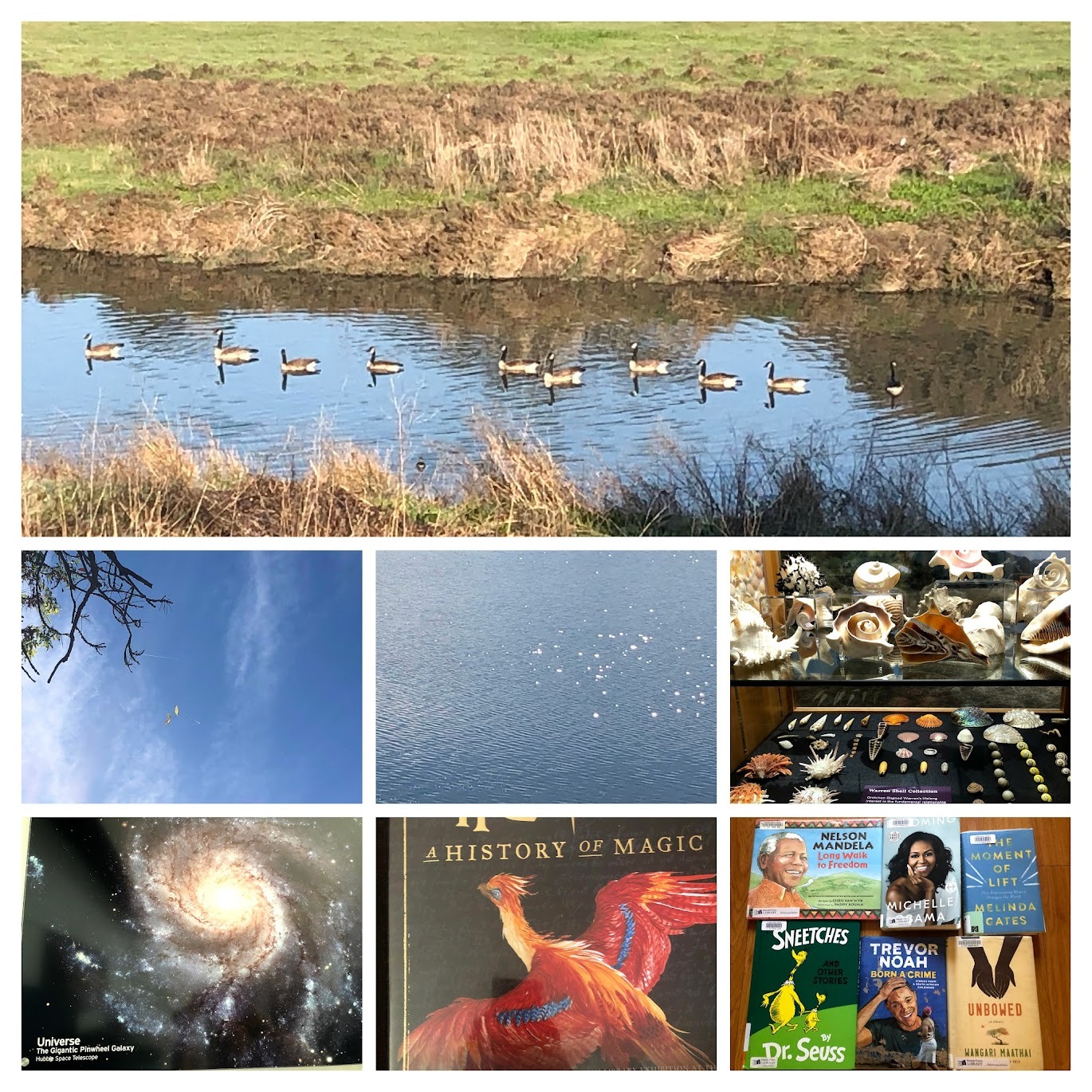
The more I tried to narrow down, the more I found myself drawn to the planet Earth. After all, I love almost every river I see, wish upon every stream and fountain – man-made or natural, love every tree, admire every flower as is wafts its scents through my senses, and adore the play of the evening light amidst the clouds. How could one place be selected? I did wonder about Mary Oliver’s poem on the unknown pond. The one in which she just refers to a nameless pond, since it could work for any pond, and I agreed with the sentiment. How many ponds have I since pondered over with that beautiful poem in mind. In fact, I have my own version of Walden’s pond, which is nothing close to Walden’s Pond that so inspired Thoreau in size or stature. But it is reachable from my home, and every time I glance upon its water, a new delight unfolds. Whether it is the pelicans, geese or ducks swimming there, or the play of the reeds movements upon its surface, every glimpse offers something lovely for the soul.

So finally, I settled on Planet Earth as my favorite. We Belong on Earth, is after all, a popular theme on the blog. Therefore, the poem chosen was A Grain of Sand – By Robert W Service

A GRAIN OF SAND

If starry space no limit knows 

And sun succeeds to sun, 

There is no reason to suppose 

Our earth the only one. 

by Robert W. Service

Followed by Carl Sagan’s ode to the Pale Blue Dot (written almost 45 years after A Grain of Sand – this ode is one for the ages) and then finally with by my own humble ode to our beautiful Earth.

As we walk upon this Earth, there is much to be grateful for, and much work to be done to fix our footprints on the sand.

The Human Earth

I was reading frantically the other night. I wanted to finish the book before the New Year. Earth’s History – 4.5 billion years in 8 short chapters by Andrew Knoll. I had galloped my way to the last chapter: Human Earth, when the eyelids lodged a formal protest, and refused to stay open.

A Brief History of Earth: Four Billion Years in Eight Chapters by [Andrew H. Knoll]

So, I did the next best thing. First thing in the morning, I came downstairs reading. There wasn’t much chance of reading in the mornings with the general comings and goings of life in the nourish-n-cherish household. But I live in hope. I sipped my coffee for all of three sips reading about Human Earth when I detected a faint fracas among the humans in the household. Cautious pricking of the ears is no use in the house. The father-in-law is steadily losing his hearing, and the mother-in-law was yelling at him for something and wanted him to know it. All the fathers-in-law in the street heard it, and so did I. 

I tried to read on, but before I knew it, I was called upon to act as referee. If one can shy away and gallop back to bed while sitting in the chair, that was me. Past performance seems to mean nothing. I mean if I were a batsman who has shown time and again that I didn’t know how to bat, would benign fortune keep giving me batting opportunities? Why then was I being called to referee a fight between them yet again? I had been given scathing reviews in the refereeing-department by both sides on every occasion in the past few weeks.

You see? Diplomacy doesn’t help. I find myself agreeing with both their points of view, much to their disgust, and annoy them both equally. Neither feels supported once I agree with the other, and I am given up as a bad job. They do seem to be united in this assessment of me, and I take that as a small victory in the peacekeeping operations. But beyond that, there is nothing I can claim to help with.

This was another day in the life of humans, and it seemed everyone was intent on huffing and puffing and blowing the house down. 

Though, I am not directly involved in all of this (thank goodness!), I tried to look mildly interested. It turned out to be nothing (quite literally nothing as is mostly the case) I clutched the coffee cup and sipped like the gods downing ambrosia, till the well of coffee ran dry. 

After some time, I declared I needed some fresh air and took myself off on a walk. 

As I walked on beautiful Earth on that cold winter’s day, I felt a fresh appreciation for the planet. The book talks of Earth’s geological clues that helped us resurrect the planet’s early history. Theories as to when the planet was really formed, half lives determining the age of species and their evolution etc. Beautiful timelines explaining the australopithicus and when homo sapiens came aboard.

Illustration from A Brief History of Earth by Andrew Knoll

In 8 chapters, it explains many things that we know in different contexts, and ties them up to Earth’s history. Oxygen Earth, Biological Earth, Geological Earth, and finishes with the chapter on The Human Earth – which is to say our influence on the planet. The most recent impacts of the last two centuries, accelerating climate change, and so much more.

As I sat there on a rock, looking at the river waters flowing, and the ducks and geese gliding on the waters, eating when they wished, I cast the mind back to The History of the Earth. In 4.5 billion years, so much has happened. One can only make educated guesstimates of the lives of all the creatures that preceded us. 

In the book, Forgotten Beasts by Matt Sewell, he uses his imagination and creativity based on the fossilized shapes of the bones found and tries to give us an image to work with.  How were their eating habits, their social constructs? We don’t know.

In the book, Life in the Garden, by Penelope Lively, she makes interesting observations based on tree rings, to figure out the years in which the trees had to endure drought, and the years they had an abundance of rain. 

But the human life? Short as it is on the timeline of some trees, it is minuscule on the timeline of the Earth. 

Would future generations of neonids or whatever-name-they-give-themselves try to look back at 2020 and 2021 as Covid years? Would they reconstruct the social dilemmas, and habits of homosapiens? We seem to be leaving an outsize impact on the planet now, but how will it manifest hundreds of years from now?

I walked into the home, and found the parents-in-law diligently cutting the fruit of the banana tree. An arduous task, requiring immense patience, and concentration. The father-in-law was peeling the layers of the banana flower and extracting the seed within. The mother-in-law took these, and rubbed it against her palm to expose the edible pieces of the vegetable. 

Vazhapoo – the banana flower

I watched them amused – working harmoniously, their morning spat forgotten, united in the making of the banana flower dish (vazhapoo paruppu usili) that would’ve stumped any species on Earth thus far. 

The House of Dreams

Finding a nest of your choice is no mean task in the Bay Area, but we managed it thanks to patience and resourcefulness on the part of the husband.

We moved in to our new nest this year, so it seems only fitting that I read Anne’s House of Dreams by Lucy Maud Montgomery twice in 2021. Once, as soon as we moved in earlier in the year, and again, when I have been flitting to Prince Edward Island in Canada later in the year.

It seemed too much to ask for all the things dear to one in a home, and so we kept on looking for years on and off. The new nest, may have some things that realtors, buyers, and property assessors don’t seem to take into account, but these things played a big role in my mind. Our realtor stoically bore with refusals of homes based on reasons that drive statisticians up the wall.

‘But’, they say, ‘proximity to freeways matters more than proximity to a stream.’. I see them exchanging looks that suggest worry on my behalf. 

‘Trees? You can plant as many of them as you’d like – why would you look for trees near your home? I mean. Just trees. ‘ I disagreed. I loved the sycamores, fruit trees, and the cypress trees in our small strip of land in our previous home, and insisted on having many trees nearby.

Walking paths for elderly people? One person asked me why I did not consider putting elderly visitors up in a hotel when they visit and buy that mountaintop house anyway. I gasped. No – a flat, safe area would be required for the visiting grandparents to take their walks in.  

So it went. 

One was rambling, one was tumbling. 

One had a nice backyard, but one did not live in the backyard. 

One had a swimming pool, but no trees. 

Really, it is curious to see how houses have developed over the years. 

Our new nest is far from perfect – the kitchen has a wine cooler in prime real estate territory (for teetotalers most of the time, this feature is being used to store yogurts and juice boxes for the children). I need a stepping stool to get at the closets with spices. 

But there are things past closets and wine coolers. Trees, for instance, or a home library and a ledge with a window looking into a marvelous tree for another, and, the best gift of all – a walking trail by a river nearby. Reminds me of the passage in which Gilbert Blythe tells Anne of Green Gables before their wedding about a little house he found for them at Four Winds Point. That is how I felt. There was no other way to feel. 

“So far, good,” said Anne, nodding cautious approval. “But, Gilbert, people cannot live by furniture alone. You haven’t yet mentioned one very important thing. Are there trees about this house?”

“Heaps of them, oh, dryad! There is a big grove of fir trees behind it, two rows of Lombardy poplars down the lane, and a ring of white birches around a very delightful garden. Our front door opens right into the garden, but there is another entrance–a little gate hung between two firs. The hinges are on one trunk and the catch on the other. Their boughs form an arch overhead.”

“Oh, I’m so glad! I couldn’t live where there were no trees– something vital in me would starve. Well, after that, there’s no use asking you if there’s a brook anywhere near. That would be expecting too much.”

“But there is a brook–and it actually cuts across one corner of the garden.”

“Then,” said Anne, with a long sigh of supreme satisfaction, “this house you have found is my house of dreams and none other.”

Anne’s House of Dreams – By L M Montgomery

The river near the home has nourished us in several ways. It is very like the stream in the passage above, although it isn’t exactly in our backyard. We live in a suburban area built up by such factors as Strong Economic Growth, Silicon Valley culture and all the rest of it. The river is a few blocks away, but it is there. Just flowing, and relaxing us whenever we can get away from it all to take a peek.

The trees don’t form a bough, but they rustle and tousle with the winds. And the chirping of the birds is quite enough to charm one.

Slowly, but steadily, the laughter, companionship of friends, and love is transforming the house into a home. To that, I am grateful.

The Books That Lit Up 2021

There were times in the past year when I felt the old reading habit was flagging. There was simply too much going on to properly immerse in the beauty and peace of it all.

Yet, somehow, looking at the list, there is a good combination of old favorite authors, re-reads of a few books – like visiting old friends again, and a marvelous spattering of new idealogies, new authors etc. The good old books did manage to light up my existence throughout the year, and I am ever so grateful to have access to them.

The Magic of Reading

Magic

Notable ones in the magical section include

  • The Girl Who Drank the Moon – By Kelly Barnhill
  • Icefall – by Michael Kirby ( loved this one for the Norse myths and the voice of the bard)
  • The One and Only Ivan – by Katherine Applegate (prompting a desire to learn to use paints and explore visual arts) 🎭 .
  • The Starry Skies – Grace Lin

Writing:

The art and craft of writing is a universe unto itself. Notable works in this genre in 2021:

The Wondrous Universe

  • Questions Asked – Jostein Garder & Akin Duzakin
  • A Pale Blue Dot – Carl Sagan
  • Cosmos – Carl Sagan’s Audible Book (in the most scattered fashion possible during 15 min car pickups and drop-offs, but it still managed to seep its way in like a raindrop permeates a thick coat somehow )

Non-fiction (only mentioning notable ones that made an impression)

Poetry:

As Ursula K Le Guin said in her Conversations on Writing with David Naimon, fiction is from the imagination, while poetry stems from contemplation. I suppose I benefitted from the contemplative minds of many stalwarts. The favorite among them this year was The Sky Full of Bucket Lists – By Shobhana Kumar. The book makes an appearance on my bedside table often, and every dip into it leaves me marveling and admiring the empathy and contemplation of life that Shobhana’s beautiful mind brings to life. (Please read it if you haven’t already – Shobhana also happens to be a dear childhood friend.)

  • A Sky Full of Bucket Lists – Shobhana Kumar
  • Emily Writes – Emily Dickinson and her Poetic Beginnings – Jane Yolen, Christine Davanier
  • Dreams from many rivers – Margarita Engle
  • Dr Seuss books : The King’s Stilts, Horse Museum ( A post on this book is long simmering in my mind. One beautiful meditative evening with crepuscular glory is rattling inside to be written about – soon!) . Several re-reads such as Horton Hatches the Egg and many more.

Humor

This section has me revisiting all my old book friends most often. Any new suggestions in the Humor genre are most welcome.

  • An Anthology – P G Wodehouse 
  • A Walk in the Woods – Bill Bryson
  • The River Bank and other stories from the wind in the willows – Graham Greene
  • P G Wodehouse (old favorites such as Uncle Fred in the Springtime, Code of the Woosters, and some others that were short story collections that our local library has acquired)
  • Miss Read (A visit to the Cotswold area in the UK is always a pleasure – in Spring, Summer, Autumn or Winter)
  • Birds, Beasts & Relatives – Gerald Durrell
  • The Shooting Star – Herge

Children’s Books: (again – only the notable ones mentioned )

The Anne Section

We moved in to our new nest, so it seems only fitting that I read Anne’s House of Dreams by Lucy Maud Montgomery twice. Also, the children made me watch Anne with an E on Netflix by touchingly creating a profile called ‘Amma’ for me, and I have all but moved into Prince Edward Island in Canada for the past few months. I joyously re-read the entire series, and then some, and have had lots of fun comparing the contrasting Moira Beckett’s version with the original ones.

  • Anne of Green Gables – L M Montgomery
  • Anne of Avonlea – L M Montgomery
  • Anne of the Island – L M Montgomery
  • Anne’s House of Dreams  – L M Montgomery
  • Anne of Ingleside – L M Montgomery
  • Rainbow Valley – L M Montgomery
  • Rilla of Ingleside – L M Montgomery
  • Christmas Tales from Avonlea – L M Montgomery

Please do share your lists too, so we may add to our to-read lists for the coming years.