
I pulled Atlas of the Invisible from the library shelves looking pleased. Here was another book straight from the dream shelf. As I thumbed through the pages, I felt a familiar flutter of anticipation. I could already visualize the happy hours spent looking into the different maps and visualizations to help understand the world around us better.
Many of us have heard of the map Dr John Snow drew up of the cholera epidemic in London as he went about his duties as a doctor. With the aid of his map, he was able to isolate and identify the contaminated water pump from which the water-borne disease was spreading. 127 people died in 3 days and over 600 people died within a month. Here was a groundbreaking example of multiple skill sets coming together to identify and problem solve.
Of course, data and its importance has only increased in the intervening century and a half since. In Dr Hans Rosling, Anna Rosling & Ola Rosling’s book, Factfulness: Ten Reasons We’re Wrong About the World–and Why Things Are Better Than You Think , examples of data collection, sampling, analysis and visualizations help us think of the world in eye-opening ways. The progression of populations from under-developed to developing to developing is fascinating and gives hope for a future that has solved many of mankind’s problems.

<Infographic from Factfulness book mentioned above.>
Now, several leading newspapers such as the New York Times commission data analysts to present their findings and even have visualization teams to help with the most succinct presentation of data.
Atlas of the Invisible – By James Cheshire and Oliver Uberti is a treat for those who enjoy analytics.

Example charts – to see if you like the book:
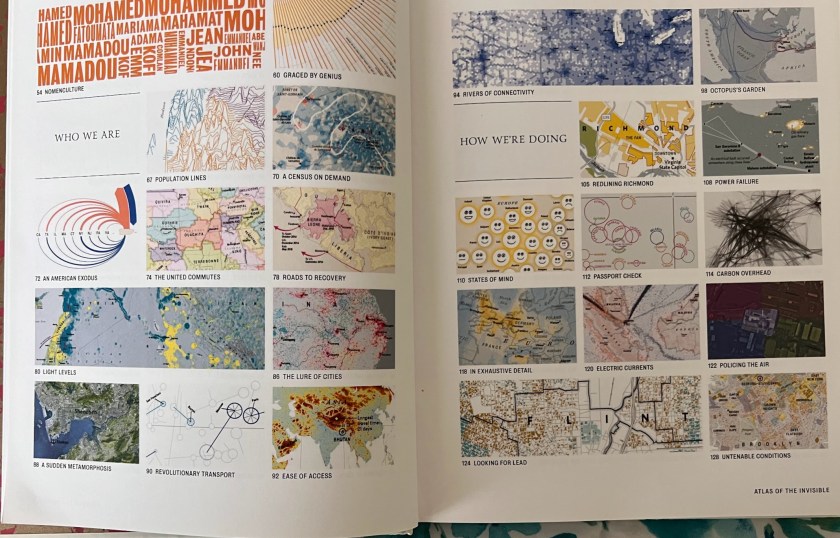
We are all data points in this world. I chuckled as I read about the folks who revealed a high security defense location in the middle of the desert simply by turning on Strava to keep track of their daily activities. A good reminder that like many of our inventions, this penchant for data tracking and analysis too will bite us in unexpected ways.
I hope you enjoy the books as much as I did.
Recommended Reading on this subject:
- Visual Explanations, Envisioning Information– Edward Tufte
- Factfulness: Ten Reasons We’re Wrong About the World–and Why Things Are Better Than You Think – Hans, Anna, Ola Rosling
- Gapminder.org
- Atlas of the Invisible – Maps and Graphics that will change how you see the world – By James Cheshire & Oliver Uberti
 Nourish-n-Cherish