The Exciting Night Life of Plum & Polly

“What do you do in the evenings?”, asked a young colleague after telling me about the exciting things that city life has to offer. Maybe my twenty year old could have stood the revels. Hectic – yes, that is the word I am looking for.  I myself prefer the quiet lifestyle. I suppose everybody wonders from time to time what everybody else does. I told him I take a walk around the neighborhood in the evenings.  He gave me a withered look. I must have sounded like a septuagenarian to his young mind.

“Err … any night life where you live? “, he quizzed, clearly not willing to give up on me just yet.

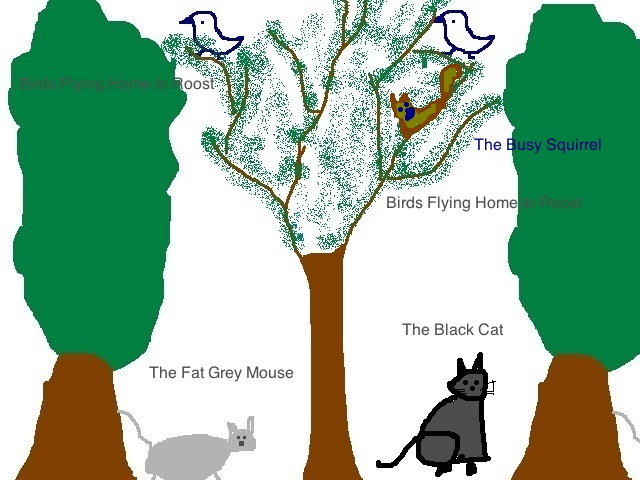
I felt it best to keep away from the domestic angle of things and spared him the details of my many culinary adventures to feed the family, and instead went for the wild flora-and-fauna angle. You know, give him the exciting side of things and so on. I told him that I recently found that a rather fat mouse comes along to the garden every night and scratches around near the fence for some food. Whether he finds it, I don’t know, but he makes enough of a noise to attract the fat black cat, and I sometimes fear for his safety, but as he(the mouse) himself seems happy enough, I cannot do much. He looked astounded. Impressed at having impressed the fellow, I plunged on. I told him that the birds coming home to their nests is a welcome sight at dusk. He thought I was cuckoo.

Night Life

So walk huh? he said circling back to what he thought was safe ground again.

The delights of an evening walk, are free, and one either likes it or has not tried it often enough to enjoy it. The seasonal delights are there for the taking, and the mind is happy enough to disassociate itself from the cares and wont’s of the corporate world for that period.

As I take a walk down in the summer evenings, I am always amazed at the flower laden trees and plants. The Oleander trees are heavy with summer flowers of various colors, the rose bushes are thriving scenting the air, the rhododendron and bougainvillea overflow, even late daffodils peek out here and there. I just learnt the name of another flowering tree:  Crepe Myrtle.  That sounds like the name that can spark a thousand songs.

A peek of yellow hibiscus flowers is a welcome sight. I have seen red ones, they are common enough, but white and yellow ones are another treat altogether. It took me back to the days when we plucked hibiscus leaves, soaked them in hot water and then made a fine paste to use as a hair conditioner. To date, no commercial conditioner comes close. Yet, I feel I cannot walk to Mr. Chin Cho’s lawn and ask him to pluck some hibiscus leaves from his tree to condition my hair. It just wouldn’t do. Plus Mr Chin Cho doesn’t look like the kind of man who cares about the texture of my hair.

I learnt recently that I had spent vast amounts of time near Aloe, and knew nothing of it. I could have just cut a stalk and rubbed my face, instead of taking the car and dashing off to Traders Joe to buy their cream with nourishing aloe vera. (The gardener was instructed to remove the plant about a year ago. In my defense, ‘Instructed’ is strictly not the right term to use here. I asked him what plant it was in Spanish, and he looked sad, and waved his hand about quite a bit. The next thing I knew the plant was gone. )

Summer also means fruits. Apricots, peaches, and plums jostle on the fruit trees, and the squirrel, Polly, is very busy.

I thought about how much the little things in life matter.  A friend of mine shared her plum produce with me, generously giving me more than I could competently handle on my own. In her home, we tasted plum chutneys and plum jams, and I came home inspired.  Last night, I was the paragon of domestic efficiency and made plum pickle. The thing is looking very proud and beetroot-pink in the refrigerator.

Maybe I shall tell the young fellow about the exciting night life in my kitchen and seal my reputation.

Counting Hadadas in East Africa

For as long as mankind could dream, birds and flying have held a fascination for us. But the kind of flying we do in airplanes that start with a roar like a hadada, is far from the soaring of the soul that the birds seem to enjoy.  Fascinating creatures, birds. Every time I set out on a walk, my ears pick up trilling and cooing and cawing of the birds. One evening, I gazed upon two pretty swallow-like birds with maroon plumage on their chests. Such beautiful little things, and yet when they trilled, I could not believe the volume that emanated from them. I also realized, to my dismay, that I could not identify them. When I do identify birds, I seem to get them wrong quite cheerfully and confidently. Like the last time I called a Canadian Goose a Duck. Both species took umbrage, not to mention fellow human beings.

I needed to rectify these aspects, I thought to myself severely.  That is why you would have seen me with my beak buried in a book called ‘A Guide to the Birds of East Africa’ by Nicholas Drayson. I see your puzzled expr. Why East Africa? Why not America. Well, for one, the book cover looked better, and for another, I thought why not East Africa? I might visit Kenya one day, and that time, I shall be prepared to dazzle and stun all with my ornithological knowledge.

guide_birds_east_africa

As it turns out, the book turned out to have quite a few bird names, but little to identify species. It was, however, a thoroughly delightful tale about an upper class club boasting members of the rich Indian community in Kenya, called the Asadi Club. In the book, Mr Malik takes the bird-watching tour every Tuesday morning with Ms Rose Mbikwa, after his doctor ordered him a hobby if he wished to spare his old heart an attack. That is how efficient, quiet and sincere Mr Malik learns to enjoy bird watching, and his guide to bird-watching Ms Rose Mbikwa.

I feel I must tell you the short tale of counting hadadas to entice you to read further or not, depending on your sense of humor. Some people like that kind of thing, some others screw up their noses, look dignified and turn away with a disdainful look on their face.  Neither can thrive while the other survives.

In the book, the members of the Asadi club are reading the newspaper which carries a research article that states on average man farts 101 times a day. This fact is hugely debated by members of the club. Member #1 cannot understand how that is possible purely from a mathematical point of view, since that amounts to 4.208 farts an hour, and he is pretty sure he has not let off 4.208 farts just in the past hour alone.

Valid point.

Member #2 feels that an average takes the high frequency hours with the low frequency hours and the past hour cannot be a reliable indicator.

Also valid point.

Enter Mr Singh, a retired magistrate, and the betting vein is tapped. Mr Singh gets the bets going, and sets terms and conditions to decide the condition. Since one cannot count the flatulence levels or fart frequency during sleep, all parties agree that a count during a 12 hour period should suffice. If a member is able to notch up 51 in 12 hours, Member #2 wins, if not, Member #1 wins. As they look around for a reliable person for the actual counting, poor sincere Mr Malik is roped in. Everybody agrees that if it has to be an unbiased outcome, it has to be vetted by someone with the efficiency and sincerity of Mr Malik’s calibre.

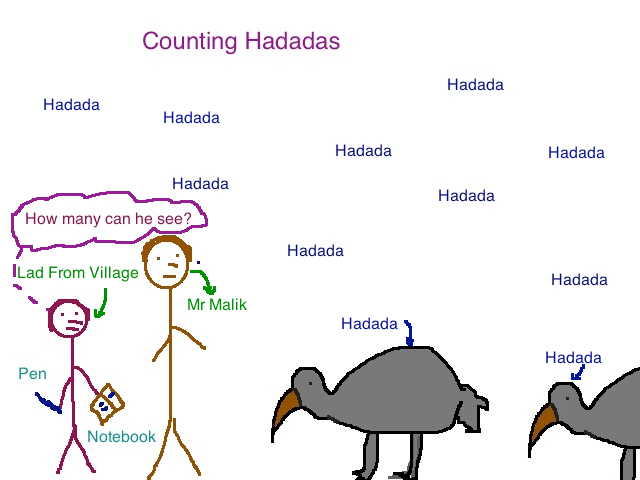
So it was that Mr Malik’s help in the house, a lad from a nearby village, is assigned the task of noting down the farts. To spare the boy the details, Mr Malik, an ardent birdwatcher tells the boy that he will tell him every time he sees a hadada, an ibis like bird that makes a loud noise haa-daa-daa hence the name, that is native to the African savannah. The boy dutifully notes it down, though seriously wondering how on earth Mr Malik saw several dozen hadadas, when he himself saw at most 4 or 5.

hadadas

It is a tale with many diversions and one thing leads to another and before he knows it, Mr Malik is up against Harry Khan, in a bird watching competition to see who can ask Ms Rose Mbikwa’s hand for a ball, and the hadada-counting boy from the village lends Mr Malik a hand (As it turns out, the boy has superior ornithological knowledge by virtue of growing up around plenty of birds).

A delightful read, if you don’t wish to exercise the bean much, and one in which you get to know the names of many birds even if you cannot identify them. As you amble along with these characters, you get to take a peek into Kenyan culture and life.

Also, Counting Hadadas is a useful euphemism to employ in public. You are welcome.

Stephen Curry Comes To Play

T’was the NBA finals – San Francisco Giants vs Cleveland Rainbows or something. There was much excitement in the neighborhood, entire families were agog watching the match. Pizzas were ordered in, for though the athletes themselves had to keep fit, there were no such demands on the audience. Some Indian neighborhoods went all out and had samosas, chaat and tea for basketball viewing. Living in California, I could take a walk, far from television, and still figure out the direction of the match when I took a walk. Loud cheers meant SF Giants basketed a ball, and moans meant the C Rainbows did the same.

The last few minutes of the match was tense judging by the tension emanating from the Television areas to the street. Right enough, I headed home to find a certain clamoring for my presence. The children’s faces were shining with excitement and so it was that I got to watch the final 5 minutes of the match. What with the replays and the fouls and the drama and the penalties, the final 5 minutes took a goodish twenty minutes to watch.

After the match was done with, commentators tripped over each other in rehashing the match, the personalities that drove the players, the flaws that seemed to have surfaced. I moved off towards more pressing demands on my time like watering the garden, getting dinner going etc, musing all the while on the whole game viewing experience.

I was never one who enjoyed being plopped passively in front of the television, and spent a good part of my childhood not knowing the difference between a 4 and a 6 in Cricket. Blasphemy. I know. All I knew was that there was a major din every time there was a 4 or a 6, and since this happened multiple times during the day, and for several days at once, I did not really see the point. The brother did his best, since he spent many mornings lovingly polishing his cricket bat. He shook his head at my cricket-ry ignorance, but loved me all the same. What is with boys and cricket?

The basketball match seems to have left a mark on the toddler in the house too. After the match was done, there he was, using his blue football and trying his best to throw it into the clothes hamper. Not just that, I noticed a certain skip in his step, and every move was complicated by the ducking and falling in vague angles that seemed critical to the ball-into-hamper process. The commentators seemed to have made an imprint too. For there was a live commentary going on, and I was pleasantly surprised to find that Stephen Curry, far from calling it a night after an exhausting match came to the old home to play with the son.

basketball

When Stephen Curry passed the ball, the son took it and on the way to the clothes hamper skirted a chair, deftly avoided me walking to the kitchen, dunked the ball into the hamper and then fell spectacularly.

His doting grandmother congratulated him on scoring a goal.

“You don’t score a goal in basketball Paati. “ he said shaking his head at such foolishness as he picked up his blue football again.

An Email About Plants On Mars

Weekday nights, apart from startling Californian flora and fauna out of their wits with the chaos and noise in the home, also means that the old father is busy. A note about the pater’s emailing habits. He settles down with a serious look on his face, a glass of warm water by his side, and corresponds with his trader in the Indian Stock Exchange. From 10 p.m to well past midnight, he is the paragon of efficiency. He painstakingly types out instructions, his tongue peeking out with concentration, leaning forward in his chair, his browser tabs opened to Gmail & Economic Times. His mind composes the shortest possible sentence before he starts typing, since he has to spend some time finding the right alphabets on the keyboard. Once a teacher, always a teacher, and he insists on using the right punctuation: commas, spaces, periods and semi-colons. Sometimes, he hits tabs for the extra space, and that lands up sending the email instead of moving the cursor, and then he starts over. The wonderful lady on the other side turns an indulgent eye on the septuagenarian’s emails, and sends him trade notifications and acknowledgements to the correct email.

Friday nights are different. The Indian Stock Market is closed, schools and offices in the USA are closed on Saturday. So the couch is cluttered with cushions, throws and comforters from the bedrooms, and the old television settles down to air a movie or television show down to the audience. Friday nights at the home always contain a general air of excitement. One would think that through the week, the children work 16 hours a day, with sparse meals and little fun, the way they whoop at the Friday evening fun. Entertainment choices are always a bit tricky given the age groups the television has to cater to at once. The son and daughter want different things. Throw the grandparents into the mix and it becomes a telling lesson in democracy. Sometimes, the choices made by popular votes turn out to be so bad that the voting audience clamors for a change midway through and the process begins again.One does not need to follow #Brexit and #Bremain for democratic ulcers.

One night we settled on The Martian. The budding toddler astronomer in our family agreed that he liked to go to Mars one day as a Space Racer, and helpfully showed us a rocket lift-off. (Space Racers is an animated television series. The main characters—Eagle, Hawk, Robyn, Starling and Raven—are cadets at the Stardust Bay Space Academy. The cadets spend each episode traveling through outer space) The old pater shelved his urgent emailing needs and settled in to watch. The rocket made a spectacular landing on the grandfather-tummy-airfield, and the audience quietened down to watch the movie.

Every time I watch a movie, I am amazed how clipped and to the point people speak. No rambling on the way we do, no unnecessary smiles. Maybe if we edited our speech thus, we would be as impressive. Meaningful glances that seal the decision of landing, curt nods that signal victory,  measured smiles that indicate tension. Waah Waah!

For those of you who have not watched The Martian, it involves an expedition to Mars going awry and people having to take off from Mars earlier than planned, thus clipping their mission short. One of the crew, Matt Damon, is left behind on Mars, and the story revolves around what he does on Mars instead of twiddling his thumbs and waiting for a slow, painful death.

Communication channels are broken, Mars looks unforgiving. Matt Damon is very sad, wondering what to do, when the pater piped up,  “If I was there, I would send an email to NASA and go to bed. “

A few scenes on, Matt Damon is growing potatoes on Mars. I know.

Martian

“What do you think happened to those organic vegetables that we planted ma? “ asked the father showing off rare horticultural curiosity.

The garden looks ready for a visit by the gardener every few months. That sturdy son of the soil comes over, sets the place to rights in an hour, and leaves after a tooth-ful smile. Last time in preparation for the gardener, the father and husband had picked up from Costco, some oddly shaped packets that looked like seed bombs to be dropped into the ground. Lo and behold, we were told, we should soon be playing host to some luscious, organic vegetables.

Anyway, it had been a few weeks since the planting of the seeds, and though the summer flowers were thriving, there did not seem to be much happening on the vegetable front. I looked forlorn: We seem incapable of growing potatoes on Earth, imagine doing it on Mars?

The toddler piped up and said he knew how to grow vegetables on Mars, since he had seen a program in which the Space Racers grew them on Mars. If I am stranded on Mars with these two, one can grow food, and the other can email NASA. It was a comforting thought to head to bed with.

Mockery Bird In Zenkali

I sat in the garden in my backyard, relishing the mild breeze after a hot day. I looked up to see that my fruit trees looked green, and played host to plenty of animals still, but the fruits were no longer there. Could the trees have lived past their prime? I do not know. My botanical knowledge is excruciatingly narrow for one who enjoys nature so much. I watched squirrels scurry up and down on the very trees I was looking at, with a sense of purpose. How sincere, how single minded in their pursuit and yet, how completely at ease on the trees they were and how beautifully they fit into the complex pattern of life and their place in the food chain?

Colors

As I looked at the little creature who was mildly peeved at finding me in my own backyard, I realized with a shock that in spirit he knows and accesses the fruit trees far more than I do, and he probably helps the trees in my backyard by seeding them elsewhere.  Then I think about how little I do know about the complex interdependencies of species. We all learn, while young, about the food chain and all that, but we need something to remind us about these marvels every now and then.

Sometimes that gentle reminder comes in the form of a marvelous book. Every once in a while you stumble upon a book that you wish you can thrust upon everybody and have them read it. But they don’t.  Do you give up? No! You write about it, you read snippets out to them in the hope that they will relent and read the book.

TheMockeryBird

Image: First Edition Cover Art by Hanife Hassan

There is nothing quite so lovely as observing nature and seeing how we are all interdependent species within this planet. Mockery Bird by Gerald Durrell is one of the most endearing books I have ever read. It is a beautiful tale of man’s ignorance and greed. Set in the picturesque fictional island of Zenkali, the book is humorous and satirical to the point of wanting to read it back to back again. It shows us how we are all part of an ecosystem – trees, flowers, insects, birds and man.

In The Mockery Bird, I sat amongst the Ombu & Amela trees, and took in the exotic scents of the tropical island, immersed in the world of Kingy, Peter Foxglove, the tribes, the side sweeps at religion, the absurdity of greed, and the twisted aims and means of the media. The book sparkled with laugh out loud moments. Like the one and only newspaper of the Island run by Damiens, that contains so many typesetting errors, it is a beauty it functions at all.

“Poor old Damiens is like that. he threw the nursing fraternity into a rare state of confusion some time ago with his article on Florence Nightingale entitled ‘The Lady with the Lump’.”

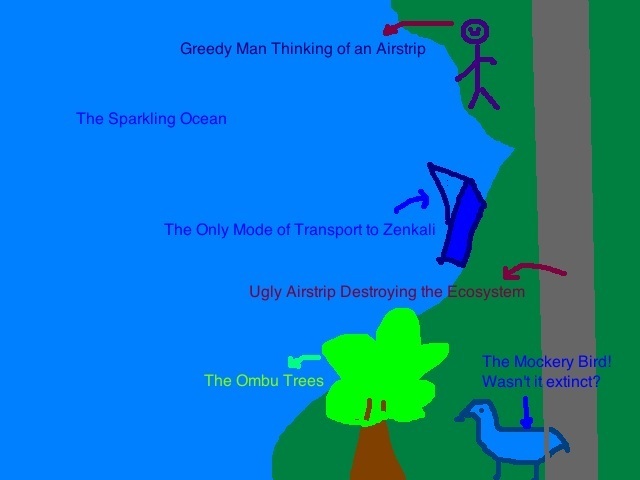
The Mockery Bird, became extinct due to the culinary prowess of the invading French colonies some years prior. The Mockery Bird is the God to one of the tribes on the island, and obviously they were not happy with the extinction of the bird. It turns out that the Ombu trees survived only because the Mockery Birds ate the fruit of the Ombu tree and not being able to digest the seed, germinated them elsewhere. Now with the Mockery Birds gone, there was only one surviving Ombu tree on the island. Plans to have an ugly airstrip through the dense forests in the island are thwarted when Peter and Damien’s daughter accidentally see that 30 Mockery birds are still alive deep in the forest amongst a long lost patch of Ombu trees. This throws the island into a state of chaos, and the ruler, Kingy, is stretched to find a solution that satisfies the international community, the locals and the environment.

Zenkali

Does anyone remember Lorax? Written by Dr Seuss, in which he shows us what greed and ignorance can do, and made into a lovely movie? Now imagine a similar theme, written with endearing characters, a brilliant sense of humor and an exceptional setting? That is Mockery Bird.

It is a pity this book was not made into a movie. If you can read the book, please do.

S’mores by the Russian River

We’d been up to the Russian River for a spot of camping and the children were obviously enamored by the flowing water. It was a  lovely river and the day was even better: Cloudy and just warm enough to not make it uncomfortable. The river was teeming with people – some canoeing, some kayaking, some paddle-boating, some just wading in the waters. There was some sort of boat race, and the local canoeing club was obviously busy with its river rentals and before we knew it, we had saddled ourselves with three canoes, a paddle boat and a highly enthusiastic bunch of children.

The whole experience brought good memories of reading Three Men In a Boat and I found myself looking at the book longingly again. It was time for a re-read.

The daughter and her friends teamed up to canoe out on their own, and made a lot of noise about girl power. They got themselves into the canoe, looking spruce and fit in their life jackets and picked up their oars. They looked ebullient at this new-found independence and pride at having been allowed to strike out on their own.

“Go Girls!” they screamed, but of course nothing happened till the local nib who rented us the canoes untied the thing and pushed it mid-stream.

The toddler son looked forlorn at not being chosen first by his sister to get on the boat. He was usually chosen, why not now? Was it because he could not row? Well, if that was the case, he was going to show her that he could. Yes he was. 

A few minutes later, all the boats had pushed off like drunken lads swaggering from a pub, and only the youngest boys were left behind by their doting sisters.

The boys looked solemn: If their sisters decided to strike out as Four Little Women In A Boat, then they would do their best to be Two Little Men Without A Boat. They found themselves a paddle each and spent the entire hour paddling standing firmly in the water. They took Jerome K Jerome’s words to heart:

IMG_2652

“Life was not an idle dream to be gaped and yawned through, but a noble task, full of duty and stern work. ”

Jerome K. Jerome, Three Men in a Boat

They found themselves going forward 5 steps and then being yanked back by 3 steps.

It was later that we learned that the girls performed in much the same way downstream when they had difficulty maneuvering their canoe. At first, they resolutely declined help from the men, and preferred to get down themselves to push the boat out again. The river was shallow enough even in the middle of the river bed for the girls to stand and push.

As they sailed into harbor, they were soaking wet and remarkably happy at being able to jump into the water.

The burgers, salads and s’mores after a day like that, were especially welcome to the children.

“We are but the veriest, sorriest slaves of our stomach.  Reach not after morality and righteousness, my friends; watch vigilantly your stomach, and diet it with care and judgment. ”

Jerome K. Jerome, Three Men in a Boat

Braving The Himalayan Cold

Uncles-in-law, aunts-in-law and friends-in-law headed over to take in a spot of the Californian sun from the hot plains of Chennai, India. During the rare glimpses of television time that we get when the house is full of visitors, the husband picked out a 5 minute segment of folks climbing Mt Everest, and wanted me to watch it. That poor optimist.

I don’t know whether the husband has thought about a role of a shepherd actively before this, but I think he now appreciates their task. Fluffy lambs, obstinate rams and flighty sheep are all fine by themselves. Put them together and try giving directions, and that is when things fall apart.

It is somewhat a situation like this that faced the husband.

After a half a dozen explanations and as many jump starts, he got the program going.

“Everest Base Camp: The weather on the mountain can take a life of its own”, says the sharp voice in the commentary, when Maama #2 asks, “What is this?”

Pause Program.

Explanation: Showing a documentary on climbing the Everest and it will only take 5 minutes. You can also watch.

Play

Maama#2 feels that his friend, Maama#1, would like the program since he once went to the Himalayas. The husband nods politely, intensely aware that Maama#1’s Himalayan visit, starting from Chennai Central Railway Station with puliodare & curd rice (with lime pickle) packets in tow, is not in the same league as the poor mountaineers trying to summit the Everest, but he gallantly refrains from saying anything.

Himalayas

Maama#1 saunters to the TV, and the Play button is pressed, when Maama#1 feels that Maami#2 would like the program since she has heard so much about Maama#1’s trip to the Himalayas.

Maama#1 hollers to Maami #1, “Are you coming? Himalaya on TV.”

Protocol demands that Maama#1 does not holler for Maami#2.

Pause Program while Maami#1 finishes her task with the laundry (drying her sarees outside because the washer and dryer do not do a good job with sarees) and comes to watch.

Explanation: Showing a documentary on climbing the Everest – these people have to take their own supplies and go up the steep inclines. You can also watch.

Play

Maami #1 hollers to Maami#2, “Everest-aan! Come and watch – your Maama will like it.” i.e, Maami #2’s husband will like it, so the protocol demands that Maama#1 calls out dearly to his wife, Maami#1. Maami#1 hollers to Maami#2, who then bellows the message to her husband, Maama#2. But Maama#2 is already there watching the program, so there is a side-show wherein communication channels are halted all around to ensure everybody understands everybody else and whoever is interested in watching the segment gathers.

This goes on for about 10 minutes, before the husband shows signs of impatience. He nudges me to watch intently, only to find that I have fluttered away to the sink to do a spot of washing while the tedious interruptions and explanations were being done with. For some reason, the husband is upset by this and just to mollify the shepherd in him, I head back filled with docility and plant myself on the sofa to watch.

Thirty seconds into the clip, two of the team slip on a crevice and go crashing down, trying to jam their pickaxes into the snow to break their descent. It is a tense moment, and the cameras do a good job of capturing the bitterly cold winds on the unforgiving mountain. I have always looked at the mountains with awe, respect and fear. At 28000 ft, how quickly a good expedition can turn into a scary and savage one?

Maami#2 interrupts : “Weren’t you saying that when you went also, the Himalayas were extremely cold, and that you could not sleep at night even with 20 blankets, and the room heater switched on?”

Maami#1 glories in her adventure and launches on an explanation of the wicked Himalayan cold, and the effect on her arthritic limbs at 5000 ft.

I don’t know whether the poor sods in the documentary made it up to the Summit, they didn’t on our Television.

P.S: Artistic licenses invoked.

How The Train Chugged Memories

It has been a great pleasure to see that my article on the little blue train made it to The Hindu (a leading publication in India) The article also mentioned my email address as a contact and I received many messages from readers. I cannot make a sweeping statement for humanity based on the emails sent to me, since most of them were sent to me by retired and/or educated folk, but I have to admit the comments were overwhelmingly warm, sincere and helped me reaffirm my faith in the basic goodness of mankind.

Of course, there were a few meant to make me skip a heartbeat. Some insurance salesmen sent me devastating statistics on disease and dying and how it is imperative for all to buy a policy (from him) in order to survive.  Then, there was this furniture salesmen who extorted his wares and offered me free shipping from some place in Hyderabad, India to anywhere. I wonder whether I should have ordered some furniture and had them shipped to California.

But such emails were few. Very few. Or my spam filter was very good. Many readers mentioned their own train-related experiences, and I enjoyed reading most of the emails.

train_tracks
Train Tracks Through a Forest

One person wrote to me about the heart warming story of his train journey in the Gir forests of Gujarat. He himself was traveling there from an urban area. Apparently, the train made many unscheduled stops along the way – there was no station, no station master and no ticketing machine, but people clambered on in these unscheduled stops. This traveller thought something fishy was going on and asked folks what the deal was. It turns out that many rural stations were closed along the way due to lack of funds, but the people in these villages still needed to use the train for various activities, so a truce with the engine drivers was reached, and the train stopped at the erstwhile stations.

“What about the tickets?” asked the fiscally conscious urban dweller, and the train clamberers shook their heads at his ignorance and said they usually purchased their tickets with the engine driver up front before climbing on.

“But what if you don’t? People can cheat this way!” said the shocked traveler.

The train clamberers were indignant. The urban dweller was told that cheating their way out of a ticket is not something that appeals to the simple and honest rural folk in that area. Every one of them held up the ticket they bought. With dignity.

Many letters came from people who had lived in the Nilgiris, or do so now,  and they wrote of their own experiences with the train. One reader even helped me track down the engine drivers who served in the approximate timeframe of my writing and narrowed it down to one or two people. They may have actually been the ones who waved to my mother.

One thing is clear, I enjoyed the ride with the little blue train all over again simply by reading the reminiscences of these readers.  I am immensely grateful for that.

The Telling Problems

I enjoy looking at the projects put up on the class room walls in Elementary Schools. Good though my schools were, when I was young, the walls were pristine. Nothing covered the walls. An odd calendar maybe, but nothing more.

Whereas the schools of today have beautiful art work done by the children covering the walls. Cows looking like dysfunctional zebras pushed through a rectangular pipe, lions with sunny, smiling faces, water-melons so red that the sunsets beg to be pink instead.

IMG_2307

One evening, a couple of months ago, I walked into a 3rd grade classroom, and I could not help noticing that the topic for the session was New Year Resolutions. I am always curious to see what runs through the minds of children. Their disclosures are never disappointing, and often amusing.

The new year resolutions of the third graders were sweet. A number of them had confessed to being warring partners with their siblings and resolved to address that issue pronto. It was also apparent that it was the area in which they received active feedback from the parents.

In the New year, I will try to be nice to my little brother

In the New Year, I will not fight with my older sister

In the new Year, I will look after my little brother and be nice to him.

Heart-warming notes all, in varying levels of penmanship, and most of them emphasized the be-nice motif. All very heartening to note in the younger generation. If these are the children who are to grow up and work towards World Peace, it seems a good place to start.

A few months ago, we went to a Science Fair for middle school and high school children. The topics under advisement there were marvelous and varied. Some of them were telling of the immediate problems they faced, and it was interesting to note that their concerns had moved on from the play-nicely-with-sibling motif:

Is yawning contagious? 

Do grades improve with playing games?

How music affects our coherence while doing homework

The number of projects in Environmental and Earth Sciences was the largest bucket, and that in itself was encouraging.

If peace and conservation of earth are occupying the minds of the young, I think we shall be okay.

The Snoof Struck Dumb

I love Spring. Every flowering tree bursts out in glorious bloom and the bushes are all brimming with flowers. Primroses, roses, jasmine, chrysanthemums, snap dragons, hill lupines,  and wild clovers jostle with each other making one’s eyes dance with joy. It is also the heady season of wondrous scents wafting through the air. Eucalytpus scented trees mingled with creeper jasmines and roses should make a highly pleasant combination, but I would not know.

IMG_2326-EFFECTS

Come Spring and I also become a snoof https://en.wiktionary.org/wiki/snoof. I can conduct an orchestra of sneezes, sniffle-puffs and croaky throats. Like an orchestra in which owls, bats and frogs are the main participants. This Spring, I also had the privilege of silence. The throat was affected. At times, there was a competition between the scratchy throat and the stuffy nose. For some time, things were rocking along pretty smoothly with an achoo here and an achichoo there, when one morning my throat gave out completely and nothing emanated.

It was marvelous I tell you, simply marvelous. Our culture suffers from a talking epidemic: it is as though talking is an art, a hobby, a vocation even. Everybody is encouraged to voice their opinions and to have a view point. Sometimes, we feel the need to say something that we don’t really mean or understand.

But you see, all that was stripped from me when I lost my throat. There were no expectations. I spend the most gleeful week possible. I would walk into meetings and try to look apologetic as I pointed to my throat. It was hugely introspective and rewarding. Like a time-out for myself in a noisy world. Colleagues had tea with me in companionable silence, marveling that it did not feel awkward at all to not have a single word between us.

https://www.brainpickings.org/2015/01/13/paul-goodman-silence/

I quote from article:

Like Paul Goodman writes:

Not speaking and speaking are both human ways of being in the world, and there are kinds and grades of each. There is the dumb silence of slumber or apathy; the sober silence that goes with a solemn animal face; the fertile silence of awareness, pasturing the soul, whence emerge new thoughts; the alive silence of alert perception, ready to say, “This… this…”; the musical silence that accompanies absorbed activity; the silence of listening to another speak, catching the drift and helping him be clear; the noisy silence of resentment and self-recrimination, loud and subvocal speech but sullen to say it; baffled silence; the silence of peaceful accord with other persons or communion with the cosmos.

IMG_2326

I wish we could all choose one day of the week, every week, in which to stay silent and just observe what is going on around us. I am sure it will make us better listeners and more appreciative of the gift of the gab.