Mockery Bird In Zenkali

I sat in the garden in my backyard, relishing the mild breeze after a hot day. I looked up to see that my fruit trees looked green, and played host to plenty of animals still, but the fruits were no longer there. Could the trees have lived past their prime? I do not know. My botanical knowledge is excruciatingly narrow for one who enjoys nature so much. I watched squirrels scurry up and down on the very trees I was looking at, with a sense of purpose. How sincere, how single minded in their pursuit and yet, how completely at ease on the trees they were and how beautifully they fit into the complex pattern of life and their place in the food chain?

Colors

As I looked at the little creature who was mildly peeved at finding me in my own backyard, I realized with a shock that in spirit he knows and accesses the fruit trees far more than I do, and he probably helps the trees in my backyard by seeding them elsewhere.  Then I think about how little I do know about the complex interdependencies of species. We all learn, while young, about the food chain and all that, but we need something to remind us about these marvels every now and then.

Sometimes that gentle reminder comes in the form of a marvelous book. Every once in a while you stumble upon a book that you wish you can thrust upon everybody and have them read it. But they don’t.  Do you give up? No! You write about it, you read snippets out to them in the hope that they will relent and read the book.

TheMockeryBird

Image: First Edition Cover Art by Hanife Hassan

There is nothing quite so lovely as observing nature and seeing how we are all interdependent species within this planet. Mockery Bird by Gerald Durrell is one of the most endearing books I have ever read. It is a beautiful tale of man’s ignorance and greed. Set in the picturesque fictional island of Zenkali, the book is humorous and satirical to the point of wanting to read it back to back again. It shows us how we are all part of an ecosystem – trees, flowers, insects, birds and man.

In The Mockery Bird, I sat amongst the Ombu & Amela trees, and took in the exotic scents of the tropical island, immersed in the world of Kingy, Peter Foxglove, the tribes, the side sweeps at religion, the absurdity of greed, and the twisted aims and means of the media. The book sparkled with laugh out loud moments. Like the one and only newspaper of the Island run by Damiens, that contains so many typesetting errors, it is a beauty it functions at all.

“Poor old Damiens is like that. he threw the nursing fraternity into a rare state of confusion some time ago with his article on Florence Nightingale entitled ‘The Lady with the Lump’.”

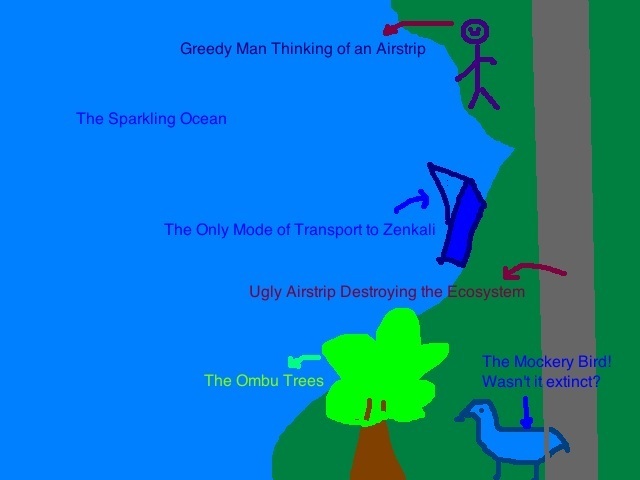
The Mockery Bird, became extinct due to the culinary prowess of the invading French colonies some years prior. The Mockery Bird is the God to one of the tribes on the island, and obviously they were not happy with the extinction of the bird. It turns out that the Ombu trees survived only because the Mockery Birds ate the fruit of the Ombu tree and not being able to digest the seed, germinated them elsewhere. Now with the Mockery Birds gone, there was only one surviving Ombu tree on the island. Plans to have an ugly airstrip through the dense forests in the island are thwarted when Peter and Damien’s daughter accidentally see that 30 Mockery birds are still alive deep in the forest amongst a long lost patch of Ombu trees. This throws the island into a state of chaos, and the ruler, Kingy, is stretched to find a solution that satisfies the international community, the locals and the environment.

Zenkali

Does anyone remember Lorax? Written by Dr Seuss, in which he shows us what greed and ignorance can do, and made into a lovely movie? Now imagine a similar theme, written with endearing characters, a brilliant sense of humor and an exceptional setting? That is Mockery Bird.

It is a pity this book was not made into a movie. If you can read the book, please do.

S’mores by the Russian River

We’d been up to the Russian River for a spot of camping and the children were obviously enamored by the flowing water. It was a  lovely river and the day was even better: Cloudy and just warm enough to not make it uncomfortable. The river was teeming with people – some canoeing, some kayaking, some paddle-boating, some just wading in the waters. There was some sort of boat race, and the local canoeing club was obviously busy with its river rentals and before we knew it, we had saddled ourselves with three canoes, a paddle boat and a highly enthusiastic bunch of children.

The whole experience brought good memories of reading Three Men In a Boat and I found myself looking at the book longingly again. It was time for a re-read.

The daughter and her friends teamed up to canoe out on their own, and made a lot of noise about girl power. They got themselves into the canoe, looking spruce and fit in their life jackets and picked up their oars. They looked ebullient at this new-found independence and pride at having been allowed to strike out on their own.

“Go Girls!” they screamed, but of course nothing happened till the local nib who rented us the canoes untied the thing and pushed it mid-stream.

The toddler son looked forlorn at not being chosen first by his sister to get on the boat. He was usually chosen, why not now? Was it because he could not row? Well, if that was the case, he was going to show her that he could. Yes he was. 

A few minutes later, all the boats had pushed off like drunken lads swaggering from a pub, and only the youngest boys were left behind by their doting sisters.

The boys looked solemn: If their sisters decided to strike out as Four Little Women In A Boat, then they would do their best to be Two Little Men Without A Boat. They found themselves a paddle each and spent the entire hour paddling standing firmly in the water. They took Jerome K Jerome’s words to heart:

IMG_2652

“Life was not an idle dream to be gaped and yawned through, but a noble task, full of duty and stern work. ”

Jerome K. Jerome, Three Men in a Boat

They found themselves going forward 5 steps and then being yanked back by 3 steps.

It was later that we learned that the girls performed in much the same way downstream when they had difficulty maneuvering their canoe. At first, they resolutely declined help from the men, and preferred to get down themselves to push the boat out again. The river was shallow enough even in the middle of the river bed for the girls to stand and push.

As they sailed into harbor, they were soaking wet and remarkably happy at being able to jump into the water.

The burgers, salads and s’mores after a day like that, were especially welcome to the children.

“We are but the veriest, sorriest slaves of our stomach.  Reach not after morality and righteousness, my friends; watch vigilantly your stomach, and diet it with care and judgment. ”

Jerome K. Jerome, Three Men in a Boat

Braving The Himalayan Cold

Uncles-in-law, aunts-in-law and friends-in-law headed over to take in a spot of the Californian sun from the hot plains of Chennai, India. During the rare glimpses of television time that we get when the house is full of visitors, the husband picked out a 5 minute segment of folks climbing Mt Everest, and wanted me to watch it. That poor optimist.

I don’t know whether the husband has thought about a role of a shepherd actively before this, but I think he now appreciates their task. Fluffy lambs, obstinate rams and flighty sheep are all fine by themselves. Put them together and try giving directions, and that is when things fall apart.

It is somewhat a situation like this that faced the husband.

After a half a dozen explanations and as many jump starts, he got the program going.

“Everest Base Camp: The weather on the mountain can take a life of its own”, says the sharp voice in the commentary, when Maama #2 asks, “What is this?”

Pause Program.

Explanation: Showing a documentary on climbing the Everest and it will only take 5 minutes. You can also watch.

Play

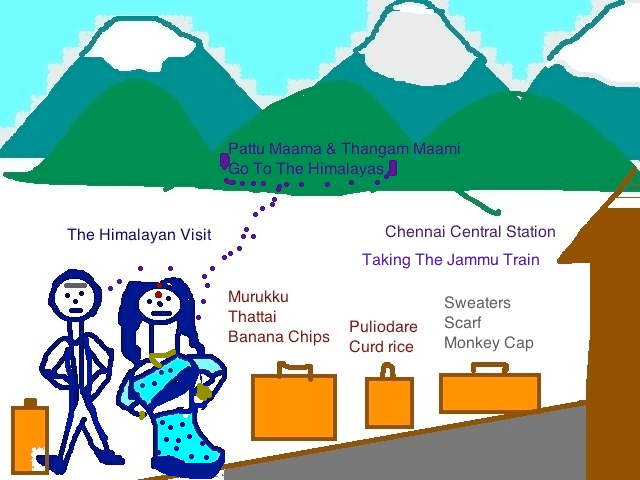
Maama#2 feels that his friend, Maama#1, would like the program since he once went to the Himalayas. The husband nods politely, intensely aware that Maama#1’s Himalayan visit, starting from Chennai Central Railway Station with puliodare & curd rice (with lime pickle) packets in tow, is not in the same league as the poor mountaineers trying to summit the Everest, but he gallantly refrains from saying anything.

Himalayas

Maama#1 saunters to the TV, and the Play button is pressed, when Maama#1 feels that Maami#2 would like the program since she has heard so much about Maama#1’s trip to the Himalayas.

Maama#1 hollers to Maami #1, “Are you coming? Himalaya on TV.”

Protocol demands that Maama#1 does not holler for Maami#2.

Pause Program while Maami#1 finishes her task with the laundry (drying her sarees outside because the washer and dryer do not do a good job with sarees) and comes to watch.

Explanation: Showing a documentary on climbing the Everest – these people have to take their own supplies and go up the steep inclines. You can also watch.

Play

Maami #1 hollers to Maami#2, “Everest-aan! Come and watch – your Maama will like it.” i.e, Maami #2’s husband will like it, so the protocol demands that Maama#1 calls out dearly to his wife, Maami#1. Maami#1 hollers to Maami#2, who then bellows the message to her husband, Maama#2. But Maama#2 is already there watching the program, so there is a side-show wherein communication channels are halted all around to ensure everybody understands everybody else and whoever is interested in watching the segment gathers.

This goes on for about 10 minutes, before the husband shows signs of impatience. He nudges me to watch intently, only to find that I have fluttered away to the sink to do a spot of washing while the tedious interruptions and explanations were being done with. For some reason, the husband is upset by this and just to mollify the shepherd in him, I head back filled with docility and plant myself on the sofa to watch.

Thirty seconds into the clip, two of the team slip on a crevice and go crashing down, trying to jam their pickaxes into the snow to break their descent. It is a tense moment, and the cameras do a good job of capturing the bitterly cold winds on the unforgiving mountain. I have always looked at the mountains with awe, respect and fear. At 28000 ft, how quickly a good expedition can turn into a scary and savage one?

Maami#2 interrupts : “Weren’t you saying that when you went also, the Himalayas were extremely cold, and that you could not sleep at night even with 20 blankets, and the room heater switched on?”

Maami#1 glories in her adventure and launches on an explanation of the wicked Himalayan cold, and the effect on her arthritic limbs at 5000 ft.

I don’t know whether the poor sods in the documentary made it up to the Summit, they didn’t on our Television.

P.S: Artistic licenses invoked.

Baboons In An Orchestra Aid Bold-And-Beautiful Actress

We played host to a few relatives from Tamil Nadu, India lately. Uncles-in-law & aunts-in-law have been taking in a spot of the Californian sun and we added ourselves a few pounds of weight with all the cooking and eating that ensues. In all the hustle and bustle that visiting folks entail, I was not entirely surprised to see that Tamil TV serials reared their ugly heads in the television too.

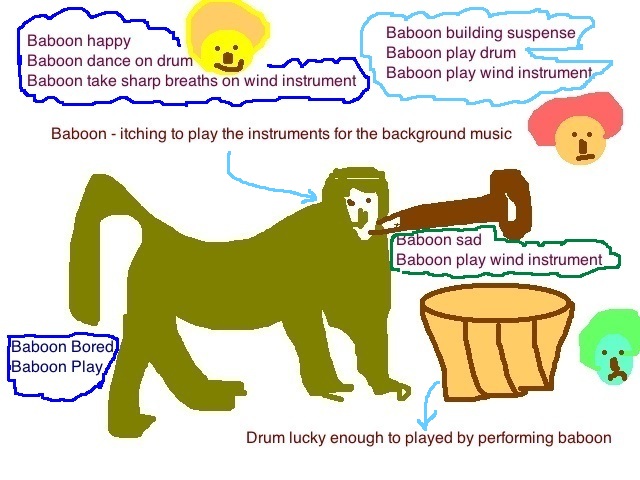
Before I start, I want you to imagine a cage with a baboon waiting to get near an orchestra of badly tuned musical instruments nearby. Bear with me, I shall explain why a baboon is caged nearby.

I was cleaning up in the kitchen after an impressive sort of meal while the visiting folk switched on the Tamil serials. I need not have worried that I had not been following the serial for the past year and a half. In ten minutes, I knew the whole plot: Rohit and his father were bad, bad men and bold-actress-with-lots-of-make-up, had filed a police complaint against Rohit. Bad Rohit’s bad father clutched his heart when his Rohit was arrested and was carted off to the hospital with a weak heart. Rohit’s mother came to plead with bold-and beautiful actress with lots of make up, who was sitting at home and reading a magazine, to take back the case, and cried a river. All with me so far? Good. For it is here, that we wade into murky waters.

Bold-and-beautiful actress said she could withdraw the complaint but she had one condition.

The baboon breaks out of his cage and is now letting loose on a harmonium, while thumping his feet on the drums and the horrendous background music prepares everyone in our house, and the neighbor’s house too, that impressive stuff is about to happen.

B-and-B actress goes to visit ailing father in hospital and tells him her conditions for withdrawing the police complaint. Baboon is warming up now and lets you know that. Apparently, reprehensive Rohit had raped poor Divya, gotten her pregnant and not only had he abandoned her, but bad Rohit and his bad father then tried their best to get poor Divya killed.

The baboon now tries a windpipe sort of instrument that makes one forlorn and wane.

The B-and-B actress sets forth her condition: Rohit must marry Divya.

The baboon bangs, clangs and deafens one with the din on an impressive scale.

baboon

There are loud murmurs of approval from the audience, and I am shocked. I should know better than to expect anything else from a TV serial, but I still am shocked. I mean to condemn that poor girl Divya with a rascal of a husband is nothing short of criminal. She could have carved out a life for herself (and her baby if she wanted to keep the baby that is) with dignity and self-respect. Who wants her to be saddled with the rapist for life?

The maudlin entertainment pulled my attention when the parents or parents-in-law were here several times previously. There the heroine is:  impeccably groomed, dressed like she is going for a party, to receive her abusive husband or to confront angry relatives. She babbles on paying no heed to the social cues, and pretty soon, there is an explosion of sorts and everything thuds to a stop with a slap on her face. The glycerine acts immediately and there are tears and dubious sentiments on culture and I gag (once again) in the confines of my home.

For all our efforts at education, social reform and trying to open the mind to gender equalization, I think we have an epic fail with the Television serials. The producers may say that in the end, good triumphs, and after three years of bearing abuse, the emancipated young lady defies that kind of ill-treatment in the last one week of the television show and their souls are salvaged.

But where is my apology? Where is the apology to the audience? For three years, you send misogynistic messages every evening to the audience – an audience comprised of young, impressionable children, parents of married daughters, parents of daughters-of-marriageable-age, parents of young sons,  parents of sons who are married, not to mention every human-being, who actively seeks or passively receives the entertainment. What is the social message you are sending them? There is no subtlety there – the socially disgusting messages are there in Techni-color with dialogues.

Like my young daughter says, “Oh. In Tamil TV, everybody slaps the women when they don’t want to talk about something anymore. They never just walk away!”

That feels like a slap. Let loose baboons on drum now.

How The Train Chugged Memories

It has been a great pleasure to see that my article on the little blue train made it to The Hindu (a leading publication in India) The article also mentioned my email address as a contact and I received many messages from readers. I cannot make a sweeping statement for humanity based on the emails sent to me, since most of them were sent to me by retired and/or educated folk, but I have to admit the comments were overwhelmingly warm, sincere and helped me reaffirm my faith in the basic goodness of mankind.

Of course, there were a few meant to make me skip a heartbeat. Some insurance salesmen sent me devastating statistics on disease and dying and how it is imperative for all to buy a policy (from him) in order to survive.  Then, there was this furniture salesmen who extorted his wares and offered me free shipping from some place in Hyderabad, India to anywhere. I wonder whether I should have ordered some furniture and had them shipped to California.

But such emails were few. Very few. Or my spam filter was very good. Many readers mentioned their own train-related experiences, and I enjoyed reading most of the emails.

train_tracks
Train Tracks Through a Forest

One person wrote to me about the heart warming story of his train journey in the Gir forests of Gujarat. He himself was traveling there from an urban area. Apparently, the train made many unscheduled stops along the way – there was no station, no station master and no ticketing machine, but people clambered on in these unscheduled stops. This traveller thought something fishy was going on and asked folks what the deal was. It turns out that many rural stations were closed along the way due to lack of funds, but the people in these villages still needed to use the train for various activities, so a truce with the engine drivers was reached, and the train stopped at the erstwhile stations.

“What about the tickets?” asked the fiscally conscious urban dweller, and the train clamberers shook their heads at his ignorance and said they usually purchased their tickets with the engine driver up front before climbing on.

“But what if you don’t? People can cheat this way!” said the shocked traveler.

The train clamberers were indignant. The urban dweller was told that cheating their way out of a ticket is not something that appeals to the simple and honest rural folk in that area. Every one of them held up the ticket they bought. With dignity.

Many letters came from people who had lived in the Nilgiris, or do so now,  and they wrote of their own experiences with the train. One reader even helped me track down the engine drivers who served in the approximate timeframe of my writing and narrowed it down to one or two people. They may have actually been the ones who waved to my mother.

One thing is clear, I enjoyed the ride with the little blue train all over again simply by reading the reminiscences of these readers.  I am immensely grateful for that.

We Are The World, We Need Kindergarten

There was great excitement as the children in the toddler son’s classroom got ready for their Spring program. Girls in pink dresses tumbled with boys in white shirts. The hustle and bustle: bazaars and marketplaces paled in comparison. I was wondering how these children could be made to calm down enough to start the program, when their teacher turned as if on cue, looked at them and said, “Now children, don’t tire yourselves out before the program, come let’s all sit and play nicely here.” and the frolicking lambs all smiled at their teacher and sat together and played.

Just like that.

I am always awestruck when I see young children behave in classroom atmospheres with their teachers.

Within minutes the children were lined up, and eagerly awaited their recital.

The heart warming program was put up by the children to the accompaniment of the Piano by a brave piano teacher. Brave, not just because he walked into a classroom full of children who can comfortably seat themselves in a doll house, but also because he did his duty marvelously. The singing that should have been in D-Major could be in C-Tenor or Z-Furore, but did that distract him? No Sir. He played like Ludwig Beethoven with that piano, and the tots shouted along as best as they could.

The children seemed energized and took us all along on a wonderful ride together with their singing and dancing, song after song.  My eyes misted up as the little ones sang at the top of their voice, carried little LED lights and sang a beautiful song. The lights dimmed and the children picked their way gingerly around one another, careful to not step on each other’s toes.

IMG_2450

There comes a time when we hear a certain call
When the world must come together as one
There are people crying 
And its time to lend a hand to life
The greatest gift of all

We are the world, we are the children
We are the ones who make a brighter day
So lets start giving

In other news, I recently finished reading the book by Dilbert creator, Scott Adams: How To Fail At Almost Everything And Still Make It Big

The book itself was a good one and Scott Adams peppered his book with anecdotes and humorous writing. He took up the saga of his diagnosis of spasmodic dysphonia and along the way explored topics related to general happiness, optimism, good diet and so on.

He mentions multiple times that it is prudent not to take medical advice from cartoonists. But cartoonists and humorists have a way of packaging material in a manner palatable to the human brain, and I thoroughly enjoyed the book.

What annoyed me was that I had borrowed the copy from our local library and the whole book was underlined in pencil by a previous reader who had no idea how to extract the main idea from a paragraph. Probably someone who did not pay attention in Elementary School, or one of those people who forgot what summaries were as time progressed. If the cartoonist had written a one-page paragraph that said something like : ‘Be active daily’, the bubbling baboon brandishing a blunt pencil had taken the pencil across the whole paragraph.

FullSizeRender (2).jpg

I have had cause to remark on this before and I shall do so again: What kindergarten children know, adults don’t. It may not be a bad idea for every adult to attend kindergarten classrooms once every decade. Yes. Every decade. All adults need to spend a school year, coloring within the lines, standing in line, learning to say ‘Thank you’ and ‘Please’, reading marvelous children’s literature to open our minds out again, singing hopeful and uplifting songs, playing whole-heartedly in the playground and getting a time-out for scribbling on books.

All recent kinder-graduates will do their part in keeping the so-called adults from slipping again, and just when it looks like they won’t listen, off they get sent to kindergarten class again.

Instead of spending all this money on law enforcement, I am sure a simple time-out like that will do marvels.

The Telling Problems

I enjoy looking at the projects put up on the class room walls in Elementary Schools. Good though my schools were, when I was young, the walls were pristine. Nothing covered the walls. An odd calendar maybe, but nothing more.

Whereas the schools of today have beautiful art work done by the children covering the walls. Cows looking like dysfunctional zebras pushed through a rectangular pipe, lions with sunny, smiling faces, water-melons so red that the sunsets beg to be pink instead.

IMG_2307

One evening, a couple of months ago, I walked into a 3rd grade classroom, and I could not help noticing that the topic for the session was New Year Resolutions. I am always curious to see what runs through the minds of children. Their disclosures are never disappointing, and often amusing.

The new year resolutions of the third graders were sweet. A number of them had confessed to being warring partners with their siblings and resolved to address that issue pronto. It was also apparent that it was the area in which they received active feedback from the parents.

In the New year, I will try to be nice to my little brother

In the New Year, I will not fight with my older sister

In the new Year, I will look after my little brother and be nice to him.

Heart-warming notes all, in varying levels of penmanship, and most of them emphasized the be-nice motif. All very heartening to note in the younger generation. If these are the children who are to grow up and work towards World Peace, it seems a good place to start.

A few months ago, we went to a Science Fair for middle school and high school children. The topics under advisement there were marvelous and varied. Some of them were telling of the immediate problems they faced, and it was interesting to note that their concerns had moved on from the play-nicely-with-sibling motif:

Is yawning contagious? 

Do grades improve with playing games?

How music affects our coherence while doing homework

The number of projects in Environmental and Earth Sciences was the largest bucket, and that in itself was encouraging.

If peace and conservation of earth are occupying the minds of the young, I think we shall be okay.

The Snoof Struck Dumb

I love Spring. Every flowering tree bursts out in glorious bloom and the bushes are all brimming with flowers. Primroses, roses, jasmine, chrysanthemums, snap dragons, hill lupines,  and wild clovers jostle with each other making one’s eyes dance with joy. It is also the heady season of wondrous scents wafting through the air. Eucalytpus scented trees mingled with creeper jasmines and roses should make a highly pleasant combination, but I would not know.

IMG_2326-EFFECTS

Come Spring and I also become a snoof https://en.wiktionary.org/wiki/snoof. I can conduct an orchestra of sneezes, sniffle-puffs and croaky throats. Like an orchestra in which owls, bats and frogs are the main participants. This Spring, I also had the privilege of silence. The throat was affected. At times, there was a competition between the scratchy throat and the stuffy nose. For some time, things were rocking along pretty smoothly with an achoo here and an achichoo there, when one morning my throat gave out completely and nothing emanated.

It was marvelous I tell you, simply marvelous. Our culture suffers from a talking epidemic: it is as though talking is an art, a hobby, a vocation even. Everybody is encouraged to voice their opinions and to have a view point. Sometimes, we feel the need to say something that we don’t really mean or understand.

But you see, all that was stripped from me when I lost my throat. There were no expectations. I spend the most gleeful week possible. I would walk into meetings and try to look apologetic as I pointed to my throat. It was hugely introspective and rewarding. Like a time-out for myself in a noisy world. Colleagues had tea with me in companionable silence, marveling that it did not feel awkward at all to not have a single word between us.

https://www.brainpickings.org/2015/01/13/paul-goodman-silence/

I quote from article:

Like Paul Goodman writes:

Not speaking and speaking are both human ways of being in the world, and there are kinds and grades of each. There is the dumb silence of slumber or apathy; the sober silence that goes with a solemn animal face; the fertile silence of awareness, pasturing the soul, whence emerge new thoughts; the alive silence of alert perception, ready to say, “This… this…”; the musical silence that accompanies absorbed activity; the silence of listening to another speak, catching the drift and helping him be clear; the noisy silence of resentment and self-recrimination, loud and subvocal speech but sullen to say it; baffled silence; the silence of peaceful accord with other persons or communion with the cosmos.

IMG_2326

I wish we could all choose one day of the week, every week, in which to stay silent and just observe what is going on around us. I am sure it will make us better listeners and more appreciative of the gift of the gab.

Lessons From The Little Blue Train

The Article below also appeared in The Hindu in the Open Page on May 10th:

http://www.thehindu.com/opinion/open-page/looking-back-at-a-little-blue-train/article8576823.ece#comments

My mother ran downhill through a steep slope in order to catch her little blue train to get to school, where she taught, everyday. We lived in a small place nestled in the Nilgiri Hills, where everybody knew everybody else and even though we might not have been invited to Tea at the train driver’s house,  he obviously knew my mother. He would see her pelting down the hill, practically skating on the little seeds dropped from the Eucalyptus trees above, as he maneuvered the train around the mountainside. He would wave a friendly hand to her telling her to slow down indicating that he would wait for her to board. What is a minute here and a minute there was his philosophy, and one that entirely suited the place and times.

lovedale

The Nilgiri Mountain Railways was not competing with the Rajdhani Express or the electric trains of Mumbai. The little steam engine was a joy, and intended to show people that true joy in living came from hard work with a dose of huffing while going uphill and a friendly toot and speed moderation while going downhill. The journey, it steamed, was the most important thing. Chug past the lakes and mountains, cling to the cliffs, take deep breaths of the nippy air and keep moving while you can.

Nilgiri_Mountain_Railway

From Wikipedia: Picture Credit: By Nsmohan – Own work, CC BY-SA 4.0, https://commons.wikimedia.org/w/index.php?curid=37242880

When people ask me about the banes of urban living, I rank not knowing the train driver quite high up on the list of grievances. I have to run up 50 stairs like an asthmatic calf to get to the platform.  So many times, just by virtue of being stuck behind a set of folks who refuse to budge on the escalator, I have missed the train. More often, I charge into the train just in time to have the doors close behind me and then stand there panting and mooing for breath.

When one considers how often I have flown past steps and hopped past debris and skidded into the train, I suppose it is only fair. A matter of tempting fate long enough. One day last week, a quick look at the watch (set to two minutes past the actual time), and another look at the car clock (set to three minutes past the actual time) revealed that I have a 30% percent chance of making it to the train if it was on time and a 43% percent chance if it was a minute late. Give me a chance at something like that and I mysteriously transform into a demonized matador bull:  I will lower my head and point head train-ward and charge like a demon with horns. However I was not feeling sufficiently bull-like that day, more like The Reluctant Dragon.

reluctant_dragon

The Reluctant Dragon is a marvelous children’s book written by Kenneth Graham. In the book, the villagers are keen to slay the Dragon assuming all dragons are vicious. The Dragon, however, wants no fighting or flame spewing. He simply wants to rest his back against a rock, think and write poetry.

The train doors above me opened and I looked upwards while running. I forgot about the raised platform around the 57th step. It was then that I took a toss. Now, when I say ‘Toss’ in that flippant manner, it does not truly capture how much an ass it makes one look.  Well, there really is no comparison with the animal kingdom, I mean have you seen deer trip or donkeys slip on the mud? That is set aside for the two-footed I believe.  The point is that the step hurled me and I fell spectacularly. My bag flew one way, my legs the other, while my knees scraped along trying to keep the bag and legs together. I lay there trying to resist a bizarre urge to laugh out loud, though I could feel the stinging pain in my scraped knees. I did chuckle to myself though – I must have looked like a prized fool sprawled there first thing in the morning when folks have important things to do and places to be. One cyclist evidently late for her own train, said, “You okay?” and I said “Yes”. She gave me the Thumbs Up and cycled off.

As I stared at the departing train to see if I could detect a smirk from anyone on the train, I need not have worried. The shiny silver train streaked off glinting against the morning sun as efficient and indifferent as ever. I did not know which was worse, the physical pain from the bruises or the indifference of the departing train. Just as quickly as laughter had come, I found much to my embarrassment, that tears stung my eyes.

No one knows whether the kind train driver who waved to my mother is still alive today, but I miss the likes of him in today’s world.

Happy Earth Day Mr.Peck

The first few minutes of my train ride are always on the dramatic side. I am charging to get on the train, no matter at what time I catch the train, I charge to get on it. My feet pump like a fast flowing river and my heart resembles a mambo drum echoing in the Kenyan national forest.  Obviously,  it takes a bit of soothing to calm down the nerves after that.

The scenery outside does just that. You see the first few minutes afford a view of a smallish lake and the hills nearby. Come Springtime, the water bodies are full of ducks with their ducklings in tow and the heart slows down. It has to. It is a marvelous sight and I must say it is with reluctance that I pass up that view as the train heads out into the bustling city.

How lucky those ducks are, I tell myself. If these ducks knew of the life Mr Peck leads, there would probably be a pang there. No trains rumbling nearby to disturb Mr.Peck’s peace. No Sir. Mr Peck was a magnificent duck the son and I befriended on one of our hikes down  at Lake Tahoe. As we set off down the steep slopes towards the lake, there was an ominous looking sign that wanted hikers to know that it was a steep hike back. While cylinders roll down easily enough, they find it hard to roll back upwards seemed to be the gist of it.

IMG_2215

So, off we went, gibbering and jabbering all the way. The snow had started to melt in places and we heard little gushes of streams all the way down. We stopped to play with some of that water and even gulped a little.

The son and I were the ones who reached the lake shores first. There was nobody down there. There was a thicket of trees behind us, a sandy beach on which there was one picnic table and the water gently lapped the shores by the picnic table. We sat together in companionable silence, and watched the distant island in the lake.  One duck, paddled away serenely at a respectable distance.

After a few minutes of this silence, the duck came to join us, probably to satisfy a noetic urge about humans. We sat quietly and he came and looked at us in turn. He then pecked at something on the lake shore and circled us taking us in. The son was beside himself with excitement, but for a toddler with a loud voice, he kept silent and the duck and son had a silent rhythm of reciprocated curiosity going. If I had not been right there, I wouldn’t have believed how long this state of affairs went on.

The duck gazed, we gazed. The duck lost interest and pecked and we looked at the lake. Then the duck gazed and we gazed back. The duck did not seem to think of us as pestilential creatures out to ruin his habitat, or if he did, masked it politely. It is one of those moments of time when a fast spinning top slows down just enough to take in the world before spinning at top speed again. It was only after the duck swam away that he was christened Mr Peck.

IMG_2223

The daughter came charging with her father and grandfather from the thicket of trees a few minutes after that. The sun was starting to set, and the pinkish hues were already coloring the peaks as if the mountains were blushing. All the contained excitement about Mr Peck came bursting forth from the son when he saw his sister. Excited gabbles were heard for miles in the surrounding Sierra Nevada mountains as Mr.Peck assumed a small role in our family story, and nestled in next to Patchy (that sweet lamb who taught us a thing or two on patience and perseverance).

I think of Mr.Peck everyday when I cross the lakes with the ducks and wonder if he knew what a lovely life he led.

Happy Earth Day to all our fellow beings. Mr.Peck, I hope you are having a nice day down by the lake.

P.S: Mr Peck has since been identified as a Canadian Goose. (The local ornithology club probably has a picture of us barring entry, but we have a history: https://nourishncherish.wordpress.com/2005/08/25/ducks-fishes/)