If ever you need to shake off your inhibitions and take a course in the art of bold self expression, I suggest taking the public transit, BART. Talking to Once-self is a free course that is offered to all riders. Also selective hearing.
Traveling on BART gives you a unique experience. One only has to close one’s nose at times and one’s eyes at others, and the rest is there for the taking.
Soliloquizing is often frowned upon: One never knows when one is talking like an onion to a donkey.
One time, I was listening to a man telling me about a music concert he’d been to.
One of the bizarre things about this particular individual was it looked like he was talking to me. I mean addressing me. Pardon me if I have told you this before, but if you need to find me on the train, you would do well to look for a sharp-ish nose buried in her writing or reading and keeping to herself, after the dramatic entry at the last minute of course.
So, I was mildly puzzled and looked up. Tell me, he said, thundering, what should the boy do? Shall I help him?
I mean. I don’t know. It depends on the boy does it not? I am usually not the one who has been asked to share advice. I was rattled. Only none of the words came out. What managed to come out was a shrug. I looked around me completely bewildered, only to be confronted by equally puzzled faces that all seemed to share the same vague feeling that this gentleman had never physically been to the concert he was talking about, and better yet, the boy could have been the lead singer on the fictional band, or his young ward, it was hard to tie the story together. He however, had something that most marketing professionals and politicians would die for: he had the unique ability to make a train-car full of passengers feel like they were being addressed individually by him.
It was amusing and interesting.
But when folks shout at you and demand that you have a good new year and a merry christmas, it is hard to not smile. Even if you are scuttling away with a slightly alarmed expression on your face.
If you stop for coffee in the mornings, there are souls standing there looking like they know they should be there. They obviously did something right to get there, but what to do after that is displayed like a puzzling Exclamation mark preceded by a Question mark on their face. Take a beaker full of coffee and send the brew through a funnel and they will stir and show some spirit. It takes a few minutes, but they eventually get buzzed up as I like to call it and crack open their day.
coffee
Curious that I should have written this without knowing that is was National Coffee Day.
One morning I decided to take the high road on nutrition and scorned coffee & tea with the air of a medieval lord. Yogurt, I decided, is the thing, and headed out towards a solid breakfast. Live cultures, probiotics with a spot of fresh fruit. I felt like just the thought of it was chasing all those terrible toxins away. I shivered at the thought of caffeinated beverages. It was as I was surveying some grape yogurt that my nose twitched in an alarming manner.
I turned my neck to aid the nose and saw that there was an egg-making section in the place. The husband is a great show-wizard in the art of egg making. He beams at his audience, he instructs, he builds suspense as to how he is going to toss the omelets and catch them. The audience watches bewitched as the omelets fly in the air and then they push the heart down, for it pops up to the mouth with all the suspense.In a fitting finale, the omelet spatters but mostly lands in the pan. He good-humoredly says,“Well, almost!”. The admiring audience then cleans away the soggy remains on the floor, the egg-shells are swept from view, and the chef presents his masterpiece.
Why I say all this is because, I don’t know whether you have stood around watching eggs being made. It is fascinating. Also crowded. The populace likes seeing the egg-toss. But that day, the egg making station was empty. So, I made for it and ordered a sunny side up just because I could, with out waiting in line.
The lady misheard me and made me two eggs sunny side up, left them a bit longer than she would have liked and I found myself staring at two fried eggs instead.
You know how we tell our children not to waste the food on their plate because poor children are starving in other parts of the World? In fact, the thing has been drummed into my psyche for so long for so many years that I leave a very clean plate. Maybe it is time for all good men and women to analyze this statement. I did not want any eggs, but landed up having two beaming up at me simply because the line was empty. Now, I could well not waste it because of those starving children.
Never one to raise hands for a breakfast, I felt a bit squeezy. A friend I know told me that mint tea always soothes the squeezy stomach, and so there I was with the kettle and teabag at the end of it all. So much for turning my nose up at caffeine.
Now, since I did not waste any of the food, all that is required is find a way to transport these calories to the starving poor.
“Do you hereby consent to transfer your breakfast to this starving, poor, poor child ?”
“Yes I solemnly do.”
Good Food Link-inator
Off the calories go zipping through the Good-Food-Calorie-Linkinator to nourish the child. The recipient has a holographic effect of eating the eggs, that trigger good memories depending on howwell the patron enjoyed his calories,thus physically and psychologically satisfying the receiver. If one has truly enjoyed it, so will the receiver of the calories, and if one has just forked them down like a robotic arm lifting garbage, the receiver does not enjoy it all, and his giver-rating goes down. That way, one can indulge occasionally, and feel good all around.
Sigh! I never see folks skip over to the treadmill because it is empty and exercise. Why do we not exhibit the same iron control with food?
We had been to attend The Physics Show a few weeks ago. Living in an area housing the world’s most frightful technologists does that to you. One scientist tells his neighbor, who tells his friend, an engineer, who tells his friend, a Biochemist, and from there it passes on from one to another, all bound together by the loose brackets of a parent. Before long, there is a list of folks beating it up the hill to The Physics Show. If you peered closely at that hill, you would have seen me there with the daughter and some friends. I can’t fool the public into believing that the Opera and Broadway are competitors, but the general populace was surging to the show.
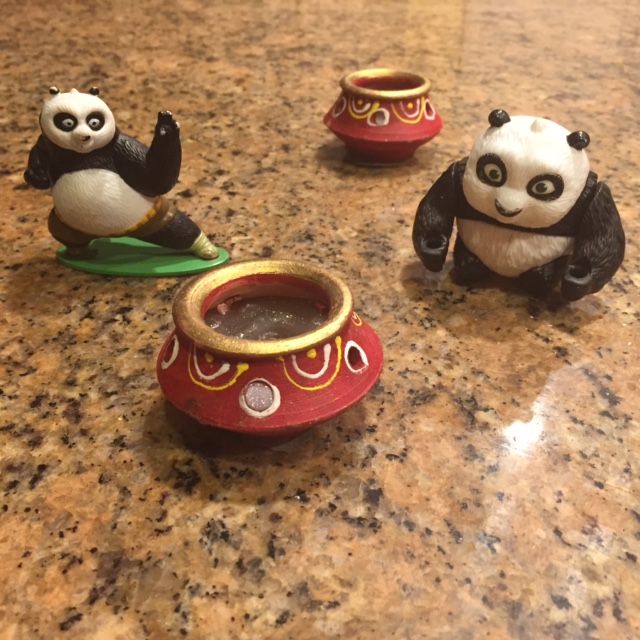
The Auditorium was atop a steep hill, and the populace was huffing and puffing like Po the Panda stopping for water breaks every now and then. I felt like I was on a strange padayatra (Journey by Foot) to see a Gingko Tree, growing amidst a grove of Japanese Cherry Blossoms, atop the Great Wall of China. The holy path only required one to sprinkle a few drops of the holy Ganga-jal along the way, to make the ritual complete.
Pada Yatra to see Gingko Tree amidst Grove of Japanese Cherry blossoms on the Great Wall of China
The populace making their way up the hill were mostly enthusiastic folks of Asian descent: Parents of Chinese, Japanese & Indian descent with their reluctant progeny.
The show by itself was reasonably good. The scientists did their best to enthuse the children. “If you can’t have fun doing Physics, you can’t be having much fun doing anything!” they boomed on stage. All the parents laughed heartily and clapped at this, while the 5 year old boy sitting in front of me turned and stared at me as if asking, “Really?! You can laugh at this, but not at the Tom & Jerry show I was uprooted from for this lark?”. It looked to me like he was having a lot more fun ogling at these specimens who laughed for that joke, than anything else. I detected a judgmental gleam in his eye, and did my best to cope with it by ignoring him and enjoying the atmosphere instead.
I scanned the crowd to see the number of children in the 5-7 age group. There were even a few 4 year olds and I hoped they were taking one for the sibling and not because parents hoped that training started early.
The scientists talked about Electricity, Temperature and Atmospheric Pressure. But the best attempts to educate drew the biggest engagement when the team on the stage fried themselves deliberately or made their hair stand up. It was hilarious to see the hopeful expressions on the faces of the well-intentioned parents, while the children enjoyed the parts of the show that looked like circus performers out at tea-time.
A few days later, the daughter and I were out and about sauntering around the neighborhood. The waning summer had few butterflies and we made them proud by flitting from one topic to the next. We were talking about progress, science, the European refugee crisis, the recent fires, dodo bird extinctions and so on. The gentle Dodos helped me steer our conversation onto humans and humanity’s path and how our Scientific progress always has a good and a bad fallout. I told her about what Albert Einstein said, “The Fourth World War will be fought with sticks and stones!”.
I went on to tie the plight of the Syrian refugees to explain how civil unrest, war etc always lead to horrifying effects on people.
“So, Albert Einstein said that the Third World War will wipe out everything as we know it right? So, then we are okay isn’t it?” she asked, her face crinkled with worry.
“Alas! Even if it is a big bang annihilating life in the end, the hurtle towards that instant itself is a long and difficult journey involving much heartbreak and agony. It will be a long drawn out affair with millions of people losing their loved ones, suffering with injuries and wretched atmosphere of fear, uncertainty and anxiety.” I said. .
The daughter was quiet and somber. A rare occurrence.I did not relish this Doomsday Scenario either. We walked in silence for a minute.
“Well then the only way out is for people to go to Oregon then.” said she after a few moments in a final sort of voice..
“Eh?! You mean the state of Oregon?”
“Yes” she said. “Oregon – above California.”
God knows I have braved enough conversations, but this still had me stumped. “Why Oregon?”
“Well. Only there you can kill yourself legally, and put an end to misery right?” said the daughter.
I have written about my train rides before. (the first one dated about a decade ago: https://nourishncherish.wordpress.com/2005/10/27/commuter-blues-or-benefits/) They are entertaining, freeing, frustrating and are not entirely the best friends to the olfactory senses, but then, when else do you get to appreciate the fact that you have allergies and a blocked nose that essentially mean that you don’t have to screw up your nose when others do?
The trains are hugely helpful for people like me who don’t enjoy having their noses stuck to a steering wheel: I would much rather stick my long-ish nose into a book. The trains are functional and not at all fancy. They take me to and from work everyday and for the most part are reliable.I don’t know what it is with casting an evil eye on the most simple things. I typed this line out about 2 weeks ago for another blog, and in the intervening time, there were huge delays on the system causing much inconvenience and noise on social networks multiple times a week. There was one time when the website said, “We have been overwhelmed with the requests on the website, please check Twitter for updates.” Like any other person, I feverishly dug up all mentions of the trains and was greeted with dire warnings. News sites and social media told me that due to delays people have been queuing up on platforms and that the platform was so full that Police were standing near the ticket gates and turning people away.
All most disturbing. I summoned up that crowd instinct nestled in all of us and made for the station. That instinct is one of many things. One, it subtly points our body in the direction we wish to go and the rest is handled by the crowd. Two, it scans the crowd to see possible options and three, it senses danger. Number Three shows the vulnerability of mankind. For all our talk about finding one’s true self and being what you are and all that, one flaming emotion in a large crowd is all it takes for a person to lose their identity to the crowd. It is enough to sway people. To push them from their standard norms of behavior, and thus behave in ways that most of them would not pride themselves in.
I have been in situations where the crowd turns nasty really quickly and they are not memories I set aside for bedtime tales. For instance, there was this boy who worked at the corner grocery store in Bangalore in those days. He had a shy smile that he flashed every time we bought something. One time, I caught him running after chicks and not making a single victory. (Not eve-teasing, this guy had bought some chicks that looked like miniature powder puffs in various colors and had, in an unguarded moment, let them all loose all at once. ).
Of course, he had imagined himself being seen to better advantage in front of his customers, but there you are. Both of us laughed at that, I bought my packet of milk and was off. A few weeks later, I remember, some riots broke out (somebody had died or somebody said something about somebody’s death – it doesn’t matter), but this hitherto mildly affable boy was transformed. I was alarmed when I saw the slightly mad look in his eyes, when I was hoping to find friendly ones.
I was strangely aware of all this as I made my way through the streets expecting to be pushed out through the escalators back to the street again, only to find that the station was completely empty. My senses jerked. One lone policeman was leaning against the wall and dreaming of his next coffee, so he could have something to do. Some homeless folk were there using the warmth of the underground pathway, a musician whose musical talent seems somewhat misplaced in a subway station, and two dogs. Nothing else.
Say what you will about news channels and social networks – they can make the happiest person court tears in minutes with nothing but a shred of news. Maybe all this real-time-update frenzy has us expecting to be alive and aware in a place, without really being there. That day, I was enormously grateful that the trains had got back on track and got me home, that I had worried for nothing. There were delays, during the day to be fair, it was the milking on that was quite unnecessary.
But it made me think. In this day and age of sharing and over-sharing, are we aggrandizing the mundane? Or worse still paltering with the truth. What is truth when one is flooded by so many perceptions of it, fanned vigorously by viral social networks?
If this had happened, would it have made a difference to what the grocer boy did in a crowd?
From then on, life is a sweet song as you crave for every work of theirs. I like uplifting material in general, and Miss Read provides just that. She has a sunny, optimistic outlook on life and chronicles life as it unfolds around her in the English country-side. She does not shy away from the harsher realities of life such as alcoholism or poverty.She manages to capture her characters with wit, sometimes scathing social commentary, but she is always charitable toward them and grants them the benefit of being human while navigating life. Every character is endearing in their own way.
Who was the author who said that, we all make a great effort to see how different we are from one another, yet, it is not how different we are from one another, but how we are like one another that shines through?Anyway, that is how I feel when I read Miss Read’s books. She may have written about a small village in the British Isles. Yet, I feel I know people like them. People who I willingly or otherwise encounter in my life. People I can pop in to have tea with and people who will be there for me when I need them. For that, I am always grateful.
Her books were written in post-war England through the 60s and 70s. There are a few novels that she set in an earlier era and I was reading one of those when a particularly poignant piece of prose moved me enough to let a tear-drop fall. She had captured, once again, like numerous others before and after her, the heart-wrenching impact of lost lives and severed limbs that is the effect of war.She had written about a cold morning in early 1915 when the family residing in the village town of Caxley was affected by the War.
There I was sitting and reading about it on a cold morning in early 2015 and it sent a shudder through my heart.
My uncle passed away a few days ago. He was 101. I sat there thinking that he was born around the time the First World War started. He served in the Second World War ( A fact I did not know about him till after his death). He rarely spoke about his time in the War, for he was a gentle soul and war jarred on him. I fervently hope that our Earth will not have to endure any more wars, but that is wishful thinking. As long as there are human-beings, there will be conflict. We can only hope that we gain enough tolerance to settle down together, minimize our losses and learn to live happily. He lived through India’s fight for Independence, (including hard times in his own fortunes), and a half-century of post-independence history. We all remember him as a sweet and gentle soul with a ready smile, a good encouraging word to share for everyone, a tower of strength to his wife, sister and daughters and a lover of knowledge.
A few days later, an aunt passed away. She was 82. She may not have had the worldly outlook that the uncle had, for she was busy battling a tough life. Stricken with polio at the age of ten, I think her life was one hard song. Yet, when I think of her, the first thing that my brother and I can remember is when she came and stayed with us for a few months during a particularly rough patch in our life. She was there limping her way with enthusiasm never wincing to take on an ounce of extra work, never complaining that her leg impeded her. She was happy amidst the fruits and vegetables that were aplenty in our home and showed her gratitude by cooking sweet rice (pongal) and offering it to the Lord everyday. We begged her to go easy on the sweets, for they were not going easy on our waist-lines and she said, “As long as you make the offering to God first, you will not put on weight!”
My father, a compassionate man, told us not to stop her, for she had never seen plenty. ‘We will lose the weight easily enough, but can you see her this happy?’ (I don’t think the father lost the weight easily enough, but that is a side-point)
That had been our little joke for years. It morphed into various statements:
Tuck into the chocolates – if your heart is good, you won’t put on weight.
Plunge into the rasgollas – if you are happy, you won’t put on weight.
Bite into the almond cakes – if you are grateful for it, you won’t put on weight.
Wade into the payasam – even the Gods drank nectar, and they never put on weight.
You get the gist.
Both of them lived long, rich and diverse lives spanning a century. They watched lifestyle changes, outlook changes, political drama, technological advances, personal challenges – good and bad. How often we don’t stop to think what the person next to us has undergone? How often we think of ourselves, our voices and our motives alone, without stopping to think about another person’s perspective?
We can learn from everyone’s example and everyone’s mistakes . I hope life brings with it a certain wisdom while retaining the enthusiasm to learn and try new things.
The grandparents have arrived and ever since the children have been clamoring over them leaving me high and dry. They sometimes look at me and give me fleeting, commiserating hugs as if to assure me that they have not forgotten me, and then fly back like butterflies attracted to nectar filled flowers. The grandparents, are of course, thrilled with this reception. The son thinks goes a step farther in making them both feel equally loved and addresses them together at all times: Grandfather-Grandmother. As in :
“Grandpa-Grandma, see this car!”
“Grandpa-Grandma, I will show you my toys.”
“Grandpa-Grandma, I am going to pee.”
I saw all of this and did what any normal parent would do. I sneaked off for a longish hike with the husband one early Saturday morning leaving the butterflies, nectar etc. with Gpa-Gma. Got to make hay while the sun shines, what? Which seems to be a lot by the way. The hills near our place are dry and make for a brown water-starved eyesore. It usually is this way at this time of the year. Apparently, these hills made for some excellent cow-grazing pastures for the cattle years ago and all the forests were, well, deforested. As far as shortsighted planning goes, I think this is the classiest. For now: there is no cattle grazing up there. It is empty, parched grasslands eh hay lands with walking trails taking an insane amount of foot traffic for those wanting to burn off a few calories before that week-end sumptuous tuck-in after the week-long exercise-less tuck-ins that is. The Earth looks strangely unaccustomed to the onslaughts we continue upon it daily.
The Unaccustomed Earth
There is another thing one has to note in the nature of conv. between the h and self. If there is one word that truly describes it, it is FRAG.<Hey! No pouring water inside the bus!>.MEN.<Do you really want to fill up on chocolates now? Put them away – not on that sofa. Chocolate melts.>.TED. <What were you saying? Sorry, I got distracted>.
So, give us a few minutes in which complete sentences can be exchanged and we are like apes thrown in water. It is a skill lost. I suppose we can talk to other people without shouting out crazy things in between. The point is, after sometime we got our tongues rolling (mostly I got my tongue rolling.) The h. was strangely quiet and nodding. After a particularly longish sermon of about 23 minutes on deforestation and water-conservation etc, I looked at the husband smiling at me. I was pleased with the results of my talk. I asked him what he thought, and he said, “I think it may be because of the headphones I wear. I can’t hear anything. I think my ears are blocked again. I suppose I should get them cleaned. Couldn’t hear much of what you said.”
I suppose that is what most environmentalists must feel like. Or Unaccustomed Ears. Sigh!
P.S. A friend of mine had used the phrase ‘Unaccustomed Earth’ in a rather beautiful status update, and I have been stuck with the phrase in my head ever since.
I confess to being a bit dim-witted especially when people add and subtract hours from my life at random. I have complained (often) that I don’t have enough time. I have wished for my day to magically incorporate 48 hours instead of 24, but I want that so that I would be able to do things that have to be done and get cracking on things I enjoy most like staring idly at the waters on the lake with a book in hand (you know…give myself the illusion of satiating my mind), or watching that bird befriend that cow. I don’t want an hour tagged on and then several hours worth of work tagged on because of that extra hour.
Somehow, it seems to me that the daylight savings phenomena can be explained away with these equations: 24 hrs = x work units Adding 1 to both sides => 24 + 1 = x+1 But what really happens is this 24+1 = 24 * 7
I am no Mathematician, but that doesn’t sound right to me. And I’ll tell you why. Systems that run automatically at a given time are all suddenly confused. One spends the next few days soothing them and cajoling them while they whimper.
In the good old days of yore, one started work in the fields when the sun rose and stopped again when the sun set. In the current days, one starts work before the sun rises and stops again after the sun sets. The goal here is to see as little of the merry sunshine that encourages the flitting of monarch butterflies as possible. So, why bother with this daylight change? All systems run time-based. I know several people who only eat by looking at the clock – “Ah! 8 o’clock, time to breakfast”, they say and hunger or no hunger will sit again in front of a full-ish looking meal at half past noon. Why upset these systems?
As usual, I have no real say in the matter, which should technically stop me from saying anything. But you know how I am…
I have to be up all week-end trying to explain to large systems, small systems, weepy systems and whiny systems that this is how it is. One hour set back for all of you.
Recently, the brain has been quite busy wrapping itself around the book ‘Life, The Universe and Everything’ by Douglas Adams. When I say wrapping itself around, that is a loose word, since the bulk of my reading is conducted in sporadic bursts in the noisiest of places with thousands of people milling around, gently prodding me in the ribs to move on, while somebody looks apologetically as they squeeze their shoes on my feet.
“Sorrreeee!” they smile as they park the foot on mine.
“It’s okaaayyyy!” I respond with a smile struggling through the grimace of pain, and hang on with great resolve in the crowded public transit.
Douglas Adam’s SEP doctrine is interesting. SEP is Somebody Else’s Problem, and we being the self centered goons that we are, anything that is somebody else’s problem we safely ignore, so long as it does not provide one with fodder for thought or comment. We simply go on believing it does not exist. http://en.wikipedia.org/wiki/Somebody_Else’s_Problem
However, today I can proclaim : Thine eyes have seen the glory of SEP. I was determined to see for myself, and when the mind is made up, it sees the SEP.
I was treated to a 180-pounder tender a shrill “Sorreee” as she pinned her pin-point apology on me in this morning. I was tottering along, after the onslaught, musing on masochistic footwear and how otherwise sunny people willingly jam their feet like sausages into the narrow confines of their footwear, when I was rewarded with a sight I would otherwise have missed.
There was a girl in front of me. She was walking as though no problem existed. Only a problem existed. Yes it did. I saw it. I spotted it. You see one of her shoes had heels like this
The other had heels like this.
Chipped. Broken. Gone. Yet, she artificially pumped her broken heel leg up so she could give the illusion of not having a broken heel. I know how hard it must be walking like that, given that I have solid years of practice to back me up in my claims. Credit: Those vast hours of our youth that we spent on noble pursuits (including walking like air-hostesses, which meant walking around on imaginary heels). I don’t know why in our girlish minds, air hostesses were credited with high heels always, but those were the days of the far away dreams of flight – the unattainable for the average middle class Indian. High heels being equally unattainable, the combination must have been the ultimate fodder for our imagination.
I had an inclination to tap the girl on her shoulder and helpfully tell her that her heel was broken. It would have been priceless to see the look on her face, like she did not know. Start the ‘Mystery of the Missing Heel in the Universe’ series what?
Mankind is pursuing a macabre race, and is shamelessly analysing TV shows where people are instructed to zap contestants with voltage – shocks for every wrong answer. So, what answers cause death?
Would you shock someone with potentially lethal amounts of electricity simply because you were told to do it? That’s exactly what the subjects in Stanley Milgrim’s experiments did in the early 1960s. His objective was to test obedience to authority, and the world was surprised to see the results. A majority of ordinary citizens in the test chose to shock an innocent person when they were ordered to by the scientist leading the experiment. The individuals on the receiving end of the powerful shocks were actually actors pretending to suffer, but the subjects believed they were causing the actors real pain throughout the study.
French Television went a step further and aired the show on TV. Of course, they made sure they announced afterward that the contestants were actors and were just acting as though voltage coursed through them. I did not actually see the show, but I’d like to imagine how wrong this show could go
Quiz Master: What is 12345679 * 8?
Contestant: 98765432
ZAP! A shocking voltage shock rips through the contestant’s body, who stabilizes himself after the shock wears off and swears.
“Mad Math Phobiacal Moth eating Mobs! Curse you all into worm-eating oblivion. That is the right answer! Why don’t these guffoons have a calculator before making the decision to hose my life?!”
Chopsticks have always intrigued me. They look disconcertingly similar to knitting needles. Now you knit up in your mind the old wizened lady lovingly using both her hands, sitting in a rocking chair by the fire and knitting a warm sweater. I hate to dish it to the old lady like this, but you only can use only one hand, use both needles and knit the same beautiful sweater OL. Go on old lady. Try. Try like the dickens. How does that sound?
That is exactly what eating with chopsticks seems to me. You are given two condiments, you have two hands. Simple? Not simple. The technique is simple, any child brought up on Chinese food in a Chinese setting will tell you how easy it is to use chopsticks. All you have to do is grasp the sticks like this.
Then, move finger number two by using finger number one as the lever/rudder. (When you are trying to keep the sticks afloat in a bowl of watery soup, you are allowed to use the word rudder). Let’s get back to technique now that the use of rudder has been explained.
During the entire process, finger number three is jammed between the sticks, and is expected to move in the same angle maintaining a level of parallelism with finger number two. Never mind that finger number 3 is screaming for respite by now. That demand cannot be met. Ignore finger number 3. It can start acting up midway through the process, and you will be stuck with a finger-chiropractor, soothing function back to it. Don’t worry, it is a part of life. I realise there is no such profession as a finger-chiropractor, so if you would kindly tell me the name of one such specialist, I will gladly update the post.
The trick is to be firm with finger number 3. Show it fingers number 4 & 5 as a method of consolation. Fingers 4 and 5 are in a worse state. They can’t move remember?
Also remember that while one is fiddling with these sticks in the soup, the soup is turning cold. Not to mention the odd contours on the face as lines of worry and concentration contort it into a horrible frown. One would think, that not being able to function with chopsticks will have sent the author home hungry and dejected, with a new sense of purpose – learning to use the sticks before the next soup stop.
Not so…not so! Mere technicalities like chopsticks don’t deter me. I creased out the lines of concentration, ironed out the frown and put on a smile. I then attacked the soup like this.
People were looking at me with awe. Pretty soon, I could see folks cast me the envious look. Their eyes screamed the obvious “Why didn’t the Chinese think of it?”
I refused to wipe the smug smile of my stupid face, and went on eating like this, till a waiter who was charging about the vicinity like a racing bull, stopped in his tracks. You know how these cars screech when they sudden brake? Something like that.
“Next time – fork okay? I give fork okay?” he said.
I shrugged – I’d already mastered chopsticks now, who cares for forks?