The Sappy Pine

I sat outside idly watching the world as it continued on its day. These rare moments of solitude and stillness are more refreshing than any energy pills being advertised on television or in between YouTube videos. The wind stirred at the pace it was going to: Today , incidentally, was idle breeze day. The clouds in the distance were parting to reveal a blue sky. The birds made their brave show chirping, catering to their little ones in their nest, or flitting about joyously it seemed. 

Sitting outside like this, without any fast forward buttons reminds us of the nature of time. How come we manage to fill all our moments with alarms, and meetings, placing firm demands on the hours available to us, while other living beings around us manage to live in harmony with the seasons? The rose buds bloom, the fresh leaves sprout after winter, the nest eggs hatch, and life seems to go on: on a schedule of its own, quite distinct from what we have.

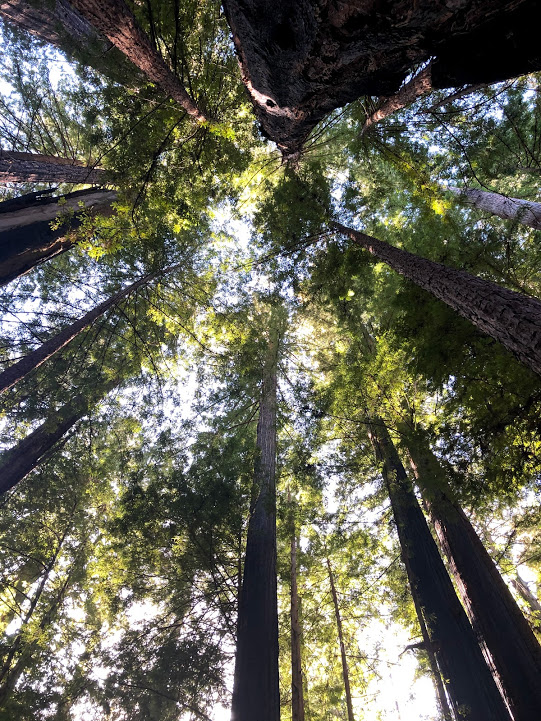
I watched mesmerized as the breeze rippled through the luscious pine tree nearby generating green soothing waves, and thought of the magic of life around us. Every tree, every plant was a marvel, and a couple of sparrows playing high near the top of the tree were a joy to watch. Nature’s forms are truly amazing. 

The car was parked under the beautiful tree, and enjoying its hospitable shade. I nodded approvingly as the Californian summers have started beating down after cloudy starts to the day. It is like the curtains part around mid morning, and then the sun seems to take upon itself to show us its dazzling abilities.  

Musing on how we must spend some time sleeping under the stars, watching the moonlight piercing through the sharp pine needles etc, I headed inside.

Komorebi (木漏れ日): is a beautiful word meaning the sunlight or moonlight filtering through the trees.

I managed to convey a rather jumbled version of this evocative feeling of nature to the children and husband, and they looked at me with something approaching pity. Was I alright? Did I need my head examined? They certainly weren’t having this business of sleeping under pine trees whatever else I said.

“What if a pine cone falls on your head huh?” said one, and I had no answer.

“Well….they aren’t very big pinecones.”

A large guffaw greeted this rather clever observation. I drew myself up haughtily and said, “You know how you are worried about something? Well, if you sit down outside, and watch the wind rustle the pine leaves, you aren’t. “ I said. I must admit, it sounded weak even to me, as I said it. So, I finished up strongly: “I mean nature always delivers!”

I peeked at the car standing in the shade, and shrugged happily at it. At least the car was having a good time of it. 

Maybe I should’ve waited before pandering on about the pine tree, for a few days later, the car was distinctly sticky. A large dose of pine sap had dripped on the car. 

“Eww! That is disgusting and it refuses to come off when you wipe it!” I wailed. 

The nourishncherish household exchanged amused looks and did not say, “Nature always delivers!” To that, I am grateful.

Musical Musings

The busyness of living had taken over the days, and I felt a little soulful pondering and meandering was in order. I listened to an uplifting album of Anoushka Shankar as I went about the chores in the home after a long week of deadlines, and never-ending demands on my time physically and emotionally.

The children gave me indulgent looks, and nodded approvingly. They had been telling me to get my head out into the clouds for some time now.

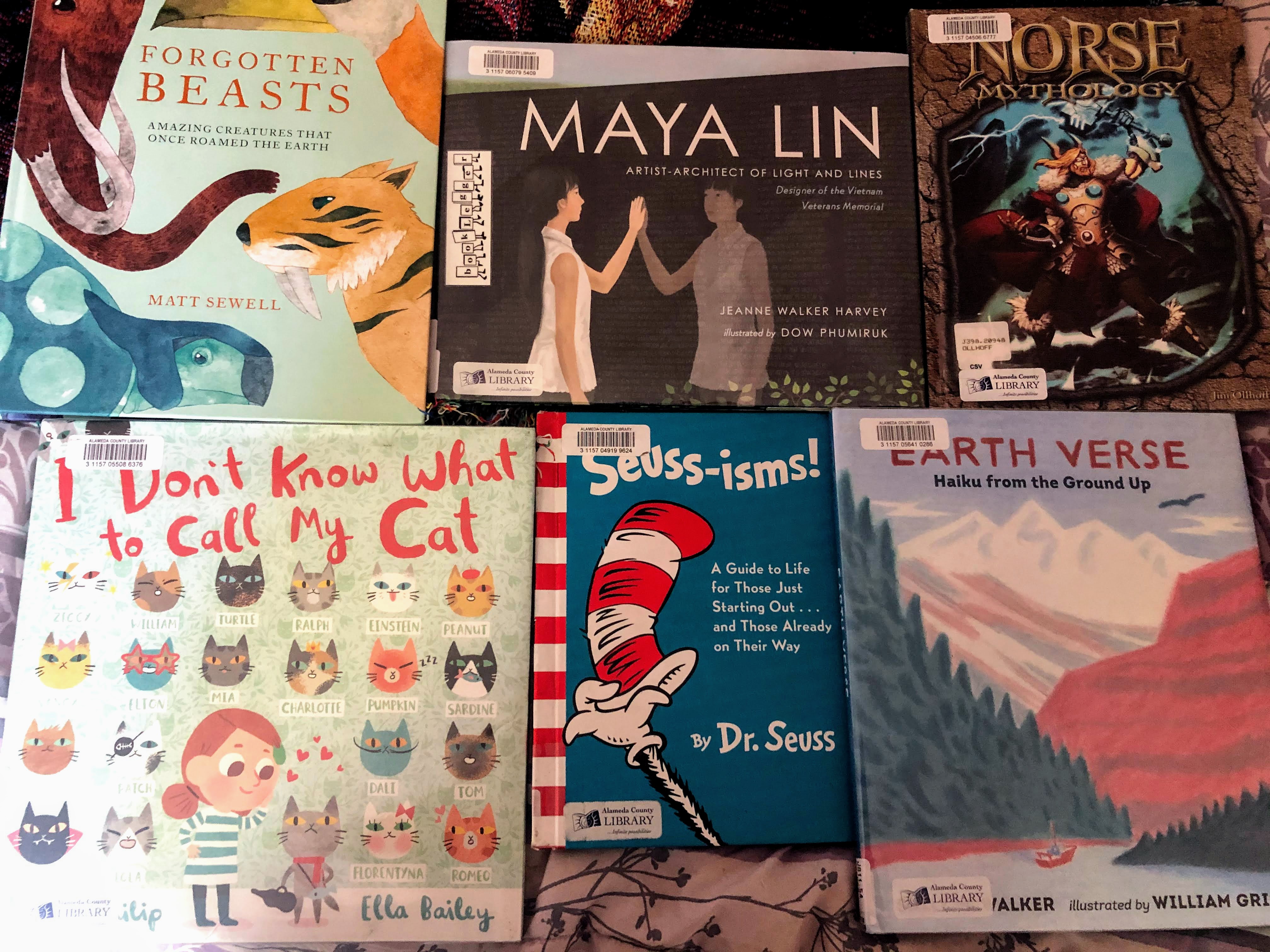
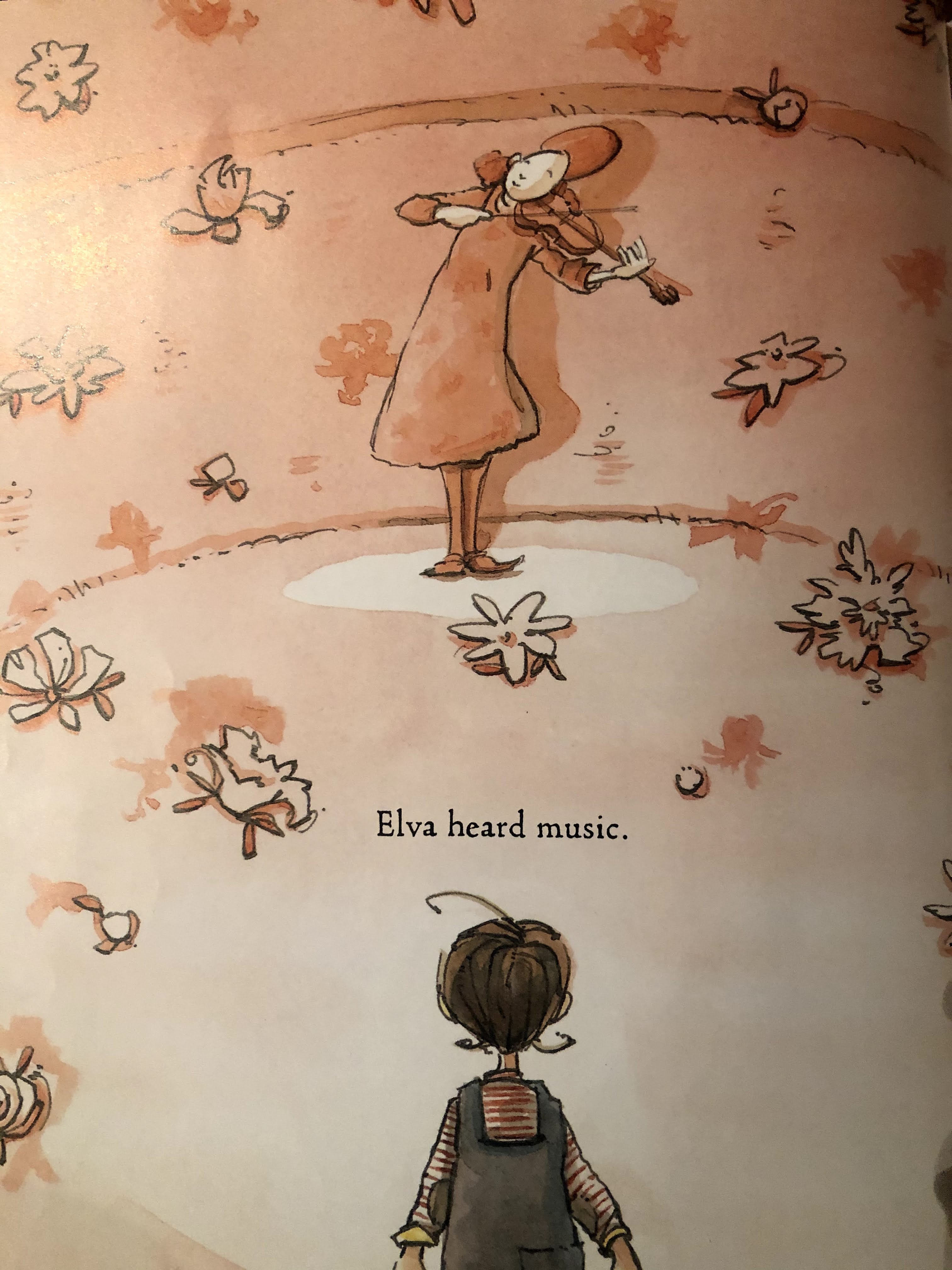
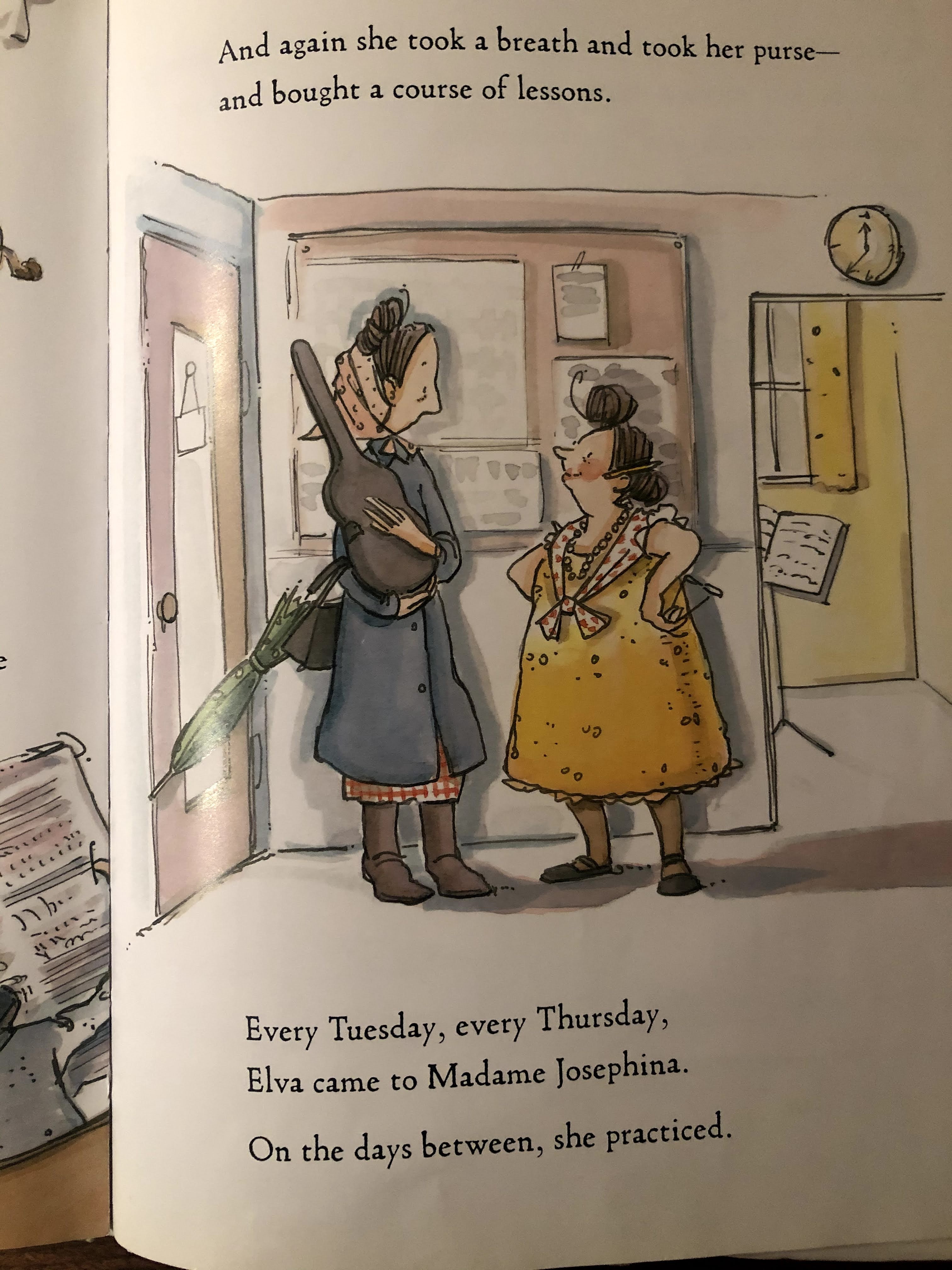
I peeked out the window and saw a breeze flutter though the pine tree outside, and resisted no more. I picked up the beautiful children’s book, A Violin for Elva by Mary Lyn Ray, Illustrated by Tricia Tusa.

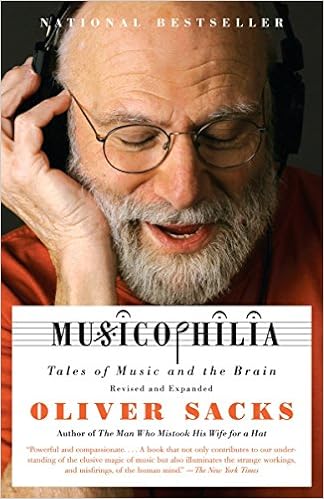
Fresh from reading Musicophilia – Tales of Music and the Brain by Oliver Sacks, I found myself analyzing the music in our lives. In Musicophilia, Oliver Sacks writes about musicians who don’t read music, but get to listen to the music in their heads as they read the sheets. I imagined the neurons in their brains reacting like those little piano keys – bobbing up and down.

Who remembers Tom & Jerry Piano Concerto? Here it is for those of you requiring a refresher.

The music teachers at our school had been blessed by the muses themselves. I remember many a morning assembly being mesmerized by our piano teacher’s musical notes wafting from her swift hands flying across the piano. The band master and the Indian music teachers were just as talented and gifted. 

How could one man teach the saxophone and the bugle, just as marvelously as the drums?

How could one person teach the harmonium, sitar and the tabla? 

I have always wanted to learn to play a musical instrument. It is probably why I never tire of seeing Anoushka Shankar’s hand leap up and down the sitar producing marvelous music. The harp player must be harnessing a power of the gods, and no wonder the goddess of learning in Hindu mythology holds the Veena.

I sat by the rose bushes reading. A gentle breeze accompanied the birdsong outside. I watched mesmerized as the breeze rippled through the luscious pines generating green soothing waves. Well, I may not know how to play a musical instrument, but I am lucky indeed to be able to enjoy the music.

I opened the book, A Violin for Elva, and was soon so happy with the choice of book. The book talks of Elva listening to music wherever she went. She imagines herself playing the violin, and asks her parents for one, but she doesn’t get one. She goes about imagining her toothbrush, tennis racket and anything else to be her violin. The whimsical illustrations are a joy to behold.

Life passes her by, and in her working years, the faint whiff of her love of music is there, but she is too busy in the busyness of living. 

Finally, after her years of working, she gets herself a violin to teach herself, but finds it very hard. She then goes for music lessons and when she gives her first concert, the sense of accomplishment, the much-delayed gratification she receives is amazing. It is also a reminder to those of us waiting to do what we love that though it is never too late to take up what we love. It is also pointless to let life pass us by. 

“How we spend our days is, of course, how we spend our lives.” 

Annie Dillard

Elva’s story reminded me of Mary Oliver’s essay on the three distinct selves within each of us:

  • The Child Self
  • The Social Self &
  • The Eternal Self.

Though in the essay, Mary Oliver, refers to the Eternal Self as the artistic self, I like to interpret it as the Creative self. 

  • The Child Self is in us always, it never really leaves us. 
  • The second self is the social self. This is the do-er, the list maker, the planner, the executer. 
  • Then, there is the third self: the creative self, the dreamer, the wanderer. This is the self that needs nurturing.

The essay ended on this note:

“The most regretful people on Earth are those who felt their own creative power restive and uprising, and gave to it neither time nor power.”

Mary Oliver

It was a chastening thought to enjoy those things that sustain us, and in doing so make our lives meaningful and joyful.

What would you like to nurture?

The Mystery of Human Potential

The Undoing Project, By Michael Lewis, started off with a baseball team’s challenges in picking the next star. I might’ve appreciated this chapter more had I known baseball ⚾️ I suppose. As things rest, I know it is a lot of activity, running, a bat with a ball and two teams. However, I appreciated the gist of it i.e the ability to spot human potential. Now, that, I can identify with. 

The Undoing Project: A Friendship That Changed Our Minds by [Michael Lewis]

As the book moves on to introduce us to Danny Kahneman and how as a single psychologist in the Israeli Army, he was tasked with the humongous task of trying to identify army recruits and figure out which positions they would be best suited for. Which ones would make good tank operators, which ones are better suited to quick guerilla warfare, which ones will fare better as aerial surveyors etc. 

The fact that this was not only attempted and done, but still stands in its rudimentary form is amazing. 

Unlocking and identifying human potential is one of the toughest problems in the world. There are indicators, yes, but no sure way of knowing who has the ability to self-motivate and stay in the game. As a technology leader, it is often a baffling experience for me. People who fared exceedingly well in well-thought out structured interviews come onboard and don’t sparkle in their roles at all. Some others who were doubtful in the screening process, come through as diligent, hard workers, willing to put in their all to learn and be happy about it. 

Recruiting sites, AI/ML models all have only limited success in the true test of human capabilities. The fact that there is a lot happening that just cannot be captured is a well-known fact. The field of psychology and mathematical models using statistics to better understand human mystique is fascinating. 

I am only halfway through the book, but the collaboration of the great minds of Daniel Kahneman and Amos Tversky is already a pleasure to read. 

Psychology – as is termed by Academia as a bin for all things unsorted is a great place to be. The combination of mathematical intuition with the brains functions, and how to design experiments for these are fascinating by themselves.

How come some of us are optimists, others pessimists and so many of us in all the areas of gray between these two extremes?

How come we make large decisions without as much agonizing as the smaller ones?

How come some of us embrace humor?

I am only about halfway through – I am fascinated, but not enamored by the book.

The Moon Periodically Enchants Us

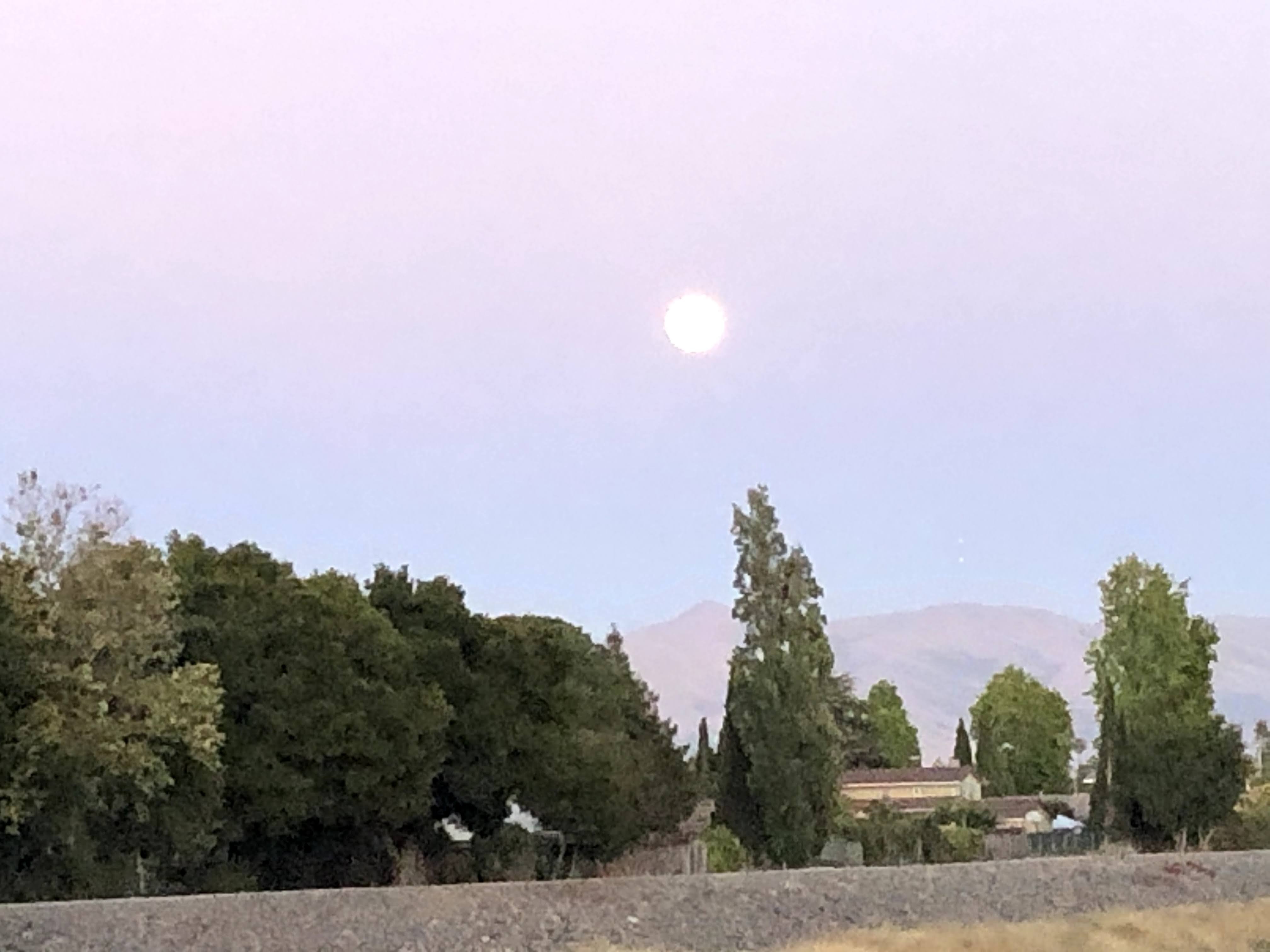
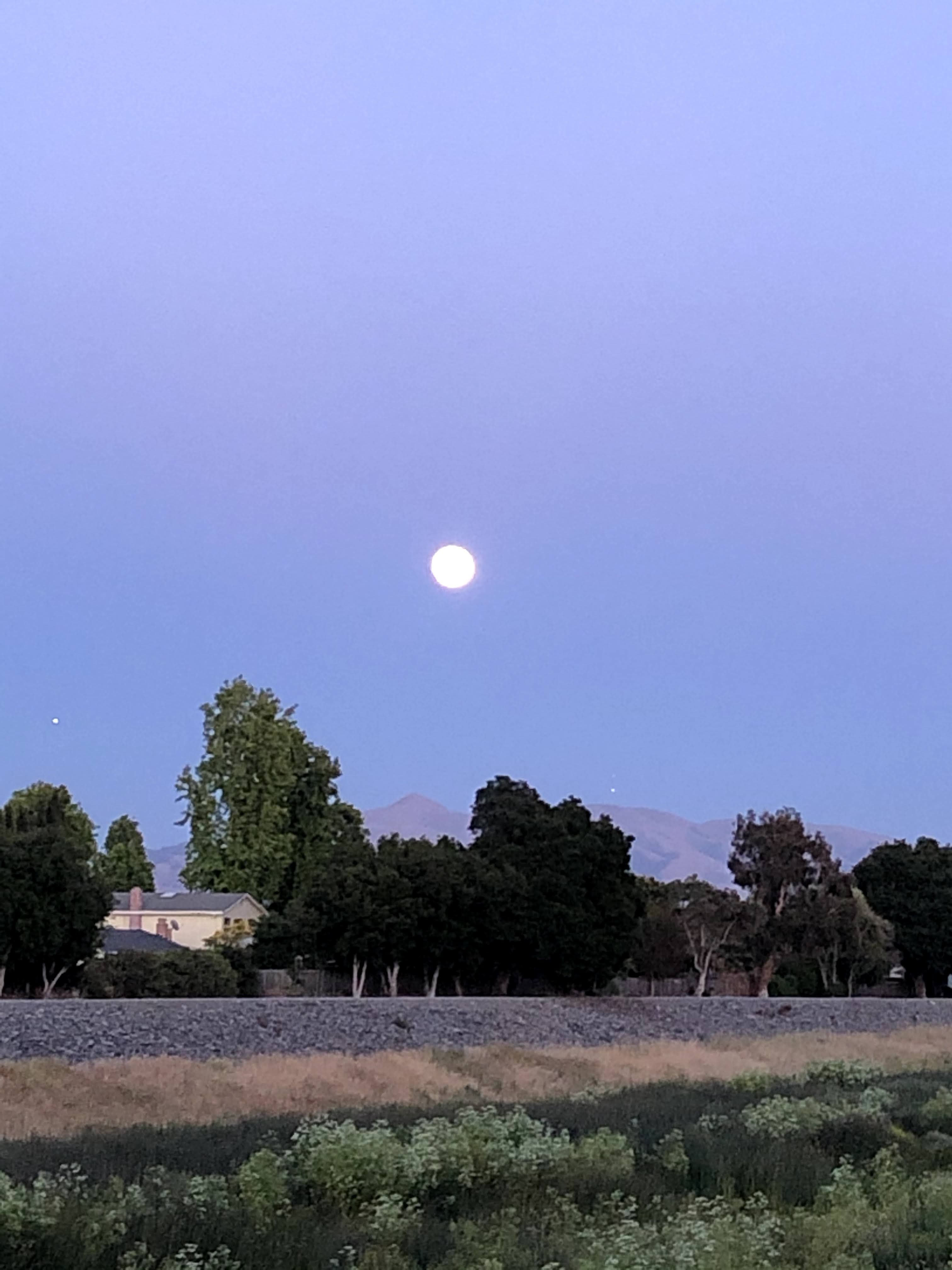
It was only fitting that the full lunar eclipse of Wednesday was best visible from the little cosmologist’s room window.

I walked into the son’s room to wish him good night. There he was, lying down on his tummy in his pajamas, his face cupped in both his hands staring at the periodic table poster and glancing at the moonlight shining outside. 

He looked up at me, and said, “Isn’t it amazing how many elements there are? I think I can sing the periodic table song till the second row.” And then, of course, he proceeded to sing it. We talked about the elements and how they found each one. 

The periodic table game is an enchanting one. Which letters don’t have an element? Are there many more elements in the universe that we didn’t yet know about. I mean they found Lawrencium etc pretty recently didn’t they? 

Reminded me of the book, Uncle Tungsten by Oliver Sacks in which he talks of his obsession with the periodic table. 

“The periodic table was incredibly beautiful, the most beautiful thing I had ever seen. I could never adequately analyze what I meant here by beauty – simplicity? coherence? rhythm? inevitability? Or perhaps it was the symmetry, the comprehensiveness of every element firmly locked into its place, with no gaps, no exceptions, everything implying everything else.” 

Oliver Sacks, Uncle Tungsten, Memories of a Chemical Boyhood
Uncle Tungsten: Memories of a Chemical Boyhood by [Oliver  Sacks]

We sat there wondering whether our beautiful moon itself has other elements, or essentially those of the Earth. Fascinating questions to engage the mind on a beautiful full moon night. 

I knew he would be equally thrilled about an adventure in space that was to take place early the next morning, and told him about it. A full lunar eclipse my boy! Can you imagine that?

“…We ourselves were made of the very same elements as composed the sun and stars, that some of my atoms might once have been in a distant star. But it frightened me too, made me feel that my atoms were only on loan and might fly apart at any time, fly away like the fine talcum powder I saw in the bathroom.” 

Oliver Sacks, Uncle Tungsten

Almost immediately, he said, “Okay Google! Set an alarm for 4 a.m.”

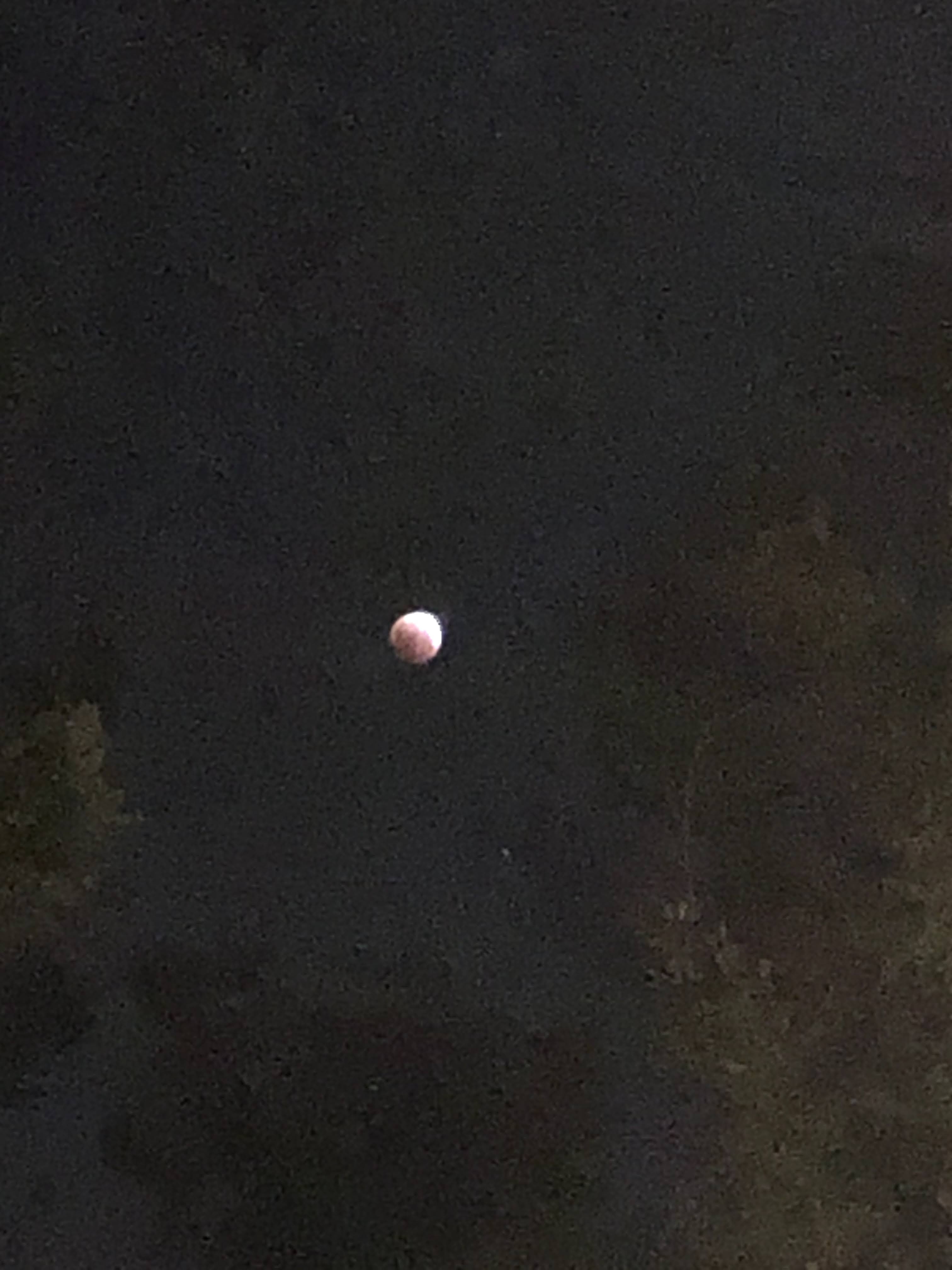
The next morning, I snoozed my alarm titled ‘Moon Magic’ at 4 a.m., and was wondering whether to pull myself out of bed, when I heard the son bustling about. He tugged us all downstairs and we stood there in the courtyard in front of our home gazing at the beautiful red moon – a giant golden orb that huge low in the sky had morphed into a silver ball of luminescence and was now a red rock suspended in mid-air. If this wasn’t magic, I don’t know what is.

The husband went into the home after a few moments – we were slightly cold, but stood mesmerized by the slow show being put up for us by the cosmos. The husband called in a few seconds, and said to the son, “By the way, the best view is from your room!” We raced up to his room, and gazed outside the window. True enough. It was the best view. Snuggled up in his warm comforter, sipping hot cocoa, I left the fellow to gaze and dream on as the silvery moon emerged from earth’s shadow. 

The eternal magic of light combining with the structural elements of the earth and moon make for a magical night indeed. 

The Music of Rose-Scented Winds

Roses are blooming everywhere. The white, saffron, yellow, pink, corals and red roses are a real treat to behold. Watching the breeze gently take the rose essences and waft off into the neighborhood reminded me of an old Tamil song. “Rojavai thalaattum thendral…” a few weeks ago, and I hummed it as I went about my day. Loosely translated, it means a breeze that caressed the roses. 

“Dei! One more time, you sing that song……” said the husband. 

His tone of voice reminded me of my elementary school friend all those decades ago, when I sang something continuously, wrongly and unknowingly at times. 

Particularly prone to these brain-itches or ear-worms, I am not particularly fond of them either. I thought life was full of them, till I noticed my friends seemed to be able to enjoy a song, hum it a bit and then move on with their lives, without the annoying thing being stuck in their heads for weeks at a time. 

The curious case of not being very good at picking the lyrics out in a song also means that I am singing garbled nonsense, and often just snippets of them as I go about the house. 

I don’t know how folks live with me, for I want to box my ears every time  ‘rojavai thaalattum thendral ‘loops on in the old brain. Apparently, the song itself has a good enough lyrical quality, but I would not know anything about it for I have never been great at catching the words in a song. I sing

Rojavai thalaatum thendral, poon thendral, yen mandral (No meaning). 

Un nenjil porattangal hohoho (Santa Claus>!), rojavai thalaatum thendral…”

I am sick of the song, but luckily not of the roses. 

For one prone to brain-itches such as these, the modern world can be quite the problem. There are catchy songs on television, in cars, radio stations, not to mention gas stations, almost everywhere. It is only recently that I found listening to instrumental music helps since it allows me to listen to music without having garbled phrases stuck in my head on an endless loop.

“Many people are set off by the theme music of a film or television show or an advertisement, This is not unusual for they are catchy tunes” says Dr Oliver Sacks, in his book, Musicophilia (Read the essay titled “Brainworms, Sticky Music and Catchy Tunes”)

He writes of his friend,Nick, who had fixated on the song, “Love and Marriage”and was ‘trapped inside the tempo of the song’. 

I nodded along fervently as he wrote of his affliction:

“With incessant repetition, it soon lost its charm, its lilt, its musicality and its meaning. It interfered with his schoolwork, his thinking, his peace of mind, his sleep.”

Originating from the literal translation of the German term Ohrwurm, an earworm can go on for weeks, or in some cases months.

When I read about this phenomenon in Oliver Sacks’, Musicophilia, I hummed the broken piece. I wish I could’ve written to the wise doctor and asked him whether he had come across any cases where the patient was stuck in a song with lousy garbled words in the correct tune, and how their marriage with a man who could not hold a tune but could ace the words would function. (Read: The Noetic Touch to the Poetic Muse

Alas! Dr Oliver Sacks is no longer alive to share his insights with us.

The Covid Vaccine

We rolled into the expansive grounds to receive the Covid vaccine. Everything shone with efficiency starting from the way our appointments were scheduled. It always astounds me when I see undertakings as large as this. Any public health initiatives are amazing in their scope and ability, and I was in awe. Like a child at the fairgrounds, I soaked in the sign boards, the appointment process, the courteous health workers all working on Saturday mornings to ensure the world can be a safer place. 

There were no questions unrelated to one’s health. No checks other than ensuring one was eligible age-wise and health-wise and had no known allergic reactions. 

As we waited for our turn and watched the registered nurses, volunteers and traffic attendants go about their duties, I thought once again of all the great things human beings are capable of as a species. Within a year of the coronavirus bringing the world to a stand-still, a vaccine was not just found, but mass produced and administered to millions of people. That is nothing short of a miracle. Even as the virus continues to spread its tentacles in waves, the vaccine outreach program was offering hope.

Extensive testing, mass production, and a dizzying level of community outreach and logistics had gone into place for this to work. But how did the mRNA vaccines work?

We live in the Information Age, and know first-hand how it can quickly be turned on its head to a Misinformation Age. A Quote from the Demon Haunted World came to mind.

“We’ve arranged a global civilization in which most crucial elements—transportation, communications, and all other industries; agriculture, medicine, education, entertainment, protecting the environment; and even the key democratic institution of voting—profoundly depend on science and technology. We have also arranged things so that almost no one understands science and technology. This is a prescription for disaster. We might get away with it for a while, but sooner or later this combustible mixture of ignorance and power is going to blow up in our faces.”

Carl Sagan, The Demon-Haunted World: Science as a Candle in the Dark

The nurse came up to the car with a thin needle and I closed my eyes instinctively. She smiled and said, “It’s done. You feeling okay?”

Just like that, the tiny ant-like pinch of the needle that delivered a tiny dose of messenger RNA gave rise to something else.

I felt a surge for love for America

A touch of pride in its efficacy and its courtesy

A ripple of gratitude for Science

A shiver while thinking how it might have been had the 46th President not been elected.

And finally a sense of gratitude that we did have a President who valued these things.


Musings: Whally Mousical

 I was reading to the son’s classroom. I had planned out two little sections – one from the Tale of Despereaux and the other a true story of a pod of whales saved from the iced in waters of Siberia. The theme linking the two was music. I started, and the little musicians looked thrilled. I was too.

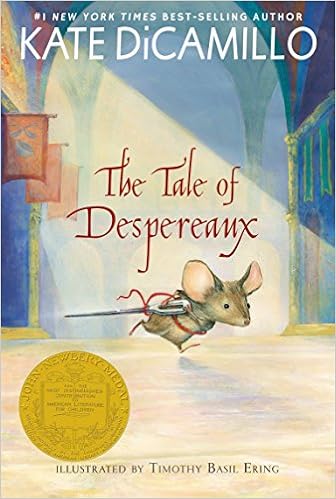
As I turned to the start of Chapter 4 in which the little mouse who was different finally understands what that honey-sweet sound was. I felt like Despereaux myself as I read about how little Despereaux felt a welling in his heart for the music, and how he slowly forgot where he was, or what he was doing. Slowly, he inched out from his hole, listening, mesmerized to the king playing music. As I read it out aloud to the children, I wanted to stifle a laugh, for a childhood memory peeked out of its deep hole the same way that Despereaux did. 

“And he discovered, finally, the source of the honey-sweet sound.

The sound was music.

The sound was King Phillip playing his guitar and singing for his daughter, the Princess Pea, every night before she fell asleep.

Hidden in a hole in the wall of the princess’s bedroom, the mouse listened with all his heart. The sound of the King’s music made Despereaux’s soul grow large and light inside of him.

Oh,” he said, “it sounds like heaven. It smells like honey.” 

Kate DiCamillo, The Tale of Despereaux

We lived in the chilly mountainsides, and often times, the cold outside attracted rats and mice into the warm house. Several times, when music was playing in the old tape recorder, we would notice a mouse peeping cautiously and just listening. Curious as to what the noises meant maybe, but maybe not. One of the family would shriek, and the pater would at first try to quieten us down saying it was just a little mouse enjoying some music – so what, or something to that effect, only to have a somewhat more hysterical reaction. 

Almost reluctantly would ensue a hilarious game of hockey sticks against furniture trying to get the mouse. Mice are as nimble as well, mice, and humans are – how do I put this kindly? Clumsy. Well-fed humans have several disadvantages stacked against them as they go about the mouse chase:

* Leaning back in the chair after a good meal listening to music in the background has made them soporific, so while the hockey stick is meant to be a tool, it is often used as prop against which to lean on to catch a breath

* They lack the right motive to catch a mouse. The human’s motive is to see if they can tumble in another gulab jamun into the tummy before bed. The mouse’s is to get to the hole

* Crowd sentiment is hard to gauge. The mouse chaser is in the tough spot of being a warrior and a saviour. While the shrieking indicated that something must be done, if something were done, the shriekers would be devastated and clamor for animal rights. So, the mouse chaser has to diplomatically chase the mouse, but not harm it in anyway.

 By the end of this jolly game of mouse chasing, the furniture has received several whacks from the hockey stick, and the mouse has strolled into its hole, while the music lilts on from the tape recorder. Which takes me to the curious scenario of mice in kings courts. I wonder how a mouse must’ve been treated in the king’s court. Would the musicians stop playing, while the commotion continued, or would they lilt on? The shriekers would be more, and therefore the motive higher. Would the courtiers gallantly prove their loyalty to the king by mouse chasing themselves, or let the warriors go for it?

They say a mouse’s brain is closest in structure to the human brain, so is that why we enjoy music together? 

New Items: Lab Rats Listen to Mozart and Become Maze Busters

So Mozart turns rats into maze-busters. But does it have a similar effect on humans?

I suppose The Pied Piper of Hamelin knew what he was doing. 

The story of the effect of Classical Music on Whales is equally mesmerizing. From the book, The Symphony of Whales, By Steve Schuch

The story, is based on a real incident that happened in the narrow Senyavina Straits of Siberia. Over 3000 beluga whales had been trapped by the rapidly freezing waters in 1984-1985. For seven weeks, the people of the Chukchi peninsula, and the crew of the Moskva risked their lives to save the whales.

The story does not end there. Once the icebreaker ship, Moskva, had cleared the way, the whales had to follow the ship out into the open seas, but they were reluctant to do so. The crew tried playing whale song to lure them. While they reacted to the music, they were not assured of human intent, and were still scared of the engine sound. They lurked in the waters.  Then they tried Classical Instrumental Music.

“The crew found some classical music. First, the sweet sounds of violin and violas, next the deeper notes of the cellos and, deepest of all, the string basses…and way up high, a solo violin…

Everyone fell silent as the music carried over the waters.”

That had done the trick. The ship’s engines started and the whales slowly followed the icebreaker out into the open ocean.

Some musings are whally mousical, and all the more whimsical for it. The children seemed to enjoy the reading too. Their wondrous brain did not once question why a mouse liked music or how whales, mice and humans liked the same kind of music. 

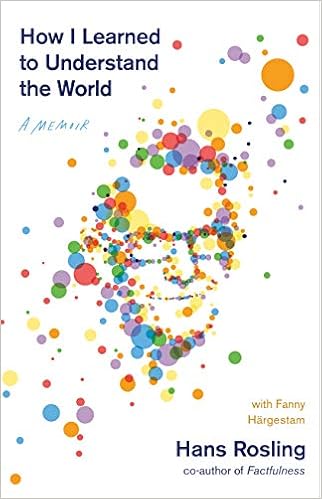
Coming Soon: Musicophilia

Roving on Planets

Standing outside by the curbside of our home one night, my eyes were drawn to the beautifully illumined Sirius shining bright in the night sky. Sirius has been looking brighter than usual in the winter skies, and I have often stared at the blinking star wondering what was happening that far away in the Universe.  Every dot in the night sky suggesting a universe of possibilities. The space between dots showing the emptiness, the dots themselves, bright and important only because of the surrounding darkness

Almost subconsciously, my eyes moved over to the red spot Mars. For here, in our own solar neighborhood, we know that something is happening. Something of human interest, and intent. To think that on that distant reddish spot in the sky, 3 generations of rovers have spent the time taking photographs and trying to determine the existence of life on the planet, is surreal. Not to mention the fact that they have been able to transmit the pictures back to Earth for analysis. 

Screen Shot 2021-02-21 at 2.46.02 PM

The planet has long beckoned us with its allure. All those Science Fiction writers, who used the planet as the home for their fertile imagination, paved the way for these missions. 

Fiction on Mars isn’t new. In fact, the red planet invited writers as early as mid-1800’s to set their stories there. Long before knowing anything about the sounds on Mars, the temperatures, or the atmospheres; worlds were set in it. War of the Worlds had the strangest creatures that human imagination could think of (cephalopod like creatures), who could overpower humans. (This quest for dominance vs courteous co-existence is a pet peeve – why must we turn everything into a conquest? But then, do ants wonder the same about us?) 

martian-ray

Throughout the week, the little cosmologist in the house interspersed our Earthly life with Mars-ly anecdotes and clips. 

Do you know? If we want to live on Mars, we have to have high metal barrier suits. If you go out on an adventure without a suit, there is so much radiation that it could kill you. “ (He had read a novel set in Mars)

Wonder what happened to all water on Mars. The video said there really was water there.” (He has been watching the NASA  videos with interest)

One evening, we sat together huddled up, watching pictures stitched together from the 3 Mars rovers: Opportunity, Curiosity, Perseverance. Barren desert landscapes, not unlike those in the Sahara desert or the Arizonian deserts, are all the rovers could see. In some shots, the commentator says the NASA team stitched thousands of individual images together to gain a clearer view. In some pictures, a blue sky is visible  (the commentator says that NASA colored the skies blue, so as to be able to see the images better, and I thought about how pretty blue skies are and how blue is a very rare color in nature. )

Curiosity and Perseverance will help us find answers. Till then, we have the opportunity to ponder and puzzle about these things. More than any of these curious wanderings, the one thing that the Martian landscape reinforces to me, is that our Earth is a beautiful planet – so vast in its diversity, and lifeforms. The Martian pictures make me want to go out and sigh and fall in love, look after, and cherish the one planet we can thrive on. To admire the miracle that is every tree, every lake, every cloud, every blade of grass, and every flower. 

summer-collage

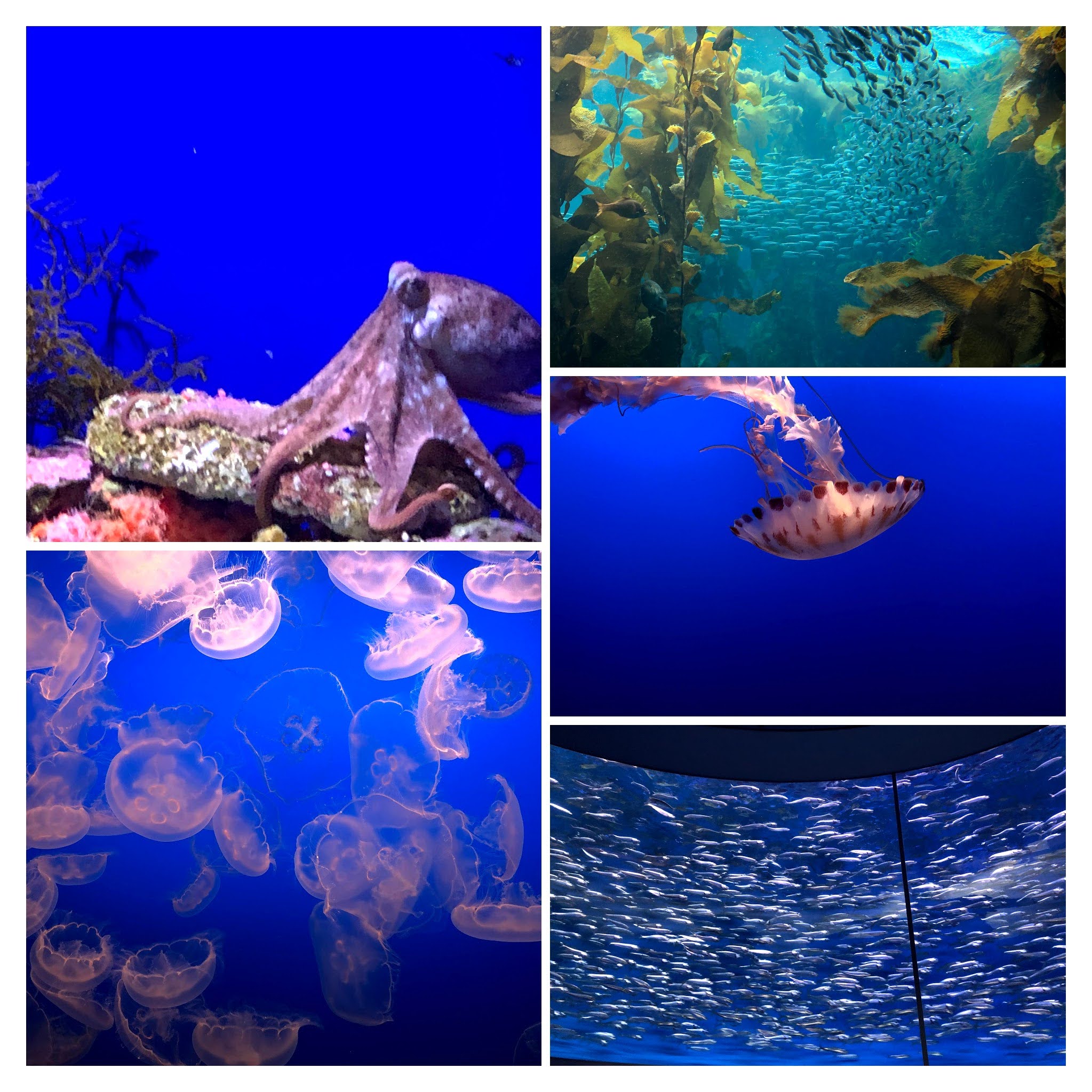
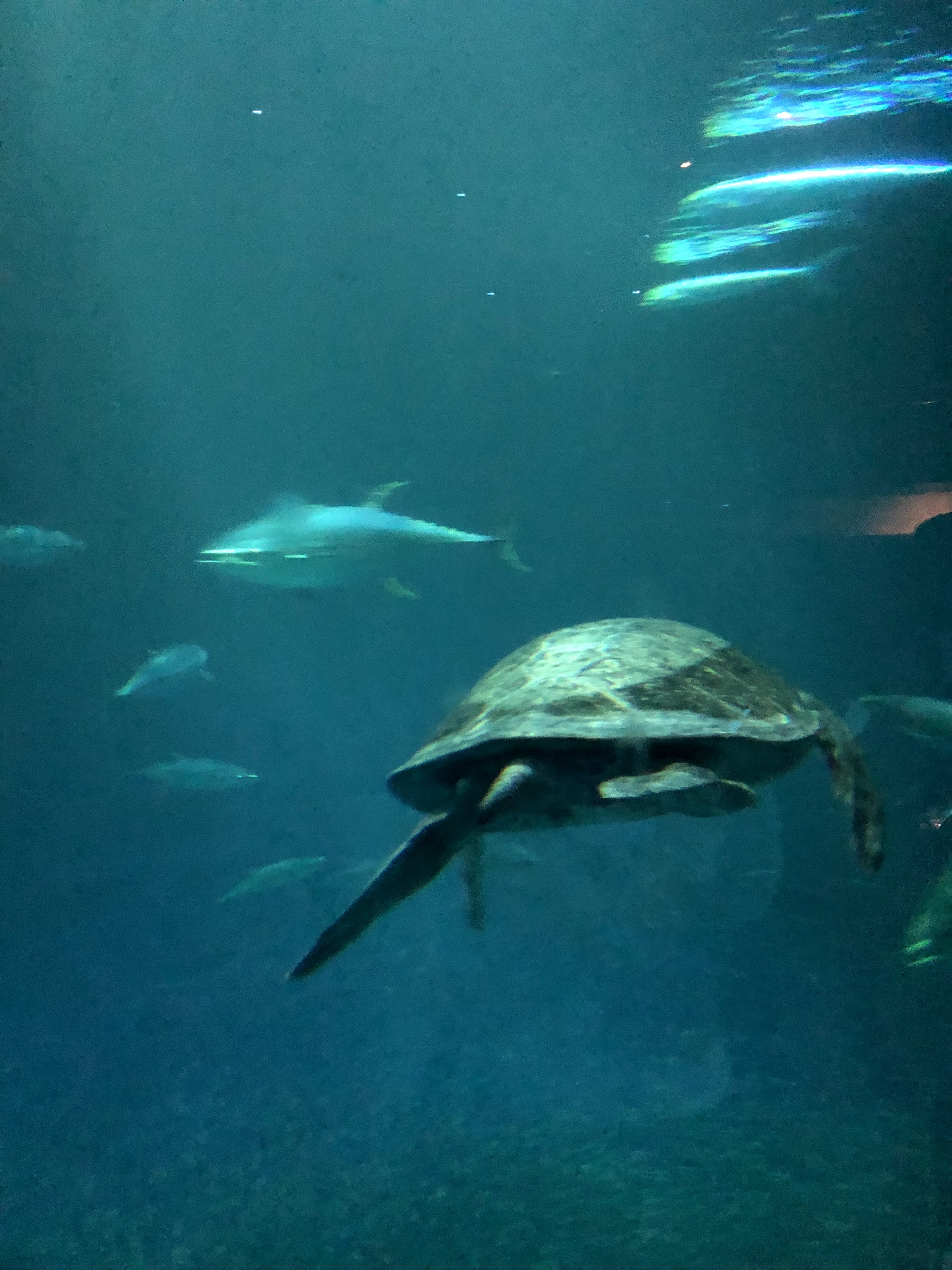
Not to mention the great miracle of life in the form of marine creatures, land based creatures and those that are able to aerially survey our beautiful planet. 

img_1168-collage

If Martian 4K resolution images have taught me anything, it is to buckle down and look after the one planet we do have. If I am to be roving on planets, why not this beautiful one that has so much to offer?

“I walk in the world to love it.” – Mary Oliver

The 3 Cs

The daughter was educating me on Cancel Culture. I sometimes get classes such as these from the snarky teenage daughter. The syllabus is contemporary and loosely defined. Topics include ‘vibing’ with the times, progressive thinking patterns, book/movie reviews etc. This, she says, is necessary for someone like me who knows nothing about trends, latest pop culture references etc. “I get by!”, I tell her. But even as I say it, I get the feeling that I must sound like a wheezy dinosaur who hibernated too long and woke up in today’s age to her. Time is a curious entity for I remember the parents laughing when I enlightened them on some of these things as a teenager. 

“Anyway, want to come for a walk with me?” 

“Nope – going by myself.”

In the written medium, it is hard to pull off the time-lapse between the question and the ‘nope’ because there was none. Immediate response. Nope. Going by myself. 

“Fine! Be that way! Canceling walks with mom huh?!” I said, rolling my eyes. It did not seem to bother the girl. Off she went, straight backed and a little wave of her hand as a response. 

A few minutes later, I set out on a walk by myself, and who should I find? But the darling daughter, in apparent distress too.

“Hey! I am here!” I said waving inelegantly. I was thrilled to be seeing her, but by the looks of her reaction, I was no better than a twig fallen from the trees bereft of leaves above. Some people quietly act like their raised hand was just an attempt to stretch or straighten their hair. Nonchalance, ease, grace are all words that come to mind. Yours truly, on the other hand, upped the efforts. I was now gushing steam from my trunk-like spout of a nose, and waving like elephant ears in mid-sprint warding off pesky flies, not to mention sounding like a hoarse trumpet. 

I finally attracted the child’s attention. As I should have guessed, she had air-pods stuck in her ear-lobes and seemed relieved to see me. Her slipper straps were broken, and she needed help hobbling back home. 

It was a beautiful, sunny February day, The cherry blossoms were in bloom everywhere, the trees had not yet started to grow their leaves, and the blue blue skies above made for a perfect day! Though it was technically winter still, Spring was clearly in the air. If I lived near fields, hedgehogs may have been up and about. I didn’t know. All I knew for certain was that yellow thrushes, sparrows, and blackbirds had all hatched, and the air about us was rich with the twittering of birds. I said as much to the daughter. She rolled her eyes. 

“Yes Miss Different. I know you don’t think you are like me, but look at you mooning about the roads on a beautiful day inhaling the deep fresh air! “

She had the grace to laugh. I looked around sniffing rapturously and stopped. There was a beautiful patterned bug going about its business by the sage and lavender bushes. “Oh! Look – such a beautiful pattern on its back too!”

“Amma! Don’t touch it. This is a red bug – it is probably poisonous!” she said. 

“That’s Color-ist! So, what now if a bug is red, it is poisonous?! Going cancel-culture on red bugs now, are we? Oooh! “ I said. She laughed, and I carried on, feeling encouraged, “What about ladybugs huh?! You were constantly telling me to bend down and watch lady bugs slurry about in spring time when you were a child. Are they poisonous too?!”

“No….it is their defense mechanism. “ 

“Huh! How interesting!” I said. I think the genuine surprise and curiosity in my voice took her aback somewhat. But she liked it, and carried on. “Yes…monarch butterflies for instance are that bright orange for a reason. They are poisonous to birds, and birds know to leave them alone. So, painted lady butterflies evolved that way as a defense mechanism. They look very similar, but they aren’t poisonous.”

“Wow! You know so many interesting things. That is why I ask you everyday to go for a walk with me my dear.”

“Yeah! Ma! This is 4th Grade Science.” she said in her Elementary-my-dear-Watson voice. We laughed and sailed home together. I think Maria Meriam would have approved of our natural wonders lesson in Spring time.

The Girl Who Drew Butterflies: How Maria Merian’s Art Changed Science – Joyce Sidman

IMG_8198.jpg


Mars Marvels

There is something special in being able to watch the Mars Perseverance Rover land on Mars during the day with your fellow explorer. 

Mars.Nasa.Gov

A work day was in bustling progress.  Many meetings, many projects, many interruptions, and many more deadlines were jostling about in the ether, when the son came charging into the room. It was the middle of his school day (one of the many high points of the corona lifestyle), “Amma! Amma! You will like this. I just came to tell you this! The Mars landing just happened!”

I plucked myself away from the myriad day-to-day happenings of my world, and looked up at his excited face. Luckily, it was one of those rare ½ hour slots that was meeting-free. “Do you want to see the landing? “ I asked, and he nodded. There is something special in being able to watch the Mars Perseverance Rover land on Mars during the day with your fellow explorer. 

Mars.Nasa.Gov

Screen Shot 2021-02-21 at 2.46.02 PM

The video attests to Carl Sagan’s deductions in the book, Pale Blue Dot (essay: Sacred Black). The Martian atmosphere does look pinkish red with heavily desert hues. The son & I looked outside at the beautiful blue sky with reassuringly white clouds flitting by. 

The Mars Perseverance Rover is tasked with looking for evidence for extraterrestrial life.

Excerpt from Wikipedia:

The Perseverance rover has four science objectives that support the Mars Exploration Program‘s science goals:[8]

  1. Looking for habitability: identify past environments capable of supporting microbial life.
  2. Seeking biosignatures: seek signs of possible past microbial life in those habitable environments, particularly in specific rock types known to preserve signs over time.
  3. Caching samples: collect core rock and regolith (“soil”) samples and store them on the Martian surface.
  4. Preparing for humans: test oxygen production from the Martian atmosphere.

Mars has, it seems, been a most fertile planet for the imagination through the centuries. From harboring questions about life on its surface to envisioning warfare between worlds. As rich as lifeforms on Earth are, even in our imaginings, we are somewhat limited by how life has evolved on Earth. Cephalopods, trees, giraffes, humans – but what else is possible? What sensory powers are we not even considering?

https://en.wikipedia.org/wiki/Mars_in_fiction

The War of the Worlds (1898) by H. G. Wells. Features an attack on England by cephalopod-like Martians and their advanced technology to employ fighting machines to decimate the world.

Even as early as the 16th and 17th century, writers made bold attempts at imagining life on its surface. The canal like squiggles on its surface, led to intriguing theories on an advanced civilization running advanced colonies etc. 

Now, seems like a good time for me to read The Martian Chronicles by Ray Bradbury. Given what we know about the Martian atmosphere now, there are places where the writing seems awkward. For instance, Ray Bradbury writes of a blue Martian sky – an example that it is hard for us to un-imagine what is. 

martian-ray

The Martian Chronicles (1950) by Ray Bradbury. Features human-like Martians with copper-colored skin, human emotions, and telepathic abilities. They have an advanced culture, but the human explorers are greeted with incomprehension. 

Science took us to Mars with the reddish sky, but it was the blue sky with white clouds that enabled us to dream. The hunter gatherer is us out to explore the cosmic ocean, as Carl Sagan would say.