The Pandemic Year

“Why don’t you pick out a children’s book from the ones stacked there?” I said nodding at the pile from the library.

The son picked out Our Great Big Backyard for us to read together. Written by Laura Bush and Jenna Bush Hager, and illustrated by Jaqueline Rogers, the book extols the beauty of the natural world around us. It is about a girl, Jane whose family takes a wonderful road trip across the United States making several stops along the way at the magnificent national parks. Jane is very reluctant at first, and fights with her brother missing her friends back home initially. But as the family makes their way from Everglades National Park in Florida to Yosemite National Park in California, Jane’s appreciation of the natural world expands.  She cannot wait to share the wonders of the natural world with her friends back home in their own backyard.

“Can you imagine last year this time, we were traveling all over the world?” I said, expressing shock at how soon our world changed for the n-th time since Covid-19 started

It was true. I had made several trips back to back in December 2019, and early January 2020. I remember feeling unmoored from Earth, somewhat dizzy in my speed of movement around the globe, and had felt a strange sense of being connected to the earth when I saw the spider’s web glinting in the winter dewdrops after the hours of flying. (I call it Tao)

It is a whole year since the World Health Organization declared Covid-19 a pandemic. A year in which some people adjusted admirably to their changed circumstances, while many others found it much harder.  Life everywhere was shaken out of its steady state. 

The past year was the year in which we morbidly looked at the death rates on a daily basis, and adjusted to losses of family members, and friends to Covid-19. It was also the year in which humanity astounded us by developing a vaccine before the year was out

The vaccines are being rolled out to older populations and front-line workers, teachers etc. While there are variants of the virus, there is already talk of returning to work, normal functioning etc. Many schools have resumed in-person instructions. 

This past year, Covid-19 has made everyone take pause and tread slower. Travel plans are seldom made, and even then, hopefully, are made considering crowds, infection and exposure. Most folks I know have turned an appreciative eye to what lies close by though. How many years the trees near us have had the same flowering in spring and fall, only to be barely noticed by us? Yet these past few months, the enjoyment of it has been greater. 

I feel like a renewed appreciation for Thoreau as he observed the intricacies of nature in Walden Pond. For this long, I hadn’t noticed how the moon rises later and later during the waning period, and earlier and earlier during the waxing period. (Or just the changes in when we see the moon) 

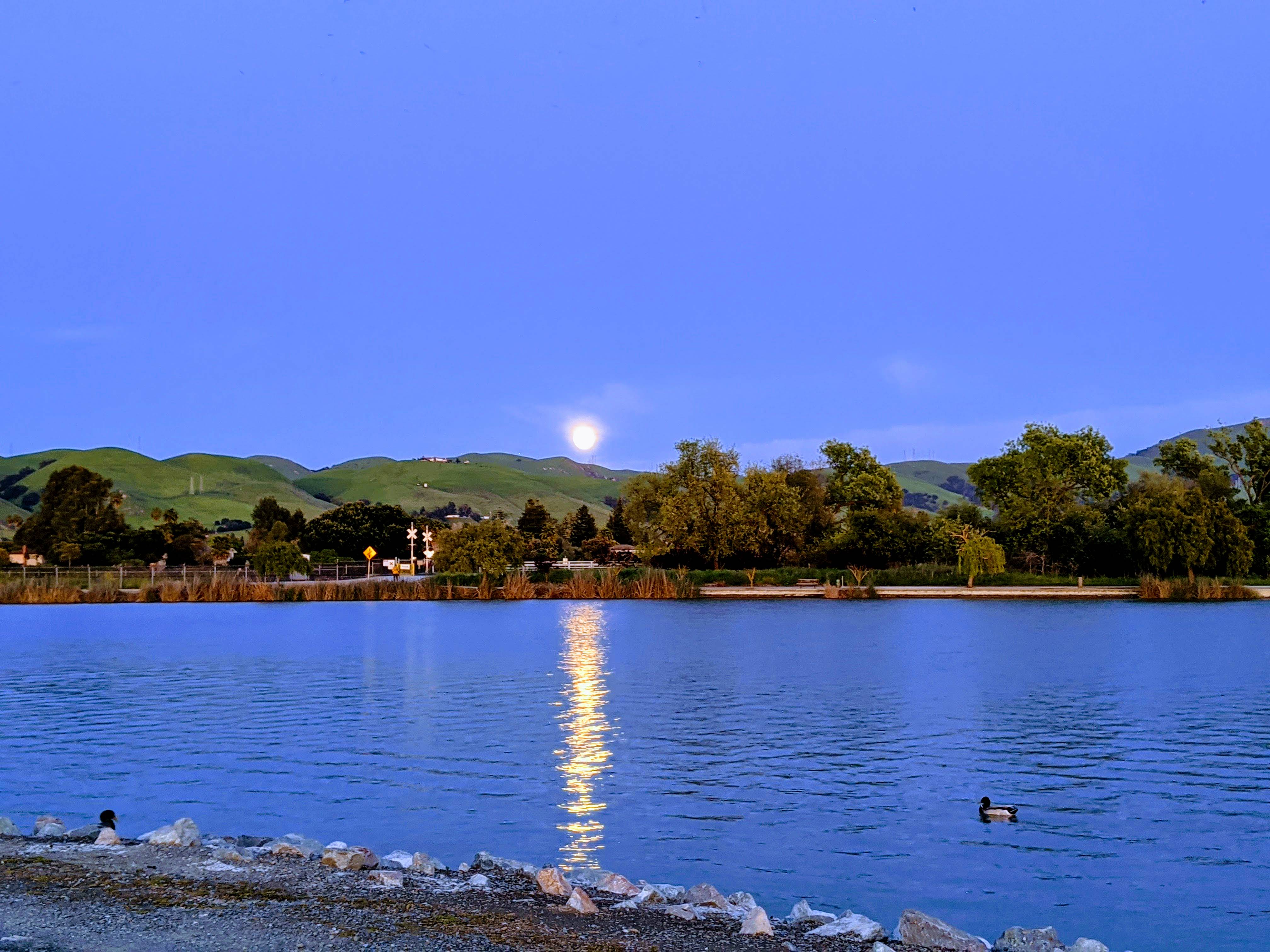
Full Moon Rising – March 2020

The Spring equinox means the days are getting longer, the cherry blossoms are in full bloom, and the leaves are sprouting everywhere. I remember one night when I was wakened by the sound of the pelting rain. I watched the rain for sometime, but wascompletely awed the next day, for the rains had ushered in the leaves on the trees overnight. I swayed around the trees wondering how  it would have been to watch the leaves grow overnight. 

Like Jane, the protagonist in Our Great Big Backyard , many of us realized, maybe for the first time, the many wonders of the natural world around us. 

As the vaccines are rolled out, and life limps back to normal, I hope we put the trying period behind us, but also remember the good things of this phase. The CDC announced that those who have been vaccinated can now gather indoors safely.

Musings: Whally Mousical

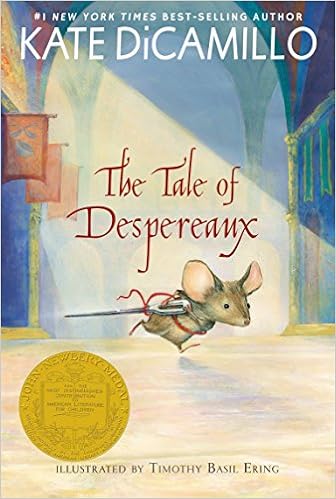
 I was reading to the son’s classroom. I had planned out two little sections – one from the Tale of Despereaux and the other a true story of a pod of whales saved from the iced in waters of Siberia. The theme linking the two was music. I started, and the little musicians looked thrilled. I was too.

As I turned to the start of Chapter 4 in which the little mouse who was different finally understands what that honey-sweet sound was. I felt like Despereaux myself as I read about how little Despereaux felt a welling in his heart for the music, and how he slowly forgot where he was, or what he was doing. Slowly, he inched out from his hole, listening, mesmerized to the king playing music. As I read it out aloud to the children, I wanted to stifle a laugh, for a childhood memory peeked out of its deep hole the same way that Despereaux did. 

“And he discovered, finally, the source of the honey-sweet sound.

The sound was music.

The sound was King Phillip playing his guitar and singing for his daughter, the Princess Pea, every night before she fell asleep.

Hidden in a hole in the wall of the princess’s bedroom, the mouse listened with all his heart. The sound of the King’s music made Despereaux’s soul grow large and light inside of him.

Oh,” he said, “it sounds like heaven. It smells like honey.” 

Kate DiCamillo, The Tale of Despereaux

We lived in the chilly mountainsides, and often times, the cold outside attracted rats and mice into the warm house. Several times, when music was playing in the old tape recorder, we would notice a mouse peeping cautiously and just listening. Curious as to what the noises meant maybe, but maybe not. One of the family would shriek, and the pater would at first try to quieten us down saying it was just a little mouse enjoying some music – so what, or something to that effect, only to have a somewhat more hysterical reaction. 

Almost reluctantly would ensue a hilarious game of hockey sticks against furniture trying to get the mouse. Mice are as nimble as well, mice, and humans are – how do I put this kindly? Clumsy. Well-fed humans have several disadvantages stacked against them as they go about the mouse chase:

* Leaning back in the chair after a good meal listening to music in the background has made them soporific, so while the hockey stick is meant to be a tool, it is often used as prop against which to lean on to catch a breath

* They lack the right motive to catch a mouse. The human’s motive is to see if they can tumble in another gulab jamun into the tummy before bed. The mouse’s is to get to the hole

* Crowd sentiment is hard to gauge. The mouse chaser is in the tough spot of being a warrior and a saviour. While the shrieking indicated that something must be done, if something were done, the shriekers would be devastated and clamor for animal rights. So, the mouse chaser has to diplomatically chase the mouse, but not harm it in anyway.

 By the end of this jolly game of mouse chasing, the furniture has received several whacks from the hockey stick, and the mouse has strolled into its hole, while the music lilts on from the tape recorder. Which takes me to the curious scenario of mice in kings courts. I wonder how a mouse must’ve been treated in the king’s court. Would the musicians stop playing, while the commotion continued, or would they lilt on? The shriekers would be more, and therefore the motive higher. Would the courtiers gallantly prove their loyalty to the king by mouse chasing themselves, or let the warriors go for it?

They say a mouse’s brain is closest in structure to the human brain, so is that why we enjoy music together? 

New Items: Lab Rats Listen to Mozart and Become Maze Busters

So Mozart turns rats into maze-busters. But does it have a similar effect on humans?

I suppose The Pied Piper of Hamelin knew what he was doing. 

The story of the effect of Classical Music on Whales is equally mesmerizing. From the book, The Symphony of Whales, By Steve Schuch

The story, is based on a real incident that happened in the narrow Senyavina Straits of Siberia. Over 3000 beluga whales had been trapped by the rapidly freezing waters in 1984-1985. For seven weeks, the people of the Chukchi peninsula, and the crew of the Moskva risked their lives to save the whales.

The story does not end there. Once the icebreaker ship, Moskva, had cleared the way, the whales had to follow the ship out into the open seas, but they were reluctant to do so. The crew tried playing whale song to lure them. While they reacted to the music, they were not assured of human intent, and were still scared of the engine sound. They lurked in the waters.  Then they tried Classical Instrumental Music.

“The crew found some classical music. First, the sweet sounds of violin and violas, next the deeper notes of the cellos and, deepest of all, the string basses…and way up high, a solo violin…

Everyone fell silent as the music carried over the waters.”

That had done the trick. The ship’s engines started and the whales slowly followed the icebreaker out into the open ocean.

Some musings are whally mousical, and all the more whimsical for it. The children seemed to enjoy the reading too. Their wondrous brain did not once question why a mouse liked music or how whales, mice and humans liked the same kind of music. 

Coming Soon: Musicophilia

Sunny Side Up

California is bursting with beauty in Spring. Sometimes, the beauty is unimaginable in the literal sense of the world. When I close my eyes at night,  I see upon my mind’s eye the flowers rushing to bloom, and the leaves sprouting etc, but reality is much better. Hope is stirring, and I feel a great need to join nature’s party. 

The pandemic lifestyle has chipped into my reading time somewhat, so I felt a treat was in order. Uncle Fred in the Springtime, by P. G. Wodehouse was that treat. I spent time with the decision. Like an excited toddler told that they can choose either the candy or the ice cream. Should I visit Bertie Wooster & Jeeves, or the beautiful gardens of Blandings Castle? 

As I sat squashed between a rosemary bush on the left, a lavender patch behind me and purple verbena flowers (I think) on the right, I felt like Lord Ickenham (Uncle Fred) myself. A great sense of peace and a sanguine sense all-will-be-well stole over me. 

Uncle Fred in the Springtime by [P. G. Wodehouse]

Not for the first time did I thank the universe for sunny minds like P.G.Wodehouse. I suppose there are quite a few like him in this world- thank goodness he chose to share his bounty with us. 

A telling piece had me analyzing life from various angles and my restive spirit bounded off on its own. A helpful bee buzzed me back to the gardens of Shropshire where Lord Emsworth waited patiently with his large pig, The Empress of Blandings. 

“Anyone ignorant of the difference between a pessimist and an optimist would have been able to pick up a useful pointer of two by scanning the faces of this nephew and this uncle. The passage of time had done nothing to relieve Pongo’s apprehensions regarding the… As always when fate had linked his movements with those of the head of the family, he was feeling like a man floating over Niagara Falls in a barrel.

Lord Ickenham, on the other hand, was all that was jovial and debonair. Tilting his hand at a jaunty angle, he gazed about him with approval at the decorous station which has for so many years echoed to the tread of county families.”

I felt for Pongo Twistelton. To hobnob with one with such an optimistic outlook as Lord Ickenham isn’t all roses and lavender, as I knew only too well.  The husband suffers from incorrigible optimism, and it is most trying. When you’d like to blow a few whistles like a cooker with too much pressure built up, it doesn’t help to see your partner-in-exactly-the-same-situation bleating happily and behaving like all these pressures are life’s little gifts meant to tease and ease our life.

The t-shirt his children chose for him has the phrase: ‘There is 50% water, 50% air, Technically, the glass is completely full!’

And he deserves every syllable of it. 

Screen Shot 2021-03-06 at 11.21.19 PM

Personality perplexes all the time. I have wondered how perfectly stout fellows with excellent circumstances in life, go about life like their last bondas were nicked from under their nose perpetually; and how others who have their last bondas nicked from under their noses, go about singing and shrugging it off saying, ‘That last bonda would really have been too much. Truly marvelous!”

The Disney Pixar movie, Soul, hits the mysteries of personalities bang on the head.

https://www.youtube.com/watch?v=Gs–6c7Hn_A

Who enters the optimistic tent and which ones were lured into the pessimistic tents? Could we find a way to get us some optimism? The surest way I’ve found is via a peek into the ‘sunlit perfection’ of the worlds created by sunny minds such as P G Wodehouse.

For those moping about life, please head outdoors and take a sprig of spring. All others, please do the same. 

img_1318


Roving on Planets

Standing outside by the curbside of our home one night, my eyes were drawn to the beautifully illumined Sirius shining bright in the night sky. Sirius has been looking brighter than usual in the winter skies, and I have often stared at the blinking star wondering what was happening that far away in the Universe.  Every dot in the night sky suggesting a universe of possibilities. The space between dots showing the emptiness, the dots themselves, bright and important only because of the surrounding darkness

Almost subconsciously, my eyes moved over to the red spot Mars. For here, in our own solar neighborhood, we know that something is happening. Something of human interest, and intent. To think that on that distant reddish spot in the sky, 3 generations of rovers have spent the time taking photographs and trying to determine the existence of life on the planet, is surreal. Not to mention the fact that they have been able to transmit the pictures back to Earth for analysis. 

Screen Shot 2021-02-21 at 2.46.02 PM

The planet has long beckoned us with its allure. All those Science Fiction writers, who used the planet as the home for their fertile imagination, paved the way for these missions. 

Fiction on Mars isn’t new. In fact, the red planet invited writers as early as mid-1800’s to set their stories there. Long before knowing anything about the sounds on Mars, the temperatures, or the atmospheres; worlds were set in it. War of the Worlds had the strangest creatures that human imagination could think of (cephalopod like creatures), who could overpower humans. (This quest for dominance vs courteous co-existence is a pet peeve – why must we turn everything into a conquest? But then, do ants wonder the same about us?) 

martian-ray

Throughout the week, the little cosmologist in the house interspersed our Earthly life with Mars-ly anecdotes and clips. 

Do you know? If we want to live on Mars, we have to have high metal barrier suits. If you go out on an adventure without a suit, there is so much radiation that it could kill you. “ (He had read a novel set in Mars)

Wonder what happened to all water on Mars. The video said there really was water there.” (He has been watching the NASA  videos with interest)

One evening, we sat together huddled up, watching pictures stitched together from the 3 Mars rovers: Opportunity, Curiosity, Perseverance. Barren desert landscapes, not unlike those in the Sahara desert or the Arizonian deserts, are all the rovers could see. In some shots, the commentator says the NASA team stitched thousands of individual images together to gain a clearer view. In some pictures, a blue sky is visible  (the commentator says that NASA colored the skies blue, so as to be able to see the images better, and I thought about how pretty blue skies are and how blue is a very rare color in nature. )

Curiosity and Perseverance will help us find answers. Till then, we have the opportunity to ponder and puzzle about these things. More than any of these curious wanderings, the one thing that the Martian landscape reinforces to me, is that our Earth is a beautiful planet – so vast in its diversity, and lifeforms. The Martian pictures make me want to go out and sigh and fall in love, look after, and cherish the one planet we can thrive on. To admire the miracle that is every tree, every lake, every cloud, every blade of grass, and every flower. 

summer-collage

Not to mention the great miracle of life in the form of marine creatures, land based creatures and those that are able to aerially survey our beautiful planet. 

img_1168-collage

If Martian 4K resolution images have taught me anything, it is to buckle down and look after the one planet we do have. If I am to be roving on planets, why not this beautiful one that has so much to offer?

“I walk in the world to love it.” – Mary Oliver

The 3 Cs

The daughter was educating me on Cancel Culture. I sometimes get classes such as these from the snarky teenage daughter. The syllabus is contemporary and loosely defined. Topics include ‘vibing’ with the times, progressive thinking patterns, book/movie reviews etc. This, she says, is necessary for someone like me who knows nothing about trends, latest pop culture references etc. “I get by!”, I tell her. But even as I say it, I get the feeling that I must sound like a wheezy dinosaur who hibernated too long and woke up in today’s age to her. Time is a curious entity for I remember the parents laughing when I enlightened them on some of these things as a teenager. 

“Anyway, want to come for a walk with me?” 

“Nope – going by myself.”

In the written medium, it is hard to pull off the time-lapse between the question and the ‘nope’ because there was none. Immediate response. Nope. Going by myself. 

“Fine! Be that way! Canceling walks with mom huh?!” I said, rolling my eyes. It did not seem to bother the girl. Off she went, straight backed and a little wave of her hand as a response. 

A few minutes later, I set out on a walk by myself, and who should I find? But the darling daughter, in apparent distress too.

“Hey! I am here!” I said waving inelegantly. I was thrilled to be seeing her, but by the looks of her reaction, I was no better than a twig fallen from the trees bereft of leaves above. Some people quietly act like their raised hand was just an attempt to stretch or straighten their hair. Nonchalance, ease, grace are all words that come to mind. Yours truly, on the other hand, upped the efforts. I was now gushing steam from my trunk-like spout of a nose, and waving like elephant ears in mid-sprint warding off pesky flies, not to mention sounding like a hoarse trumpet. 

I finally attracted the child’s attention. As I should have guessed, she had air-pods stuck in her ear-lobes and seemed relieved to see me. Her slipper straps were broken, and she needed help hobbling back home. 

It was a beautiful, sunny February day, The cherry blossoms were in bloom everywhere, the trees had not yet started to grow their leaves, and the blue blue skies above made for a perfect day! Though it was technically winter still, Spring was clearly in the air. If I lived near fields, hedgehogs may have been up and about. I didn’t know. All I knew for certain was that yellow thrushes, sparrows, and blackbirds had all hatched, and the air about us was rich with the twittering of birds. I said as much to the daughter. She rolled her eyes. 

“Yes Miss Different. I know you don’t think you are like me, but look at you mooning about the roads on a beautiful day inhaling the deep fresh air! “

She had the grace to laugh. I looked around sniffing rapturously and stopped. There was a beautiful patterned bug going about its business by the sage and lavender bushes. “Oh! Look – such a beautiful pattern on its back too!”

“Amma! Don’t touch it. This is a red bug – it is probably poisonous!” she said. 

“That’s Color-ist! So, what now if a bug is red, it is poisonous?! Going cancel-culture on red bugs now, are we? Oooh! “ I said. She laughed, and I carried on, feeling encouraged, “What about ladybugs huh?! You were constantly telling me to bend down and watch lady bugs slurry about in spring time when you were a child. Are they poisonous too?!”

“No….it is their defense mechanism. “ 

“Huh! How interesting!” I said. I think the genuine surprise and curiosity in my voice took her aback somewhat. But she liked it, and carried on. “Yes…monarch butterflies for instance are that bright orange for a reason. They are poisonous to birds, and birds know to leave them alone. So, painted lady butterflies evolved that way as a defense mechanism. They look very similar, but they aren’t poisonous.”

“Wow! You know so many interesting things. That is why I ask you everyday to go for a walk with me my dear.”

“Yeah! Ma! This is 4th Grade Science.” she said in her Elementary-my-dear-Watson voice. We laughed and sailed home together. I think Maria Meriam would have approved of our natural wonders lesson in Spring time.

The Girl Who Drew Butterflies: How Maria Merian’s Art Changed Science – Joyce Sidman

IMG_8198.jpg


Mars Marvels

There is something special in being able to watch the Mars Perseverance Rover land on Mars during the day with your fellow explorer. 

Mars.Nasa.Gov

A work day was in bustling progress.  Many meetings, many projects, many interruptions, and many more deadlines were jostling about in the ether, when the son came charging into the room. It was the middle of his school day (one of the many high points of the corona lifestyle), “Amma! Amma! You will like this. I just came to tell you this! The Mars landing just happened!”

I plucked myself away from the myriad day-to-day happenings of my world, and looked up at his excited face. Luckily, it was one of those rare ½ hour slots that was meeting-free. “Do you want to see the landing? “ I asked, and he nodded. There is something special in being able to watch the Mars Perseverance Rover land on Mars during the day with your fellow explorer. 

Mars.Nasa.Gov

Screen Shot 2021-02-21 at 2.46.02 PM

The video attests to Carl Sagan’s deductions in the book, Pale Blue Dot (essay: Sacred Black). The Martian atmosphere does look pinkish red with heavily desert hues. The son & I looked outside at the beautiful blue sky with reassuringly white clouds flitting by. 

The Mars Perseverance Rover is tasked with looking for evidence for extraterrestrial life.

Excerpt from Wikipedia:

The Perseverance rover has four science objectives that support the Mars Exploration Program‘s science goals:[8]

  1. Looking for habitability: identify past environments capable of supporting microbial life.
  2. Seeking biosignatures: seek signs of possible past microbial life in those habitable environments, particularly in specific rock types known to preserve signs over time.
  3. Caching samples: collect core rock and regolith (“soil”) samples and store them on the Martian surface.
  4. Preparing for humans: test oxygen production from the Martian atmosphere.

Mars has, it seems, been a most fertile planet for the imagination through the centuries. From harboring questions about life on its surface to envisioning warfare between worlds. As rich as lifeforms on Earth are, even in our imaginings, we are somewhat limited by how life has evolved on Earth. Cephalopods, trees, giraffes, humans – but what else is possible? What sensory powers are we not even considering?

https://en.wikipedia.org/wiki/Mars_in_fiction

The War of the Worlds (1898) by H. G. Wells. Features an attack on England by cephalopod-like Martians and their advanced technology to employ fighting machines to decimate the world.

Even as early as the 16th and 17th century, writers made bold attempts at imagining life on its surface. The canal like squiggles on its surface, led to intriguing theories on an advanced civilization running advanced colonies etc. 

Now, seems like a good time for me to read The Martian Chronicles by Ray Bradbury. Given what we know about the Martian atmosphere now, there are places where the writing seems awkward. For instance, Ray Bradbury writes of a blue Martian sky – an example that it is hard for us to un-imagine what is. 

martian-ray

The Martian Chronicles (1950) by Ray Bradbury. Features human-like Martians with copper-colored skin, human emotions, and telepathic abilities. They have an advanced culture, but the human explorers are greeted with incomprehension. 

Science took us to Mars with the reddish sky, but it was the blue sky with white clouds that enabled us to dream. The hunter gatherer is us out to explore the cosmic ocean, as Carl Sagan would say.

Why is our sky not green?


Listen on Spotify – Narration by the elementary school going son https://spotifyanchor-web.app.link/e/2DSnHpVohsb

The elementary school going son, like many children his age, pulls a full why-wagon with him wherever he goes. The questions tumble out with ease, and can be anywhere on the spectrum : 

They are all fair game.

Sometimes, of course, his questions chip away at the stoutest of theories. For instance, a few years ago, as we mooned about the hills overlooking the bay at sunset and taking in the shades of pinks, oranges, blues, grays, purples and reds, he said, “Why is the sunset never green?

img_0631

Now, that is a perfectly valid question with a perfectly scientific answer. However, it had me stumped, for it never occurred to me to ask that particular question.  I remember being awed a few years ago, when the children had drawn rust and pink colored skies when asked to imagine a sky for their imaginary world. 

How often do we take the time to question things that just are? 

This is why when I read the Pale Blue Dot by Carl Sagan, and he comes up with a marvelous chapter based on determining the planetary world one is in simply based on the color of the sky, I shone with girlish delight. Here, was the kind of leap in imagination where only deep thought and research can take you, and here he was, simply giving it away in a book. All his marvelous thought processes, his wonder of the world, his eternal curiosity and scientific rigor just laid out on a page so we could embrace it in one simple reading. 

“The color of the sky characterizes the world. Plop me down on any planet in the Solar System, without seeing the gravity, without glimpsing the ground, let me take a look at the sun and the sky, and I can, I think, pretty well tell you where I am, That familiar shade of blue, interrupted here and there by fleecy white clouds, is a signature of our world. “ – Carl Sagan, Pale Blue Dot

46cb7740-195d-41f7-985d-38de5514ec27

The whimsical side of me wants to ask whether he will recognize Earth at sunrise, sunset, during wildfires and what-not. 

The essay, Sacred Black , in the book, Pale Blue Dot is well worth reading. He explains the reasoning behind the colors of the planets as we see them. He deduces the color of the sky based on the elements found in their atmospheres. 

  1. Venus, he says, probably has a red sky.
  2. Mars has a sky that is between ochre and pink much like the colors of the desert.
  3. Jupiter, Saturn – worlds with such giant atmospheres such that sunlight hardly penetrates it, have black skies. He talks about this bleak expanse of a sky being interrupted here and there by strokes of lightning in the thick mop of clouds surrounding the planets. This image does make for a sober shiver for someone who loves the sky and its myriad attractions. Imagine, not being able to the stars, the sun, or anything beyond the clouds – brrrr.
  4. Uranus & Neptune – uncanny, austere blue color. The distant sunlight reaches a comparatively clean atmosphere of hydrogen, helium and methane in these planets. The skies may be blue or green at a certain depth resulting in an aquamarine or an ‘unearthly blue’.

pale_blue_dot_pichttps://commons.wikimedia.org/wiki/File:PIA23645-Earth-PaleBlueDot-6Bkm-Voyager1-orig19900214-upd20200212.jpg

He shows us how in the absence of an atmosphere, an inky deep purple is all there is. How, our planet is only a pale blue dot floating in an inky void illumined by a ray of light from the sun. Our eyes may not show us green colors in the sky at sunset, but it does detect plenty of green in the flora around us.

What would you like to see in a sky?

Clouds & Rain

Rain Rain Go Away

Come Again An-other Day

The son was plucking away at the notes on the keyboard. I recognized the nursery rhyme and said, Let’s sing it as :

“Rain Rain Come Again

We have had none To-day”

He gave me a quizzical look, and started laughing. “Is this your words have meaning thing-y?”

“Well…yes! I mean everyday the forecast starts out as 100% rain, and then by the time the day rolls over, it is down 80% and then 40%, and then a tiny squirt like the clouds are having unitary tract issues. “ I said. 

Once their guffaws subsided, I sang along 

“Rain Rain Come Ag-ain 

We have had none To-day”.

I pondered about the garden-beds knowing that they should be bursting forth with clovers right about now, and the daughter would tell me not go about removing them, as they are so pretty. I mock-sigh, but enjoy this exchange every year all the same. I love the clovers too. The three-headed beauties remind me of the resilience of life, and the sweet and sour nature of life itself. When all the world is waiting for a spring, the snowdrops and clovers are the only ones brave enough to poke their head out and take into that leap of life.

img_1162

I am so glad to say that the first proper rains of the season descended on us this week. The sounds of the rain provided a beautiful back-drop as we went about our days. At nights, I relished the sounds of the gentle pattering rain, and the smooth whishing of the trees in the backyard. 

How beautiful gentle-ness is and how different from the gale-force winds that had ripped branches off a few days earlier? 

img_1149

I took a proper walk relishing the solitude of the fresh Earth two days after the heavy rains yesterday. Clouds were everywhere and there is nothing at all that nudges the philosopher awake like clouds and the smells of clean Earth. Thousands of seeds seem to have taken the leap of faith with the waters that descended over them in the past week, and the hills were green with possibilities. The poignancy of the writing in the book, Lab Girl, By Hope Jahren, nudged me. I stood there, admiring the fresh shoots, and relishing what she wrote:

“Each beginning is the end of a waiting. We are each given exactly one chance to be. Each of us is both impossible and inevitable. Every replete tree was first a seed that waited.” – Hope Jahren, Lab Girl

The possibilities of beginning and waiting play out endlessly in our lives. Sometimes, it is with the need for action, the time to spurt forth. At others, it is in the waiting. The time for things to play out so we can gain clarity. For those of us who favor action, the waiting of the seed is an important lesson. At others, the spurting of life itself is the nudge to take the leap of faith.

I came back with that look of contentment that the family recognized: there was no denying it, I had photographs to show them, and though I recognized the medium could hardly capture the magnificence of Being There, I still reveled in showing them pictures of all the wonders I had seen. 

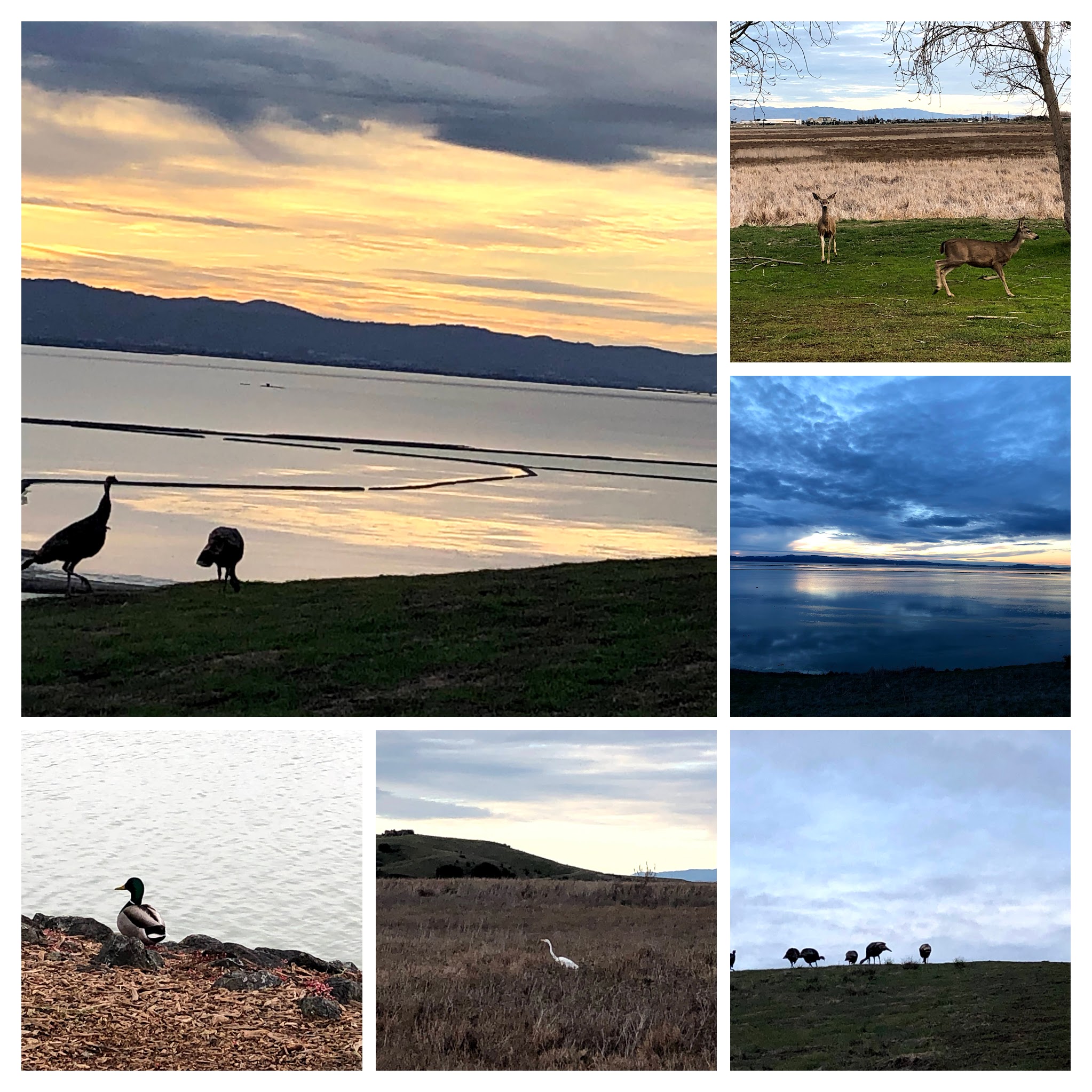
Sometimes, nature astounds me with variety: In one day out with nature I saw hawks, wildcats, squirrels, turkeys, deer, herons, grebes, fresh shoots of all sort of flora and fauna, not to mention the play of the light through the clouds at sunset. A friend of mine feels that animals cross our paths to send us a message. I think the menagerie I encountered was trying to send me the message that life is beautiful, if we take the time to live it fully, creatively and wholly.

img_1168-collage

Some of the books in January had already set the message :

  • A Walk in the Woods – Bill Bryson
  • The River Bank and other stories from the Wind in the Willows – Graham Greene
  • Friends at Thrush Green – Miss Read
  • The Girl Who Drank the Moon – By Kelly Barnhill
  • The Water Princess – Susan Verde (Childhood experience of Georgie Badiel)
  • Emily Writes – Emily Dickinson and her Poetic Beginnings – Jane Yolen, Christine Davanier

That evening, the son plucked at the notes for Clouds on his keyboard, and the clouds flitted above:

See the Clouds, in the sky

Wonder how they, Fly so high!

The Girl Who Drank The Moon

I was dawdling one evening. Quite uncharacteristically I might add. For the evening walks I go on are brisk and filled with purpose: I focus on getting the day’s stresses out of my head and to appreciate the larger world around us. I arrive after these walks, therefore, a trifle breathless maybe, but mostly refreshed in mind and spirit. 

“Are you tired?”, asked a solicitous neighbor. 

I smiled and said truthfully that I had been very tired when I set out on the walk, and after briskly taking in the sights, was now rejuvenating myself in the magic of the moonlight. “Moon-Bathing!” I called it, and she gave me an indulgent smile knowing my leaning towards nature.

Sometimes, all it takes is a peek of the waxing moon, or the brilliant hues of the setting sun, or the clouds in the skies painting a thousand pictures for us, or a hummingbird flying in the light of dusk, or geese flying overhead with the light of the moon on their wings never failing to remind me of the beautiful song in The Sound of Music : These are a few of my favorite things.

All good things are wild and free. – Thoreau

IMG_1157-COLLAGE

Other times, it is inordinately hard. I find it very hard to leave the village behind as Thoreau says. 

“I am alarmed when it happens that I have walked a mile into the woods bodily, without getting there in spirit.”  – Henry David Thoreau

I feel the Earth works doubly hard at these times. Always granting a little something extra by the end of it all to make up for the time lost in thought and worry. The wintry evenings of the past few days have been working hard at setting my mind at ease and helping the stresses of the day take flight into the unknown tendrils of the night. Lost in space, till I can grab newer positive strands from the cosmos and replace them consciously.

That evening that I was dawdling, had been one of these evenings. The light of the full moon shone through the clear dark skies, and I felt the strength of its benign light seep into my very being. The wintry skies have the magic of starlight, but the days when the moon is also at play, the nights feel vibrant with possibilities and magic.

img_1175

Maybe I was feeling poetic because of all the beautiful poetry in the book I had just finished reading. For those of you wanting a strong dose of magic, I strongly recommend The Girl Who Drank The Moon by Kelly Barnhill.  

“The heart is built of starlight 

And time.

A pinprick of longing lost in the dark.

An unbroken chord linking the Infinite to the Infinite.

My heart wishes upon your heart and the wish is granted.

Meanwhile the world spins.

Meanwhile the universe expands.

Meanwhile the mystery of love reveals itself,

again and again, in the mystery of you.

I have gone.

I will return.

Glerk” 

Kelly Barnhill, The Girl Who Drank the Moon

It maybe because of the waxing and waning of the moon, and the fact that we have only one moon, the sheer delight of catching a glimpse of its benign light in the evening skies is magic enough. The son, as regular readers knows, is a cosmologist and a curious wonderer at heart. One night, when he was a toddler, he asked me, “Imagine how it must be to take a walk on Jupiter, and you look up and see 64 moons in the sky.

Note: Jupiter has 79 known moons, and more are being discovered.

I suppose the magic of that sort of walk must be exemplified, but for now, I am grateful for a peaceful Earthly existence, with the ability to gaze and gain peace with the one moon we do have.

A Celebration Of … 🌏

The afternoon was a mild, sunny one. Quite unusual for wintry January. The grass has turned green enough, the birds were chirping, and every now and then, the son and I stopped to admire a willow tree. How different each tree looks, and yet how soothing they all are together?  One doesn’t need a leap of the fanciful to liken the willows to beautiful damsels letting their hair down to dip ever so slightly into the waters below. What is remarkable is these damsels don’t seem to mind us watching. 

img_1119

I do not remember the first willow tree I saw, although I am sure I would have admired it long before knowing its name.  These are times I feel remiss. 

Why do we not make a celebration

of smelling the first sprig of lavender

and falling in love with the scent of it? 

Why do we not celebrate the perfect clovers,

the first feel of moss against a damp earth 

the taste of the first wild berry, 

the first sniff of eucalyptus after a fresh rain, 

the first time we touched a petal, 

the first time we sat and watched a butterfly, 

the first time we heard the name of someone who would go on to become kindred spirits 

and brighten our lives forever more?

While at this, why not also celebrate 

the times, we can watch a tree upside down,

The moon rise, or the sun set?

The times we spot the shape of a fluffy dog in the clouds,

the times we are mesmerized by a rainbow,

the times we can watch the world flit by with nary a worry?

summer-collage

Anyway, where was I before I went off on my little celebration-of-life poetic trail? Yes yes. It all comes back now: I cannot quite resist the charm of a willow tree. It’s true. There is a generosity to its form. The tree just seems to give itself. The long tresses weigh down as they reach into the waters below.  When you walk along a river, you can be fairly certain that if there is one willow by the banks, nature would have given us a few more beautiful ones just further downstream. It was while reading Lab Girl, by Hope Jahren that I learnt many of these willow trees are identical genetically. Apparently, all it takes is for a branch to break off by a riverside, float down the banks, a little joyful eddy to push it near the banks, and voila: it can take root. An identical, genetically mapped tree, though it looks different on the outside – the trunks bulge differently, the branches fan out differently, but essentially the same. Hope Jahren’s lyrical writing is as beautiful as the willows themselves. 

“It is easy to become besotted with a willow. The Rapunzel of the plant world, this tree appears as a graceful princess bowed down by her lush tresses, waiting on the riverbank for someone just like you to come along and keep her company.” 

We walked on for some time on this beautiful day, before I plonked myself on the grass. I tugged the little fellow’s arm to sit on the grass next to me. After the initial reluctance of getting his clothes dirty, this suburban child gave in to the pleasures almost completely.  There we were, lying down on the grass, the willow trees drooped into the waters nearby while winter’s afternoon sun gently glowed upon us, and the clouds drifted above.

I told him about the willow trees and how most of the ones we saw may have originated from the same one. He looked awed. 

“Science has taught me that everything is more complicated than we first assume, and that being able to derive happiness from discovery is a recipe for a beautiful life. It has also convinced me that carefully writing everything down is the only real defense we have against forgetting something important that once was and is no more,” 

Hope Jahren, Lab Girl

Will he remember the first time he learnt that willow trees reproduce with just a branch flowing downstream? I hope he does, but if not, here it is written down: It was a golden day in early winter on a walk with his loving mother: when all the world was green and filled with possibility.