Distressed (in) Jeans

Regular readers know I take a commuter train into work. Folks have asked me to describe it and I often feel like a tree being asked to talk about the weather. I mean, no day is like any other. There are changes to atmospheric conditions, air quality, moisture, noise levels, pollution and climatic conditions.

Ever since smartphones arrived, most folk surrender to the phones and I am left looking to find a few folks like me who read a book in the old fashioned manner. The trains have been getting more and more crowded too, and to see folks standing from the first station is not uncommon.

So, obviously, one day when I walked into the train, and not only found a place to sit, but also a thick-ish Vogue magazine lying on the seat, I was happy. It seemed like an empty day to commute into the city, and I called my brother. I try to avoid making phone calls on the train (There is an interesting blog absolutely rattling in my head about phone calls, and one day I shall have to simply shake myself like a dog stepping out of a swimming pool after being flung in, and let the contents spill out, but till then read about the Hippoceres Effect).

I must confess that Fashion is not my area of interest. I have been known to wear clothes stitched from curtain cloth and fit like pillow cases. So, I was obviously intrigued to see what appears in the Vogue. Vogue, I hear, is like the Taj Mahal of fashion magazines and so on.

As I was idly swapping stories with the brother while thumbing through Vogue, I noticed that Fashion must be a terribly sad and serious business. One did not have to be perspicacious to notice that. It is no surprise that folks like me don’t set store by it. All the women models looked they had been through the most trying times in their lives. They looked abused, beaten, sad, morose or downright pugnacious. The men looked unshaven, querulous, cunning or sulky. Some of them wore torn jeans (I have been told that these are called Distressed Jeans – it certainly distressed me.)

And the poor things all looked like they could use a good meal. I am glad to see I am not the only one who thinks this way.
http://www.bbc.co.uk/newsbeat/article/35975219/advertising-authority-says-gucci-model-was-unhealthily-thin

The book had about 400 pages and there were no smiles there. Talk about sombre reading. If it were not for the fact that I was chatting merrily with the brother, I should have sobbed. The torn clothes, the misery in their eyes, the tortuous moments captured on film. Heart-rending I tell you.

You know, how you smile when people point a camera at you? In fact, I smile when I am taking a picture of somebody. None of that. There were even shots of a wedding where the bride looked she was going to be pelted with stones in one direction, and chased by a pack of wild wolves in the other. Not the radiant happiness one likes to see in brides in other words.

I pointed it out to the brother that none of these models looked happy and he wisely said, “Well, I don’t think they are supposed to be happy – they are going for the Sultry look.”

Maybe one day in the far future when people can split their time amongst different careers, modeling days could be the days one feels like a distressed jean trying to clothe a hippo’s legs.

vogue

Cybotic Leaders or Alien Invasions?

I am reading a book called Mind, Life and The Universe: Conversations With Great Scientists Of Our Time. It is a compilation of interviews with scientists. It is fascinating reading. Holding one book letting one know so many areas in which one knows nothing is nothing but humbling.

One interview is with Jane Goodall. She says that what struck her as horrifying while studying chimpanzees was the fact that they could identify with a clan and go on to attack, maim or kill fellow chimpanzees belonging to a different clan. Similar to what human beings do to each other. Somewhere along the evolutionary cycle, our genes seem to have mutated thus – to identify race and religion and any number of extra associations and look down upon others.

Carl Sagan, in his book, The Cosmic Connection, writes about how if an alien civilization were observing us now, they would think that what we value most is violence. For that is what is available as entertainment and that is what being streamed into our homes everyday, and what our children engage in, in the form of video games.

(https://nourishncherish.wordpress.com/2015/10/09/the-wind-in-the-reefs/)

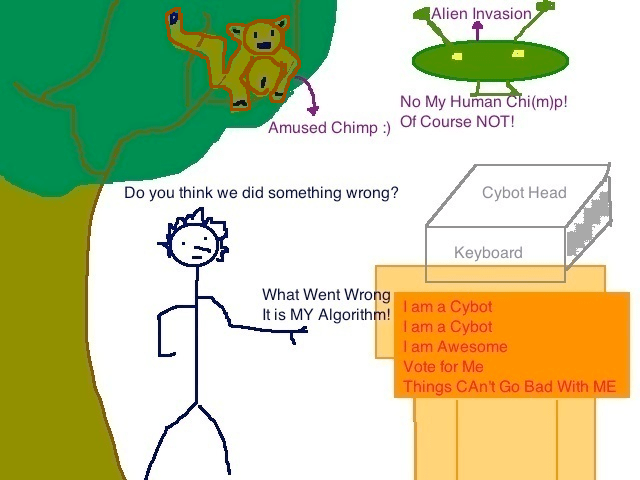
Last week, we did not need aliens to observe and see what is taught to us. A twitter bot, Tay, written by humans was let loose in the internet to learn and respond like a real user (The future is not far when a good cybot becomes the President of a country). Within 24 hours, we had turned Tay into a racist, misogynist, abuse-spewing user. Who can blame Tay for learning to be a racist jerk in one day? If that is what we are teaching twitter bots, could it be what we are teaching our children in a slower, sturdier manner?

I quote from article below:
http://www.cnbc.com/2016/03/30/tay-microsofts-ai-program-is-back-online.html

“Unfortunately, in the first 24 hours of coming online, a coordinated attack by a subset of people exploited a vulnerability in Tay,” Lee explained. “As a result, Tay tweeted wildly inappropriate and reprehensible words and images.”

How do we teach an algorithm empathy? As Jane Goodall said, “Only when our clever brain and our human heart work together in harmony can we achieve our true potential.”

https://www.brainpickings.org/2014/09/30/jane-goodall-empathy/

I remember a P.G. Wodehouse book, Right Ho Jeeves, in which Jeeves (that all-knowing butler who saves his young, idiotic, but thoroughly good-natured master, Bertie Wooster many times over) says, that the best way to unite warring factions is to introduce a common enemy.

chimp

It looks like an alien invasion might save us from ourselves. If those aliens are only 0.1% percent more evolved than us, we can be their chimps.

The Happiness Machine

In one story track of the Dandelion Wine, one of the characters, Leo Auffman, sets out to create a Happiness Machine after listening to low-spirited conversations among the old. Grandpa Spaulding, does let us know early in the process not to wait for the thing with bated breath, but we do.

Leo sets out to make his happiness machine imagining all the things that will make us happy. One quiet evening when he asks his wife what she thinks of it, she is stiff in her response, but Leo is too excited to notice that she doesn’t approve of the project. He spends more and more time creating the machine much against the wishes of his wife. He grows increasingly fond of what he is creating and neglects his family, too busy to notice the discordant strings starting to play out among the children. His wife tries to get him to see reason, and tells him that he is better off with his children, and spending time with them, but the excited Leo can barely wait to unveil the beautiful Happiness Machine to the world so there will never be discontent among the populace again.

It is only when he discovers his son weeping uncontrollably after taking a spin in the Happiness Machine that he fumbles. He is confused and cannot see where he went wrong. He pleads with his wife, Lena, and she too tries it out. At first, he hears her laughing, but slowly a deep wracking crying emerges from within the machine. Poor Leo – all he wanted to do was make people happy.

Lena comes out, and tells Leo that at first it was beautiful and she thoroughly enjoyed it. There was Paris, and all the wonderful places to see, right there in her backyard, but slowly a discontent set in. Hitherto, Paris and Greece were wondrous places, but not ones she ever dreamed of going to, and she was happy with her chores and the family. But now, the happiness machine had shown her everything that was possible.

Happiness_Machine

What’s more, she goes on to say that she truly started crying only when the Happiness Machine took her dancing with Leo again. They hadn’t been to a dance in twenty years. Leo says he could take her dancing that very evening, but she says that is not the point, since all the Happiness Machine did was remind her of those golden times and foolishly wish for it again instead of treasure the memory. The children have to be fed, chores need doing around the house. Who wants a sunset to last forever? The sunset is only beautiful because it does not last forever. The whole time I am thinking I have my real life to get back to. My children to feed, my home to clean, my work that awaits me. Oh Leo, how could you forget that real life can never match up to what a Happiness Machine says my life should be like?

The story finishes with Leo realizing that a Happiness Machine was there with him all along – he was just too absorbed to notice it. One that doesn’t always work, but will do – his family.

A book written in 1957. Brilliant.

Dandelion Wine

I used to eat wild berries. This is the kind of statement that gets folks today squeezy. Were you really okay after eating wild berries? Yes. You sample one and then another if the first felt okay. Leave it at that and then a few days later, if you haven’t spent the preceding few days heaving up your insides, go for it again. Yet, every time I try to eat one, the husband grabs my arm and looks at me accusingly. The daughter twirls her eyes at the rebellious mother and berry eating becomes another adventure that is reflective of my wild youth.

In other news, I read an excellent book, Dandelion Wine, by Ray Bradbury. Dandelion Wine is essentially a book of a boy’s summer in a small sized town. The first time he realizes that he is alive. Alive in a way he can observe the smells of summer, relate to the activities the hot sun brings with it, deduce what relationships mean, deal with the pain of seeing a childhood friend move, and how we need a sense of community. In this short book of related short stories, there emerges a brilliant, simple narrative of a 12 year old boy, Douglas Spaulding.

In one story, Grandpa Spaulding realizes that Bill Forrester, their young gardener, who is training up to be a journalist one day, buys a particular variety of grass that only grows to a certain height and then stops, thereby making a lawn mower redundant. (Luckily, no such grass exists to this day.) It is just a pretty lawn requiring very low maintenance. Grandpa is shocked at Bill for considering buying something that inches out the clovers and dandelions which means there will be no bees or butterflies in the garden. He goes on a tirade saying that this is the problem with the younger generation.

7B35B2B0-F446-4A6C-B797-88D7DA9EEE8F

He tells a stunned Bill that he wants nothing to do with the grass till he dies, for he likes mowing the grass. He likes the joy in small things. The problem with the younger generation, he says, is that they hop from one big thing to another and find methods to get rid of all the small things that fill the day. He tries to explain to him that one day he would go crazy trying to find little things to fill his day.

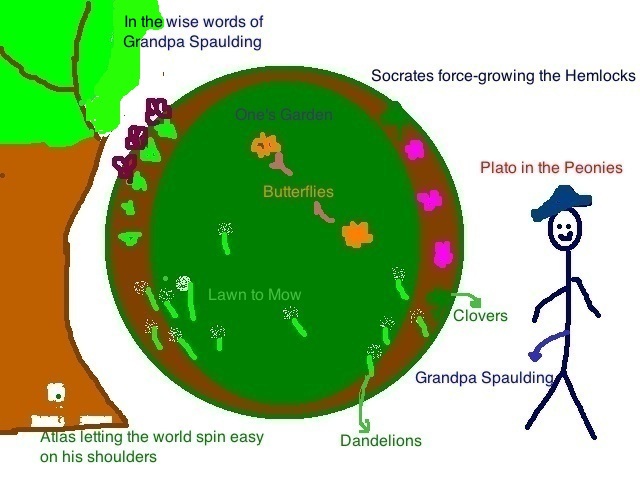
“Lilacs on a bush are better than orchids. And dandelions and devil grass are better! Why? Because they bend you over and turn you away from all the people and the town for a little while and sweat you and get you down where you remember you got a nose again. And when you’re all to yourself that way, you’re really yourself for a little while; you get to thinking things through, alone. Gardening is the best excuse for being a philosopher. Nobody guesses, nobody accuses, nobody knows, but there you are. Plato in the peonies, Socrates force-growing his own hemlock. A man toting a sack of blood manure across his lawn is akin to Atlas letting the world spin easy on his shoulder. As Samuel Spaulding, Esquire, once said, ‘Dig in the earth, delve in the soul’. Spin those mower blades, Bill, and walk in the spray of the Fountain of Youth. End of lecture. Besides, a mess of dandelion greens is good eating once in a while.”

I haven’t eaten Dandelion stems though – time to try some freshly washed ones from the backyard. I like the way Grandpa Spaulding thinks.

garden

I just need to remind myself of Grandpa Spaulding’s wise words when I am moaning in the kitchen doing the after dinner cleanup.

Published in 1957, this story’s theme resonates on multiple levels. Today, we find other distractions to fill our day. We graze on Facebook, we try the pulse of Twitter, we farm with the flick of a finger on Farmville. Which brings me to the next lovely topic on The Happiness Machine in Dandelion Wine.

The Grandparents Party

I wonder whether you would garner any praise if you walked into your next important meeting, say a board of governors meeting, and showed everyone your perfectly tied shoelace. Unless your product pitch requires a nifty lace to be tied. I don’t see the b.o.g-s typing themselves up in knots because you put on your own shoes.

Even better, I wonder what they would think if you walked up to them and showed them how you put your right shoe on your left foot and your left shoe in your right foot. Depending on how well liked you are, I suspect some sympathetic mumbling and secret plans to find the next person to succeed you.

Anyway, I digress.

Every day for a month, the son would get up, wish us a brisk good morning, run and pick up a pen and then circle the day off in the calendar. When I noticed this sense of urgency and purpose I chalked it down to one of the many useless things the daughter makes him do. And it was. There is a look of reverence associated with any task entrusted to him by his older sister. She told him to circle off every day in the calendar, telling him to count down to the number of days left for his grandparents to arrive.

gp

The result of all this hard work is that the days passed and the grandparents arrived. Between the excited grandchildren and the excited grandparents, the roof is developing cracks in the plaster and all is well.

The son has never been one of those children who mumble and fumble causing you to stop mid-stride and ask, “What did you say? Speak up boy!” He addresses you with a voice meant to carry a school assembly without a mike even if you are only a few feet away. A fact that gives his like-throated maternal grandfather no end of joy. The old father has in fact carried school assemblies without a mike.

Anyway, what struck me observing grandparents and grandchildren is that we would all have excellent grades and reviews if our grandparents were our professors, managers and board of governors. I mean study the facts:

I caught them the other day absolutely beaming with pride and throwing loving glances at their grandson because he put on his shoes and socks by himself.

Then another day, they chuckled fondly at the fact that the son puts his left shoe on his right foot and vice-versa.

Not what the b-o-g-s in Paragraph 2 would do in other words.

I read somewhere that if we lived the other way around, i.e. started out as jaded old folk, then grew into the adult working life, and wound up as children, life would be happier and I cannot but agree. I would like to be congratulated for wearing the right pair of shoes on the wrong feet.

For Poignant Reading

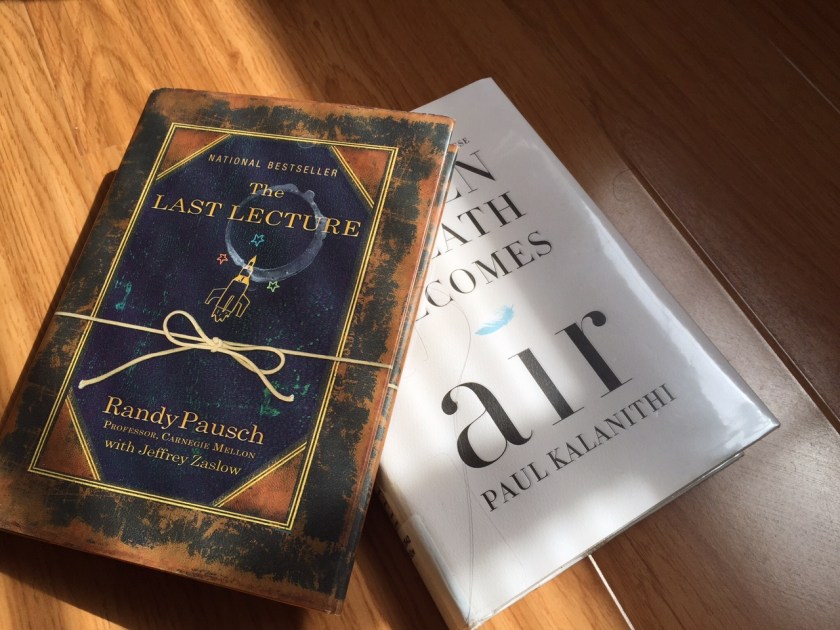
I finished reading When Breath Becomes Air by Paul Kalanidhi a few days ago.

Peppered throughout the slim volume are references to literary works that appealed to the author during his life. Dr Paul Kalanidhi was a neurosurgeon and neuroscientist. He  double majored in Biology and Literature from Stanford University. His love for literature and the underlying angst to understand the question of ‘where morality, biology and philosophy intersect’ are evident throughout the book. His experiences with living and dying as a surgeon only deepened his yearning to understand the truth and he eventually seemed to learned to view his illness as a method of finding out what that very question meant in the face of death.

At one point in time, his oncologist, wanted to start keeping tabs on his mental acuity as tumors spread to his brain. His wife started recording him reading something everyday. One evening, he started reading with his infant daughter seated on his lap. A few seconds into the reading, he put down the book and recited the whole passage from memory. His wife and mother exchange smiles that clearly say, “How typical of him!”. Little glimpses like that made the human being who comes through the pages a very like-able person. A good son, friend, husband, brother, friend, father and doctor.

The book finishes abruptly as time accelerated and Dr Paul Kalanidhi died before he could finish the book.

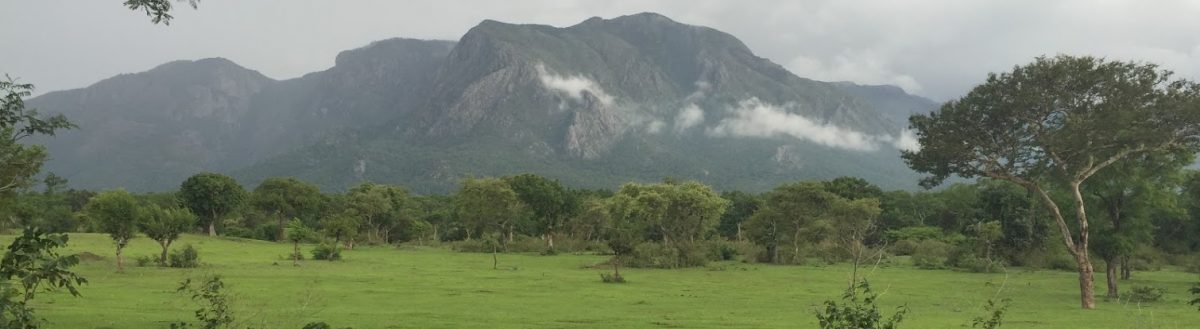
You can easily skip the prologue. It adds little value to the book or to the personality of the author. But the epilogue written by his wife, Dr Lucy Kalanidhi, was incredible and wrapped up Paul’s story. I read it twice back to back. I loved how beautifully she wrote about the place they chose for his final resting place. A serene place in the Santa Cruz mountains overlooking the coast, and where deer eat the flowers, and gentle rains make the grass grow. It is also the place where the natural elements rage. Much like his life.

There is one particularly moving passage where Dr Paul Kalanidhi writes to his baby daughter, Cady, that there will come a time when she lists her accomplishments and weighs her contributions to the world. At that moment, he tells her never to forget that she made a dying man very happy. I teared up every time I read that.

IMG_7533

I felt the same when I read Dr Randy Pausch’s The Last Lecture. Both these people may have written their books when they knew they were dying, but both books are incredible pieces on how to live.

Nose in Books & Feet in Socks

As an immigrant to the United States, there are things I will always cherish. Lovable quirks such as “Water no ice please” or “Aww..”. Things like different reading fare is marvelous. Growing up in the misty mountain valleys of South India, we had access to good children’s books, and I relished every moment spent with my nose in books and my feet in socks.

Enid Blyton lifted all of us children into clouds above The Magic Faraway Tree or whisked us away on the Wishing Chair. Tinkle comics & Champak took us for a spin (I am trying to remember some of the characters without the aid of the Internet – a cheap thrill in the current times – Kalia, Chamataka, Doob-Doob, Tantri the Mantri, Suppandi, Naseeruddin Hodja, Vikram & Betal and of course, that vague huntsman who should be the mascot for gun control laws, Shikari Shambu).

tinkle-collage

Later, Nancy Drew, Bobbsey Twins, R.K.Narayan, and Alexander Pushkin were the in-things to read.

As more serious fare gradually replaced this wonderful array, I never expected to be revisit that wondrous feeling of picking up a children’s book where you know not what magical world opens up to you, and when. But that is exactly what happened when I had children here, and we journeyed into these marvelous worlds together. I had never read the Thomas Train series or the Curious George series or the Beranstein Bear series or any of the books by Dr. Seuss as a child and I got to experience all of this with them for the first time. Oh! The simple pleasures of reading a book like any of these for the first time is gift enough, but to be blessed to be able to read it for the first time as an adult is surreal. It was like growing up all over again. To that, I am eternally grateful.

Walking into the children’s section of books is such a treat. Dr Seuss’s birthday gave rise to a number of excellent articles and I relished them almost as much as the books.

What Pet Should I Get?

Seuss-isms

Just as Dr Seuss promised, the nonsense woke up the brain cells that were sluggish due to lack of use and life became an adventure again.

dr seuss

It even makes me think nothing of making a fool of myself publicly and putting out things like:

Do you want to be a Sailor?
Or do you want to be a Tailor?
Maybe we need to be a Failor
Before we become a Winnor.

Space Racers – Together The Fun Begins!

It gives me great pleasure that this article was published in The Hindu’s Open Page dated 27th September 2016. The illustration is beautifully done by Mr Deepak Harichandran

http://www.thehindu.com/opinion/open-page/open-page-rise-and-shine-on-astronomy-day/article9150779.ece

There is something deeply calming and beautiful about gazing up at the stars at the end of a long day. It feels reassuring to know that we are but a small part of the cosmos, and it helps us puts our worries, anxieties and fears in perspective.

If there is nothing for the children to enjoy in terms of nature,  divert their attention to the ever changing panorama of the skies and let them experience wonder said Reverend James Woodforde in The Diary of a Country Parson when asked about children growing up in urban surroundings, who do not have the luxury of waddling through nature.

Reverend Woodforde (https://en.wikipedia.org/wiki/James_Woodforde) would be pleased indeed if he went on a walk with the toddler son. Once the stars are visible, the son makes it a point to look up, his eyes filling up with wonder and questions bubbling up.  His ardent sister fans him along by pointing to the constellations and asking him to identify some of them. The young astronomer accepts this great responsibility with grace. He then proceeds to point at Ursa Major and calls it Orion, Ursa Minor is christened Sirius, Jupiter is labelled Venus and the Moon remains the Moon. All of this is done with confidence and joy, and the walk takes on a gentle humor of its own.

It is hard to identify constellations for us and even less need to do so now that we have access to excellent apps such as Skymaps and Google Sky. The skies are, however, fascinating and it will be nice to be able to identify the constellations even if we don’t need them to navigate from Spot A to Spot B at the moment.

star_gazing

One night as we stepped out for a stroll after a particularly satisfying meal and dessert, we diverted our gaze skywards as is our wont.

“If I become a space traveler, will you come with me?” he asked me a little line of worry creasing his face.

The background to this question was, of course, another conversation in which we had to let him know that when he grew old enough to become an astronaut, we would be past the age that is currently acceptable for astronauts. Maybe his sister could join him, but we may be past it. He looked forlorn when he heard that, and I made a mental note to remind him about how keen he was to have our company on a space vehicle, when he attempts to learn driving as a teenager.

I looked at his face and said, “You know? A century earlier, nobody could have thought your grandparents could fly across the world to meet you, so we don’t really know how things will change. Maybe if things progress along space travels, we could. Who knows?” I said. He seemed happy with the answer, and said,”Where would you like to go first? Which planet?”

I thought for a moment and said I would like to go to Neptune. “How about you? Where would you like to go?” I asked him.

“I want to go to Jupiter – maybe the great big spot in the storm.” The daughter asked him why, and he said, that he would like to see the moon have some company. On Jupiter, you can see 64 moons right?

“Did they teach you that in School?” I asked pleasantly impressed and surprised.

“No…..on Space Racers, Eagle and Robin get stuck in the storm on Jupiter remember?” said the couch-astronaut. (Space Racers is a TV program created with input from NASA)

“Space Racers – Together the Fun Begins…Rockatocka mission, we’re on our way….Space Racers…..” He then sang the whole title song for my benefit,laughing to fit (https://www.youtube.com/watch?v=HZPOAEGhTl8)

Whether through Television, movies, smart phone apps that map the sky for us or through Science lessons, it is wonderful to glory in the expanse of the Universe and humbly accept our position within it. Like Carl Sagan, the noted physicist, said, “Astronomy is a humble and character building experience.”

Happy Astronomers Day!

A Jane Austen Education

 I like to draw relaxation from the joy in little things. The ability to stop and look at a flower or amble along with friends and family discussing the little matters of life that make up the notes of music as we hum along in our lives.

IMG_7466 (1)

The ability to feel like it is okay to not be driven by this high sense of purpose, but living a useful life all the same.

There is no power on Earth that can neutralize the influence of a high, simple and useful life. - Booker. T. Washington
There is no power on Earth that can neutralize the influence of a high, simple and useful life. – Booker. T. Washington

When people talk about good stories, they are usually pumped up about plot, drama and suspense. I am all for plot, drama, suspense, mystery, hot-cold love and so on. But our lives don’t always turn out that way, nor should it. That is why I recharge myself with writings of Miss Read, Jane Austen and P.G.Wodehouse. When I read these authors, I can assure myself that it is perfectly okay to lead lives that will not get a dramatist to reach for his recording device, but one that is joyful enough in its pursuits and activities to make it an interesting one.

Every time, I unwind with a Jane Austen movie, the nourish-n-cherish family rolls its eyes and flees the television area. Now that I think about it, it seems to be the only way for me to get some air time with the television. Hmmm (Evil laugh with gleam in eyes). But I hope one day to be able to get them to enjoy the movies with me.

I am reading ‘A Jane Austen Education’ by William Deresiewicz, that is essentially all the life lessons that her writings have for us to imbibe. Such a delightful book! There are some things that are clearly just the author’s perspective of applying her writing to his life. Not to mention that this book was written by a man, so it is only natural that his and my perspectives vary. 

The books starts with my favorite book of hers: Emma.

Little nuggets of writing like this spot the whole book and make me want to open it up at random and read again.

Jane Austen was about a year old when another English Author wrote a statement that could serve as a motto for all her books. “Life is a comedy for those who think”, said Horace Walpole,  “and a tragedy for those who feel.”. Everyone thinks and feels, but Jane Austen’s question was, which one you are going to put first? Comedies are stories with happy endings. I could grow up and find happiness, Austen was letting me know, but only if I was willing to give up something very important. Not my feelings, but my belief in my feelings, the conviction that they were always right.

Another one:

Being happy and feeling good about yourself are not the same thing.

A dictum that Mansfield Park reveals, that is as good today or even more apt today than any other day in the past.

Perpetual amusement leads only to the perpetual threat of boredom.

 I can tell you that it was truly a shocking revelation to me, that a recent study said we reach for our phone 221 times a day. (http://www.nybooks.com/articles/2016/02/25/we-are-hopelessly-hooked/)

Imagine that. More than 200 moments in time when we could be observing (anything at all really) spent checking a digital device. Are we not just as guilty as the Crawfords in Mansfield Park for needing that kind of continuous stimulation? It is no wonder that Digital Addiction is a real thing  requiring treatment.

http://www.gq.com/story/video-game-rehab?utm_source=nextdraft&utm_medium=email

It reminds me of this article:

Anyone with any degree of mental toughness,” artist Georgia O’Keeffe wrote in contemplating life and the art of setting priorities, “ought to be able to exist without the things they like most for a few months at least.

A sobering thought indeed.

The Dream Conveyor Belt

The understanding of time, the night sky and dreams are common themes of hilarity with the toddler son. His proud sister breaks into giggles every time he spouts a dubious theory to his great annoyance. He is a serious fellow and likes to think that his theories have merit. It was even harder for us when all he said after a bout of serious thinking was the word, “CAR” and shoved a toy Lightning McQueen car in your face. Though Lightning McQueen still reigns in the fellow’s world, we get a lot more of narrative content to aid our understanding these days – thank heavens for that.

One evening, he bounded into the kitchen full of energy from his afternoon nap: “Hi Amma. You know I had a dream. A bad dream. It was so scary: I cried and everything.”

“Oh! What was it?” I asked him injecting a note of concern while sipping blissfully at my tea. He looked fine to me. In fact, he looked radiant and energetic, not at all like a child scarred by nightmares in other words.

“You already know. You was in my dream remember?”

There are times for deep breaths and times for deep gulps of fortifying tea. I did both and then broke it to him gently that though I may have appeared in his dream, it did not mean that I knew his dream. He looked confused at that, and said, “But you hugged me and then we went for a hike, remember?”

“Maybe we did that in your dream, but I don’t know that because I can’t see your dream.”

“But yesterday you said you had a dream too.” Technically, I hadn’t said this the previous day, I had said it the previous week. But I explained to him, again that I may have had a dream and he could not know what it was even if there was a chance he starred in the dream.

“So what was the dream bone-head?” said his sister giggling to split, and thoroughly intrigued with this whole business of streaming dreams like television channels that one could tune into on demand.

dreamer

“Oh! I am hungry. Ask Amma – she knows.” said the maddening fellow and set to his evening snack with relish.

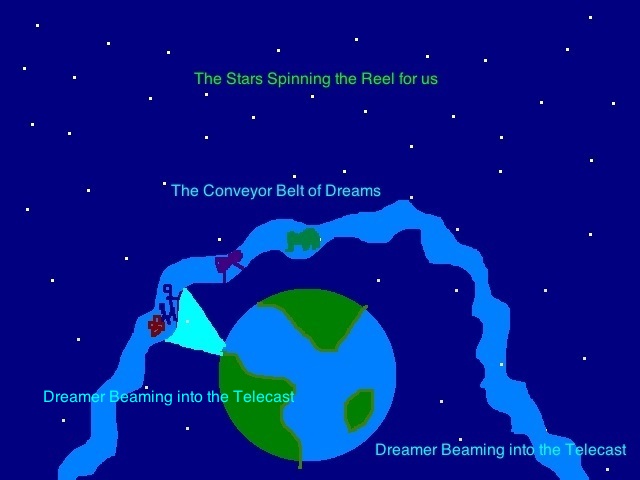
I wonder what Sigmund Freud would make of that theory, and whether our dreams could overlap in an alternate universe even if they were a week apart. Maybe in that world, there is no concept of time and so we all see different parts of the dream theatrically produced and fragmented by the stars of the night. Like stepping on and off a dream conveyor belt. Who knows? I think I’d like to retain the mystery of the dream. Even if they are confusing at times.